In discussions around place and visual representation, images and local framing have been shown to influence one’s perception of climate change. In discussing visual communication, Altinay (2017) states that images are more persuasive and allow for the communication of climate change “into a language that non-technical audiences can quickly grasp.” In addition, when one incorporates local framing, it allows for greater recognition of local impacts of climate change. Altinay refers to this as “place attachment, which is defined as the bond between a person and a place.” Therefore, upon reflection, several visuals from my sit spot led me to narratives relevant to society’s relationship with the climate crisis. In this case, references to society are from a North American perspective.

My sit spot is on a wooden bench chained to a tree in the middle of the community garden. Nothing else in the garden is chained down, not the berry bushes, the beautiful flowers or the food producing plants. However, the lifeless bench is clearly deemed of greater value than all the living things around it. This reminds me of Noskiye, a Cree journalist cited in Iseke (2013) who declares how “everything made by the creator is alive and anything made by man is dead”. This image thus has a touch of irony given all that is living plays a vital role in sustaining human life. Man must therefore reevaluate its relationship with the natural environment.
This image of the chained bench may also narrate climate change further in visualizing society’s relationship to the natural environment. Society does after all need resources to survive as environmental justice campaigner Dayeni (2021) points out as “the right of people to the resources required to create productive, dignified, and ecologically sustainable livelihoods.” However, today’s societal culture is not one of living sustainably but rather an addiction to mass consumption and mass extraction of natural resources. Society must therefore see a shift in mindset or behaviour to reduce the impacts of climate change.

These pictures of the tennis courts and playground may communicate the local impacts of a warming world on my neighborhood. In reference to global warming, the IPCC (2021) “finds that averaged over the next 20 years, global temperature is expected to reach or exceed 1.5°C of warming.” It goes on to say how this increase will lead to “increasing heat waves, longer warm seasons and shorter cold seasons.” Looking around me I already see glimpses of that future, a future that is hotter and harsher to live in. Firstly, I notice the public tennis courts that run alongside the garden. Any other time I have come to my sit spot the tennis courts are occupied, however with today’s unbearable heat the courts are empty and will remain so until the cooler evening. Secondly, the playground adjacent to the garden on the opposite side sits empty too, the weather again forcing those of all ages to stay inside or seek refuge in the shade.

Am I thus witnessing the start of a culture shift whereby one does not leave the house during the height of the day? Is this the beginning of an environment too harsh to venture out to during the peak daytime hours? These impacts can already be seen around the world as there are even laws forbidding work during the hottest hours of the day. Arab News (2022) reports how the United Arab Emirates now enforces a midday break during the summer for construction workers running from 12:30pm until 3:00pm. This evident change in behaviour due to global warming strikes me as I leave the park and notice its hours of operation, “Closed 10pm until 6am.” Maybe one day in the not-so-distant future this park sign could read, “Closed 10am until 6pm.”
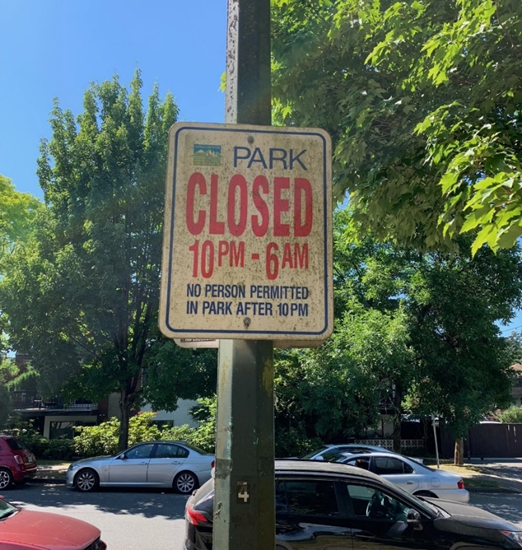
In conclusion I would like to share these images and narratives with friends and neighbours in the hope of highlighting the local impacts of climate change. Although, I will be conscious not to attempt this conversation during any games of tennis as my inability to serve usually dominates discussion.
References
Altinay, Z. (2017). Visual Communication of Climate Change: Local Framing and Place Attachment. Coastal Management, 45(4), 293–309. https://doi.org/10.1080/08920753.2017.1327344
Arab News. (June 9, 2022). UAE announces midday break for laborers during summer months. https://arab.news/zgvq7
Dayaneni, G. (Guest). (May 7, 2021). Gopal Dayaneni on the Exploitation of Soil and Story /233. For The Wild. [Audio podcast]. https://forthewild.world/listen/gopal-dayaneni-on-the-exploitation-of-soil-and-story-232
IPCC (August 9, 2021). Climate change widespread, rapid, and intensifying. IPCC Newsroom. https://www.ipcc.ch/2021/08/09/ar6-wg1-20210809-pr/
Iseke, J. (2013). Indigenous Storytelling as Research. International Review of Qualitative Research, 6(4), 559–577. https://doi.org/10.1525/irqr.2013.6.4.559