
Photo by Jack Moreh from Freerange Stock
Research into how infrared light, energy received as sunlight, could heat the atmosphere, now known as the greenhouse effect is not a new concept and has been experimented with since 1856 by Eunice Foote, although not commonly credited for her work (Jackson, 2019), and 1859 by John Tyndall using similar yet different methodologies when studying how gases absorb thermal radiation, the energy radiated from objects of mass. This concept was advanced by Svante Arrhenius and Arvid Högbom in 1900 when they proposed global temperature increases relative to carbon dioxide levels in the atmosphere (Krauss, 2021. p.53-81). Since then, a relationship between greenhouse gases and rising global average temperatures has been confirmed and scientists have been studying the effects of greenhouse gas emissions on global average temperatures to better understand this relationship. Furthermore, simplifying the concept of remaining carbon emissions to a term coined “carbon budget” dates back to the 1980s when it was deemed to be too oversimplified. The term carbon budget has seen an increase in popularity in use since 2009 when the target of 2oC global warming became climate policy and was accompanied by an estimated remaining emission budget before this warming is achieved (Lahn, 2020, para.20-26). In order to sustainably spend the estimated remaining carbon budget it is important to understand how the global carbon budget was determined, how this budget has become unbalanced, and what the potential outcomes of a depleted budget could mean.
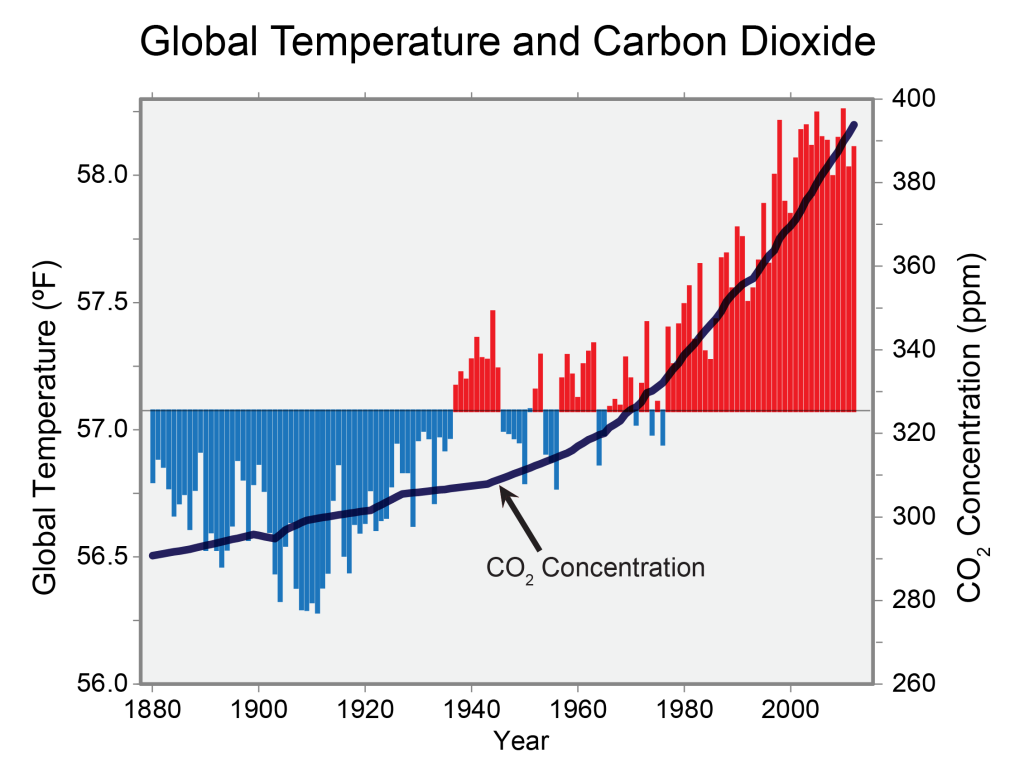
How did scientists calculate the remaining carbon emissions we can emit globally? Figure 1, graphically displays the historic average global temperature and the historic atmospheric carbon dioxide levels, a linear relationship between the two is visible. Similarly, increased radiative forcing can be seen as a result of increased atmospheric carbon dioxide (EPA,2021). Radiative forcing represents an energy balance measured in watts per square meter, if positive it means more energy is being trapped in the atmosphere resulting in heating. Relationally, if radiative forcing is negative more energy is released from the atmosphere resulting in cooling. Furthermore, the IPCC Fifth Assessment Report generated five Socio-economic Pathways (SSPs) and Radiative Concentration Pathways (RCPs), from low global emissions to high global emissions. RCPs project potential levels of radiative forcing upon earth due to solar energy from the sun as a result of atmospheric carbon dioxide. I find the relationship between historic carbon dioxide levels and average global temperatures lends validity to Arrhenius and Högbom’s proposal in 1900 that CO2 levels will affect global temperatures. In addition, I find the similarity in global temperature increase relative to atmospheric carbon dioxide levels and Arrhenius and Högbom’s theories increases the credibility of assumptions needed to be made for values and their impacts within climate models lacking data that require further research. Using the relationship between global average temperature, atmospheric carbon dioxide levels, and levels of radiative forcing; approximate carbon budgets were estimated for each of the 5 RCP and SSP scenarios.
Global greenhouse gas emissions can be categorized into two types, natural emissions from the environment and human-related emissions known as anthropogenic. Carbon budgets, temperature projections, and radiative forcing refer to the pre-industrial level (1850-1900) as a baseline for comparison due to being the earliest period with near-global observations, even though this time frame could have been anytime pre-industrial revolution (Allen et al., 2018, p.57-58). Global anthropogenic emissions have increased since the pre-industrial era and continue to accelerate, disregarding 2020-2021 emission rates due to Covid (Ritchie & Roser, 2020). As a result, an unbalanced budget where emissions are greater than captured by natural carbon sinks, such as the ocean and forests, has been created. This is troublesome to me as the rate of emissions has only accelerated despite 195 countries being members of the IPCC. Furthermore, there are noticeable increases in emission rates since the Kyoto Protocol (1997) and Paris Agreement (2016) indicating to me that our carbon emissions will continue to accelerate despite efforts currently being made. Moreover, I believe there is a need for more assertive socioeconomic measures supported with technofixes to help lessen the deficit within our carbon budget and slow its depletion.
Depleting the projected carbon budget associated with scenarios does not mean we have reached a point of climate bankruptcy where we can just give up. Essentially, it means we are now committed to a new level of warming and the projections associated. Greenhouse gases have a natural life of between 1.4 and 50,000 years depending on the gas emitted (Prather & Enhalt, 2007) making it more important to achieve zero emissions while within our estimated budget. Additionally, to reclaim emissions we need to operate at net negative emissions, which can only occur through sequestration after achieving net zero emissions. The general consensus amongst climate scientists is that as global temperatures increase so does the frequency and severity of climate events such as heat waves, heavy precipitation, flooding, and drought (EPA, 2022). I agree with this statement and am simplifying it for applied science use where increased air temperature allows higher levels of humidity before precipitation occurs. Therefore, drought will increase due to increased humidity being held within the air, storm severity increases due to higher humidity, and levels of precipitation will increase due to held humidity (Eyquem & Feltmate, 2022, p.27-29). Furthermore, with increased drought and storm severity comes an increased probability of storm-related wildfires. Taking this into consideration, increased climate event severity furthers the need to avoid emissions where possible as we commit to new levels of warming as we deplete the projected carbon budget for each scenario, even if it is not enough to be committed to the next scenario.
In summary, the carbon budget is not a set quantity of emissions remaining. Rather, it is an approximate and dynamic value that projects which scenario we are trying to stay within to limit levels of radiative forcing that result in an increased global temperature. Secondly, we are creating this unbalanced budget by expending more emissions than can be captured by natural carbon sinks creating a deficit in the remaining carbon budgets of the RCP scenarios. Most importantly, if global average temperatures continue to increase, due to current emission concentrations or continued emission rates, so do the frequency and severity of climate events. Similar to finances, if we continue to spend our emissions budget at an unsustainable rate, we are going to encounter greater difficulties in the future.
References
Allen, M.R., O.P. Dube, W. Solecki, F. Aragón-Durand, W. Cramer, S. Humphreys, M. Kainuma, J. Kala, N. Mahowald, Y. Mulugetta, R. Perez, M. Wairiu, and K. Zickfeld. 2018: Framing and Context. In: Global Warming of 1.5°C. An IPCC Special Report on the impacts of global warming of 1.5°C above pre-industrial levels and related global greenhouse gas emission pathways, in the context of strengthening the global response to the threat of climate change, sustainable development, and efforts to eradicate poverty. [Masson-Delmotte, V., P. Zhai, H.-O. Pörtner, D. Roberts, J. Skea, P.R. Shukla, A. Pirani, W. Moufouma-Okia, C. Péan, R. Pidcock, S. Connors, J.B.R. Matthews, Y. Chen, X. Zhou, M.I. Gomis, E. Lonnoy, T. Maycock, M. Tignor, and T. Waterfield (eds.)]. Cambridge University Press. pp. 49-92. doi:10.1017/9781009157940.003.
Delmotte, V., Zhai, P., Pirani, A., Connors, S.L., Péan, C., Berger, S., Caud, N., Chen, Y., Goldfarb, L., Gomis, M.I., Huang, M., Leitzell, K., Lonnoy, E., Matthews, J.B.R., Maycock, T.K., Waterfield, T., Yelekçi, O., Yu, R., Zhou, B. The Physical Science Basis. Contribution of Working Group I to the Sixth Assessment Report of the Intergovernmental Panel on Climate Change. 2021: Summary for Policymakers. Climate Change 2021. Cambridge University Press. https://www.epa.gov/climate-indicators/weather-climate
EPA. (2021, April). Climate Change Indicators: Climate Forcing. United States Environmental Protection Agency. https://www.epa.gov/climate-indicators/climate-change-indicators-climate-forcing#:~:text=Of%20the%20greenhouse%20gases%20shown,in%20radiative%20forcing%20since%201990.
EPA. (2022, August 1). Climate Change Indicators: Weather and Climate. United States Environmental Protection Agency. https://www.epa.gov/climate-indicators/weather-climate
Eyquem, J. L., & Feltmate, B. (2022). Irreversible extreme heat: Protecting Canadians and communities from a lethal future. Intact Centre on Climate Adaptation, University of Waterloo. https://www.intactcentreclimateadaptation.ca/wp-content/uploads/2022/04/UoW_ICCA_2022_04-Irreversible-Extreme-Heat.pdf
Karl. T, Melillo. J, Peterson. T. (2009). [Image] Global Climate Change Impacts in the United States. Cambridge University Press. https://data.globalchange.gov/figure/global-temperature-and-carbon-dioxide
Krauss. L. (2021, March 1). The Physics of Climate Change. Post Hill Press. 53-81.
Jackson R. (2019, February 13). Eunice Foote, John Tyndall and a question of priority. Notes Rec. 74:105-118. https://doi.org/10.1098/rsnr.2018.0066
Lahn, Bård. (2020, January 1). A history of the global carbon budget. Wiley Interdisciplinary Review. https://doi.org/10.1002/wcc.636
Myhre, G., Shindell, D., Bréon, F.-M., Collins, W., Fuglestvedt, J., Huang, J., Koch, D., Lamarque, J.F., Lee, D., Mendoza, B., Nakajima, T., Robock, A., Stephens, G., Takemura, T., Zhang, H.. (2013). Anthropogenic and Natural Radiative Forcing. In: Climate Change 2013: The Physical Science Basis. Contribution of Working Group I to the Fifth Assessment Report of the Intergovernmental Panel on Climate Change. https://www.ipcc.ch/site/assets/uploads/2018/02/WG1AR5_Chapter08_FINAL.pdf
Prather, M., Enhalt, D. (2007) Atmospheric Chemistry and Greenhouse Gases. International Panel for Climate Change. Fourth Assessment Report. 244. https://www.ipcc.ch/site/assets/uploads/2018/03/TAR-04.pdf
Ritchie, H., Roser, M.. (2020) CO2 and Greenhouse Gas Emissions. Our World in Data. https://ourworldindata.org/co2-emissions