
With the support of my family, friends, and NunatuKavut Community Council (NCC, my place of work), I have the privilege of taking the Graduate Certificate in Climate Action Leadership program from Royal Roads University (RRU). I am one of seventeen students who are the first cohort attending either the graduate certificate or the Masters in Climate Action Leadership program (MACAL). This blog post will be a reflection on the two-week learning intensive (or Unit 1) of the Leading Climate Action in Society course (CALS 501) that will span the year of my program. And yes, it was intensive!
There were two things that really struck me during this first unit of the course: first, how open and accessible the program courses are, and second, how much the instructors and RRU emphasized a decolonizing thinking process and inclusion of Indigenous ways of knowing. In my very first blog post, “Yikes! I have to write a blog.”, I discussed the topic of openness. However, I did not define what open education was so I will try to do that now. An open education is a philosophy of “democratizing and decolonizing education” (DeVries, 2020) to improve access to education, resources, and a chance for students to inform the courses that they participant in. I will again link to Dr. Robin DeRosa’s introductory video who can explain these concepts.
The second thing that struck me was the emphasis on the decolonizing aspects of the course. I was pleasantly surprised that the course, the instructors, and the students all took this stance. My mind wanders to think of Dr. Amy Hudson, one of my best friends, and her decolonizing work for NCC. I think she would be pleased that the program is taking this approach especially to such a complex problem of climate change. As Gram-Hanssen et al. (2021) stated “a growing number of scholars argue that climate change can be seen as a form and product of colonialism” because both are of the same mindset (para. 1). Those involved in this course are teaching and learning to decolonize our thinking, to include Indigenous ways of knowing, to empathize with those who are marginalized and most impacted by this wicked problem of climate change, and to work towards solutions instead of only talking about the problems.
In my work life, I have seen scientists trying to incorporate the Indigenous way of knowing into their western science, but it was still a solo pillar. This can also be seen in the article by Alexander et al (2011), which states that ‘indigenous narratives are minimally included in the [Intergovernmental Panel on Climate Change] or other global assessments of climate change” (p. 483). However, Indigenous people knew long before western science confirmed that species populations are cyclic (Beaulieu, 2012). I still remember something that my director, George Russell Jr., said to me, ‘I see traditional knowledge as a science in itself, and it needs to have the same respect as other science disciplines’ (G. Russell Jr., personal communication, 2019) or words to that effect. This brings me to one of the fundamental concepts of the program, transdisciplinary thinking, and which I believe is the same as the Indigenous way of knowing.
Transdisciplinary thinking is learning from all perspectives to understand the people, wildlife, lands, and waters to make creative solutions. I’ve heard countless Indigenous peoples and I have also stated or asked how can we understand our issues and develop solutions if one group is not at the table. The MACAL course primer states that transdisciplinarity “is a process of inquiry. Mutual learning, exploration between and beyond disciplines, social responsibility, emergent knowledge, and possibility are aspects of transdisciplinarity” (Corman et al., 2020, p. 2). This is true of how indigenous people also learn to survive, living off the land and waters, as well as share and teach their kids resilience (Whyte, 2017). A great way to visualize transdisciplinary thinking is the graphic that Sean Walker created on his blog shows the difference between multidisciplinary, interdisciplinary, and transdisciplinary through the mixing of colors, which can be seen below.
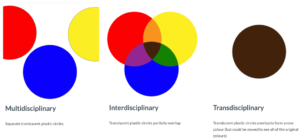 (Walker, n.d.)
I find it hard to explain Indigenous ways of knowing since it is so intertwined into every part of our being. It is not just the experience and knowledge of how we lived, but the relationships with the people, animals, land, and waters, as well as our histories. Our knowledge and learnings are passed down through the generations in numerous ways such as our stories, our culture, our languages, our ceremonies, as well as being on the land. Indigenous peoples are truly open to learning to understand the people, animals, lands, waters, and their connections. We are always concerned about what we are leaving behind to our children and our children’s children. This intertwine-ness is why I believe that Indigenous peoples are great examples of transdisciplinary thinking.
This is why the CALS501 was inspiring to me – I could see myself in it. I can see myself assisting with the discussion on climate action. For instance, ‘Team Braiding’ comes from diverse backgrounds that we braid into transdisciplinary thinking. To be an effective climate action leader, one will need to open, honest, and respectful of each other’s knowledge so that braided together can develop creative solutions to this wicked problem of climate change.
References
Alexander, C., Bynum, N., Johnson, E., King, U., Mustonen, T., Neofotis, P., Oettlé, N., Rosenzweig, C., Sakakibara, C., Shadrin, V., Vicarelli, M., Waterhouse, J., & Weeks, B. (2011). Linking Indigenous and Scientific Knowledge of Climate Change. BioScience, 61(6), 477–484. https://doi.org/10.1525/bio.2011.61.6.10
Beaulieu, D. (2012). Dene traditional knowledge about caribou cycles in the Northwest Territories. Rangifer, 32(2), 59-67. https://doi.org/10.7557/2.32.2.2252
Corman, I., & Cox, R. (2020). Transdisciplinary Thinking in the context of the MACAL program. Royal Roads University. https://commons.royalroads.ca/macal/wp-content/uploads/sites/88/2021/04/MACAL_Transdisciplinary_Thinking03-31-21-3.pdf
DeVries, I. (2020). Open Learning Primer. Royal Roads University. https://media.royalroads.ca/owl/media/macal/documents/open-education-primer.pdf
Gram-Hanssen, I., Schafenacker, N., & Bentz, J. (2021). Decolonizing transformations through ‘right relations’. Sustainability Science. https://doi.org/10.1007/s11625-021-00960-9
MACAL Program. (n.d.). Master of arts climate action leadership. https://macal.royalroads.ca/
PSU Open. (2020, May 3). Intro to open education. [Video]. YouTube. https://www.youtube.com/watch?v=Bd-GAFCHwKc
Royal Roads University. (n.d.). Welcome to CALS 501-Leading Climate Action in Society Part 1. https://commons.royalroads.ca/cals501/
Walker, S. (n.d.). Transdisciplinary learning: All mixed up! PYP in Practice. https://sites.google.com/isparis.net/conceptualinquiry/transdisciplinary-learning-all-mixed-up?authuser=0
Whyte, K.P. (2017). Indigenous Climate Change Studies: Indigenizing Futures, Decolonizing the Anthropocene (February 28, 2017). https://ssrn.com/abstract=2925514
Hi Charlene,
I really enjoyed your blog post and the theme you chose to explore. In reading your post, I completely agree with you that indigenous ways of thinking are transdisciplinary. I see transdisciplinarity as taking multiple perspectives into account and integrating them so that everyone’s needs are met and the solution benefits everyone. I see your culture as taking so many different species’ (as well as the land’s, the water’s) needs into account – not just human needs – and coming up with a way of life that benefits everyone. It takes so much openness and thinking outside of ones’ own (human) perspective to be able to empathize with our non-human relatives and design solutions that integrate all needs, so it is indeed an incredible example of transdisciplinarity.
Thanks for sharing 🙂
Miriam