
Appropriate mitigation and adaptation efforts are critical in the discourse of how we, as a global society, must and can prepare for the environmental and social ramifications of climate change. Understanding how our future might look under different conditions is critical for effective climate action. Climate models, including a range of conceivable scenarios, are a powerful tool for illustrating the challenges ahead and outlining the mitigation and adaptation measures required to stay within the required limits of global warming. Which inputs inform climate models and the contributing scenarios?
The international climate modelling community gathers every five to seven years to employ the most recent versions of their climate models in a coordinated suite of model simulations. The model ensemble results assist a wide range of climate change impact and adaptation research and activities, as well as public education and outreach. This Coupled Model Intercomparison Project (CMIP) has been highly successful. The results of a CMIP, including the findings reported, published, and peer-reviewed by participating groups and scientists, contribute to the Intergovernmental Panel on Climate Change’s (IPCC) assessments and reports. The IPCC is a United Nations (UN) intergovernmental body tasked with regularly examining the science of the Earth’s changing climate and determining the state of knowledge about climate change. The IPCC does not conduct original research; instead, it commissions thorough evaluations of the peer-reviewed literature that is published each year. In the process, IPCC Assessment Reports (ARs) make substantial use of a large body of research and current CMIP model data (ECCC, 2022).
The World Climate Research Programme (WCRP) organized the Sixth Phase of the Coupled Model Intercomparison Project (CMIP6). The WCRP coordinates the efforts of CMIP’s partners and modelling groups. As involvement in CMIP increased and the number and complexity of climate models progressed, the requirement for increasingly precise and coordinated experiments led to CMIP becoming an integrated framework within which a number of different Model Intercomparison Projects (MIPs) are established. MIPs are collections of experiments and simulations that are used to evaluate and compare various aspects of climate models. There are 23 distinct MIPs in CMIP6. The Diagnostic, Evaluation and Characterization of Klima (DECK) experiments are an essential component of CMIP6 because they use historical simulations (1850–near present) to test how well the model can predict the climate of the past. The DECK experiments are required for any model to participate in the CMIP. The intricate and interrelated nature of CMIP6 is depicted in the graphic below (ECCC, 2022).
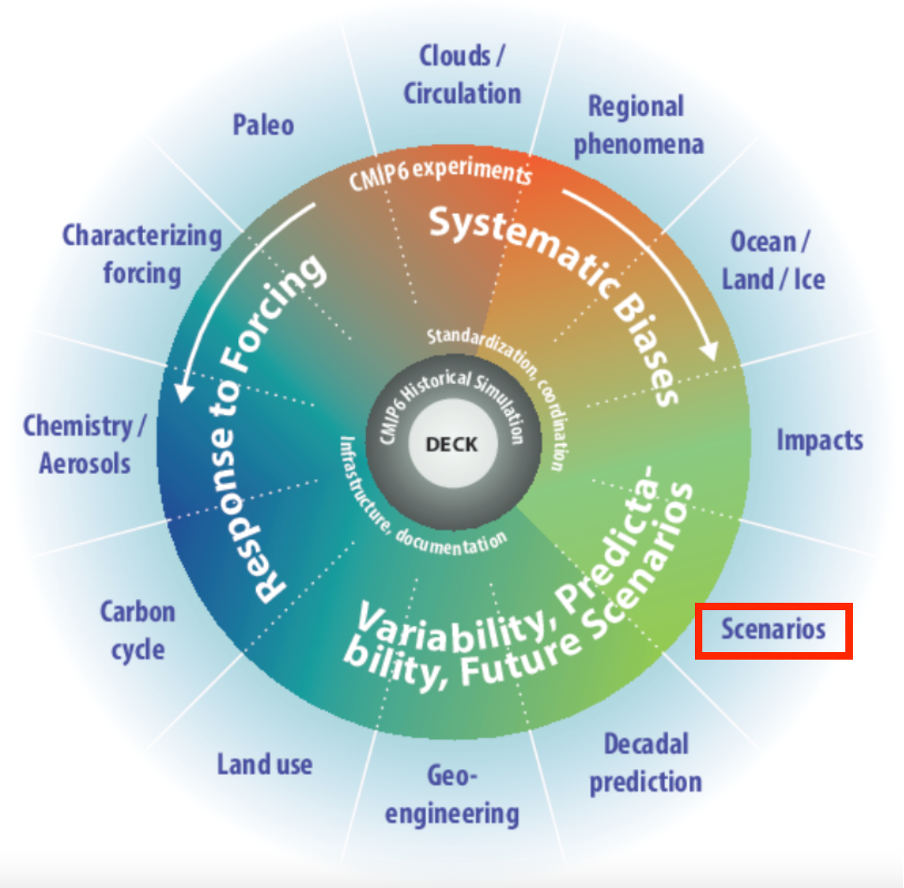
As shown in the above illustration, scenarios are an integral part of climate modelling and have been used for decades in global change studies to describe uncertainty in complex, interwoven human and ecological systems. They are used to weigh the pros and cons of prospective futures to achieve the best possible outcomes while avoiding unfavourable ones (O’Neill et al., 2020). The Shared Socio-economic Pathways (SSPs) are the most recent set of scenarios, used for CMIP6 (2016-2021) and IPCC Sixth Assessment Report (AR6). The SSP scenarios are the most complex to date, ranging from very ambitious mitigation to continued emissions growth. The most ambitious mitigation scenario was especially developed to align with the Paris Agreement’s global temperature objective of keeping the increase in global temperature well below 2°C above pre-industrial levels and pursuing efforts to limit the increase to 1.5°C. SSPs integrate components from the Special Report on Emissions Scenarios (SRES) and Representative Concentration Pathways (RCPs), the two scenario iterations that preceded the SSPs. The SSPs propose alternative narratives about how the world might evolve over the course of this century in the absence of climate policy. Five SSPs were developed, each with a different set of assumptions regarding human development, such as population, education, urbanization, GDP and economic growth, the pace of technological innovation, emissions of greenhouse gases (GHG) and aerosols, energy supply and demand, changes in land use, etc. As a result, SSPs represent the challenges of implementing any global policies, or mitigation and adaptation measures (ECCC, 2022; Riahi et al., 2017).
To assess scenarios and thus the potential action pathways within our reach, it is essential to look at what information goes into scenarios and what information could go into them but is not considered, although it could offer innovative new approaches to mitigation and adaptation planning. Focusing on what information does not go into scenarios, specifically from a socioeconomic perspective, it stands out that all SSPs assume ongoing economic growth and do not consider other economic pathways. Economic approaches that reduce production and consumption are not employed. This excludes the possibility of a solution-based transformation away from an economically growth-centred society. Given the significance of scenarios in climate science, strategies beyond the growth logic are effectively excluded from the discourse on climate policy and society (Kuhnhenn, 2018). Degrowth is “first and foremost, a critique of growth. It calls for the decolonization of public debate from the idiom of economism and for the abolishment of economic growthas a social objective. Beyond that, degrowth signifies also a desired direction, one in which societies will use fewer natural resources and will organize and live differently than today” (Kallis et al., 2014, p. 3).
Since degrowth concepts are not considered in developing the SSPs, it seems not surprising that IPCC reports touch only briefly on degrowth concepts. Degrowth is mentioned in the IPCC AR6 WGIII a total of seven times in four different sections. It is introduced in Chapter 1: Introduction and framing as an alternative sustainability concept with a particular focus on well-being; it is then discussed in Chapter 3: Mitigation pathways compatible with long-term goals as a scenario feature for modelling mitigation pathways; in Chapter 5: Demand, services, and social aspects of mitigation; and finally in Chapter 17: Accelerating the transition in the context of sustainable development. (Parrique, 2022; IPCC, 2022).
Therefore, the IPCC’s reports show only a fraction of the potential developments; they do not explore the aspect of economic development and climate policy measures that call for reduced production and consumption. This is important because the continued economic growth is a primary generator of GHGs; therefore, following ambitious climate change mitigation routes is challenging in a growing economy. Hence, the existing models fail to consider the possibility (and necessity) of profound social transformation by disregarding pathways that do not assume economic growth (Kuhnhenn, 2018).
This seems to indicate that currently used scenarios operate within the systemic boundaries of the dominant economic paradigm of neoliberal capitalism, a system that ultimately contributed to the climate crisis. Limiting the scenario narratives to the concept of continuous economic growth potentially also limits the scientific and public discourse in ways that could suggest that growth-based economic scenarios represent all that’s feasible, possible or realistic when, in fact, there are other potential inputs for scenarios that remain mostly ignored. Suppose we limit the socioeconomic aspects of climate science to the system-inherent “realities” instead of exploring pathways that would undoubtedly require radical ideological and practical transformations. Aren’t we excluding alternative approaches and potential solutions that could make a significant difference in climate action?
References
Environment and Climate Change Canada (ECCC) (2022, January 20). CMIP6 and Shared Socio-economic Pathways overview. https://climate-scenarios.canada.ca/?page=cmip6-overview-notes
Intergovernmental Panel on Climate Change (IPCC) (2022): Climate Change 2022: Mitigation of Climate Change. Contribution of Working Group III to the Sixth Assessment Report of the Intergovernmental Panel on Climate Change. Shukla, P.R., Skea, J., Slade, R., Al Khourdajie, A., van Diemen, R., McCollum, D., Pathak, M., Some, S., Vyas, P., Fradera, R., Belkacemi, M., Hasija, A., Lisboa, G., Luz, S., Malley, J. (Eds.). Cambridge University Press. https://www.ipcc.ch/report/sixth-assessment-report-working-group-3/
Kallis, G., Demaria, F., D’Alisa, G. (2014). Degrowth. A vocabulary for a new era. Routledge.
Kuhnhenn, K. (2018). Economic growth in mitigation scenarios: A blind spot in climate science? Global scenarios from a growth-critical perspective. Heinrich Böll Foundation. https://www.boell.de/sites/default/files/endf2_kuhnhenn_growth_in_mitigation_scenarios.pdf
O’Neill, B. C., Carter, T. R., Ebi, K., Harrison, P. A., Kemp-Benedict, E., Kok, K., Kriegler, E., Preston, B. L., Riahi, K., Sillman, J., van Ruijven, B. J., van Vuuren, D., Carlisle, D., Conde, C., Fuglestvedt, J., Green, C., Hasegawa, T., Leininger, J., Monteith, S., Pichs-Madruga, R. (2020). Achievements and needs for the climate change scenario for the climate change scenario framework. Nature Climate Change 10, 1074-1084. https://doi.org/10.1038/s41558-020-00952-0
Parrique, T. (2022, April 7). Degrowth in the IPCC AR6 WGIII. https://timotheeparrique.com/degrowth-in-the-ipcc-ar6-wgiii/
Riahi, K., van Duuren, D., Kriegler, E., Edmonds, J., O’Neill, B. C., Fujimori, S., Bauer, N., Calvin, K., Dellink, R., Fricko, O., Lutz, W., Popp, A., Crespo Cuaresma, J., KC, S., Leimbach, M., Jiang, L., Kram, T., Rao, S., Emmerling, J. (…), Tavoni, M. (2017). The Shared Socioeconomic Pathways and their energy, land use, and greenhouse gas emissions implications: An overview. Global Environmental Change 42, 153-168. https://doi.org/10.1016/j.gloenvcha.2016.05.009