The Need for Transformational Climate Risk Management and Adaptation

The CALS 503 Climate Risk Management course enabled us to examine fundamental principles, theories, and concepts of climate adaptation and disaster risk reduction. Moreover, the relationship between disaster risk management and climate change adaptation was explored with a focus on developing comprehensive risk assessment frameworks. The course material inspired further research on transformational change in climate risk management and adaptation. This approach reflects the urgent need to reassess our perception of meaningful climate action to address the perhaps most fundamental risk of failing to adapt and mitigate climate change in time.

Evidence of growing climate-related risks and impacts worldwide has prompted calls for “transformational change” in handling and adapting to that risk (Deubelli & Mechler, 2021). As climate change accelerates and we see the first signs of adaptation limits and rising compound risk (Dow et al., 2013), we can no longer rely solely on conventional methods to address climate-related risks. This presents new challenges for all sectors (Nalau & Handmer, 2015). The adverse impacts of climate change have already become apparent, and more are expected in the future. Hence, climate risk management and adaptation approaches are becoming increasingly recognized as indispensable (Kates et al., 2012). As the number of climate-related disasters rises, so do calls for innovative approaches to disaster preparedness and response, including relevant epistemic methods (David Tàbara et al., 2019) that enable radical and fundamental change for the better (Mustelin & Handmer, 2013; Nalau & Handmer, 2015).

For a change to be considered “transformational” in the climate risk management and adaptation framework, it must involve extensive, far-reaching, and in-depth changes to the system (Kates et al., 2012; Nalau & Handmer, 2015). Transformative approaches to climate risk management and adaptation may rely on innovative and learning capacities, broad stakeholder engagement, regular monitoring and evaluation, and strategic leadership, among other things, to successfully bring about such a profound change (Moser & Ekstrom, 2010; Kates et al., 2012)

Societies tend to react to pressure to change in incremental ways, focusing on maintaining the existing system or accepting gradual partial change (Kates et al., 2012). Given the multiple dynamic pressures underlying current and future global change, however, this may need to be revised, calling for a more solid understanding of how change can be managed and what supports positive transformative action and, ultimately, solutions. Ideally, this would aid in progress toward development, disaster risk mitigation, and adaptation. However, most of the attention to date has been given to incremental rather than revolutionary shifts, and the scale of the change and its evaluation in terms of both short- and long-term effects have been largely ignored (Mustelin & Handmer, 2013). There is a limit to incremental adaptation, and if it is relied on too heavily, it can lead to expensive maladaptation and system collapse (Dow et al., 2013). Transformational adaptation, on the other hand, seeks to strengthen the capacity of biophysical, social, or economic systems to meet the desired goals by altering the system’s essential properties or bringing about an irreversible regime shift (Kates et al., 2012).

Given the increasing discontent with incremental, reactive change, how can more profound, transformative change be brought about? Adaptive transformation, which considers actor-specific understandings of, say, the meaning of sustainability or climate risk, could facilitate ongoing learning and re-evaluation (Preston et al., 2013). Even when firmly committed to a specific course of action, actors can use adaptive transformation to open themselves up to new action pathways. Hence, adaptive transformation modifies how feasible various choices appear, allowing for a more generalized recognition of what constitutes a “good” course of action. The critical question is whether the transformation process is undertaken voluntarily or whether, due to external pressures, transformational change becomes the only option (Preston et al., 2013). When a system’s configuration is no longer sustainable, transition and resilience theorists view transformation as an obligatory next step. According to this theory, change is not always voluntary but occurs just before or after a system collapses (Mustelin & Handmer, 2013). Alternatively, a more anticipatory view of transformation would be highly beneficial, defining it as a deliberate decision to alter the system into a new state before any such collapse occurs (O’Brien, 2012).

The growing body of research on transformational adaptation presents opportunities for progressing toward a clear and actionable conceptualization of transformative approaches to climate risk management, adaptation, and the change processes entailed therein. However, the increasing attention has also resulted in a broad spectrum of interpretations (Nalau & Handmer, 2015). The potential for bringing about profound change toward comprehensive climate risk management and adaptation that addresses the fundamental causes of risks and enables sustainable futures may be hampered by the term’s ambiguous and inconsistent conception (Few et al., 2017). Additionally, due to a more qualitative approach, transformative climate risk management and adaptation techniques frequently lack explicit quantitative goals, unlike the literature on comparable topics like mitigation (e.g. net zero targets) and socio-technical transitions (Deubelli & Mechler, 2021), making it more challenging to address the concept within conventional (natural) scientific structures. The broad interpretation and the lack of quantitative, measurable goals point to an “operationalization gap” in terms of translating transformational change ambitions into concrete transformative measures that can be directly replicated in practice. Ongoing, transdisciplinary research into the topic will help policymakers and practitioners avoid using the concept of transformational change and transformational adaptation innocuously and instead bring about the profound shift necessary to secure sustainable futures and fortify communities against the worsening effects of climate change (Feola, 2015).

References

David Tàbara, J., Jäger, J., Mangalagiu, D., Grasso, M. (2019). Defining transformative climate science to address high-end climate change. Regional Environmental Change, 19, 807-818. https://doi.org/10.1007/s10113-018-1288-8

Deubelli, T. M. & Mechler, R. (2021). Perspectives in transformational change in climate risk management and adaptation. Environmental Research Letters, 16(5). https://doi.org/10.1088/1748-9326/abd42d

Dow, K., Berkhout, F., Preston, B. L., Klein, R. J. T., Midgley, G., Shaw, M. R. (2013). Limits to adaptation. Nature Climate Change, 3, 305-307. https://doi.org/10.1038/nclimate1847

Feola, G. (2015). Societal transformation in response to global environmental change: a review of emerging concepts. Ambio, 44(5), 376-390. https://doi.org/10.1007/s13280-014-0582-z

Few, R., Morchain, D., Spear, D., Mensah, A., Bendapudi, R. (2017). Transformation, adaptation and development: relating concepts to practice. Palgrave Communications, 3. https://doi.org/10.1057/palcomms.2017.92

Kates, R. W., Travis, W. R., Wilbanks, T. J. (2012). Transformational adaptation when incremental adaptations to climate change are insufficient. Proceedings of the National Academy of Sciences, 109(19), 7156-7161. https://doi.org/10.1073/pnas.111552110

Moser, S. C. & Ekstrom, J. A. (2010). A framework to diagnose barriers to climate change adaptation. Proceedings of the National Academy of Sciences, 107(51), 22026-22031. https://doi.org/10.1073/pnas.1007887107

Mustelin, J. & Handmer, J. (2013). Triggering transformation: Managing resilience or invoking real change? Transformation in a changing climate, 24-32. https://www.sv.uio.no/iss/english/research/news-and-events/events/conferences-and-seminars/transformations/proceedings-transformation-in-a-changing-climate_interactive.pdf

Nalau, J. & Handmer, J. (2015). When is transformation a viable policy alternative? Environmental Science & Policy, 54, 349-356. https://doi.org/10.1016/j.envsci.2015.07.022

O’Brien, K. (2012). Global environmental change II: From adaptation to deliberate transformation. Progress in Human Geography, 36(5), 667-676. https://doi.org/10.1177/0309132511425767

Preston, B. L., Dow, K., Berkhout, F. (2013). The Climate Adaptation Frontier. Sustainability, 5(3), 1011-1035. https://doi.org/10.3390/su5031011

The Space for “Yes, and” in Climate Science

Besides informing a general audience about the historical and current development of the climate system, findings of climate science are the basis for informed adaptation and mitigation efforts and overall climate action. Given the central role of climate science in climate action, it is worth looking at aspects that are either not or only remotely included in current Western climate science and how adding alternative approaches, knowledges, and concepts could be a strategy to potentially aid more holistic climate action.

The dynamics and structure of the Earth’s climate system are studied by climate science. It examines the processes by which global, regional, and local climates are maintained and how they change over time. It employs data and theories from numerous fields, including meteorology, oceanography, physics, chemistry, etc. These inputs also inform computer models of the climate system, which are a keystone of contemporary climate research (Parker, 2018). Hence, climate science provides us with robust and detailed data and information about how the Earth’s climate evolved over thousands (and even millions) of years and how it will continue to change under current and future emissions scenarios in the Anthropocene.

One of the key principles of Western (climate) science states that “scientific evidence is objective and independent of its discoverer’s personal or social attributes“ (Howarth et al., 2020, p. 323). While science itself is objective, scientific findings are influenced by what is measured, calculated and factored into, for instance, a scenario or a model. While data is a quantitative value, the qualitative value is added by a research hypothesis or the general interpretation of data. Therefore, climate scientists and their communicators need to recognize the subjectivities, including their own, that shape how people see climate science to avoid being seen as the bearers of a single, universal truth. Instead, climate science must embrace the plurality of its interpretation by acknowledging that science is perceived differently by different audiences and adapting its messages accordingly (Howarth et al., 2020).

Besides the risk of different perceptions of scientific findings, another aspect speaks against relying on Western climate science as the representation of a single, universal truth. Several concepts and ideas are not (yet) considered in Western climate science and highlight the potential for more extensive and inclusive climate research. The following two concepts exemplify how our capacity to apply meaningful climate action could be expanded.

Climate models, such as the CMIP6 models used in the IPCC’s Sixth Assessment Report (AR6), cover a range of perceivable scenarios and, thus, result in a range of projections depending on the data input (ECCC, 2022). However, certain approaches are not represented in climate models and scenarios. Adding alternative concepts and ways of thinking could expand the applicability of climate science information in adaptation and mitigation planning and overall climate action. The Shared Socioeconomic Pathways (SSPs) are the most recent scenarios utilized in the CMIP6 climate models. In the absence of climate policy, the SSPs suggest how the world might evolve over the current century under different emission scenarios and socioeconomic circumstances. Considering what information is missing from these scenarios, notably from a socioeconomic standpoint, it is evident that all SSPs assume continued economic growth and do not evaluate alternative economic pathways. Growth-critical concepts that could reduce production and consumption are not applied, which rules out the idea of a solution-based shift away from an economically growth-focused society. Hence, approaches outside the predominant neoliberal growth logic are effectively barred from climate policy and social discourse (Kuhnhenn, 2018).

Compared to Western climate science, Indigenous climate change studies show a different approach to understanding environmental changes through memories and knowledges derived from Indigenous peoples’ living heritages as societies with stories, lessons, and long histories of having to adjust to seasonal and inter-annual environmental changes and external disruptions. Colonialism and capitalism laid the groundwork for industrialization and carbon-intensive economies, which generate the drivers of anthropogenic climate change, such as widespread deforestation for commodity agriculture and the use of petrochemical technologies that rely on burning fossil fuels for energy. Anthropogenic environmental changes, such as deforestation, pollution, modification of hydrological cycles, and intensification of soil use and terraforming for specific types of farming, grazing, transportation, residential, commercial, and governmental infrastructure, significantly disrupted the lives of many Indigenous peoples shortly after the colonial invasion began several centuries ago. The natural circumstances that fostered Indigenous peoples’ cultures, health, economies, and political autonomy were disrupted due to colonial activity (Whyte, 2017).

Indigenous knowledges are systems of observing, recording, communicating, and learning about the relationships between humans, plants and animals, and ecosystems that are essential for any community to live and thrive in specific ecosystems that are subject to various disturbances. Indigenous knowledges range from how ecological information is encoded in Indigenous languages to elder and youth mentorship protocols, kin-based and spiritual relationships with plants and animals, and memories of environmental change used to draw lessons about how to adapt to similar changes in the future. Therefore, the Indigenous approach to climate change studies is structurally different from Western climate science’s data- and objectivity-driven approach. Indigenous peoples consider the renewal of their knowledge systems as a crucial method for successful adaptation planning because they believe traditional knowledges provide critical insights into navigating today’s environmental issues (Whyte, 2017).

Since Indigenous climate change studies originate from memories, knowledges, histories, and experiences of oppression that differ significantly from the approaches of non-indigenous scientists, environmentalists, and politicians who frame the current climate change discourse, Indigenous people might rightfully worry that climate scientists could rush to Indigenous communities, either on purpose or unintentionally, to claim Indigenous peoples’ knowledges to fill in gaps in Western climate science research (Whyte, 2017). Yet, the more scientists understand the importance of the practice and renewal of Indigenous knowledges for Indigenous peoples’ own purposes of preparing for climate change and protecting their ways of life, the more they will understand their responsibilities to work with Indigenous collaborators in a way that is mutually beneficial instead of exploitative (Hardison & Williams, 2013). This could pave the way for expanding the understanding of Western climate science by including Indigenous knowledges and knowledge holders without facilitating cultural appropriation.

The examples of growth-critical approaches and Indigenous climate change studies show that focusing on what can be added to Western science and tools, such as climate models, projections and scenarios, could open a path for more inclusive, just, transdisciplinary and thus holistic strategies and potentially even systemic shifts. Suppose we remain within the current framework of Western climate science instead of exploring pathways that could undoubtedly require radical ideological and practical transformations. Aren’t we limiting our scope of action by excluding alternative approaches and potential solutions that could make a significant difference in climate action? What other concepts are there? Which additional knowledges and ways of thinking can inform action and strategies and, eventually, even policies? How can additional narratives shape how we understand and think about climate change? This is not to say that Western climate science in itself is insufficient. However, the “yes, and” should be a crucial part of future research and climate action.

References

Environment and Climate Change Canada (ECCC) (2022, January 20). CMIP6 and Shared Socio-economic Pathways overview. https://climate-scenarios.canada.ca/?page=cmip6-overview-notes

Hardison, P., & Williams, T. (2013). Culture, Law, Risk and Governance: Contexts of Traditional Knowledge in Climate Change Adaptation. Climatic Change 120(3), 531-544. https://doi.org/10.1007/s10584-013-0850-0

Howarth, C., Parsons, L., Thew, H. (2020). Effectively communicating climate science beyond academia: Harnessing the heterogeneity of climate knowledge. One Earth, 2(4), 320-324. https://doi.org/10.1016/j.oneear.2020.04.001

Kuhnhenn, K. (2018). Economic growth in mitigation scenarios: A blind spot in climate science? Global scenarios from a growth-critical perspective. Heinrich Böll Foundation. https://www.boell.de/sites/default/files/endf2_kuhnhenn_growth_in_mitigation_scenarios.pdf

Parker, W. (2018, May 11). Climate Science. In Zalta, E. N. (Ed.) The Stanford Encyclopedia of Philosophy. https://plato.stanford.edu/entries/climate-science/

Whyte, K. (2017). Indigenous Climate Change Studies: Indigenizing Futures, Decolonizing the Anthropocene. English Language Notes 55(1-2), 153-162. https://kylewhyte.marcom.cal.msu.edu/wp-content/uploads/sites/12/2018/07/IndigenousClimateChangeStudies.pdf

Climate Communication on the Spectrum of Uncertainty Interpretation

The course CALS 502 – Communication for Climate Action was an opportunity to explore communication techniques that have the potential to connect with audiences over their emotional reactions to the uncertainties of climate change and to better understand what role climate communication has in motivating engagement in climate action.  

The feeling of uncertainty is a critical component in almost all types of anxiety. When anxious, we are aware of some but not all facets of a threat or situation. Anxiety and fear are natural responses to uncertainty (Pihkala, 2020). They can quickly develop into a general sense of being overwhelmed and hopeless due to the sheer complexity of the causes, effects, and implications of climate change. Climate Anxiety is the anxiety caused by facing an uncertain and potentially doomed future due to climate change.

For a Tiny Ecology exercise during CALS 502, we were encouraged to explore the Frames of Hope and Fear in climate communication. The title begs the question if hope can balance out fear and a sense of doom within ourselves and in the way we communicate about climate change. Can hope diminish the anxiety caused by unsettling and uncertain climate projections? Can hope balance out uncertainty? Climate scientist and activist Susanne Moser emphasizes that hope also lives in uncertainty (Mazur, 2019). At its roots, hope is just as uncertain as dooming scenarios for our future. If we knew what was happening, hope, as well as overly alarmist scenarios, would be obsolete.

Considering the implications of climate change, what is the service of hope? Does it encourage us to take action, or can it potentially put us at risk of climate appeasement? In her article Home is Always Worth It, Mary Annaise Heglar discusses her difficulties in using the word “hope” in relation to climate change because it is frequently employed as a tactic of appeasement by both politicians and environmentalists. (Heglar, 2019). Therefore, I wonder if strictly hopeful convictions could stand in the way of climate action by mulling down the urgency to act, just as indifference and a sense of impending doom can paralyze us. Considering the uncertain nature of hope, can engagement rely on it? Or is climate action rooted in accepting the here and now and in deciding on sensible steps forward that are designed based on the acknowledgement of where we stand and what we know as well as what we do not know yet?  

I struggle with defining hope and fear/doom as separate entities that offer a black-and-white approach to how we perceive the future. In the context of climate change and the future ahead of us, hope and doom instead seem to be on opposing ends of a spectrum of uncertainty interpretation. Climate communication moves on that spectrum. Mindfulness with and a conscious approach to language are required to provide communication that is not about conveying facts and knowledge alone. Without overselling hope or debilitating doom, climate communication can influence or even trigger emotional reactions, which shape how information is processed and interpreted, ultimately affecting engagement and the motivation to take action.

References

Heglar, M. A. (2019, September 12). Home is Always Worth It. Medium. https://medium.com/@maryheglar/home-is-always-worth-it-d2821634dcd9

Mazur, L. (2019, July 22). Despair about the Climate Crisis? Read This. Earth Island Journal. https://www.earthisland.org/journal/index.php/articles/entry/despairing-about-climate-crisis/

Pihkala, P. (2020, April 3). Climate grief: How we mourn a changing planet. BBC Future. https://www.bbc.com/future/article/20200402-climate-grief-mourning-loss-due-to-climate-change

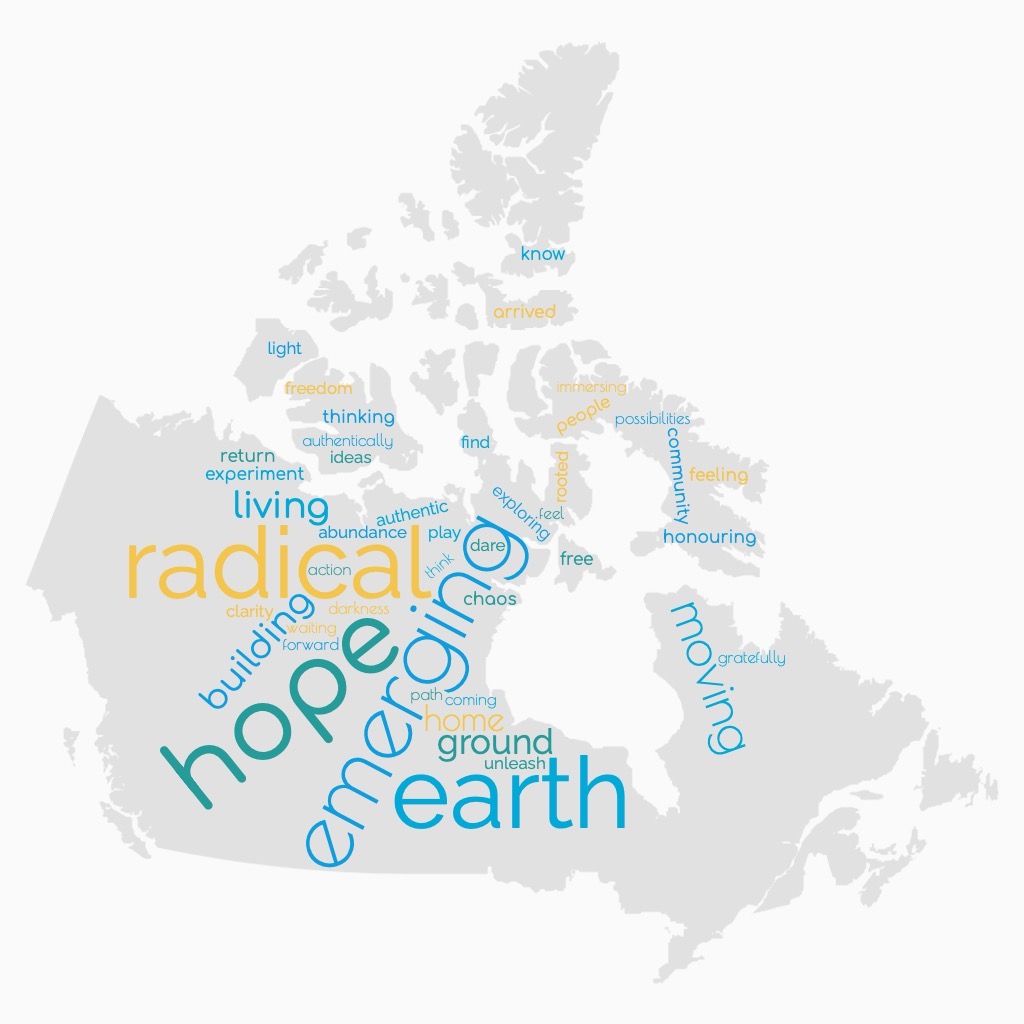
How I arrived here

by building on moving and living earth

exploring my path to find a community waiting

with the freedom to be authentic and be authentically free

coming home to ideas

being at home in action

gratefully honouring how I arrived here

being rooted in darkness and light

moving forward with a feeling clarity, immersing myself in chaos

to unleash thinking, to experiment with possibilities, to know abundance

to then return and play, think, feel and dare with my people

radical hope emerging

by growing with moving and living earth

Where do I Stand? Or: Can I Feel My Way Into Climate Action Leadership?

A slight shift in perspective can mean a whole new world to discover. This is certainly true for me as I embark on my academic journey into the Climate Action Leadership program at Royal Roads University. In my case, the slight shift is a rather long journey from Europe to Vancouver Island, Canada. With it comes an abundance of new perspectives as I am being introduced to ways of indigenous thinking and being for the very first time.

Those new perspectives have one thing in common; they are based on emotion, and I’m asking myself:

Am I allowed to feel myself into research? Where does the notion that science and research must be disassociated from emotion even stem from? And how does the process of conscious feeling shape my understanding of leadership?

As I am dipping my toes into relational systems thinking, I am overwhelmed with its potential impact in climate action leadership. Understanding that we are part of the natural system is crucial in developing ways to heal, protect, and support the very system we are a part of. The concept of relationality refers to the indigenous paradigm that we humans are in relation to all living things (Gram-Hanssen, 2022). Indigenous scholar Vanessa Watts emphasizes that “we (humans) are made from the land; our flesh is literally an extension of soil” (2013, p. 27).

Suppose we are related to our environment and understand ourselves as “respectful partners and younger siblings in relationships of reciprocal responsibilities within interconnected communities of relatives inclusive of humans, non-humans (i.e., plants, animals etc.), entities (i.e., sacred and spiritual places etc.) and collectives (i.e., prairies, watersheds, etc.)” (Johnson et al., 2016, p. 26). In that case, we will be naturally called to environmental action in general and climate action in particular, based on our intrinsic motivation to care for those close to us.

During a workshop on resilience in the context of climate action, which was part of our CALS501 course, I tried to actively be in relation with my environment: I stepped outside, looking to form a connection with a non-human relative and was drawn to a rock. But instead of just sitting down and using it as a seat with a nice view, I first introduced myself and asked if I could sit down. Then I actively felt. I felt for a response, and as I sensed that I was welcome, I sat and asked the rock, “who are you?”.

My rational mind tried to convince me that what happened next was not a conversation but a figment of my imagination; however, I heard, felt and understood how the rock supports and carries everything and everyone. How old it is, how much wisdom and knowledge it holds and how its natural relatives around it have been shaped and affected by humans without much consideration for their existence. By feelingly relating to the rock, I cared about it.

If we care about the earth and our human and non-human relatives in the same way we care about our loved ones, we will naturally take action to support and sustain them and take care of them. We will do right by them to the best of our abilities. We will embody leadership by accepting responsibility, taking action and creating room for emergent changes.

So, why is this way of thinking in academic settings so surprising to me?

I have realized that my understanding of science, research, and knowing is fundamentally influenced by my geographical and cultural learning environment, Western Europe. The Western approach to science is based on abstract descriptions instead of lived (and felt) experiences. From a Western perspective, abstraction represents a “higher form of knowledge” (Goodchild, 2021, p. 91).

As I start exploring these new understandings of and perspectives on learning, knowing and being, I see the need to understand the underlying influencing factors for how I (as a descendant of those who left to colonize the world) look at and influence the world.

It is humbling, challenging, and undoubtedly uncomfortable to examine the system that shaped me as part of the white, Western society.

Throughout the Climate Action Leadership program and beyond, I will challenge myself to face how I may unknowingly reproduce and represent colonizing world views. I will examine the structural influences of imperialism, patriarchy, and capitalism on climate change, and I will learn and demonstrate how critically reflecting on them will shape and refine my understanding of climate action leadership.

References

Goodchild, M. (2021). Relational Systems Thinking: That’s How Change is Going to Come, From Our Earth Mother. Journal of Awareness-Based Systems Change1(1), 75-103. https://doi.org/10.47061/jabsc.v1i1.577

Gram-Hanssen, I., Schafenacker, N., & Bentz, J. (2022).Decolonizing transformations through ‘right relations’. Sustainability Science, 17, 673-685. https://doi.org/10.1007/s11625-021-00960-9

Johnson, J. T., Howitt, R., Cajete, G., Berkes, F., Louis, R. P., & Kliskey, A. (2016). Weaving Indigenous and sustainability sciences to diversify our methods. Sustainability Science, 11(1). https://doi.org/10.1007/s11625-015-0349-x

Watts, V. (2013). Indigenous place-thought and agency amongst humans and non humans (First Woman and Sky Woman go on a European world tour!). Decolonization: Indigeneity, Education & Society, 2(1), 20-34. https://jps.library.utoronto.ca/index.php/des/article/view/19145