By Joanna Burris, for CALS501: Leading Climate Action in Society, Assignment
Climate scientists and researchers have projected what the Earth’s climate will look like under different scenarios of future decisions, policies, and actions taken by humans. We understand the socio-economic changes needed to actualize a sustainable future, but there is an immense challenge ahead of us to transform our societal culture and global economy.
Global climate models are complex computer models that use principles of physics and variables such as temperature, air pressure, water vapor content, and wind magnitude to simulate the Earth’s climate under different conditions (Eltahir & Krol, 2021). Global climate models, or GCMs, are highly accurate and can be used to simulate the potential future consequences of human activity on the planet (Eltahir & Krol, 2021); however, the future is uncertain, and even the most complex and accurate climate models cannot tell us how the future will unfold. Therefore, climate projections are presented as a range of possible futures.
Each possible future is based on a different emissions scenario – ranging from very low to very high emissions – and assumptions about how much greenhouse gas will be emitted by human activities in the coming years (Hausfather, 2018). These emissions scenarios are informed by Shared Socio-economic Pathways (SSPs), which describe the range of possible socio-economic conditions over the next century as well as the associated level of effort taken to reduce emissions (ClimateData, 2022).
SSPs are developed using models that incorporate assumptions about how “population, education, energy use, technology – and more – may change over the next century, and couple them with assumptions about the level of ambition for mitigating climate change”
(ClimateData.ca, 2022)
Although there are infinite possibilities for the future of human development, scientists condensed the most likely possible futures into five different SSP families. These are summarized in the figure below, from ClimateData.ca (2022).
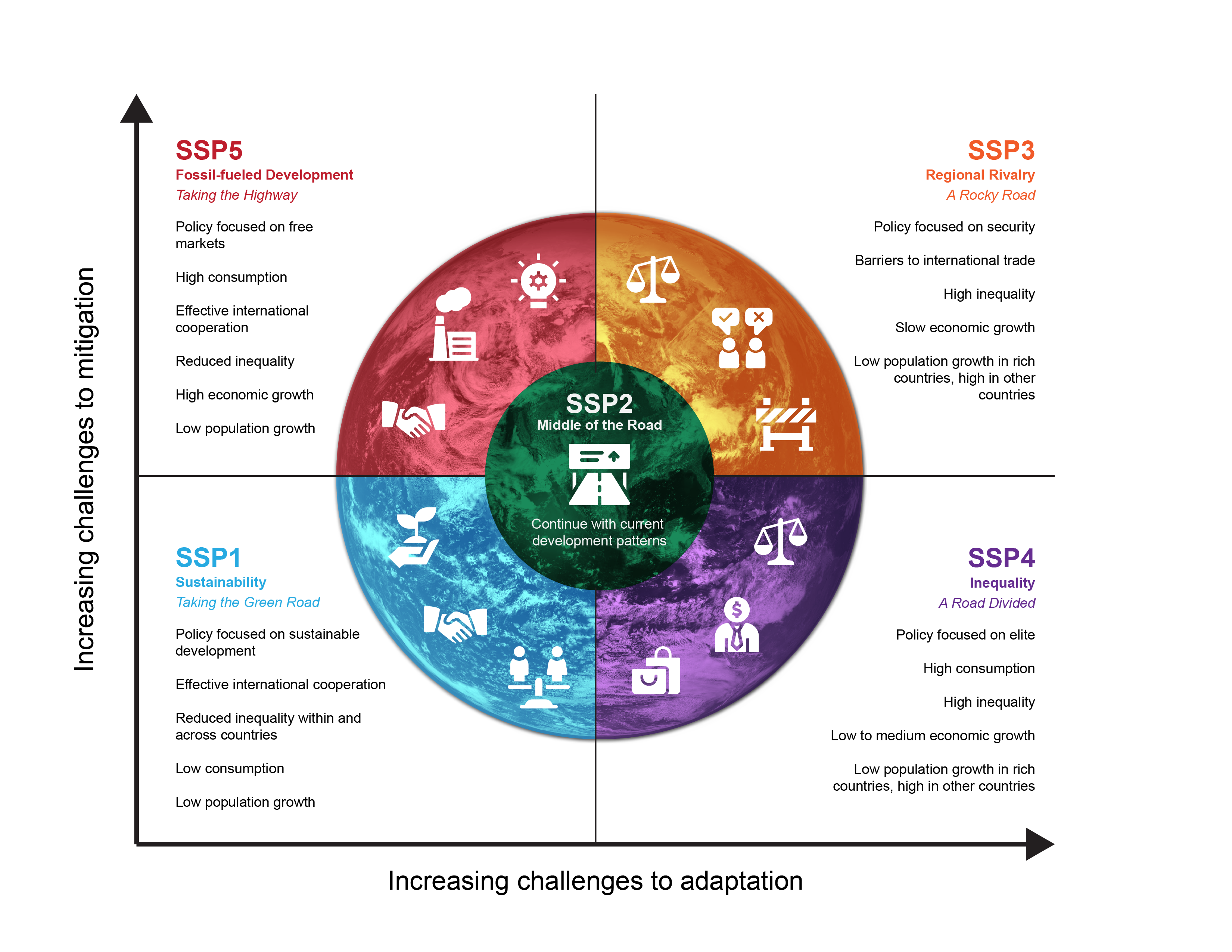
SSP1 (Sustainability: Taking the Green Road) is the most sustainable and equitable pathway; however, today’s global economic and social context most closely resembles SSP5 (Fossil-fueled Development). High consumption and high economic growth, both characteristics of SSP5 (ClimateData.ca, 2022), are critical components of capitalism.
The barriers we face to pursue pathway SSP1 seem almost insurmountable. In my previous blog post called “Working toward transformative climate action”, I explain that colonialism and capitalism are the root causes of climate change (Whyte, 2017) and explore the notion that transformative change is needed to address the climate crisis. In the global west, our nations and societies were built on slavery, exploitation (of people and the Earth), and colonial violence. Climate action that does not disrupt capitalism and its model of unlimited growth will not be sufficient to address the climate crisis. Unfortunately, capitalism is foundational to contemporary society and does not want to be disrupted.
In the CALS501 seminar on December 7, Dr. Robin Cox likened the global economy to a pyramid scheme; there are a whole lot of people at the bottom of the pyramid that support the few people at the top (Cox, 2022, 1:26:00). In a recent public lecture, Tim Merry explained that capitalism is built for self-preservation (personal communication, December 16, 2022). We cannot get enough traction for real, transformative change because the people at the top of the pyramid want to stay there and the system is designed to keep them there. Those of us in the middle rely on the system for our everyday needs, and therefore may have little inclination to disrupt it, while the people at the bottom toil, often in exploitative conditions, so that the rest of us can maintain our comfortable lives.
Kate Ervine, professor at Saint Mary’s University in Halifax explains that in order to meaningfully engage in conversations about transformative change, we must discuss the notions of “overdevelopment” and “overconsumption” (personal communication, December 12, 2022). Ervine states that it is uncomfortable for many people to have this conversation because so many of us are born into abundance, in a society where excess is normalized (personal communication, December 12, 2022) and many cannot or refuse to imagine an alternative. As stated by Daniel Wildcat, humankind needs “a cultural climate change” (Wildcat, 2009, p. 5). So far, we have seen mostly incremental changes. While any progress is good, incrementalism is insufficient to address the climate crisis (T. Merry, personal communication, December 16, 2022).
To me, the Shared Socio-economic Pathways read like a menu. They show us five vastly different futures and outcomes for life on our shared planet. The SSP narratives, such as the excerpt found below, and the climate projections generated from them help us to visualize what life could be like for us and our non-human relatives. Climate science has shown us what our options are; it is the time to decide and act.
“The world shifts gradually, but pervasively, toward a more sustainable path, emphasizing more inclusive development that respects perceived environmental boundaries.”
Excerpt from the summary of the SSP1 narrative, by Riahi et al. (2016)
To begin to disrupt capitalism and work toward sustainable development, low consumption, and increased equality, all key characteristics of SSP1, we must be able to imagine something different than our current systems (T. Merry, personal communication, December 16, 2022) and share this vision with others so they can imagine it too. We must have brave conversations about a future without excess, overconsumption, and exploitation and prioritize inclusion and equity over profits and luxury. We must reimagine our economic system, our priorities, and the way we relate to one another and the Earth. We must learn from Indigenous people, whose cultures emphasize equality, generosity, sharing, and the needs of the group over the individual (Little Bear, 2000), in stark contrast to the individualism and greed promoted by capitalism. We must demand more than incremental change from ourselves and those in power; we need transformation.
References
ClimateData.ca. (2022). Understanding Shared Socio-economic Pathways (SSPs). Pacific Climate Impacts Consortium (PCIC), Ouranos Inc., the Prairie Climate Centre (PCC), Environment and Climate Change Canada (ECCC) Centre de Recherche Informatique de Montréal (CRIM), and Habitat7. https://climatedata.ca/resource/understanding-shared-socio-economic-pathways-ssps/
Cox, R. (December 9, 2022). CALS501 unit 4 seminar [Online course seminar]. In R. Cox & E. Childs, Leading Climate Action in Society Part 1. https://commons.royalroads.ca/cals501-2022/
Eltahir, E., & Krol, A. (January 8, 2021). Climate Models. MIT Climate Portal. https://climate.mit.edu/explainers/climate-models
Hausfather, Z. (April 19, 2018). Explainer: How ‘Shared socioeconomic pathways’ explore future climate change. Carbon Brief. https://www.carbonbrief.org/explainer-how-shared-socioeconomic-pathways-explore-future-climate-change/
Little Bear, Leroy. (2000). Jagged worldviews colliding. In M. Batiste (Ed.), Reclaiming Indigenous voice and vision (pp. 77-85). UBC Press. https://www.law.utoronto.ca/sites/default/files/documents/hewitt-leroy_little_bear_on_jagged_worldviews.pdf
Riahi, K., van Vuuren, D. P., Kriegler, E., Edmonds, J., O’Neill, B. C., Fujimori, S., Bauer, N., Calvin, K., Dellink, R., Fricko, O., Lutz, W., Popp, A., Cuaresma, J. C., Kc, S., Leimbach, M., Jiang, L., Kram, T., Rao, S., Emmerling, J., Ebik, K., Hasegawaf, T., Havlika, P., Humpenöderc, F., Da Silvai, L. A., Smithd, S., Stehfestb, E., Bosettii,j, V., Eomd, J., Gernaatb, D., Masuif, T., Rogelja, J., Streflerc, J., Droueti,j, L., Kreya, V., Ludererc, G., Harmsenb, M., Takahashif, K., Baumstarkc, L., Doelmanb, J. C., Kainumaf, M., Klimonta, Z., Marangonii,j, G., Lotze-Campenc, H., Obersteinera, M., Tabeaun, A., & Tavoni, M. (2017). The Shared Socioeconomic Pathways and their energy, land use, and greenhouse gas emissions implications: An overview. Global Environmental Change, 42, 153–168. https://doi.org/10.1016/j.gloenvcha.2016.05.009
Wildcat, D. R. (2009). The climate is changing – and, well, it should. In D. R. Wildcat, Red alert! Saving the planet with indigenous knowledge. Fulcrum
Whyte, K. (2017). Indigenous climate change studies: Indigenizing futures, decolonizing the Anthropocene.English Language Notes, 55(1-2). 153-162. https://doi.org/10.1215/00138282-55.1-2.153