Part 3 of Assignment 4 – Content Remix for CALS502
Alt text: On a noisy gradient background with the colours yellow, orange, pink, blue, black, fascia, and peach, the title: Working toward transformative climate action.

The following content slides all have a strip of colours on the left-hand side matching the title page gradient. The text reads:
Title: Wanted: Cultural Transformation.
Body text: Conventional climate action, with a focus on reducing emissions and improving technology, still maintains the status quo of the global capitalist economy. What is needed is a transformation of our consumerist and capitalist culture and the values that maintain it (Gram-Hanssen et al., 2021). This post describes three areas where our communities can focus energy to influence a cultural shift: restoring our relationship with nature, following Indigenous leadership, and using art to inspire.
Two black & white photos show a chrysalis and a monarch butterfly emerging from a chrysalis.

Title: The Root Cause of Climate Change
Body text: Reducing greenhouse gas emissions is an important part of mitigating climate change, but it does not address its root cause. Climate change is the result of our global capitalist economy (Polychroniou, 2018) and its roots in colonialism and the exploitation of people and the Earth (Whyte, 2017; Young, 2021). Colonization of North America (called Turtle Island by Indigenous people) involved the removal and relocation of existing peoples who knew how to live sustainably on this land and the destruction of their knowledge systems, which are tied to land and ecological systems (Whyte, 2017).
A black & white photo shows smoke stacks from a factory puffing thick smoke into the air.

Title: The Root Cause of Climate Change
Body text: Colonialism laid the foundation for capitalism, which, by definition, relies on continuous growth; if the economy does not grow, it dies (Polychroniou, 2018). In order to continue growing the economy, contemporary society expropriates and extracts what it needs from the Earth, burning it for energy or converting to into salable goods. This way of living in the world and relating to the living systems around us is leading us toward worsening climate impacts and an uncertain future for humanity (Young, 2021).
A black & white photo shows the stark contrast between a forest and the destruction of the Alberta oil sands.

Title: Reconnect with Nature
Body text: Modern society views itself as separate from and superior to nature (Gram-Hanssen et al., 2021). By contrast, Indigenous traditions know humans to be an inseparable part of nature, with other species being our relatives. The perspective that humans are separate from nature influences how we interact with nature (Gram-Hanssen et al., 2021), which led to where we are today – facing a climate and ecological crisis of our own creation.
A black & white photo shows the New York City skyline through the distance, seen through lush grasses and foliage.

Title: Reconnect with Nature
Body text: It is much easier to justify destroying the Earth for profit when we view it as a resource, instead of a complex ecosystem of relatives which we depend upon to survive. Many argue, then, that the path forward is restoring humanity’s relationship with nature – restoring what many Indigenous people call “right relations” and understanding the obligations that come along with being in relationship with nature (Gram-Hanssen et al., 2021; Goodchild, 2021).
A black & white photo shows a young male-presenting person in a hoodie, hands in pockets, standing on a stump in a forest and looking up toward the treetops with a peaceful look on their face.

Title: Follow Indigenous Leadership
Body text: Following the lead of Indigenous people is critical for navigating a cultural shift. Living in right relationship with nature means living in right relationship with our human relatives as well as our non-human ones. Colonialism is ongoing in many ways in Canada, despite the popular belief that it is all in the past. Therefore, we will not be able to restore our connection to the land without healing our relationship with Indigenous people, who have been stewards of this land for millennia and whose guidance we sorely need.
A black & white photo shows Jean L’Hommecourt, an Indigenous woman and activist, walking along a river near Fort McMurray, Alberta. She is facing away from the camera wearing a denim jacket with a patch on the back that reads: RISE CLIMATE JUSTICE.

Title: Follow Indigenous Leadership
Body text: Indigenous people have lived on Turtle Island for at least 20,000 years (Rutherford, 2017) and know how to live in right relationship with the Earth. The rest of humanity can benefit from Indigenous knowledge that has developed over millennia of interacting with ecological systems (Wildcat, 2009). It is critical to first develop trust and build relationships with Indigenous communities that are authentic and based on respect, mutual understanding, and reciprocity. Engaging with Indigenous communities requires respect for different worldviews (Fox & Hatcher, 2022) and an understanding that Indigenous individuals, nations, and tribes have differing knowledge, cultural practices, and opinions.
A black & white photo from Parks Canada shows a group of people sitting outdoors in a circle having a conversation.
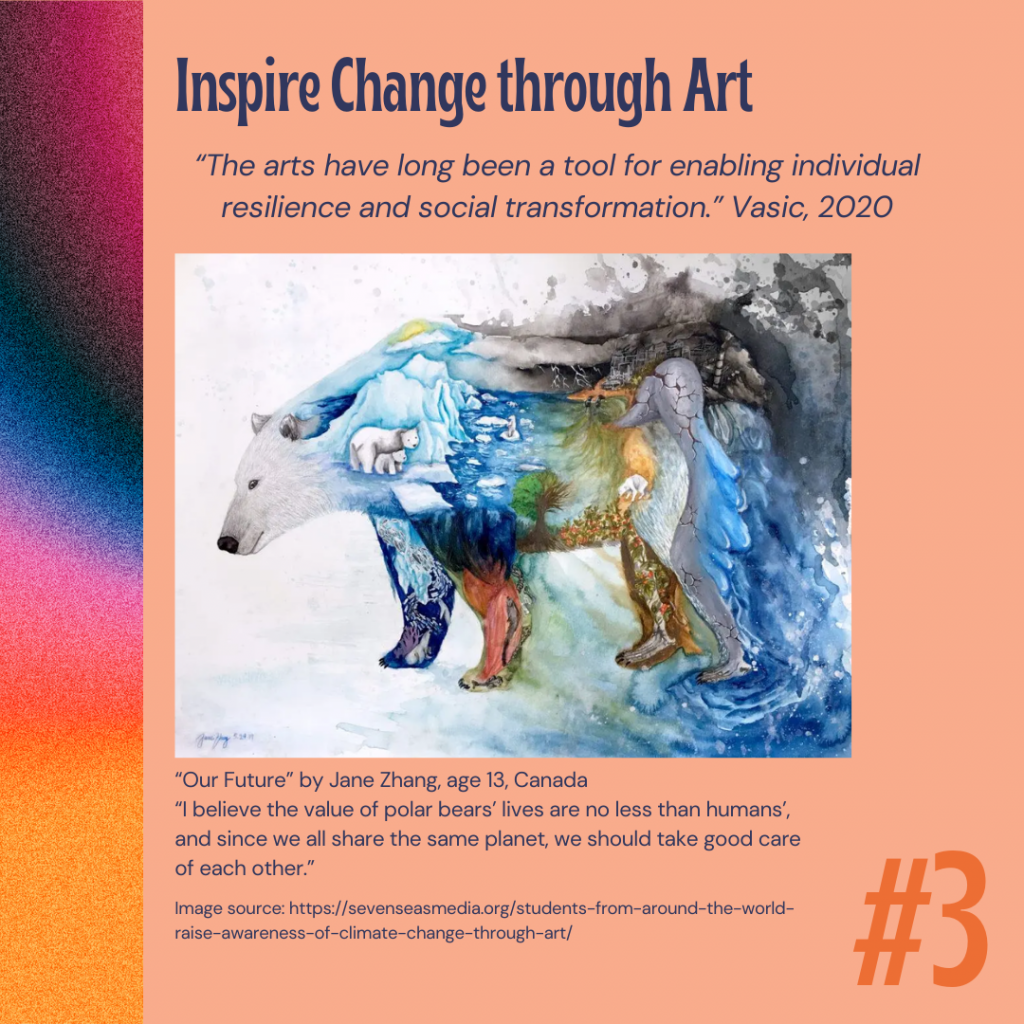
Title: Inspire Change through Art
Body text: The arts have long been a tool for enabling individual resilience and social transformation” (Vasic, 2020).
A large, colour image shows a drawing of a polar bear. Its head is white, with white snow or ice in the background, but the rest of its body is covered with brightly illustrated imagery of climate impacts. The colours and scenes follow in a stormy wave behind the bear. There is ice ahead of the bear, but only water behind. Its front leg muscle is visible on one side and looks strong, while only the skeleton of its rear legs can be seen. The bones are cracked and fissured. The scenes illustrated on the bear depict a mother and baby polar bear near breaking ice in the ocean; schools of fish and seals swirling around the underside of an iceberg; the strong; a tree losing its leaves; a vine with berries wrapped around the rear leg bones of the bear; a weak-looking polar bear sitting on a sandy beach; green pollution from a factory spouting into the blue ocean, turning it green; and a thunderstorm erupting out of the smoke from the factory.
Art details: “Our Future” by Jane Zhang, age 13, Canada. “I believe the value of polar bears’ lives are no less than humans’, and since we all share the same planet, we should take good care of each other.”

Title: Inspire Change through Art
Body text: Art has the power to move people in ways that other communication methods cannot (Lewandowsky, 2021). An important motivator for transformation is being able to imagine what a transformed society could look like and how we might live and interact with each other and the ecosystem we are part of (Gram-Hanssen et al., 2021; Young, 2021). Artists and storytellers can help people to envision the opportunities, benefits, and joys that could accompany a climate-stable future. They can also bring stories of devastating climate impacts to life in a powerful and compelling way.
See reference list below.
References
Goodchild, M. (2021). Relational systems thinking: That’s how change is going to come, from our mother earth. Journal of Awareness-Based Systems Change, 1(1). 75-103. https://doi.org/10.47061/jabsc.v1i1.577
Gram-Hanssen, I., Schafenacker, N., & Bentz, J. (2021). Decolonizing transformations through ‘right relations’. Sustainability Science, 17(2). 673-685. https://doi.org/10.1007/s11625-021-00960-9
Lewandowsky, S. (2021). Climate change disinformation and how to combat it. Annual Review of Public Health, 42, 1-21. https://doi.org/10.1146/annurev-publhealth-090419-102409
Polychroniou, C. J. (2018, November 19). Climate change is the product of how capitalism “values” nature. GP Opinion. https://www.globalpolicyjournal.com/blog/19/11/2018/interview-climate-change-product-how-capitalism-values-nature
Vasic, J. (2020, July 8). The arts and culture sector is suffering. Municipalities can help. First Policy Response. https://policyresponse.ca/the-arts-and-culture-sector-is-suffering-municipalities-can-help/
Whyte, K. (2017). Indigenous climate change studies: Indigenizing futures, decolonizing the Anthropocene. English Language Notes, 55(1-2). 153-162. https://doi.org/10.1215/00138282-55.1-2.153
Young, A. (Host). (2021, May 7). Gopal Dayaneni on the exploitation of soil and story (No. 232) [Audio podcast episode transcript]. In For the Wild. https://forthewild.world/listen/gopal-dayaneni-on-the-exploitation-of-soil-and-story-232