Lessons From a Bygone Lake
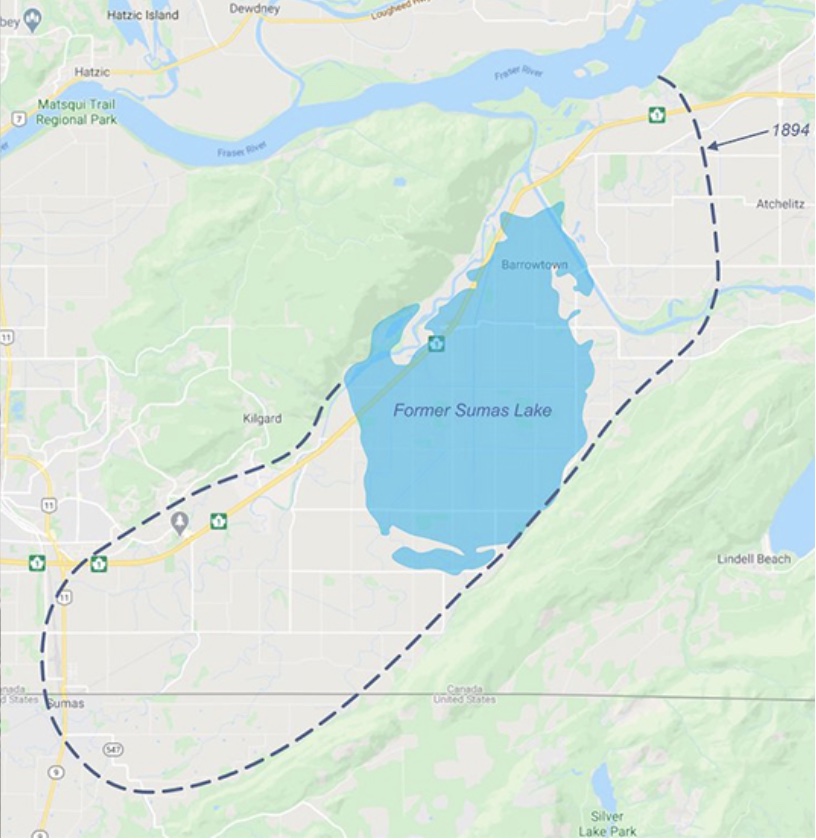
In November 2021, climate change ravaged parts of British Columbia in the form of an atmospheric river. Media coverage described the loss of life, stranded animals, heroic rescues, lost homes, and destroyed crops. Nestled deep in those articles was a fact that, for me, has become symbolic of the challenges facing society as climate change continues to rear its ugly head: the farmland of the Sumas Prairie used to be a lake.
Before the arrival of settlers, a freshwater lake existed between what is now known as Abbotsford and Chilliwack. This lake provided the Stό:lō First Nations with salmon, sturgeon, waterfowl, elk, deer, and more for thousands of years, and, in return, they stewarded the lake and wetlands (Archer). The lake and surrounding wetlands served as natural flood control, expanding during times of excessive rain and preventing flooding in other regions (Olsen, 2021).
But with colonialism came the belief humans have dominion over the land, and settlers prioritized the economic potential of the nutrient-rich lake bed over the ecosystem services it provided (Archer, n.d.). The only voice on record to oppose this destruction was Sumas Chief Ned, who said, “I am against the dyking because that will mean more starvation for us.” (Archer, n.d.). The government of the day ignored him, and in the 1920s, Sumas Lake became Sumas Prairie.
The Sumas Prairie is one of Canada’s most treasured farmlands, with total gross revenue of $635,000,000 in 2010. Crops range from corn and hay to milk and eggs to blueberries and raspberries. In 2011 there were 1282 farms and over 7000 people employed (City of Abbotsford, 2022). But climate change does not understand the value of a crop or employment statistics, so the atmospheric river did not stop at the property line of a farm. When the water crossed the system of dykes, the long-forgotten lake began to emerge. Water always finds its own level.
Adapting to climate impacts like the 2021 atmospheric river can come in three forms: resistance, incremental, and transformative adjustments (Pelling, 2015). Resistance adjustments, also known as coping (Fedele et al, 2019), repair the damage but do little to lessen exposure or vulnerability. Because the farmers live in what used to be a lake, they are not eligible for insurance (MacDonald, 2022), so the costs to repair the damage, set at 228 million, are being paid for by federal and provincial governments (Weisgarber & Gill, 2022).
Incremental adaptation strategies maintain the same social and ecological systems but reduce exposure and /or vulnerability (Pelling, 2015). To reduce vulnerability in the Sumas Prairie, the community of Abbotsford is considering four incremental options ranging in cost from 2.1 million – 2.8 billion for new pumping stations, new dykes, or both (Chan, 2022).
However, what is not under consideration is the transformative change that would result in natural flood protection and less flood damage. Transformative adaptation means changing the underlying causes of climate change, including the “social, cultural, economic, environmental, and power relations,” to radically reshape our social systems and relationship with nature Fedele et al., 2019, p. 116). In this case, farmers would be relocated, dykes removed, pumping stations turned off, and the Sumas lake would be allowed to return in all her glory and serve as a natural flood control system.
Why is this option not on the table? In short, current decision-making systems reinforce colonial social and ecological power relationships, making transformative change hard to enact.
Cost Benefit Analyses (CBA) inform adaptation strategies and other climate-related decisions by translating impacts into monetary costs and benefits to determine which options are in the best interest. While the CBA approach strives to address more than just transactional costs by including human wellbeing, the loss of an ecosystem service, such as natural flood control, cannot be replaced with money (Choy, 2018). In other words, compensation does not replace the destroyed service if a CBA finds a more significant benefit from draining Sumas Lake. Based on economic self-interest, the CBA approach fails to adequately recognize some of the ecosystem services we need to adapt to climate change (Choy, 2018).
The constraints of the CBA framework could calculate that incremental adaptation options are economically beneficial while transformative adaptation is too expensive. Developing a more pluralistic analysis that allows for other values, such as ecosystem services, to be factored into the analysis in a non-monetary way could make the transformative option viable (Choy, 2018).
Political risk is also a barrier. Transformative change is often socially disruptive, with high human and financial costs and benefits that might not be realized for a long time (Fedele et al., 2019). Politicians and political parties are in the business of getting reelected. Disruptive change, while providing long-term benefits, could result in short-term electoral risk, which politicians, by nature, avoid. Consequently, incremental adaptation or business as usual becomes the default pathway (Fedele et al., 2019).
Facilitating multidisciplinary fora that include practitioners, local leaders, policymakers, academics, etc., to build a consensus on transformative adaptation strategies could go a long way to building social acceptance. It is necessary to create places within these fora and all levels of government that welcome conversations that challenge the status quo and its power dynamics (Fedele et al., 2019), which for the most part, is colonial power.
Transformative change is needed to restore Sumas Lake. It is also required to keep global temperature change to 1.5°C, adapt to climate impacts, and fix the underlying systemic issues that leave so many people vulnerable. Until we consider transformative adaptation, we will remain locked into the socio-ecological systems that created the problem in the first place (Pelling, 2015). We need to let go of decision-making systems based solely on the western worldview and adopt an approach that enables us to value a reciprocal relationship with nature.
Until then, Sumas lake will continue to haunt us.
References
Archer, J. (n.d.), Sumas Lake. Vancouver Traces. Retrieved June 1, 2022 from https://vancouvertraces.weebly.com/sumas-lake.html
Chan, K. (2021, November 18). What is Sumas Lake? 100 years ago, Abbotsford had a 134 sq km lake (PHOTOS). Daily Hive. Retrieved June 10, 2022, from https://dailyhive.com/vancouver/sumas-lake-sumas-prairie-barrowtown-pump-station-abbotsford-flooding
Chan, K. (2022, April 11). Abbotsford’s flood prevention upgrades for Sumas Prairie could cost up to $2.8 billion. Daily Hive. Retrieved June 5, 2022, from https://dailyhive.com/vancouver/abbotsford-flood-prevention-sumas-prairie-lake-options
Choy, Y. K. (2018). Cost-benefit Analysis, Values, Wellbeing and Ethics: An Indigenous Worldview Analysis. Ecological Economics, 145, 1–9. https://doi.org/10.1016/j.ecolecon.2017.08.005
City of Abbotsford. (2022). Agriculture. Retrieved June 5, 2022, from https://www.abbotsford.ca/business-development/agriculture
Fedele, G., Donatti, C. I., Harvey, C. A., Hannah, L., & Hole, D. G. (2019). Transformative adaptation to climate change for sustainable social-ecological systems. Environmental Science and Policy, 101, 116–125.
Pelling, M., O’BrienO’Brien, K., & Matyas, D. (2015). Adaptation and transformation. Climatic Change, 133. 113- 127.
Macdonald, N. (2022, February 5). B.C. ranchers who suffered catastrophic flood damage desperate for help. The Globe and Mail. Retrieved June 8, 2022, from https://www.theglobeandmail.com/canada/british-columbia/article-bc-ranchers-who-suffered-catastrophic-flood-damage-desperate-for-help/
Olsen, T., & Kennedy, G. (2021, December 10). Abbotsford’s flood crisis could revive Sumas Lake. Fraser Valley Current. Retrieved June 8, 2022, from https://fvcurrent.com/article/sumas-lake-flooding-history/
Weisgarber, M., & Gill, M. (2022, February 8). B.C. floods: $228M announced in agriculture recovery efforts, officials say. CTV News. Retrieved June 8, 2022, from https://bc.ctvnews.ca/b-c-floods-228m-announced-in-agriculture-recovery-efforts-officials-say-1.577097
Lessons From a Bygone Lake Read More »