
My first audience was the Aylmer Town Council and their Environmental Committee. For this second iteration, I wanted to address the citizens of Aylmer. In developing content for this new audience, I began by researching demographic information about Aylmer. A large portion of the population (61.51%) are ages 15-64, (aylmer.ca). Within this group, a majority of citizens work in the manufacturing industry, and the most common occupations are in trades and transport (aylmer). A majority of people working in Aylmer hold no educational certificate (2045 individuals), or a High School diploma (1790).
My target audience for this new iteration is within this group of citizens, and could range from dismissive to alarmed in regards to climate change. My original audience were presumably alarmed, as the Town Council and Environmental Committee already have public-facing information about their climate mitigation efforts. Looking to the work of Hine et al, I will be using communication tactics for this new audience which will have a positive impact on audiences who are alarmed, uncommitted or dismissive. This means I won’t reference climate change directly (as it is detrimental to those who are dismissive), and will focus on adaptation advice, negative emotive content and local impacts (Hine, 2016, p.8). In regards to the format of the communication piece, the poster could be distributed to work places and hung in break rooms, bathroom stalls and on bulletin boards. It could also be placed on windshields and mailboxes, meeting this audience where they are.
A key communication tactic I am utilizing within this new iteration is narrative. As explained by Sundin et al, narratives can help to give context to information, generate more attention and “give evidence meaning, motivate and engage audiences and give relevance to their realities” (Sundin et al, 2018, p.2). I found three recent articles from the Aylmer area which highlight the voices of local citizens sharing stories about extreme weather events. These range from farmers speaking about the impact on their crops, extreme rainfall and a cyclist reflecting on high winds occurring earlier in the year. In the article entitled, “Using Narrative Communication as a Tool for Health Behavior Change: A Conceptual, Theoretical, and Empirical Overview”, Hinyard et al discuss the impact which narratives can have, noting that audiences may view narratives as “more personal, realistic, believable, and memorable than non narrative forms of communication” (Hinyard, 2007, p.785). I was intentional in choosing local voices to feature within the poster in order to emphasize the immediacy of climate change to the town of Aylmer. Furthermore, when audiences “connect to characters in the narrative, these characters may have greater influence on the audience members’ attitudes and beliefs” (Hinyard, 2007, p.785), therefore I was careful to choose Aylmer community members who also expressed the length of time they’ve lived in the area, hoping to create an opportunity for audiences to connect to the narratives and even trust them. As explored by Armstrong et al, audiences “tend to trust messengers who hold views similar to their own. Such messengers can pass on climate change messages that ‘speak directly’ to their peers by serving as “connective communication tissue, apprising peers about what is important” (Armstrong et al, 2018, p. 75).
Although the amount of data/science communicated within the poster is minimal, the narratives provided will also be effective in making the information relatable, as story has the ability to make complex scientific data easier to understand (Sundin et al, 2018, p.5). Information about rates of warming are complemented by citizens of Aylmer sharing stories of global warming impacts which they are already witnessing, and expressing the challenges which those impacts are having on their livelihoods.
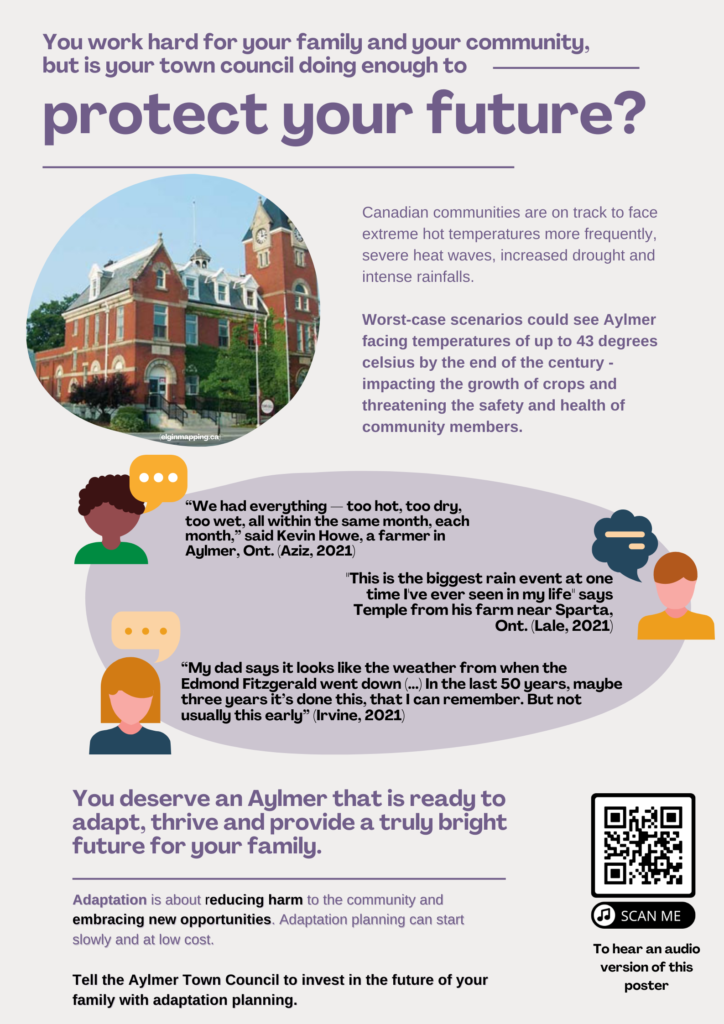
In regards to accessibility, I’ve written the poster following guidelines around accessible language, breaking up long passages into short sections visually, being brief and avoiding the use of jargon (Rallo et al, 2019, p. 13). Accompanying this poster is a radio spot which could reach audiences who are blind or have diminished eyesight. I’ve also included a QR code on the poster should anyone who has diminished eyesight or have conditions which affect their ability to process written information want another option for accessing the poster’s information.
Works Cited
Aylmer. (2021, August 25). Retrieved November 2, 2021, from https://aylmer.ca/.
Armstrong, A. K., Schuldt, J. P., & Krasny, M. E. (2018). Using metaphor and analogy in climate change communication. In Communicating climate change: A guide for educators. Cornell University Press.
Aziz, S. (2021, October 10). Pumpkin problems: ‘challenging year’ for some farmers amid extreme weather – national. Global News. Retrieved November 5, 2021, from https://globalnews.ca/news/8256473/pumpkin-season-canada-2021/.
Bush, E., Gillett, N., Bonsal, B., Cohen, S., Derksen, C., Flato, G., Greenan, B., Shepherd, M., & Zhang, X. (2019). Executive summary. Government of Canada.
climatedata.ca. (n.d.). Aylmer, ON. Location – Aylmer, ON – Climate Data Canada. Retrieved October 29, 2021, from https://climatedata.ca/explore/location/?loc=FAEIY&location-select-temperature=tx_max&location-select-precipitation=rx1day&location-select-other=frost_days.
Hinyard, L. J., & Kreuter, M. W. (2007). Using narrative communication as a tool for health behavior change: a conceptual, theoretical, and empirical overview. Health Education & Behavior, 34(5), 777-792.
Hine, D.W. et al. (2016). Preaching to different choirs: How to motivate dismissive, uncommitted, and alarmed audiences to adapt to climate change? Global Environmental Change 36, 1-11. doi: 10.1016/j.gloenvcha.2015.11.002
Irvine, S. (2021, September 27). Lake Erie storms coming too often and too soon: Expert. London. Retrieved November 10, 2021, from https://london.ctvnews.ca/lake-erie-storms-coming-too-often-and-too-soon-expert-1.5602074.
Lale, B. (2021, June 26). ‘biggest rain event I’ve ever seen’: Cleanup underway after massive 24-hour rain in Southwestern Ontario. London. Retrieved November 12, 2021, from https://london.ctvnews.ca/biggest-rain-event-i-ve-ever-seen-cleanup-underway- after-massive-24-hour-rain-in-southwestern-ontario-1.5486916.
Rallo, A., Forest, E., Kuo, J., Boutilier, R., and Li, E. (2019). Access Ability 2: A practical handbook on accessible graphic design. Revised + Supersized Second Edition. The Association of Registered Graphic Designers.
Sundin, A. Andersson, K., & Watt, R. (2018). Rethinking communication: integrating storytelling for increasing stakeholder engagement in environmental evidence synthesis. Environmental Evidence 7(6), 1-6.
November 15, 2021
Laura, this is so great! I love the radio spot, and the poster is really on-point too. I saw your version to the town council for Assignment 3, so I can say that the iteration was very successful.
November 15, 2021
Thank you so much Leah!
November 15, 2021
This is great Laura!