
A continuation of Alex’s Story about housing inequality in Whistler and how ongoing policy negatively impacts the local environment.
Whilst local business owners were my target audience for the initial story this time it is the youth of Whistler. In this case I consider youth to be those in and around the ages of 16 to 25. With this group as my target audience, I must consider youth in Whistler, their development of political opinion and why youth tend not to vote.
Whistler is a young community, according to the Resort Municipality of Whistler (RMOW) (2018) in discussions on youth it states how “Whistler has a higher than average proportion of young people. Over 25 per cent of permanent residents are under the age of 25.” This presents a sizeable segment of the local population to appeal to as those aged 18 and up can legally vote providing they are Canadian citizens. Consequently, there is potential to influence those who can vote, and those who shall be eligible in the coming years. Speaking of influence, this is a rather good time to hold political discussions with youth.
This time in a young adult’s development is one of developing opinions on society and the world around them. Damon et al. as cited in McDevitt& Kiousis (2014) states this “as the period in the lifespan when people first begin to dedicate themselves to systems of belief that reflect compelling purposes.” In addition, in his article on youth and their relationship with politics, Powless (2013) argues how youth are increasingly selective in the media they chose to engage with and are greatly connected online via social media and independent media. In this case youth are choosing to follow those who they most associate with and are thus developing their own opinions on what they want from their lives and future. But despite this development of opinion this demographic tends not to get involved in the electoral process here in Canada.
Youth are often a demographic that do not vote. According to Elections Canada (2020) the reasons why include lack of political representation, feeling like no one listens to their concerns and feeling intimidated as they struggle to understand the process. In response, Elections Canada recommends highlighting youth related issues such as, “jobs, education and future of youth.” The article continues to emphasise the need for greater focus on work placements, inclusion of young leaders in political discussions and greater education of the process at school and in the media. This is of great relevance to my audience therefore providing me with a great springboard in which to educate them on the electoral process and ability to vote for change.
Having analysed the youth demographic of Whistler, discussions around politics for this audience and the need for more education on the subject, I then considered my approach on social media.
Social Media as a Form of Communication
Social media has demonstrated how it is the best way to communicate with youth. According to The Youth Engagement Network (YEN) (2022) youth “aren’t just socializing online; they are researching and reaching out about important topics like personal health.” This means social media allows one to connect with young people on topics they care about such as their local community and environment. I will analyse this further and consider the use of Instagram as my preferred platform whilst looking at the benefits of images as a form of communication in addition to the accessibility it offers.
According to YEN (2022) a 2018 study found that “93% of youth aged 14-22 use social media.” That is perfect for my target audience but how many of them specifically use Instagram? Writing for social media management company Hootsuite, McLachlan (2022) has the answer as she finds 18–24-year old’s make up 30.1% of Instagram users. This demographic prefers Instagram over TikTok with the author remarking “If that’s an age cohort you’re looking to reach, Insta is apparently the place to be.” With Instagram then as my chosen platform, I will now consider the form of media I will post.
Instagram is primarily a visual based platform; therefore, I will consider the use of images, or in this case memes. Firstly, communicating via images is perfect for this demographic as according to Fletcher (2022) “Generation Z are voracious consumers of visual media.” In addition, she adds how too much text can turn them away, and one should focus on the “eye candy.” Secondly, just how strong are memes for communication? In discussions on the power of memes Denisova as cited in Way (2019) refers to them as “fast food communication” and “when used strategically they become mindbombs.” This refers to the ability to quickly consume a meme and how an idea may be planted in one’s mind leading to an emotional impact. This sounds perfect for my audience who want information and fast, but how can I accommodate accessibility to these Instagram posts?
Instagram allows for ALT text to support accessibility, so as I will be posting memes this allows me to not only attach a short written caption but also ALT text for the memes image. According to Penn State (2014), “ALT text allows authors to include images, but still provide the content in an alternative text-based format.” Therefore, when I use ALT text to describe an image, it allows a visually impaired individual to hear that description on a screen reader. When providing ALT text, Penn State also recommends the approach of describing an image as you would over the phone, keep it concise but one that is relevant to the content at hand. These benefits for accessibility, the strength of social media in reaching this audience, and memes as a relevant form of communication, will prove hugely beneficial for my Instagram posts.
Alex’s Wonderland on Instagram
I have developed four Instagram posts to encourage the youth of Whistler to participate in the electoral process. As for the content of these posts, the Change Story Roadmap by Withers (2022) provides guidance and structure in the same way it did for the father’s speech in the original story. These four posts will address the problem, vision, obstacles and solutions, and finally, anxiety and action.
As Alex outlines in her story, Whistler youth have an uncertain future due to current policies impacting the environment and housing. In discussions around youth and housing, Powless (2013) recognises how “More and more are forced to live with their parents for extended periods and must work unstable jobs unrelated to their chosen fields of study, as the “rising tide” of the economy fails to lift all boats.” In other words, the youth are upset with the current situation and have been for some time given this resource is nearly 10 years old.
Figure 1
The Problem
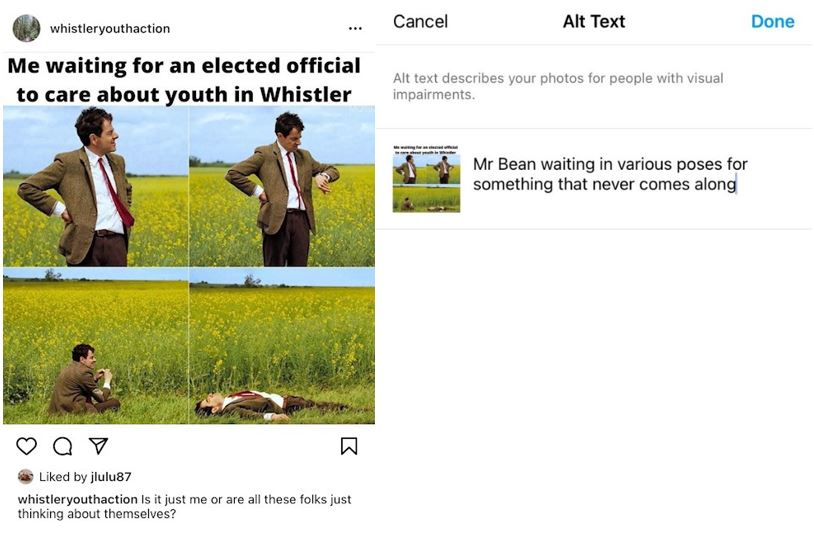
In Whistler where local policy allows for homes to be left empty this only adds fuel to the fire for disgruntled youth. Thus, I have portrayed their problem through the meme in Figure 1. This meme provides a way for youth to recognise their shared problem of elected officials not caring about the issues they face in Whistler. The recognition of this shared problem will then lead to discussions on building a vision or future achieved through collective action.
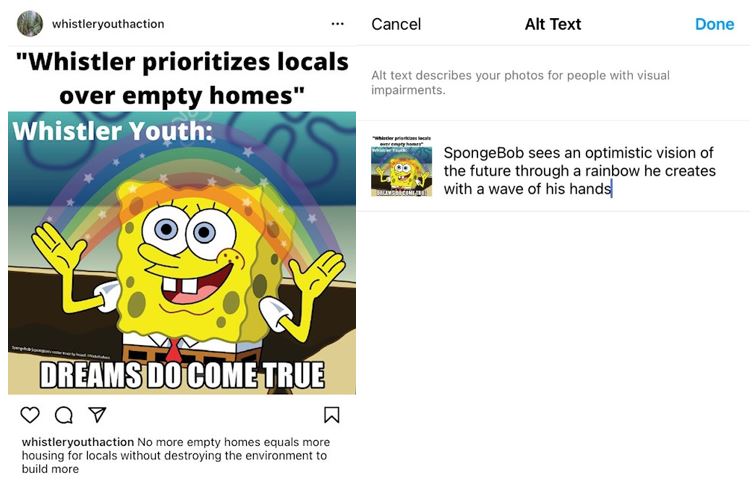
When discussing a vision of the future, Alex’s father outlines one of greater equality in the community where respect for one another and nature are central to future decision making. This vision is of a community that has access to affordable housing which ideally comes in the form of ones that are already built as opposed to those involving further clearing of land. As discussed in the original story, housing issues are forcing people to leave the community in search of better housing prospects. Therefore, the meme in Figure 2 provides youth with the motivation and realisation that a better future is possible. This provides an alternative narrative to one of uncertainty and shows how grasping the opportunity to change just one thing can contribute to a vision of a brighter future. Having developed a vision, it is now necessary to map the journey to making it possible, beginning with obstacles and solutions.
The Vision
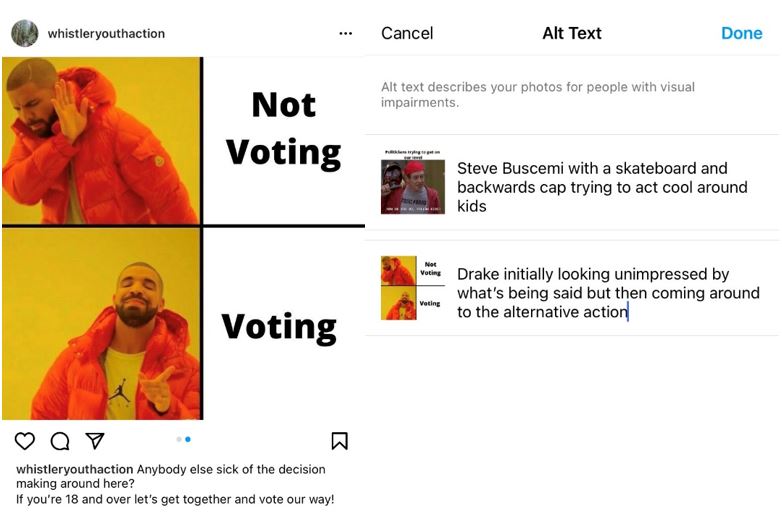
When acknowledging obstacles her father spoke of the community’s unwillingness to change along with the desire for short-term gains over long-term impacts. The obstacle in this case would be the disconnect between elected officials and a young voter. The solution as outlined in the father’s speech centered on better leadership and policy where the community and environment came first. These solutions impact a young person as they influence the fate of their community and natural environment. This Instagram post consists of two separate images as can be seen in Figure 3 and Figure 4. Figure 3 seeks to outline the disconnect between politicians and youth as was outlined above through the Elections Canada resource. Figure 4 declares how the solution lies with informing youth of their right to vote, and the power it holds in a community where they make up a sizeable segment of the population. Current policy favours those in the short term so it is natural that youth will feel a disconnect to the decision-making process on their future. Therefore, my solution for a demographic that is ironically so well connected to each other online is stimulating the conversation around the right to vote and developing one’s collective voice. Having overcome the obstacles and presented a solution, it is time to consider how to deliver this behaviour change.
Figure 3
The Obstacle
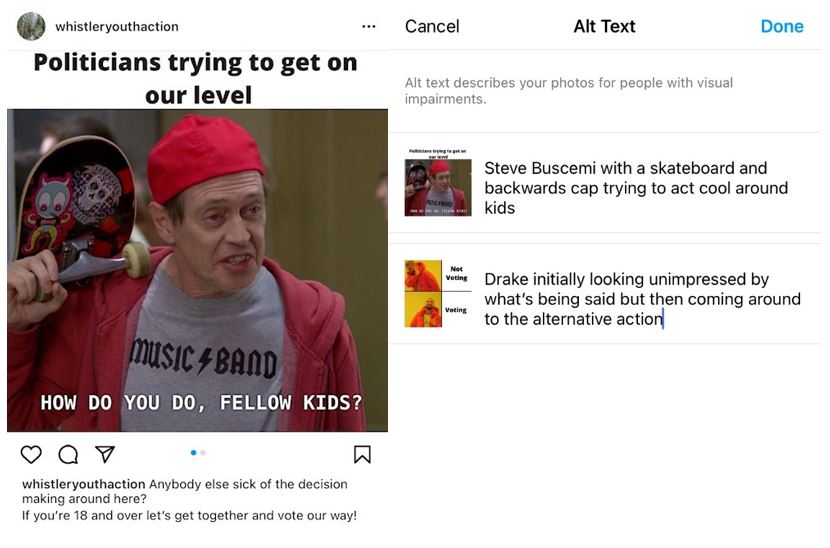
Figure 4
The Solution
For anxiety and vision, I created a post aiming to address both concerns. Alex’s father paints a picture of the town dying unless the business community intervenes. Thus, the same could be said here as unless youth intervene and take control of their destiny, politicians will continue to play up to the electorate who vote for them. For youth, the reality in this case may entail moving to a new community and leaving their friends and jobs behind as they or their parents move in search of more favourable living conditions. In delivering change Alex’s father encourages others to make this step together and vote, youth can vote too and must recognise the need to act now. Creating this urgency for action brings home the realization of the need to act through one simple step, finding one’s voice and voting for change. From identifying the problem and overcoming the solutions along the way, youth can fulfill their vision of a better future through action.
Figure 5
Anxiety and Action
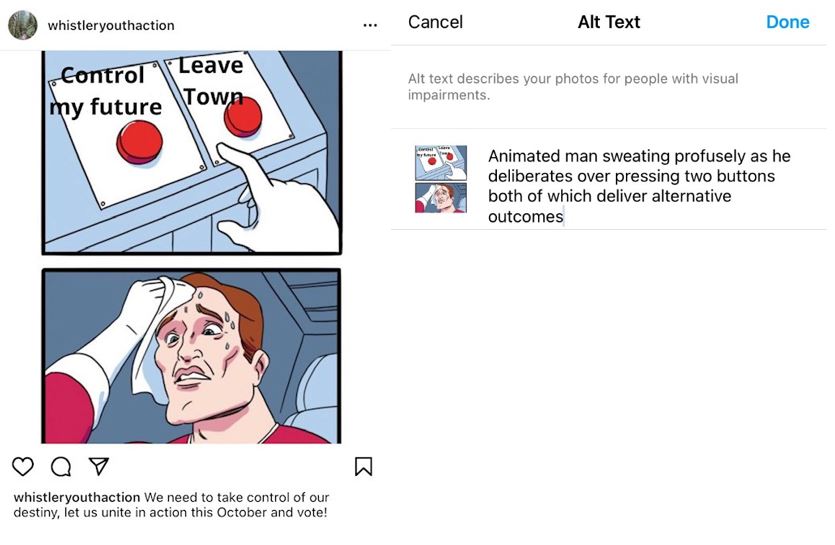
Whilst I did not dabble in hashtags or tagging other Instagram pages in my post, this would offer another option to attract more followers or eyes to my posts. In addition, the widespread use of these images as memes makes it tricky when attributing ownership of the original image. In this case I consider Cheng & Polataiko’s (2020) discussions on copyrights and memes who conclude that providing they do not lead to negative impacts for the original work and are not being used for commercial purposes then the issue of infringement is further avoided. Finally, as discussed above this demographic is selective with the media they interact with, I therefore hope these posts would not only appeal to them but are shared amongst friends leading to greater awareness of their collective voice and in doing so the ability to enact change.
References
Altinay, Z. (2017). Visual Communication of Climate Change: Local Framing and Place Attachment. Coastal Management, 45(4), 293–309. https://doi.org/10.1080/08920753.2017.1327344
Cheng, C., & Polataiko, M. (June 23, 2020). Copyright and memes: Drake effect, exceptions to infringement. Osler, Hoskin & Harcourt LLP. http://www.osler.com/en/resources/regulations/2020/copyright-and-memes-drake-effect-exceptions-to-infringement
Elections Canada (May 12, 2020). Explaining the Turnout Decline in Canadian Federal Elections: A New Survey of Non-voters. https://www.elections.ca/content.aspx?section=res&dir=rec/part/tud&document=youth&lang=e
Fletcher, C. (February 3, 2022). Using Social Media Marketing to Appeal to Younger Generations. Spiralytics. https://www.spiralytics.com/blog/using-social-media-marketing-to-appeal-to-younger-generations/
McDevitt, M., & Kiousis, S. (2014). Active Political Parenting: Youth Contributions During Election Campaigns. Social Science Quarterly, 96. https://doi.org/10.1111/ssqu.12127
McLachlan, S. (March 24, 2022) Instagram Demographics in 2022: Most Important User Stats for Marketers. Hootsuite Blog. https://blog.hootsuite.com/instagram-demographics/
Penn State. (October 6, 2014). Image ALT Text. Accessibility and Usability at Penn State. https://accessibility.psu.edu/images/alttext/
Powless, B. (February, 2013). Youth in Revolt. Canadian Dimension, 47(1), 17-19,4. https://www.proquest.com/magazines/youth-revolt/docview/1286680562/se-2
Resort Municipality of Whistler. (June 20,2018). Children, Youth, Young Adults and Seniors. https://www.whistler.ca/ocp/children-youth-and-seniors
Way, L., C. (2019). The importance of memes. European Journal of Communication, 34(5), 552–556. https://doi.org/10.1177/0267323119873742
Withers, D. (2022). Narrative Intelligence – Change Stories. Denise Withers. https://www.denisewithers.com/narrative-intelligence/ni-fundamentals/ni-process/ni-change-stories/
Youth Engagement Network (July 25, 2022). Engaging With Youth on Social Media—Youth Engagement Network. https://www.etr.org/yen/news/engaging-with-youth-on-social-media/