
Addressing climate change presents a complex challenge to society. This has been termed a “wicked problem” due to the challenge of identifying or defining the problems it presents, further hampering one’s ability to offer a clear solution (Murtugudde, 2019). So despite the growing literature on climate change continues, awareness among stakeholders and policymakers remains low. This continues to limit climate action as both mitigation and adaptation often remain overlooked in decision-making. Therefore, frameworks can assist in communicating the risks of climate change. In a report by Nichols (2023) titled “Cascading Climate Risks Are a Threat Latin America Must Take Seriously,” he demonstrates the advantages a framework has in factoring this wicked problem into decision-making.
Frameworks help to provide a structure for organizing and presenting information to aid understanding. According to Wallace (n.d), a framework should not waste the readers’ time with irrelevant information, but rather the minimum you need to make a good decision. For instance, in his article, Nichols (2023), discusses cascading climate risks as they are often overlooked in place of physical risks. As seen in Figure 1, he recognizes four physical risks of climate change before linking those to further cascading risks. Consequantly, what the author highlights here is in the importance of moving away from linearity in the decision-making process. This is a moving target we’re dealing with now and “experiences and heuristics of the past may no longer be a reliable guide to the future” (McKinsey Sustainability, 2020). Accordingly, the reader is now aware of the wider dangers of limiting their awareness of climate risks to just four areas of concern.
Figure 1: Simplified Flow of Cascading Climate Risks
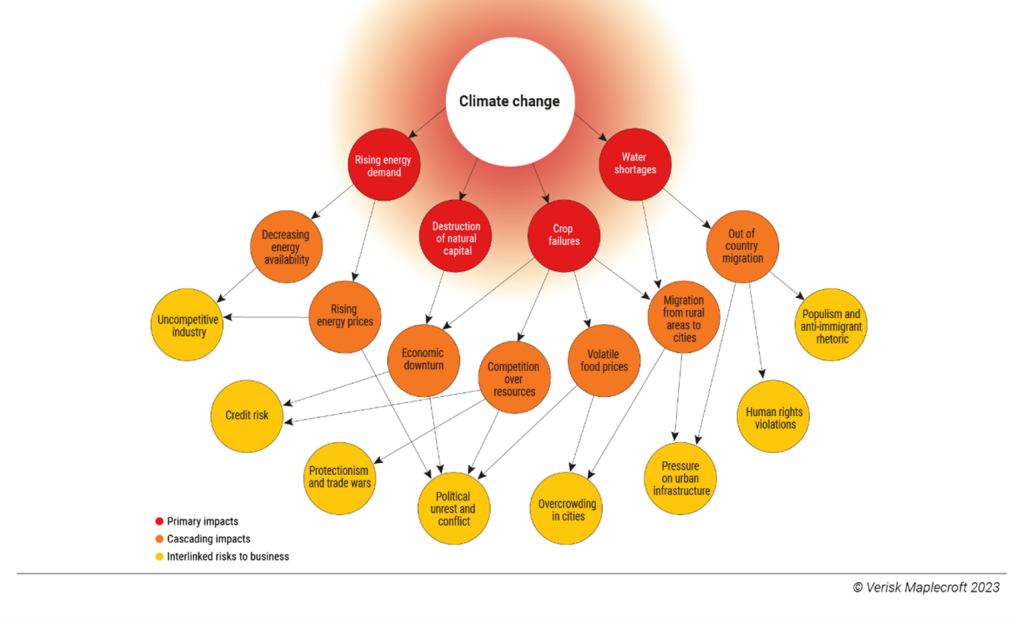
Note: Sourced from Nichols (2023)
Nichols (2023) supports Figure 1 further by emphasizing the importance of resilience in addressing and managing these risks. To do so he uses both imagery and an analogy to support his message, both of which are beneficial tools for climate communication (Schuldt et al, 2018 & O’Neill, 2020). This can be seen in Figure 2, where climate safeguards or a country’s forms of resiliency resemble a dam as they hold back climate risks. As resilience is the measure of a systems ability to maintain an acceptable level of function when exposed to hazards, having a “dam” in place minimizes the possibility of cascading risks. Unfortunately, many countries do not have the benefits of dams or resilience and are already experiencing the impacts of climate change. As someone who grew up in a country now plagued by corruption and deteriorating infrastructure, I understand the dangers of cascading risks such as populism and civil unrest.
Figure 2: Countries become more susceptible to cascading risks as safeguards crumble
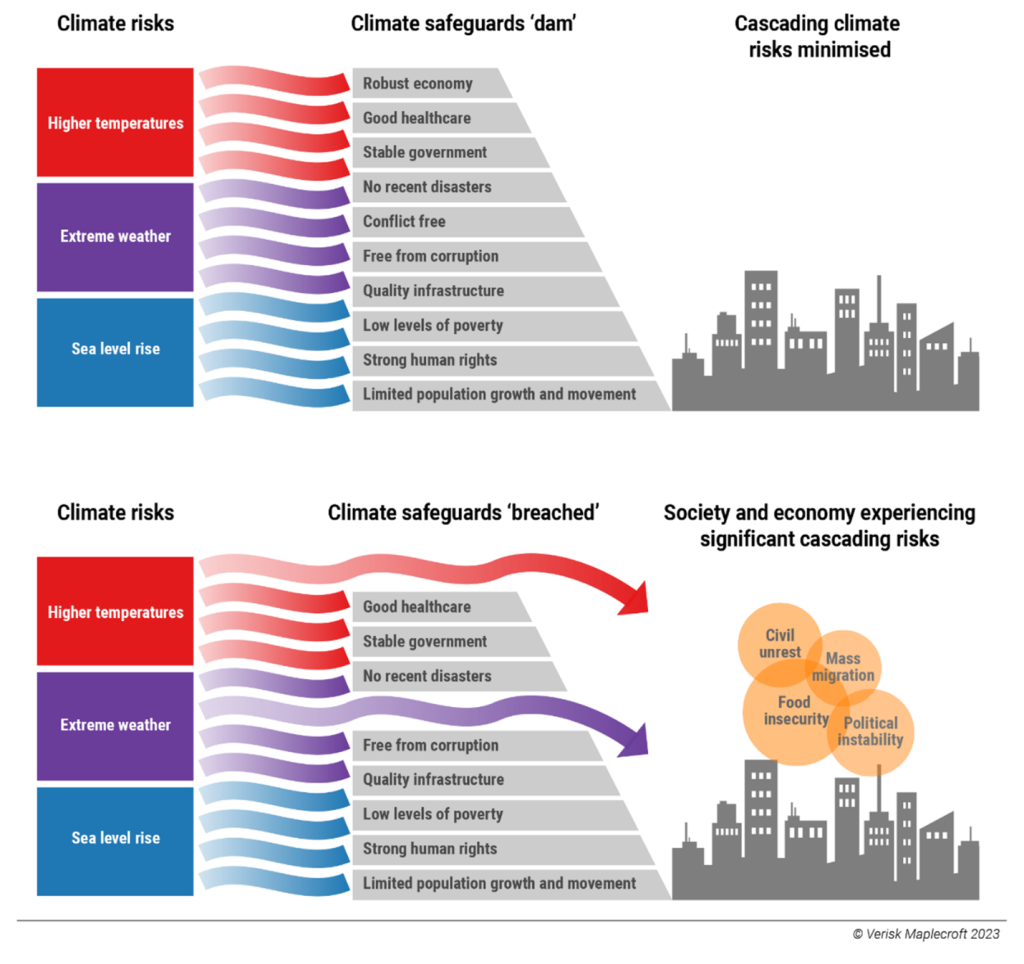
Note: Sourced from Nichols (2023)
I do my best to stay abreast of current affairs around the world, so I enjoyed this article Nichols (2023) as it informed me of the ongoing climate risks in Latin America. Indeed, what the author excels at here is his presentation of a serious topic in a simplified and easy-to-understand way. When discussing climate risks, we don’t need to litter our communication with buzzwords and technical jargon, there’s enough of that in scientific papers. And as a Climate Action Leader that’s what I recognize as one of my biggest challenges. How can I connect science to action? Unfortunately, it appears in many cases, these scientific papers don’t land on the desks of power brokers due to their length and complexity. It’s therefore necessary to produce reports such as Nicholls to identify the necessary indicators and paint an accurate picture of climate risk.
References
McKinsey Sustainability. (2020, May 15). Confronting Climate Risk. McKinsey Quarterly. http://ceros.mckinsey.com/authors-sidebar-climate-risk-desktop
Murtugudde, R. (2019, December 11). 10 Reasons Why Climate Change Is a “Wicked” Problem. The Wire. https://thewire.in/environment/climate-change-wicked-problem
Nichols, W. (2023, October 11). Cascading climate risks are a threat Latin America must take seriously. Verisk Maplecroft. https://www.maplecroft.com/capabilities/climate-and-environment/insights/cascading-climate-risks-are-a-threat-latin-america-must-take-seriously/
O’Neill, S. (2019). More than meets the eye: a longitudinal analysis of climate change imagery in the print media. Climatic Change, , 1-18. https://doi.org/10.1007/s10584-019-02504-8
Schuldt, J.P., Krasny, M.E., & Armstrong, A.K. (2018). Communicating Climate Change: A Guide for Educators. Ithaca: Cornell University Press., https://doi.org/10.1353/book.68536.
Wallace, M. (n.d.). What is a Framework? | Principle to Practice. Retrieved February 12, 2024, from https://www.principletopractice.org/from-principle-to-practice/what-is-a-framework/