
Did you know that our future climate will be defined by natural variability along with the influence of human activity? This activity is “determined primarily by current and future emissions of greenhouse gases and aerosols” (Government of Canada, n.d.).” Unfortunately though, according to Hausfather & Friedlingstein (2022), “global CO2 emissions from fossil fuels hit record high[s] in 2022.” That doesn’t sound promising does it? If only there was a way to get an idea of both our future climate and future concentrations of greenhouse gases. Well this is where scenarios come in to play as they are developed as plausible emissions pathways, but how can they help us, what are the pathways, and what do you need to watch out for?
Figure 1
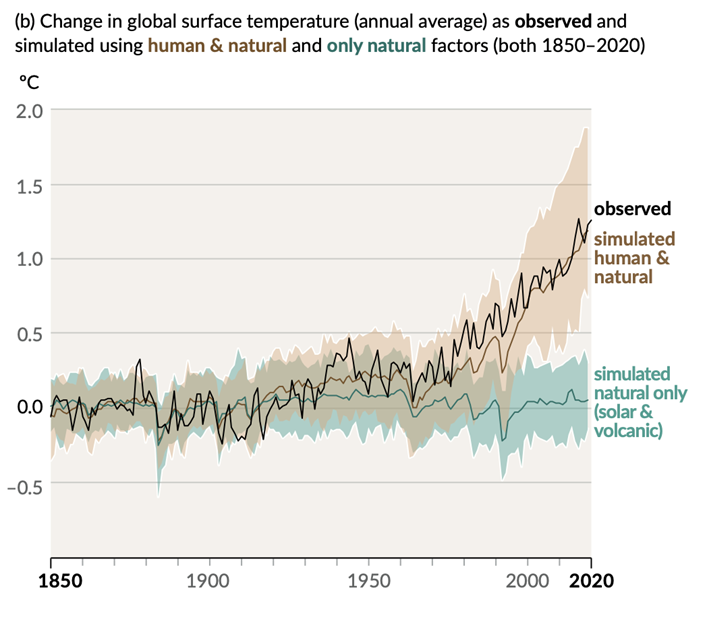
Changes in Global Surface Temperature relative to 1850-1900
Note: Retrieved from IPCC, 2021, p. 6.
Scenarios help to communicate and narrate the influence human activity has on global warming. According to the IPCC (2021) “it is unequivocal that human influence has warmed the atmosphere, ocean and land” (p. 4). This can be seen in Figure 1 which clearly indicates the influence human activity, primarily in the form of carbon dioxide emissions, has on the warming of the planet when compared to only natural factors. In fact, according to the IPCC (2021) “in 2019, atmospheric CO2 concentrations were higher than at any time in at least 2 million years” (p. 8). So, as the concentration of carbon dioxide and other greenhouse gases (GHG) increase in the atmosphere, this leads to increasing levels of radiative forcing that continue to warm the planet. Radiative forcing “describes the amount of excess energy trapped within the Earth’s climate system due to the variation of a climate change factor such as GHG concentrations” (Climate Data Canada, n.d.). Thus, as we can establish the link between global warming and human activity, the development of emissions pathways or scenarios helps project our future climate, but what do they look like?
Figure 2
The Five Shared Socio-Economic Pathways

Note: Retrieved from Climate Data Canada, n.d.
In recent years researchers have developed and used two forms of scenarios, namely Representative Concentration Pathways (RCP’s), and as shown in Figure 2, Shared Socio-Economic Pathways (SSP’s). RCP’s were used in the IPCC Fifth Assessment Report in 2014 and provide us with scenarios as they consider radiative forcing over time and what our world may look like in terms of global temperature. In other words, RCP’s provide sample pathways of radiative forcing relative to the concentration of GHG’s which aid in understanding climate impacts at its various levels of warming. This contrasts with SSP’s as they “make assumptions of how population, education, energy use, technology – and more – may change over the next century and couple them with assumptions about the level of ambition for mitigating climate change.” Climate Data Canada (n.d.). According to Hausfather (2018), “the two efforts were designed to be complementary.” Therefore, the SSP’s compliment the RCP’s to give us a better idea of future pathways for GHG emissions and how the world may or may not achieve emissions reductions. However, as informative as the scenarios are, they are still plausible, and one must exercise a degree of caution in using them.
Despite the advantages of both RCP’s and SSP’s in producing scenarios for the future, there are some aspects worth considering. Most notably these are plausible pathways and are not entirely set in stone with the biggest variable, in my opinion, being predicting human behaviour. Furthermore, “the complex nature of the climate system, climate models, and human factors makes it challenging to determine exactly how the climate will change” (Climate Data Canada, n.d.). However, in saying that, there are outcomes that are certain to play out regardless of what pathway society takes into future. Examples of these include impacts on our oceans as “past GHG emissions since 1750 have committed the global ocean to future warming” (p. 21) and “it is virtually certain that global mean sea level will continue to rise over the 21st century” (IPCC, 2021, p. 21). The simple reality is, the world is hotter today with “a best estimate of 1.07°C” (IPCC, 2021, p. 5) of global surface temperature increase since 1850-1900. Thus, scenarios may narrate the future, but we need to deal with the relative impacts now and not get drawn into believing this is a just a future issue.
Overall, in the past, climate science has struggled to communicate global warming and the urgency to act. However, scenarios now benefit discussions on the relationship between human activity and its impacts on global warming. But while they may provide a plausible pathway, the biggest variable is you and I, just what exactly are we going to do? Whether we take SSP1 or completely fail and take SSP5, the reality is our climate is changing today and we need to prepare for that too.
References
Climate Data Canada. (n.d.). Understanding Shared Socio-economic Pathways (SSPs)—Climate Data Canada. Retrieved November 26, 2022, from https://climatedata.ca/resource/understanding-shared-socio-economic-pathways-ssps/
Government of Canada. (n.d.). Forcing scenarios. Retrieved November 23, 2022, from https://climate-scenarios.canada.ca/?page=forcing-scenarios
Hausfather, Z. (2018, April 19). Explainer: How ‘Shared Socioeconomic Pathways’ explore future climate change. Carbon Brief. https://www.carbonbrief.org/explainer-how-shared-socioeconomic-pathways-explore-future-climate-change/
Hausfather, Z., & Friedlingstein, P. (2022, November 11). Analysis: Global CO2 emissions from fossil fuels hit record high in 2022. Carbon Brief. https://www.carbonbrief.org/analysis-global-co2-emissions-from-fossil-fuels-hit-record-high-in-2022/
IPCC. (2014). Climate Change 2014: Synthesis Report. Contribution of Working Groups I, II and III to the Fifth Assessment Report of the Intergovernmental Panel on Climate Change [Core Writing Team, R.K. Pachauri and L.A. Meyer (eds.)]. IPCC, Geneva, Switzerland, 151 pp. https://www.ipcc.ch/report/ar5/syr/
IPCC. (2021). Summary for policymakers. In V. Masson-Delmotte, P. Zhai, A. Pirani, S. L. Connors, C. Péan, S. Berger, N. Caud, Y. Chen, L. Goldfarb, M. I. Gomis, M. Huang, K. Leitzell, E. Lonnoy, J. B. R. Matthews, T. K. Maycock, T. Waterfield, O. Yelekçi, R. Yu, and B. Zhou (Eds.), Climate change 2021: The physical science Basis. Contribution of Working Group I to the sixth assessment report of the Intergovernmental Panel on Climate Change, (pp. 1−32). Cambridge University Press. https://www.ipcc.ch/report/ar6/wg1/
Thanks Niall,
I agree, the SSPs are an important step forward in communicating the scientific realities so that people can start to envision what the world might be like in the future and then help to make that vision a reality.
I think it’s a step forward in moving the conversation beyond the weather to the socio-economic impacts and hard choices that need to be made and that are already being made.
The reminder that the world is feeling the impacts already and that a certain level of warming has already been locked in is an important part of the conversation. We all need to be considering the complexities that come with adapting for what’s already happening and is locked in, while at the same time, be practicing constructive hope and mitigating for the best possible future.
Thank you for an informative post – Julie