 I have this recurring dinner party fantasy, like my own private symposium, where I invite cool folks to my house to eat spaghetti. Near the top of my guest list, just under Martha Nussbaum, but before Kim Deal (bass player of the pixies) is American academic and game designer Ian Bogost. We could hang. We’d be buds.
At a Game Developers conference in 2011 Bogost gave a brilliant lecture entitled “Shit Crayons“. Bogost’s metaphor, as iconoclastic as it is beautiful, speaks to the poetry created by Nigerian political detainee,  Wole Soyinka while in solitary confinement. Restricted and oppressed, yet driven to write and create with any medium available, sometimes faeces, Soyinka wrote touching poetry. And this is us, Bogost says, resilient creatures of amazing potential, wit and creativity, trapped in the narrow constrained world of social gaming, “spinning shit into gold”. Bogost, as a new hero in a new world of digital ideas, is the perfect addition to my tri-partite party.
I imagine that over spaghetti that Ian tells us about how gamification can instil empathy through modelling, role playing, and world-building, that game play affords new opportunities to connect and create  experience – to educate and enlighten. Kim will nod – she grooves on Bogost because he is a culture-jammer who lives to disrupt and doesn’t mind if she smokes at the table.
 But Martha Nussbaum won’t swallow the typical platitudes, “empathy created through imagination, cultural representation, and its relation to social justice, is not a new idea – not a ‘digital’ product of secondary orality – but an old enlightenment idea presented by Adam Smith in his Theory of Moral Sentiments and by me in Poetic Justice. Aren’t we taking literate ideas into a more limiting digital space. You sure you are not championing another ‘shit crayon’?”, she jibes, “Or worse a modern version of bread and circuses?”.
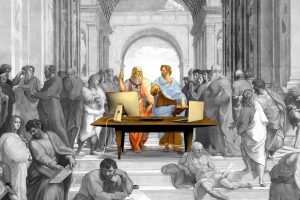 “Sounds like the ancient battle between the Poet and Philosopher all over again” interjects Stacey, eager to impress Martha, “Plato banned the poets from his Republic because they led us farther from the truth – with attractive lies and trickery. Perhaps games are something similar – a nouveaux form of unbridled sophistry and rhetoric?
 “Nope, but yes”, says Bogost leaning back from the table with an ironical grin, “I’m saying that Video gaming is a new kind of rhetoric – procedural rhetoric. Bogost quotes his text: “Video games do not simply distract or entertain with empty, meaningless content. Rather, video games can make claims about the world. But when they do, they do it not with oral speech, nor in writing, nor even with images. Rather, video games make argument with processes. Procedural rhetoric is the practice of effective persuasion and expression using processes”, (p. 125). “Like the technologies of the literate age – and the poets Plato was so suspicious of – we make of it what we will”.
Stacey sits back, dim lights slowly coming on, “sooo – we are exposing procedures through the creation of algorithms – of breaking our world, our actions, into tiny fundamental steps – and communicating and representing our lives – painting/writing with this medium. Digital gaming, is in fact, something new – a new form of expression then ..” She starts to put the pieces together. “We are just having the same ancient arguments about a new technology – commodification, ethics, and social responsibility …”
“We’re out of beer” says Kim, as she puts the Ramones on the stereo.
Stacey leans back in her chair, listening to Ian present his intriguing notions of Play and Fun, describing possibilities for the elevation of human interaction through gaming and on-line technologies. Martha verbally thrusts and parries, pointing to the increased brutality of discourse on-line. She bristles at Bogost’s easy deflections, pointing to sexual objectification and outright pornography, making him pause to consider her notions of the fragility of goodness and the true nature of pleasure.
Ultimately, in the heat of the discussion and the smash of opinion, Stacey realizes that these unlikely houseguests have much in common – they both focus deliberate critique on ideas and cultural conceptions, in hopes that, as Bogost says “they blush and give up their secrets”.
As everyone knows. A good party is about inviting the right people.
 The
The  Some argue that clicking on a social cause can be more of an escape, a mirage of political engagement, which creates a placebo effect that inoculates us from further activism. They call it
 If Marshall
 However, it is interesting that the Chauvet caves were never inhabited – there was no midden, no sign of regular use, and can be interpreted as a sacred site :