Digital communication technologies have changed the nature of the “audience” from a static viewer to an engaged participant who is able to both consume and produce on-line content. The possibilities for counter publics, as places for black twitter, feminist art, or transvestite communities are inteiguing. Marginalized voices are able to engage on the web, reach each other, and claim space. However, these changing tools and levels of engagement have not eradicated hegemonic discourse or built a more liberating public sphere. Campbell (2015) speaks of the way these counter publics and hashtag communities become co-opted when over shared and popularized; lingo and nomenclature are often altered and debased. He demonstrates this by describing the concept of “realness” and the way it loses its original referent or import when it moves into the manistream through the popularity of the television show Rupaul’s Drag Race. Campbell (2015) tells us “#realness, [is] a term that has become so ubiquitous as to be only tenuously connected to its source” (p. 164). But these concerns of homogenization and watered down appropriations have to be viewed in context of what we stand to gain as well as what is lost. Santoro’s (2015) description of the #RaiderNation hashtag public as “arguably the most expansive and accommodating canopy under which superdiverse groups can come together in mutual recognition and on equal footing” ( p.191). Santoro (2015) points to how these digital tools and publics have the ability to self-realize, resist hegemonic values, and “neo-liberal regimes” , but he also points to the fact that these “discrete spaces” have been “created and marked out for us” (p. 199). I am still left with this overarching question about power and the limits of our ability to take these digital spaces.
The actual structure of the net – the algorithms and search engines, issues of net neutrality, the platforms that enable these communications, are not completely free from manipulation and control. Moreover, the proliferation of ‘fake news’ and ‘click bait’ may be the irritating consequences of unvetted and free sources, but I feel the solution may be worse than the problem. Shirky (2010) proposes some interesting ideas around cognitive surplus and out ability to use human generosity for public good, and I think many of us want to be more active forces for a more liberating net.
In reaction to recent Facebook algorithm changes, many of my friends have been advocating a new way of collecting and documenting information sources. This recent post from the Tyee –Better Facebook-Smart Friends – is a prime example. Rupp advocates getting “around the latest algorithm tyranny simply by choosing to pay more attention to people who post high-quality articles”. She feels that although communicative capitalism, the way it panders to dominant socio-political opinions in order to sell advertising, has destroyed “ol’timey newspapers” which provided a variety of opinion and championed notions of objective reporting, we have the opportunity to capitalize on something very surprisingly like Shirky’s idea of cognitive surplus. Shirkey argues we can use our human generosity to share information and contribute to a more rational public sphere. However is this enough to rescue rational public debate? Is it possible that the ability to communicate on-line, is actively being censored and controlled?
A recent article on Global research, Thought police for the 21st century is much darker in tone and calls for us to stiffen our spines and mobilize – to reclaim, our personal and private spaces and chart new directions for the public sphere. Chris Hedges (2018) argues that Facebook’s new policies are more active and dangerous then we realize. He posits that the new Facebook security team composed of “10,000 [people] —7,500 of whom “assess potentially violating content”. He argues that social media companies are “intertwined with and often work for U.S. intelligence agencies” and that this “army of censors is our Thought Police”. He is very concerned with how this mediation of our access to information will become another form of state sponsored censorship “designed to prevent a distressed public from accessing the language and ideas needed to understand corporate oppression, imperialism and socialism”.
Although Hashtag Publics and Shirky point to much of the good digital communications offers and the benefits and possibilities of a highly communicative global village. Are we naive in thinking we are really able to tap human generosity and talent to benefit humanity? Or are we too lost in a system beyond out control? Have we, as Hedges (2015) states begun the “ominous march to an Orwellian world of Thought Police, “Newspeak” and “thought-crime” or, as Facebook likes to call it, “de-ranking” and “counterspeech.”
Campbell, A. (2015). Chapter 11. Rambukkana, N.(Ed.), Hashtag publics: The power and politics of discursive networks (pp. 155 – 167). New York: Peter Lang.
Santoro, A. (2015). Chapter 14. Rambukkana, N.(Ed.), Hashtag publics: The power and politics of discursive networks (pp. 189 – 201). New York: Peter Lang.
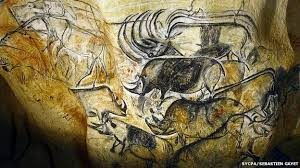
 However, it is interesting that the Chauvet caves were never inhabited – there was no midden, no sign of regular use, and can be interpreted as a sacred site :