To Die- Bolstering Learnings and Perspectives

The Master of Art in Climate Action Leadership (MACAL) virtual summit comprised of: talks, with a range of presenters on topics related to climate action; poster presentations by MACAL students, topics chosen by each student individually, sharing key learnings from the program; and a workshop series hosted in collaboration with Royal Roads University Resilience by Design (RbD) Lab and Solvable. The workshop series focused on Regenerar, a documentary investigating the relationships between colonial modernity and the climate emergency through the lenses of: To Die, To Dream, and To Live (Solvable, 2024).

Attending the summit in conjunction with one of my electives, ENVP 500: Developing a Sustainability Perspective, offered a different perspective into the first lens To Die. In the elective, we were exploring 1st, 2nd, and 3rd generation sustainable development: 1st generation being a top-down, outcome driven approach; 2nd generation focusing on public engagement, collaboration, and deliberation, working to understand the interconnections between social, economic, and ecological factors; while 3rd generation meaningfully responds to equity issues and addresses systemic issues of power and conflict (Robinson & Dale, 2012). When analyzing and assessing various organizations that are doing important and powerful work related to climate action, it was challenging to find an organization that truly fit into 3rd generation sustainable development. We learned that 3rd generation sustainable development was the way forward and highlighted that our current systems were often the factor holding back organizations in 2nd generation sustainable development, but how do we escape these systems? A poem shared by author Dani D’emilia titled Co-sensing with Radical Tenderness states that we must “interrupt addictions to consumption, not only of ‘stuff’ but also of knowledge, experiences, and relationships” (D’emilia, n.d.). Experiencing the To Die session allowed me to see how true transformation and 3rd generation sustainable development could happen, by exploring harmful beliefs, policies, laws, narratives and more, that need to die within individuals, organizations, communities, and structures. During an activity titled the Toxic Waste Collective Exhibit, participants were asking to gather photos that portrayed these harmful beliefs, policies, etc. that need to die and have toxic effects on our daily lives (Solvable, 2024). The exhibit was split into three galleries, one being Wolf in Sheep’s Clothing, flawed methods, approaches and protocols from the sustainability/regeneration/climate industry (Solvable, 2024). This exercise brought a whole new way of thinking to the teachings from ENVP 500, as we had been discussing how being less bad, either at an individual level or organizational level, is not enough. Various topics and themes highlighted in the Wolf in Sheep’s Clothing gallery related back to this concept that we have in many ways accepted choosing the less bad option. It’s almost as if the less bad option has become a way to clear our individual and collective conscience, when really it is just a wolf in sheep’s clothing.

My own work for the poster presentation centered around moving from a space of climate anxiety to climate action. The second day of the Regenerar workshop titled To Live, started with a collective rest, where all participants took five minutes to rest; blankets and pillows were encouraged. This related back to some key learnings and takeaways from my presentation, prioritizing rest in order to continue to move forward with important climate action work. The opportunity to collectively rest during a professional workshop showed a tangible example of how the death of toxic policies or norms is possible.

Overall, the MACAL summit housed powerful learning moments and provided opportunities to view course content, such as the generations of sustainable development from ENVP 500, or my own desktop research in climate anxiety to climate action, in different and more experiential ways. The idea of completely dismantling these harmful beliefs, policies, laws, narratives, structures, communities, etc. is daunting, but viewing the work through lenses such as, To Dream and To Live made me believe in the possibility.

References

D’emilia, D. (n.d.). Co-sensing with Radical Tenderness. Gesturing Towards Decolonial Futures. https://lapubli.online/RadicalTenderness.html

Solvable. (2024). Regenerar November 2024 Series: To Die. To Dream. To Live. Solvable- Notion. https://solvablehq.notion.site/regenerar-november-2024-series

Robinson, P., & Dale, A. (2012). Chapter 1: Generational responses: Why a third? In A. Dale, W.T. Dushenko & P. Robinson (Eds.), Urban sustainability: Reconnecting space and place (pp. 13-28). Toronto: University of Toronto Press.  

To Die- Bolstering Learnings and Perspectives Read More »

A Year In Review

As I started to write the final blog post for CALS 501 Leading Climate Action in Society, I looked back on my initial blog post at the start of the course and the program itself. The post centered around the concept of design thinking and all of the nuances we were learning about; however, after a year of the design thinking challenge, I think it is safe to say that the only way to really understand design thinking is to experience it. Our team went through many iterations, ideas, and concepts before arriving at the prototype that we presented last week. Each course provided us with a fresh perspective and new learnings to consider and incorporate into the design thinking challenge.

Starting the program, climate anxiety was an area of interest for me, partially because I was transitioning from working in mental health and I wanted to bridge the gap with my previous experience, and partially because I had experienced some level of climate anxiety myself. At the beginning of the design thinking challenge, addressing climate anxiety was low on the list of elements to incorporate into our idea. By the end of the challenge, we had created a prototype for an app called “Resilience” that addresses climate grief and anxiety for parents and youth by transforming anxiety into action through daily challenges.

The theory of change that we used to inform our thinking allowed me to view climate anxiety and grief in a whole new way. By engaging parents first as role models, we can mobilize youth to take climate action (Elsen & Ord, 2021). Inter-generational climate action can be taken once psychological, emotional, and social barriers have been addressed. (Ojala, 2012). The daily challenges provided by the app utilize therapeutic coping skills, decolonizing knowledge, place attachment, and collective action to foster psychological resilience, both on an individual level and community level.

Prior to this, I had never thought of decolonizing knowledge, place attachment, or inter-generational climate action as ways of coping with climate anxiety. Exploring the research that is being done in these areas provided hope for the future of collectively managing feelings of climate anxiety. There are many examples of how the various courses that we took throughout our first year informed our thinking for the design thinking challenge. One example that I will speak to specifically is the concept of place attachment. Place attachment is an emotional bond between a person and a place and is shown to have benefits for human health and pro-environmental behaviours (Junot et al., 2018). This is a concept that we learned and experienced in CALS 502 Communication for Climate Action. One of our assignments was to have a sit spot that we visited weekly to experience place attachment. This is just one example of a concept that we learned and experienced the power of, which resulted in our team including it in the prototype.

This first year and the design thinking challenge have allowed for major learning and growth. Connecting with my design thinking team and the whole cohort has been a fulfilling experience and I’m looking forward to continuing to connect and push the agenda on climate action with this group.

References

Elsen, F. & Ord, J., 2021). The Role of Adults in “Youth Led” Climate Groups: Enabling Empowerment. Frontiers in Political Science. DOI:10.3389/fpos.2021.641154 

Junot, A., Paquet, Y., & Fenouillet, F. (2018). Place attachment influence on human well-being and general pro-environmental behaviors. Journal of Theoretical Social Psychology, 2(2), 49–57. https://doi.org/10.1002/jts5.18 

Ojala, M. (2012). How do children cope with global climate change? coping strategies, engagement, and well-being. Journal of Environmental Psychology, 32(3), 225–233. https://doi.org/10.1016/j.jenvp.2012.02.004 

A Year In Review Read More »

Climate Change Risk Assessment Analysis

The North Shore Sea Level Rise Assessment & Adaptive Management Strategy focuses on the unceded lands of Coast Salish First Nations (North Shore of Metro Vancouver). Similarly to most coastal regions, sea level rise is a major concern for this area. This strategy is a collaborative process with the District of North Vancouver, District of West Vancouver, Sḵwx̱wú7mesh – Squamish Nation, City of North Vancouver, North Shore Emergency Management Office, and Vancouver Fraser Port Authority. The purpose of this climate risk assessment is to prepare for, manage, and appropriately respond to identified risks associated with sea level rise hazards across the North Shore. The importance of building resilience in all North Shore municipalities mentioned above, Sḵwx̱wú7mesh – Squamish Nation, and Port Authority is highlighted throughout the assessment (KWL, 2020).

This assessment uses a variety of approaches, starting with a bottom-up approach, which highlights and uses the skills and experiences of stakeholders and community members to develop the climate change risk assessment, rather than using a top-down approach which can be performed as a desktop study using data and literature rather than engaging with stakeholders to gather information from their experiences and expertise (CCME). Sea level rise has the potential to impact communities along the North Shore in a variety of different ways. In this climate risk assessment, a bottom-up approach was emphasized as extremely important due to the ability to build community awareness of sea level rise risks, foster informed community input, reflect community values in the approach, and ensure that the community is ready to move forward with additional stages of adaptation planning and implementation (KWL, 2020).

A qualitative risk assessment was conducted using coastal flood consequence assessment results from the following sectors: social services, environment, culture and heritage, buildings and infrastructure, economy, and transportation. A qualitative approach uses non-scientific data such as local knowledge, whereas a quantitative approach uses scientific data such as modelled climate projections. Qualitative approaches are typically easier for stakeholders to contribute and participate in, which is why it works well with this specific assessment that is heavily community based (CCME, 2021).

The approach is considered tightly scoped, as it focuses on a theme- sea level rise. Alternatively, a comprehensive approach would look at multiple climatic parameters or multiple thematic areas. In order for the assessment to be considered comprehensive, it would need to look at a larger number of flood scenarios across different sea level rise time horizons (CCME, 2021).

The approaches chosen for this climate change risk assessment related to sea level rise accomplishes what the authors and contributors set out to accomplish. A bottom-up, qualitative, tightly scoped approach offers a greater chance to connect with community and stakeholders and include their lived experiences in the process to build awareness initially and implement strategies later in the process.

References

Canadian Council of Ministers of the Environment (CCME). (2021). Guidance on Good Practices in Climate Change Risk Assessment. https://ccme.ca/en/res/riskassessmentguidancesecured.pdf

KWL (Kerr Wood Leidal- Consulting Engineers). (2020). North Sore Sea Level Rise Risk Assessment & Adaptive Management Strategy. Draft Report. https://www.dnv.org/sites/default/files/edocs/draft-north-shore-sea-level-rise-strategy.pdf

Climate Change Risk Assessment Analysis Read More »

Establishing Trust in Design Thinking

To set the scene, we are now checking in after completing CALS 502- Communication for Climate Action, having completed the first half of CALS 503- Climate Risk Management, and ideating the Design Thinking (DT) Challenge, which is an ongoing component of CALS 501- Leading Climate Action in Society Part 1. The DT challenge is an iterative process, my DT team has been through many versions of our idea and we are now at the prototyping stage of the challenge. The question that we are trying to answer with the DT challenge is “what are ways we might encourage the public [businesses, politicians, educational institutions, not for profits, communities] to use their voice and understanding to become more actively engaged in creating and implementing climate adaptation strategies?” We chose to focus on youth and create an open education source to empower youth to take action on climate change.

Recently in CALS 503- Climate Risk Management, we studied different approaches to climate risk assessments. A bottom-up approach focuses on involving partners or stakeholders from the first stages of the process and using their knowledge and expertise of the area. Building trust is a key element of a bottom-up approach, which takes time. The hope is that this is time well spent because it is proven that involving stakeholders or partners in all stages of the process improves the chances of long-term success in reducing risk. (CCME, 2021).

At this point in the DT challenge, we are focusing on facilitating a DT challenge for the youth participants. This concept would provide youth with the tools and supports for them to be the experts and leaders of their own ideas and climate solutions. Similarly to a bottom-up approach of climate risk assessment, it focuses on the youth/stakeholder/partner being involved from the beginning of the process. As mentioned, one key factor in the a bottom-up approach is forming a trusting relationship. How do we ensure that trust is part of the equation so that youth feel seen, heard, and ready to take action?

The concept of trust between educator and audience was explored more deeply in CALS 502- Communication for Climate Action. “Trust between the educator and the audience plays a key role in audience receptivity to climate change messages. Educators can establish trust by working with local trusted partners and opinion leaders and by thinking carefully about the messenger” (Armstrong et al., 2018, p. 76). The text goes on to state that environmental educators are often already considered a trusted source of information. As mentioned, the aim of our DT challenge concept is to give youth the tools and resources to take action. How do we create trust between the concept we are creating (the educator) and the youth (the audience)?

In a presentation on risk, vulnerability, and resilience, Dr Lori Peek states that “young people learn the most, they remember the most, and they are able to affect the most change when they are the ones to identify both the problems and the solutions” (The National Socio-Environmental Synthesis Center, 2016). Giving the youth as much independence and control as possible has been a key focus in our team’s DT thinking challenge process.

Establishing trust in the climate action space is a theme that has surfaced in each course so far and is a component that I hope our team can incorporate into the DT challenge. The questions that I still have are how can we establish trust from an online platform? Will the level of trust established impact the amount of leadership and independence taken on by the youth?

References

Armstrong, A. K., Krasny, M. E., & Schuldt, J. P. (2018). Communicating climate change: A guide for educators. Comstock Publishing Associates, an imprint of Cornell University Press.

Canadian Council of Ministers of the Environment (CCME). (2021). Guidance on Good Practices in Climate Change Risk Assessment.

The National Socio-Environmental Synthesis Center. (2016, February 18). Risk, vulnerability, and resilience. [Video]. YouTube. https://www.youtube.com/watch?v=jlXWot27Omk

Establishing Trust in Design Thinking Read More »

Apocalyptic Fear Narratives + Decolonial Practices (Tiny Ecology 4)

Introduction

The prompt that I chose for my final Tiny Ecology post explores the limits of fear narratives when framed through apocalypse and how these types of narratives relate to decolonial practices within climate change.

Apocalyptic Fear Narratives

Inducing fear in a narrative is meant to move people to action and has been studied for many years in relation to a wide variety of topics. Fear narratives that are framed through an apocalyptic narrative have become fairly standard within climate change communication. I regularly hear friends make comments such as, “we will be extinct soon anyways”, often in a joking tone. I personally see this attitude as a result of these apocalyptic fear narratives. This is harmful in many ways and as shown in this example with my friends, typically instils feelings of dread and ultimately inaction. More importantly, apocalyptic narratives are framed in a way that makes it sound new, or like it would be happening for the first time. Climate change is already disproportionately impacting marginalized communities and groups in so-called Canada. This is glazed over in a large portion of climate change communication when warnings of what the future could look like is already a reality for certain marginalized communities.

“We desperately need narratives that move past apocalypse as an endpoint, not only because there are people and societies already living in the Western world’s vision of climate apocalypse on a daily basis, but because looking at the climate crisis as an apocalypse can only inspire a helpless waiting for the post-apocalypse to arrive, suddenly, to cleave the past from the future” (Hull, 2019).

Sit Spot Connections

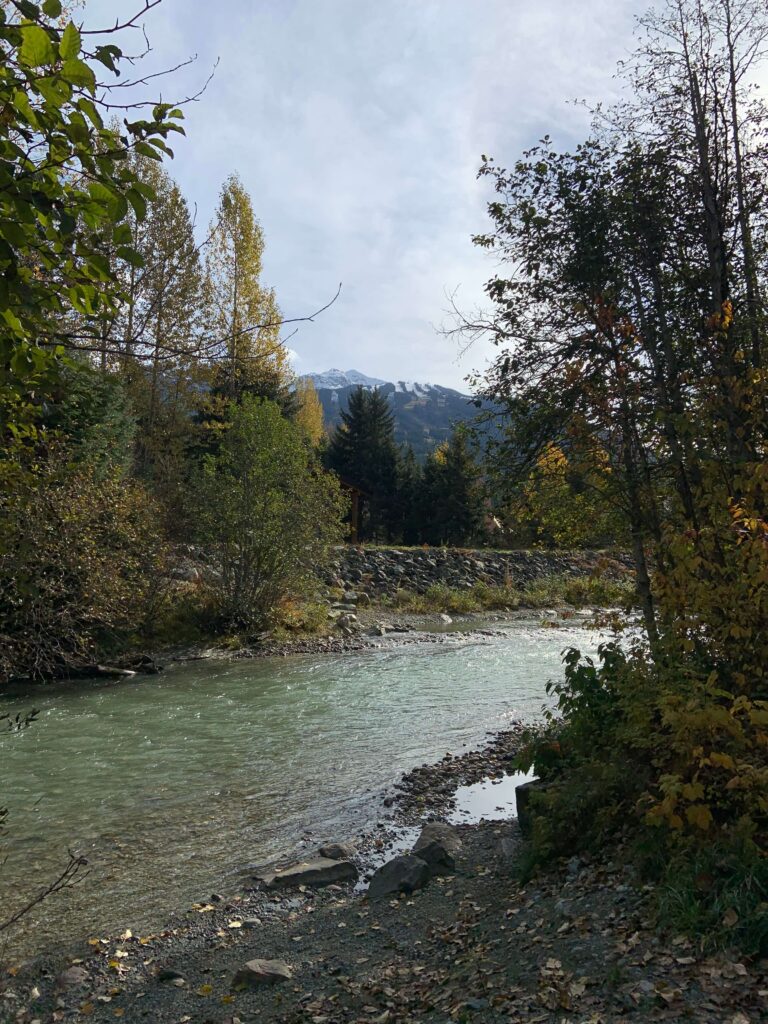
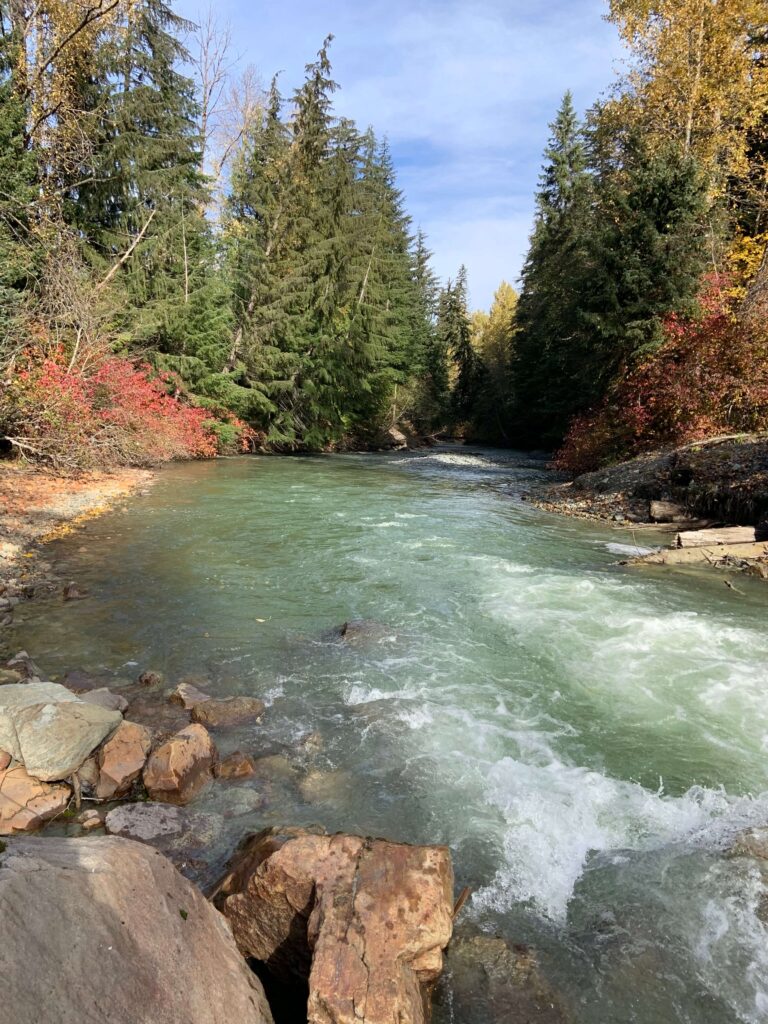
At the sit spot I have been visiting throughout the Tiny Ecology project, apocalypses have already occurred for Indigenous communities on this exact creek. “The Lil’wat Nation chose to live in this area because the land was rich in hunting, fishing, gathering, spiritual training sites and important trade and travel routes. This area was known as the Wolf Clan Territory, where the Wolf Clan (now known as the Wallace Family) resided and had their trap line along Fitzsimmons Creek” (SLCC, 2020).

There are no longer fish in this section of the creek, which shows a small glance into the apocalypse that occurred and is still occurring in this area for the Lil’wat Nation.

An apocalyptic fear narrative suggests that as settlers, we are taking a colonial stance on climate change. “Instead of dread of an impending crisis, Indigenous approaches to climate change are motivated through dialogic narratives with descendants and ancestors. In some cases, these narratives are like science fiction in which Indigenous peoples work to empower their own protagonists to address contemporary challenges. Yet within literature on climate change and the Anthropocene, Indigenous peoples often get placed in historical categories designed by non-Indigenous persons, such as the Holocene. In some cases, these categories serve as the backdrop for allies’ narratives that privilege themselves as the protagonists who will save Indigenous peoples from colonial violence and the climate crisis” (Quote, year).

In order to work towards decolonial practices in climate change, narrative and wording considerations need to be at the forefront of communication practices.

References

Ettinger, J., Walton, P., Painter, J., & DiBlasi, T. (2021, January 25). Climate of hope or doom and gloom? testing the climate change hope vs. Fear Communications debate through online videos. Climatic Change. https://link.springer.com/article/10.1007%2Fs10584-021-02975-8.

 Hull, A. (2019, December 9). Hopepunk and Solarpunk: On Climate Narratives That Go Beyond the Apocalypse. Literary Hub. https://lithub.com/hopepunk-and-solarpunk-on-climate-narratives-that-go-beyond-the-apocalypse/.

Noisecat, J. B. (2020, June 2). How To Survive an Apocalypse and Keep Dreaming. The Nation. https://www.thenation.com/article/society/native-american-postapocalypse/.

The significance of the Squamish Lil’Wat Cultural Centre’s location. SLCC Squamish Lil’wat Cultural Centre. (2020, December 27). https://slcc.ca/the-significance-of-the-squamish-lilwat-cultural-centres-location/.

Whyte, K. P. (2018, May 30). Indigenous Science (fiction) for the Anthropocene: Ancestral dystopias and fantasies of climate change crises. SAGE Journals. https://journals.sagepub.com/doi/10.1177/2514848618777621.

Apocalyptic Fear Narratives + Decolonial Practices (Tiny Ecology 4) Read More »

Climate Change and Disability at a Community Level (Tiny Ecology 2)


Introduction

The prompt that I chose for my second Tiny Ecology is based on Elizabeth Wright’s piece on Climate Change, Disability, and Eco-Ableism. This prompt asks us to explore how disability affects people in our community and why it is important to understand disability in our own community in general and in relation to climate change.

Disability in Whistler

The first thing that came to mind when thinking about how disability affects people in my community was the access to my sit spot. The main access point to my sit spot or anywhere along the Fitzsimmons Creek is the valley trail. The valley trail is a 46 kilometer paved, two way trail that runs from one end of town to the other and can take you to most places in between. As far as accessibility goes, the valley trail is fairly accessible with the exception of a few steeper hills and the occasional pothole in the spring. Moving off of the valley trail towards the creek quickly becomes less accessible. In order to get to my sit spot, you have to climb over multiple larger rocks and then down onto some sand. Thankfully, slightly further down the creek, there are multiple accessible access point with benches offering similar and some even better view points.

Whistler is a town of roughly 10,000 permanent residents, often with up to 40,000 people in town during peak seasons. From an accessibility standpoint, quadrupling the town’s population can pose some challenges. Whistler’s accessibility improved in 2010 when they hosted events for the Paralymic and Olympic Winter Games. In order to be approved to host the winter games, each facility that hosts an event must meet the standard set by Accessible Design for the Built Environment. Not only did Whistler’s sport event facilities see accessibility improvements, but a new accessible playground was built, more accessible accommodation was built and renovated, and the Whistler Adaptive Sports Program was expanded.

Whistler Adaptive Sports Program is a non-profit that provides recreational programs for people of all ages with physical, sensory, or cognitive disabilities, aiming to break down barriers to entry for sport, recreation, and therapeutic programming. As mentioned, their facilities were expanded with the Paralymic Games in 2010 and they continue to grow.

Of course, Whistler has areas of strength and also areas of improvement in terms of accessibility. So where does climate communication fit in? “With 37.5% of the global population living with a disability alongside the increasingly alarming problem of climate change, it is our prerogative to ensure that disabled people are included in the solutions” (Wright, 2020).

One thing that comes to mind is access out of Whistler. The main road out of Whistler to Vancouver is the BC-99 South, a single lane highway that mainly weaves between rock faces and cliffs and the ocean. Alternatively, you can take the BC-99 North towards Pemberton; however, this is only included as an evacuation route in the summer months due to road conditions.  

“As a result of climate change, Whistler is expected to experience longer wildfire seasons in the future. The RMOW’s Community Energy and Climate Change Action Plan (CECAP) suggest that over the next 25 to 55 years Whistler will experience longer, hotter and drier summers” (Sea to Sky Multimodal Evacuation Plan, 2019).

The report suggests that on a peak winter day, approximately 267 people would require assistance evacuating and on a peak summer day, approximately 244 people would require assistance evacuating. Of course, many people with disabilities would be able to evacuate independently; however, 37% of 40,000 is 14, 800. Assuming that there would be approximately 40,000 people in Whistler during peak summer or peak winter season and approximately 37% of those people would have varying disabilities, that would mean 14, 800 people with disabilities would need to evacuate. As mentioned, not everyone with a disability would require assistance evacuating. What this does mean is that disability needs to be a main consideration in all aspects of climate action. Furthermore, are adaptation and mitigation measures in Whistler accessible? What barriers do people with disabilities face in taking climate action? Is climate change messaging accessible in our community?

References

McColl, M. A. (2021, November 1). Should I say ‘disabled person’ or ‘person with a disability’?⁠. The Conversation. Retrieved November 22, 2021, from https://theconversation.com/should-i-say-disabled-person-or-person-with-a-disability-113618.

Resort Municipality of Whistler and District of Squamish. (2019). Sea to Sky Multimodal Evacuation Plan. https://dev.whistler.ca/sites/default/files/2019/Jul/related/25957/sea_to_sky_multimodal_evacuation_plan_final_26_june_2019.pdf.

Sowailem, A. &. (2014). Whistler Adaptive Sports Program2014. Whistler Adaptive Sports Program. https://whistleradaptive.com/.

Standardizing accessibility, part of the 2010 Paralympics legacy. Standards Council of Canada – Conseil canadien des normes. (2012, March 27). https://www.scc.ca/en/news-events/features/features-standardizing-accessibility-part-of-the-2010-paralympics-legacy.

Valley Trail updates and projects. Resort Municipality of Whistler. (2021, November 3). https://www.whistler.ca/culture-recreation/trails/valley-trail.

Wright, E. (2020, February 20). Climate change, disability, and eco-ableism: Why we need to be inclusive to save the planet. Medium. https://uxdesign.cc/climate-change-disability-and-eco-ableism-why-we-need-to-be-inclusive-when-trying-to-save-the-88bb61e82e4e.

Climate Change and Disability at a Community Level (Tiny Ecology 2) Read More »

Local Storytelling- The Fitzsimmons Creek (Tiny Ecology 1)


Introduction

The prompt that I chose for my first Tiny Ecology is based on Krauß and Bremer’s work where they outline a number of lessons for climate risk governance learned from place-based narratives. This prompt asks us to to tell a story about our sit spot and connect it to one of the features of narrative they describe, and explain that connection.

Story

The Fitzsimmons Creek weaves through Whistler at all elevations and reminds you that the peaks of the mountains and the village are connected. If you’re skiing or traveling on the glacier at 2,603-metre elevation, the hard ice and snow crunches underneath your feet. That same glacial ice is the water flowing underneath the Peak 2 Peak Gondola that connects Whistler and Blackcomb mountains. You look through the glass floor at the creek far below, that looks tiny from the confines of the gondola, but is much larger when you find yourself hiking beside the creek each summer, far from town. That same creek flows through the village, as you walk over bridges, the creek moves beneath your feet and people are stopping to take pictures with the creek in the background. This is the same creek that they took pictures of earlier today on the Peak 2 Peak gondola through the glass floor. That same water that flows through a built up village, under human built cement and stone bridges, is the water that you find yourself sitting quietly beside and reflecting. The creek goes further than this though. Maybe there is someone sitting at Green Lake, thinking about all of the places and people that this water has passed by before getting to them. Perhaps they are fishing, swimming, or kayaking in this ice cold water on big, beautiful Green Lake. At the creek where you sit, kids skip rocks slightly upstream and their laughs almost echo down the banks. You can see high up the mountain from where you sit. Not quite to the top where this water started on the glacier but pretty far. You can visualize the path that this water took to get here, flowing right in front of you in this peaceful place.

This is the place I have chosen for my sit spot, a mere two minute walk from my house, for which I feel extremely fortunate. A multi-use trail is only 15 meters or so from where I have chosen to sit, but you would never know as the sound of the creek is loud enough to distract anyone sitting beside it from the noise of the outside world. The bank provides shelter so that I also feel hidden away in all senses. This is my sit spot for the remainder of this course, although even though I’ve only been here a couple times I can already tell I will returning beyond the duration of the project.

All photos taken by me. Note: A typical Tiny Ecology does not involve phones or technology but I took a few photos to paint the picture!

Addendum

The feature of narratives that this story is connected to is that narratives situate events in a certain place and a certain time. A creek like this is a great example of the power of storytelling. Bayer & Hettinger state that local community members often have place-based stories to share. This could be someone who has lived in town for 30 years and observes the rising levels of the creek or someone who visits a couple times a year for a big ski trip and notices the glacier receding year after year. O’Sullivan has a similar message stating that stories need to be locally anchored. Storytelling in regard to nature might has the ability to get specific and reach a wide range of people. The person who enjoys sitting by the creek or the lake might not be the same person who enjoys skiing on the glacier, but a story like this has the ability to reach both of those people and everyone in between.

References

Bayer, S., & Hettinger, A. (2019). Storytelling: A natural tool to weave the threads of science and community together. The Bulletin of the Ecological Society of America, 100(2). https://doi.org/10.1002/bes2.1542

Krauß, W., & Bremer, S. (2020). The role of place-based narratives of change in climate risk governance. Climate Risk Management, 28, 100221. https://doi.org/10.1016/j.crm.2020.100221

O’Sullivan, F. (2019, November 11). To Survive Climate Change, We’ll Need a Better Story. Bloomberg CityLab. https://www.bloomberg.com/news/articles/2019-11-11/meet-sweden-s-chief-storyteller-for-climate-change.

Local Storytelling- The Fitzsimmons Creek (Tiny Ecology 1) Read More »

Assignment 4: Double Content Remix

Audience

My original piece for Assignment 3: Climate Content Creation was a blog post with the intended audience being the LGBTQIA2S+ community and anyone interested in spending time in nature/ in the outdoor community. This audience was broad; however, it was a good starting point as the piece was meant to be an overview of the topic. The audience I have chosen to focus on for the double content remix is LGBTQIA2S+ youth specifically.

First Iteration Considerations

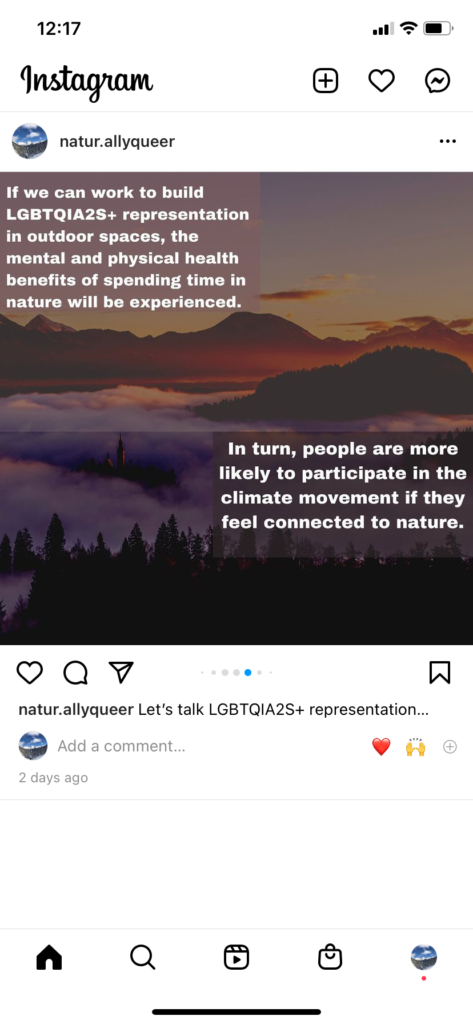
The first iteration of this content remix are two pieces for Instagram, one post and one reel. The post is meant to be informative while the reel is meant to be inspiring. The reel also adds a storytelling element by giving youth the opportunity to share their story by reposting their own reel. I chose to create an Instagram account from the perspective of a hypothetical queer person who grew up in a city and then started to spend more time connecting with nature. I decided not to use my own personal story or Instagram account; however, I did use all of my own photos.

In terms of accessibility, the post uses minimal font on each slide and users have the ability to scroll through each slide of the post at their own pace. The reel includes all of the text visible, with minimal text displayed in each section of the video with a song in the background. Users have the option to pause the video as it plays to read the text at their own pace.

It is also important to note that viewing the post and reel on Instagram would be higher quality than as you see here on my blog.

First Iteration- Instagram Post and Reel:

Second Iteration Considerations

The second iteration is a slideshow designed to be used at an LGBTQIA2S+ youth group with a facilitator present who is leading the discussion portion. The facilitator could also choose to read the slides, rather than playing the audio recording depending on the preference and needs of the group. The portion of the activity that is meant to be spent outside in nature could be the lawn of the youth facility or a nearby park. This would of course be dependent on the location and protocols of the youth facility. This activity is designed to have a storytelling element as well with the discussion portion. Youth who do not have access to or do not use social media would be able to benefit from this.

Second Iteration- Presentation and Interactive Storytelling for LGBTQIA2S+ Youth Group:

Find the presentation here: https://1drv.ms/p/s!ArpJoboCYXrjh04UOlKX8IIcTzq9?e=55vaat

References

Bell, K., & Foster, E. (2021). Environmentalism and LGBTQIA+ Politics and Activism. In Diversity and Inclusion in Environmentalism (pp. 82–97). essay, Routledge.

Blumberg, A. (Host). (2021, October 14). Environmentalist Drag Queen Pattie Gonia Says The Outdoors Is for Everyone. [Audio podcast episode]. In How To Save A Planet. Gimlet. https://gimletmedia.com/shows/howtosaveaplanet/gmhogdm/environmentalist-drag-queen- pattie-gonia

Brady, A., Torres, A., & Brown, P. (2019, June 13). What the Queer Community brings to the fight for climate justice. Grist. https://grist.org/article/what-the-queer-community-brings-to-the-fight-for-climate-justice/.

Gordon, W. (2020, November 2). Why do so many Queer Folks Love Urbanism? Greater Greater Washington. https://ggwash.org/view/79495/why-so-many-people-in-the-queer-community-love-urbanism

Rallo, A., Forest, E., Kuo, J., Boutilier, R., and Li, E. (2019). Access Ability 2: A practical handbook on accessible graphic design. Revised + Supersized Second Edition. The Association of Registered Graphic Designers.

Robbins, J. (2020, January 9). Ecopsychology: How immersion in nature benefits your health. Yale 360. https://e360.yale.edu/features/ecopsychology-how- immersion-in-nature-benefits-your-health.

Simmons, D. (2020, October 23). What is ‘Climate justice’? Yale Climate Connections. https://yaleclimateconnections.org/2020/07/what-is-climate-justice/

Assignment 4: Double Content Remix Read More »

Transdisciplinary Approach in Climate Action

CALS501 Assignment 4: Unit 2 Blog Post

This piece is a reflection for CALS501, Leading Climate Action in Society Part 1 after completing CALS500, Climate Science, Impacts, and Services and having had the chance to work with my team for the design thinking challenge as part of CALS501. Transdisciplinary thinking is a focus of the Master of Arts in Climate Action Leadership program and the further we get into the program, the more deeply I understand the importance of a transdisciplinary approach to climate action.  In CALS500, Climate Science, Impacts, and Services, it became even more apparent how challenging and complex climate science can be. Some of the resources shared in class were extremely interactive and digestible for folks who don’t necessarily have a science background, such as the MIT Climate Science Interactive Module. The Intergovernmental Panel on Climate Change Sixth Assessment Report (IPCC AR6) was released this past summer while we were in CALS500, Climate Science, Impacts, and Services. The IPCC Summary For Policymakers was another important resource in this course; however, it is challenging to absorb information from this resource as a non-scientist.  

This is where a transdisciplinary approach becomes important. The IPCC report is a great example of a resource that should be widely used and understood due to the importance of its content, but is often not widely understood because of the technical nature of climate science. The IPCC acknowledges this by taking part in outreach in various capacities.

Our cohort’s current course, CALS502, Communication for Climate Action, gives us the tools to communicate effectively , focusing on story, place, and diversity. Accessibility is a major focus of this course, which has made me realize just how inaccessible most of the climate science resources are.

The experience of taking these two courses back-to-back has been inspiring, as there are so many tools that can be used to bridge the gap between important information and people (the public, politicians, decision makers).

My team’s thinking in the design thinking challenge for CALS501, Leading Climate Action in Society Part 1 is informed by these courses and the focus of a transdisciplinary approach. We have decided on creating an open-access resource for youth in Canadian public high schools to learn about climate action in a hands on way. The resource will include information from Indigenous perspectives, Western climate science, and as many diverse perspectives as possible.

Now we continue to learn about communication in relation to climate action before regrouping in CALS501, Leading Climate Action in Society Part 1. As each course builds on the next, the transdisciplinary approach will continue to be a key component of both the design thinking challenge and the program itself. I look forward to seeing how CALS502, Communication for Climate Action will inform our thinking as we come back together to go through another iteration of our design thinking challenge as a team. How can we create an idea that is as accessible as possible from a communications standpoint? How will our upcoming course, CALS503, Climate Risk Management inform our thinking?

References

Emanuel, Kerry A. Climate Science, Risk & Solutions. Massachusetts Institute of Technology, 15 May 2020: https://climateprimer.mit.edu/climate-science-risk-solutions.pdf

Summary for Policymakers IPCC, 2021: Summary for Policymakers. In: Climate Change 2021: The Physical Science Basis. Contribution of Working Group I to the Sixth Assessment Report of the Intergovernmental Panel on Climate Change [MassonDelmotte, V., P. Zhai, A. Pirani, S.L. Connors, C. Péan, S. Berger, N. Caud, Y. Chen, L. Goldfarb, M.I. Gomis, M. Huang, K. Leitzell, E. Lonnoy, J.B.R. Matthews, T.K. Maycock, T. Waterfield, O. Yelekçi, R. Yu, and B. Zhou (eds.)]. Cambridge University Press. In Press.

Transdisciplinary Approach in Climate Action Read More »

Climate Content Analysis

For this climate content analysis assignment, the digital climate communication that I have chosen to analyze is an article that was published in The Guardian titled; Just 100 companies responsible for 71% of global emissions, study says: A relatively small number of fossil fuel producers and their investors could hold the key to tackling climate change. It is important to note that this article was published on July 10, 2017. For an article that is over four years old, it is still referred to and talked about relatively often, which is partly why I chose to analyze it for this assignment.

The Guardian is an open source online newspaper that encourages donations from readers but is open to everyone free of charge. The default setting for The Guardian is ‘international edition’; however, there are also options to filter ‘UK edition’, ‘US edition’, and ‘Australia edition’.

The audience for this piece is technically international; however, it is important to note that the article is published in English. Due to the UK, US, and Australia edition options on The Guardian, it is assumed that there may be higher levels of engagement from those countries. The author, Tess Riley is the deputy editor of Guardian Sustainable Business. The article can be found under the ‘Climate Crisis’ category.

Due to the nature of the broad variety of topics published in The Guardian, it is also assumed that this article would be consumed by people who are interested in a variety of topics- not just climate action. The title of the article explicitly calls out companies and investors and the article itself lists 100 companies by name, so it is also assumed that anyone involved in these companies would be consuming the article.

There are many techniques for effectively communicating climate change. This piece will focus on three of those techniques including; identifying and understanding audience, the ecological model, and localizing the issue.

  1. Identify and understand your audience
    1. Communicating climate change: A practitioner’s guide- Insights from Africa, Asia, and Latin America from the Climate & Development Knowledge Network by Dupar states the importance of starting from a place where information is relevant to the audience’s knowledge and values. Audiences will be mobilized to contribute when they feel as though the framing of an issue is relevant to them.
  2. The ecological model
    1. An ecological model of climate marketing: A conceptual framework for understanding climate science related attitude and behaviour change by Jaigris Hodsen describes the ecological model as bidirectional. Within the four levels; individual, relational, community, and society, the individual interacts with all broader levels. The ecological model uses currency, personalization, community and trust in relation to climate communication. Currency refers to both the timing of the message and where the message is coming from. Personalization refers to framing the message in a way that is relevant to the audience, ensuring that they feel empowered and avoiding fear-based messaging. Community refers to the concept that humans look to others within their own community for social norms. In the case of climate communication, Hodsen recommends framing the desired outcome or action as a social norm within said community. Lastly, trust refers to the source that the information is coming from and whether that source is trusted or not.
  3. Localize the issue
    1. In the article Conveying the Human Implications of Climate Change: A Climate Change Communication Primer for Public Health Professionals by Maibach, Nisbet, and Weathers, they highlight the importance of making climate change a more concrete, localized concern, rather than a global and abstract concern. In this case, climate change is framed as a public health concern, making it more localized within each distinct community.

The strengths of this piece lie in trust for the platform that it is being communicated through. As mentioned above, The Guardian has maintained a committed following, especially those that get most of their news through this platform. There is presumably a level of trust in the organizations that are referred to and cited in the report including The Carbon Majors Report, The Climate Accountability Institute, Sierra Club, and most notably, the Intergovernmental Panel on Climate Change (IPCC).

As mentioned above, this article is still referred to quite readily for an article that is four years old. In terms of climate change communication techniques with the audience being the general public, climate change is framed as an issue for the 100 companies responsible for 71% of global emissions, not mentioning the roll that the general public plays in consuming products from those same companies. Of course, it is important to hold companies and investors accountable; however, for a public facing article such as this, it does not make the audience feel like it is an issue that is relevant to them (Dupar, 2019).

The ecological model is centered around ensuring that the individual, in this case, the general public interacting with the article, is able to interact bidirectionally with the relational level, community level, and societal level. This article could try to adopt an ecological model, rather than isolate companies and investors (societal level) without bidirectional interaction to other levels. Another important component of the ecological model, specifically within personalization, encourages avoiding fear-based messaging (Hodsen, 2019). Fear-based messaging is not avoided in statements such as “If fossil fuels continue to be extracted at the same rate over the next 28 years as they were between 1988 and 2017, says the report, global average temperatures would be on course to rise by 4C by the end of the century. This is likely to have catastrophic consequences including substantial species extinction and global food scarcity risks” (Riley, 2017).

Lastly, looking at the climate communication technique of localizing the issue, the title of the article refers to “the world’s greenhouse gas emissions” and explores global emissions throughout. As mentioned earlier, of course it is important to look at emissions on a global scale; however, this does not give an opportunity to ‘localize the issue’ (Maibach, 2011).

It is no surprise that this article is still a topic of conversation after four years, as Shandell Houlden states “Content that elicits strong emotions in its readers is more likely to spread rapidly than unemotional content. This is especially true for negative emotions such as fear and anger” (Houlden 2021). The title and the article itself are both considered emotional content. For a public facing article, it is trusted by the audience due to the source of information (The Guardian). It could be improved upon by implementing some of the climate change communication strategies such as; identifying and understanding the audience, considering the ecological model, and localizing the issue.

References

Dupar, M., with McNamara, L. & Pacha, M. (2019). Communicating climate change: A practitioner’s guide. Cape Town: Climate and Development Knowledge Network. https://unfccc.int/sites/default/files/resource/Communicating%20climate%20change_Insights%20from%20CDKNs%20experience.pdf

Hodson, J. (2019). An ecological model of climate marketing: A conceptual framework for understanding climate science related attitude and behavior change. Cogent Social Sciences, 5(1), 1-15. https://doi.org/10.1080/23311886.2019.1625101

Houlden, S. (2021). Week 4 Readings- Disinformation (Video). Royal Roads University (Moodle). Retrieved from https://moodle.royalroads.ca/moodle/mod/forum/discuss.php?d=809116

Maibach, E., Nisbet, M., & Weathers, M. (2011). Conveying the human implications of climate change: A climate change communication primer for public health professionals. George Mason University Center for Climate Change Communication. https://www.climatechangecommunication.org/wp-content/uploads/2016/04/Climate-Communication-Primer-for-Public-Health-Professionals-1.pdf

Moser, S .C. (2016). Reflections on climate change communication research and practice in the second decade of the 21st century: What more is there to say? WIREs Climate Change May/June, 345-369. Doi: doi-org.ezproxy.library.yorku.ca/10.1002/wcc.403

Riley, T. (2017, July 10). Just 100 companies responsible for 71% of global emissions, study says. The Guardian. Retrieved October 8, 2021, from https://www.theguardian.com/sustainable-business/2017/jul/10/100-fossil-fuel-companies-investors-responsible-71-global-emissions-cdp-study-climate-change.

Climate Content Analysis Read More »