
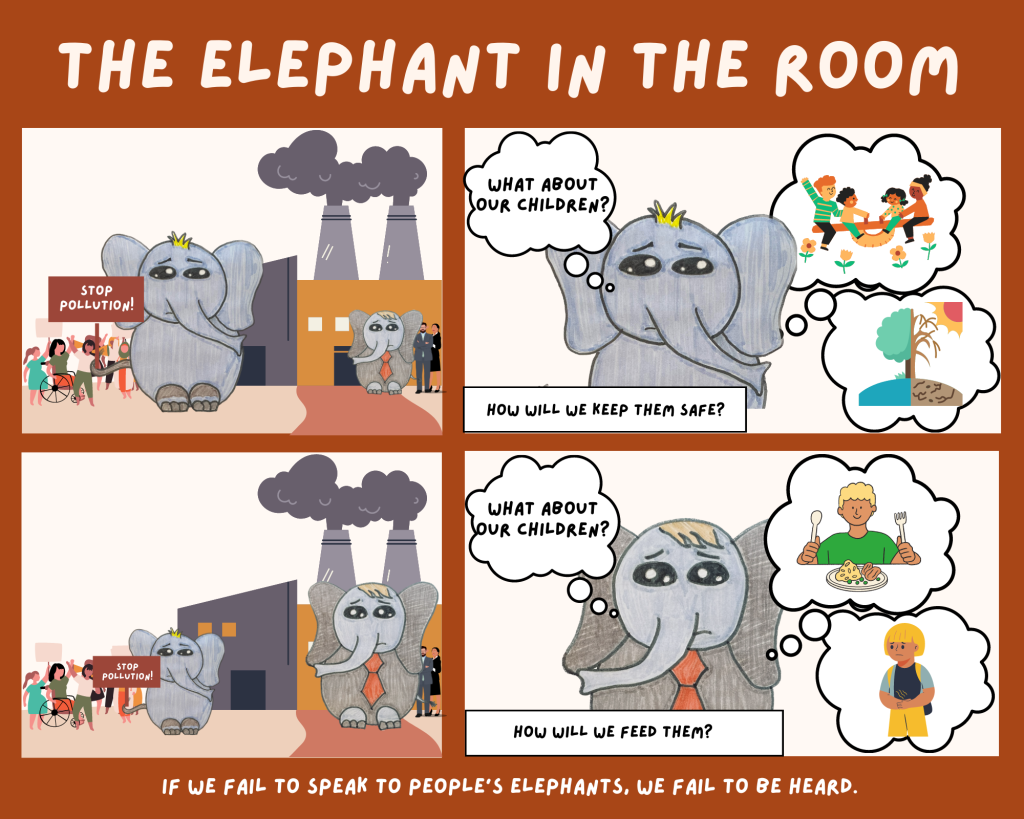
The elephant on the left most closely aligns with my intuitive thinking, which has been shaped by my lived experiences and education (Roberts et al., 2021). My elephant is comprised of a multitude of factors, including my gender, age, job, role as a mother, and geographic location. Similarly, those who align with the elephant on the right have their own intuitive knowledge based on their unique experiences. These differences in thinking could lead to an impasse, where we could stay stuck. Forever.
So how do we get unstuck?
I believe this is the question that has led me to the MACAL program. Repeatedly, the themes that resonate with me provide insight into how to escape this deadlock: equity and communication.
During the process of learning about risk assessment in CALS503, these themes emerged once again, underscoring their interrelated nature. Together, they represent the how and the why of climate change. How do we communicate effectively and why does it matter?
The latter question could be fully expanded to read: why does climate change matter and who is affected? It matters because every living being on this planet is affected, with those least able to adapt disproportionately impacted (Boyd, 2019). We are now at the point where adaptation is essential (Jackson et al., 2010), yet incorporation of equity into this work is an additional challenge not always achieved (Moser et all., 2017). Equitable adaptation requires intention. Adaptation without intentional prioritizing of equity is failure. Failure to consider those most vulnerable to harm due to systemic, not personal, faults. Failure of morality. As eloquently stated by Monhot et al. (2019), “if protecting the lives of the most vulnerable is the goal, social equity must be intentionally included in all stages of planning and implementation” (p. 8). And, frankly, protecting the lives of the most vulnerable must be the goal. It is important to bear in mind that protecting those most vulnerable to risk ultimately protects everyone.
“Protecting the lives of the most vulnerable must be the goal”
To ensure the protection of everyone, we need to hear everyone. Not literally every single voice, but rather through inclusive representation. The risk assessment process highlights the importance of communication, particularly as an element of relationship building, to create equitable change. I think of these relationships as synonymous to any close personal relationship. Consider a meaningful relationship in your life. If the person failed to ask a question or listen to you, would you be inclined to listen to them? Probably not.
Just as with our personal relationships, it is important to choose and nurture these relationships with purpose, as they provide the foundation to gain support, build capacity, and ultimately implement adaptation strategies (Jackson et al., 2010). Risk assessments involve active engagement of stakeholders, ranging from community members to local policy makers, through collaboration. This collaboration provides an opportunity to use effective communication techniques, such as listening instead of broadcasting and risk currencies, which work synergistically. The former refers simply to listening, instead of talking, to understand the needs of others (Roberts et al., 2021). An important tool for any relationship. Risk currencies refer to how someone prioritizes risk due to their intuitive thinking (Roberts et al., 2021). Developing a deeper understanding of someone’s thought process and learning to communicate with them in that language enhances the likelihood of creating a unified goal.
This focus on communication is essential. Personally, I sometimes feel desperate in my search to find effective ways to reach people. I now realize that dumping my concerns and knowledge onto someone is unlikely to inspire action. Instead, active listening and mutual understanding might allow us to move forward by learning from one another.
In his book, How Minds Change, David McRaney (2022) speaks of an (ethically questionable) experiment that was conducted on kittens who were not exposed to horizontal lines. Upon finally being introduced to them, their unfamiliar brains simply did not see them. They bumped into tables and fell from ledges, unable to perceive horizontal surfaces. Upon exposure, their brains eventually began to incorporate the lines into their reality.
Those cats represent all of us.
Climate change solutions, despite their complexity, seem so obvious to those of us who have been exposed. But they may initially look like horizontal lines to those unfamiliar. We need to find a way to speak to each other’s elephants (and cats?) so everyone is heard, understood, and considered equally. As aptly stated by McRaney (2022), “we must admit that if we had experienced what others had, we might even agree with them” (1:00:11). Acknowledging that our realities are shaped by our unique experiences is crucial for effective communication.
“We must admit that if we had experienced what others had, we might even agree with them”
– David McRaney
What do inclusivity and effective communication look like for me now? For me, it entails refraining from immediately sharing my own interpretations and experiences or diving into the scientific data. Rather, it means always starting with a question and a quest for deeper understanding.
What does it look like for you?
Above cover image from envato elements
References
Boyd, D. (2019). Safe climate: a report of the special rapporteur on human rights and the environment. United Nations [UN] Human Rights, Office of the High Commissioner. Report to UN General Assembly. https://documents-dds-ny.un.org/doc/UNDOC/GEN/N19/216/42/PDF/N1921642.pdf?OpenElement
Jackson, E., Barry, L., & Marzok, N. (2010). Changing climate, changing communities: Guide and workbook for municipal climate adaptation. International Council for Local Environmental Initiatives Canada (ICLEI Canada). https://icleicanada.org/wp-content/ uploads/2019/07/Guide.pdf
McRaney, D. (2022). How minds change: The surprising science of belief, opinion, and persuasion (D. McRaney). [Audiobook]. Audible. https://www.audible.ca/pd/How-Minds-Change-Audiobook/0593457331
Monhot, S., Bishop, J., & Sanchez, A. (2019). Making equity real in climate adaptation and community resilience in policies and programs: A guidebook. The Greenlining Institute. https://greenlining.org/wp-content/uploads/2019/08/Making-Equity-Real-in- Climate-Adaption-and-Community-Resilience-Policies-and-Programs-A-Guidebook-1.pdf
Moser, S., Coffee, J., & Sevile, A. (2017). Rising to the challenge, together: A review and critical assessment of the state of the US climate adaptation field. Kresge Foundation. https://kresge.org/wp-content/uploads/2020/06/rising_to_the_challenge_together_linked_0.pdf
Roberts, F., De Meyer, K., & Hubble-Rose, L. (2021). Communicating climate risk: A handbook. UCL Climate Action Unit, University College London. https://doi.org/10.14324/000.rp.10137325