CALS 502

Double Content Remix: Tweeting and Talking Compost

A photo of a cutting board with vegetables and peels, coffee grinds, a countertop compost bin, and a plant. Photo by Lenka Dzurendova on Unsplash.

A few weeks ago, our Communication for Climate Action class completed a content creation assignment (note: it was not posted to this blog). For that assignment, I wrote a grant proposal for the curbside collection of organic waste and a composting facility in Golden, BC. I focused on the benefits of diverting organic waste from the landfill and on examples of operational compost collection programs. The intended audience was the committee reviewing grants and I assumed that they would have a level of proficiency with technical language with regards to landfills and greenhouse gas emissions.

For this assignment, I am remixing the content from the prior assignment to reach a different audience with different accessibility needs. I’ve created two new pieces of content to help reach a broad spectrum of people.  The audience, in this case, is the general population of Golden, BC (my hometown).  Note that the reference list for both pieces of content is found at the end of this post.

Part 1

For the first piece of content, I’ve created a hypothetical Twitter campaign to convince the residents of Golden, BC to vote yes in a municipal referendum on implementing curbside collection of organic waste. For this campaign, I worked with the assumption that residents have some knowledge of the referendum via other means (ie. conversations with other residents, outreach campaigns by the town, or newspaper articles). With this in mind, I was able to craft my tweets without providing extensive background information. My idea was that these tweets would be part of a larger community conversation, and that residents would be posting their own tweets and commenting on mine, as well. I tried to add prompts to some tweets to start community conversations. I did not assume any level of expertise with regards to landfills or greenhouse gas emissions. My goal was to make the campaign accessible to the general population by using simple language and avoiding technical jargon (like using the word pollution instead of emissions or rotting instead of decomposing). I also made the tweets short in order to reduce the cognitive load necessary to process the message. The techniques listed above are introduced in Rallo et al.’s (2019) work. Although the handbook is aimed towards those practicing graphic design, the portions of the handbook that deal with text provided helpful insights into accessibility for this assignment. As per Rallo et al. (2019), communicators should “aim for clarity and economy while avoiding needless complexity” (p. 13). This is what I aimed to accomplish (and it’s worth noting that Twitter’s character limit helps with this, as well). Dupar et al. (2019) also introduced the concept of using language appropriate to your audience in their work. Additionally, I made the case to Twitter users to share the content to (hopefully) reach a wider audience, further increasing the accessibility. Lastly, because Twitter is a computer-based platform, people with sight impairments would be able to use screen readers to have the tweets read out loud to them or translated to braille. 

I put the relevant sources at the end of each Tweet to satisfy the citation requirements; however, my vision is that the citations would not appear in the Twitter campaign itself.

Twitter Campaign

30% of Golden’s landfill waste is made up of organics. We can do better with curbside organics pickup. Use #LetsCompostGolden to spread the word. (Source: Maura Walker & Associates, 2015)

Did you know that when organic matter rots in the landfill it produces methane, a potent greenhouse gas? Composting can reduce methane pollution. Composting = #ClimateAction. #LetsCompostGolden #VoteYesToCompost. (Source: City of Kamloops. n.d.)

Apple cores don’t belong in the landfill. Cast your ballot for curbside organic collection in #GoldenBC. You’ll be voting for: ↓ Reduced landfill capacity needs, ↑ More compost for farmers and gardeners, ↓ Reduced greenhouse gas pollution. (Sources: Bong et. al, 2017; Government of BC, n.d.)

Did you know that Vancouver, Squamish, and Gibsons all have curbside collection of organic waste? Let’s join them, #GoldenBC! #VoteYesToCompost #LetsCompostGolden #ClimateAction (Sources: City of Kamloops, n.d.; Town of Gibsons, n.d.)

What do banana peels have to do with the #ClimateCrisis? A lot! Composting organics instead of sending them to the landfill is a powerful way to reduce methane pollution. #VoteYesToCompost #LetsCompostGolden #ClimateAction (Source: City of Kamloops, n.d.)

Chicken bones, hardened bits of cheese, avocado pits, paper towel. These things end up in our landfill everyday, but it doesn’t have to be that way.. Cast your ballot for curbside organics collection so that EVERYONE can compost. #VoteYesToCompost #LetsCompostGolden

Attention apartment dwellers! Backyard compost may not be an option for you, but curbside organics collection is. #VoteYesToCompost #LetsCompostGolden

#LetsCompostGolden: Talk about curbside organic collection with your neighbours to get more people to #VoteYesToCompost

In Canada, methane pollution from organic waste rotting in landfills is a big problem. #GoldenBC may be a small town, but we can be part of the solution. Curbside organic collection would reduce pollution and help combat the #ClimateCrisis. (Source: Government of Canada, 2017)

Gardeners call compost ‘black gold’. What if we made our own black gold in #GoldenBC from household organic waste? Comment below ⇩ if you’d use it in your garden. #VoteYesToCompost #LetsCompostGolden

What can you do to help avert the climate crisis today? #VoteYesToCompost and tell a friend to, too. 

#ClimateAction can be wind farms, solar power, or biking to work. Did you know composting can also contribute to #ClimateAction? #VoteYesToCompost #LetsCompostGolden

⇧ composting  = ⇩ methane = ⇩ climate crisis. #VoteYesToCompost (Source: City of Kamloops. n.d.)

Part 2

For the second portion of this assignment, I have created a Google Slides document to be presented at a Town Hall-type event. This event would be part of the same campaign as above. The aim is to have residents vote yes in a municipal referendum on implementing curbside collection of organic waste. As with the Twitter campaign, the intended audience is the general population of Golden, BC. Accessibility is addressed by providing a visual presentation (Google Slides) as well as an audio presentation. Therefore, the needs of people with both hearing and sight impairments are addressed. Of course, accessibility for those with mobility challenges would need to be addressed in choosing the venue, as well. To further contribute to accessibility, I have chosen to use a large, easily readable font. Specifically, I used the Arial font, as this is rated as one of the preferred fonts by those with vision and/ or reading difficulties (Rallo et al., 2019). I chose to limit my use of text in the Google Slides presentation to reduce cognitive load, which is also in line with Rallo et al.’s (2019) design principles. In contrast to my tweets, I used some more technical language in my presentation, but I have explained any potentially confusing terms or phrases (see the speaker notes). I have tried to use more complex language only when absolutely necessary. This is based on the work of Rallo et. al. (2019) and Dupar et al. (2019). I have added photos to the presentation to increase audience engagement, based on the work of Dupar et al. (2019) and Hodson (2019). Lastly, I’ve added Alt Text to these photos, in case people with vision impairments want to access the presentation from their home computers at a later date.

Note that there are also speaker notes that go along with the presentation. Also note that citations are found in the speaker notes as well as this text. The reference list for both follows.

The Google Slides presentation can be found here.

References – for Twitter campaign and Google Slides presentation

Bong, C. P. C., Lim, L. Y., Ho, W. S., Lim, J. S., Klemeš, J. J., Towprayoon, S., Ho, C.S., & Lee, C. T. (2017). A review on the global warming potential of cleaner composting and mitigation strategies. Journal of Cleaner Production, 146, 149-157. doi.org/10.1016/j.jclepro.2016.07.066

City of Kamloops (n.d.). Curbside organic waste collection. letstalk.kamloops.ca/organics

Dupar, M., with McNamara, L. & Pacha, M. (2019). Communicating climate change: A practitioner’s guide. Cape Town: Climate and Development Knowledge Network. https://unfccc.int/sites/default/files/resource/Communicating%20climate%20change_Insights%20from%20CDKNs%20experience.pdf

Government of BC. (n.d.). Organic waste diversion. www2.gov.bc.ca/gov/content/environment/waste-management/food-and-organic-waste/organic-waste-diversion

Government of Canada. (August 11, 2017). Municipal solid waste and greenhouse gases. www.canada.ca/en/environment-climate-change/services/managing-reducing-waste/municipal-solid/greenhouse-gases.html

Hodson, J. (2019). An ecological model of climate marketing: A conceptual framework for understanding climate science related attitude and behavior change. Cogent Social Sciences, 5(1), 1-15. https://doi.org/10.1080/23311886.2019.1625101

Maura Walker & Associates. (September 30, 2015). CSRD technical memorandum: Organics diversion strategy. www.csrd.bc.ca/sites/default/files/reports/CSRD%20Technical%20Memo%20Organics%20Diversion%20Strategy.pdf

Rallo, A., Forest, E., Kuo, J., Boutilier, R., & Li, E. (2019). Access Ability 2: A practical handbook on accessible graphic design. Revised + Supersized Second Edition. The Association of Registered Graphic Designers.

Double Content Remix: Tweeting and Talking Compost Read More »

Tiny Ecology Project #4: Climate change in my front yard

Close up of a birch tree. Photo by Universal Eye on Unsplash.

Once upon a time, a birch tree stood sentry in front of my home. It started small, as all trees do, but by the year 2021 it stood at least ten meters tall. It had papery bark that peeled easily and knots in its trunk that told stories of its past.

Everyday, the birch provided gifts to us, the residents of the house that sat behind it. In the spring, it hosted chattering birds who added music to our days and gave us a reason to stare idly out the window. In the summer, it cast shade on our home, providing valuable cooling. In the fall, it dropped its leaves onto the ground below. We raked the leaves and added them to our garden as mulch. In the winter, it provided a cozy location for tea with a friend. Chairs were set out in the snow under its bare canopy, next to its thick trunk – the perfect location for a good conversation.

Until one day, climate change started to disrupt the way that the birch gave to us throughout the seasons. Over the next twenty five years, everything changed for this tree.

Because of climate change, far fewer birds visited us in the spring. For some, their migration patterns were disrupted. Sadly, some bird species didn’t survive at all. Their young hatched too early in the spring, when plentiful food wasn’t yet available.

Because of climate change, the tree stopped providing enough cooling for our home in the summer. We became uncomfortable in the intensifying heat and had to find other means of cooling our home.

Because of climate change, the tree grew less leaves, as it was stressed by changing conditions. We lost some of the precious mulch that we used to spread over the garden in the fall, which helped our vegetables grow robust the following summer.

Because of climate change, we set chairs out for wintertime tea in sloppy mud, rather than crunchy snow. The tree dripped water on us, melting when – in the past – it would have stood frozen for months on end.

Until finally, the tree could no longer survive. It was not able to satisfy its thirst for water. It did not have the stability it needed – season after season – to know when its leaves should bud, grow, and drop. It did not know when to store energy and when to spend it on new growth. It missed the snowy winter and the chattering birds. It slowly began to die off from the inside, and then suddenly limbs ten meters off the ground were succumbing to stress and falling dramatically to the ground.

And everyday after that, for a long time, the climate continued to change. Where the tree used to stand, new life began to grow. Grasses and shrubs overtook the area. Changing landscapes were something that we, as humans, had to get used to. Trees died off and new species – sometimes other trees, or grasses, or bushes – took their place.

*** This post was structured based on the idea of the story spine, which helps stories take shape with a set of prompts. The prompts I used were based on those in Cunningham’s (2017) work. The story spine idea was originally developed by Kenn Adams in How to Improvise a Full-Length Play: The Art of Spontaneous Theater and popularized by Emma Coats, who worked for Pixar, in a series of tweets (Cunningham, 2017). 

Beyond its use in helping a storyteller develop the structure of their story, Rotman (2017) showed that the story spine can be used in a workshop setting with people from different disciplines to “foster empathy, engagement, creativity, and reflection” (p. 304). Rotman also noted that, in these settings, storytelling using the story spine can act as a “social lubricant” (p. 308). Thinking in this context, the above post could be used in a workshop setting – for example, with different stakeholders in my community – to convey my feelings and thoughts about climate change in the local context. I wonder what other personal climate stories I could tell by using the story spine?

References

Cunningham Bigler, K. (March 1, 2017). Jumpstart your story with the story spine. Curiographic. https://www.curiographic.com/blog/2017/2/18/jumpstart-your-story-with-the-story-spine 

Rotman, S. (2017). “Once upon a time…” Eliciting energy and behaviour change stories using a fairy tale story spine. Energy Research & Social Science, 31, 303-310. https://doi.org/10.1016/j.erss.2017.06.033

Tiny Ecology Project #4: Climate change in my front yard Read More »

Tiny Ecology Project #3: Emergency preparedness for all

My sit spot is beneath a big birch tree in my front yard. I sat outside under the tree earlier today. The birch was getting ready to rest for the winter, having lost most of its orange leaves over the past week. The grass beneath it was white with frost. The mountains in the distance were dusted with snow. It was quiet – save for the distant sounds of children on the playground at school – and still. Of course, the scene at my sit spot changes daily. Soon the ground will be blanketed in snow. Sometimes the wind is whipping and branches are falling from the tree onto my roof. But what if, one day, something more unusual happens?

Recently, British Columbia has been experiencing severe wildfire seasons, with blazes burning across the province. What happens if – one summer in the future-  a fire travels up and over the gorgeous mountains in the distance, across the parched grass throughout town, and lights the birch tree at my sit spot on fire? 

In all likelihood, by the time the hypothetical fire would breach the limits of town, residents would be evacuated. Some would go to friends’ and families’ houses, some would go to hotels, and others would go to evacuation centres. But how do we ensure that evacuations, in the case of climate-fueled disasters, are executed in an accessible manner?

Firstly, we need to make sure that those with mobility issues have the help they need to get to safety in a timely manner. Many disabled people are not able to respond to an evacuation order in the same time frame as an able bodied person. During Hurricane Katrina, disabled people and their families were disproportionately represented amongst those who could not evacuate (Jampel, 2018). Evacuation plans that include specific measures for disabled people need to be created by emergency planners at all levels of government.

Secondly, evacuation centres must be accessible for everyone, including disabled people. Disabled people who went to evacuation centres during Hurricane Katrina found that these spaces were sorely lacking in accessibility measures (Jampel, 2018). Lessons should be learned from this, and – again – emergency planners should have robust plans that include accessibility measures for evacuation centres. 

Lastly, disabled people should have a seat at the table so that they can help craft effective emergency preparedness policies. They should be an integral part of the planning process to ensure their needs are met. Dines (2019) wrote about how disabled people need to be represented when decisions are being made about climate mitigation policies. These policies can impact disabled people in unintended ways. For example, plastic straw bans can make drinking a beverage at a restaurant much more difficult for some disabled people (Dines, 2019). I would argue that the same holds true for emergency preparedness policies. Disabled people need to be part of the decision making process so that they can shape policies that contribute to their well-being in the event of an emergency.

My town may experience a wildfire or a flood or another climate-fueled disaster in the future. Careful planning now will help ensure that all residents are able to evacuate safely during an emergency.

I wonder, what are some ways that effective communication could play a role in ensuring a safe evacuation for all?

References

Jampel, C. (2018). Intersections of disability justice, racial justice and environmental justice. Environmental Sociology, 4(1), 122-135. https://doi.org/10.1080/23251042.2018.1424497

Dines, H. (October 15, 2019). The climate revolution must be accessible – this fight belongs to disabled people too. The Guardian. https://www.theguardian.com/commentisfree/2019/oct/15/climate-revolution-disabled-people-activism

Tiny Ecology Project #3: Emergency preparedness for all Read More »

Climate content analysis: Zero Carbon newsletter

Climate content: September 24th issue of the Zero Carbon newsletter from Canada’s National Observer

Reference: Hatch, C. (September 24th, 2021). Zero carbon newsletter: 5 ways the election changed climate politics. Canada’s National Observer. https://www.nationalobserver.com/newsletters/zero-carbon/2021/09/24/5-ways-election-changed-climate-politics

Access: Open access

Intended audience

  • Adults
  • English-speaking Canadians
  • Those already engaged with and informed about climate policy and action in Canada; those looking to stay up-to-date on climate policy and action in Canada
    • The newsletter uses this quote in its introduction: “We’re exploring the climate crisis in Canada and around the world. The latest news. What’s working? What’s holding us back? What to do about it and how to talk about it (sometimes even how to think about it)” (Hatch, n.d., para. 2). This suggests some expected prior interest in or engagement with the subject of climate change. The fact that the main way people would receive the newsletter is by signing up via email also suggests that the audience is seeking climate news, rather than passively coming across it as part of their general news consumption.

Climate communication techniques assessed

  • Target the needs of the intended audience to make the content as relevant as possible; use language and terms that are appropriate to the intended audience (Dupar et al., 2019).
  • Use narratives to increase engagement (Hodson, 2019; Moser, 2016), trust (Bayer and Hettinger, 2019), and action (Moser, 2016).
  • Ensure content is easy to access and redistribute (Dupar et al., 2019).
  • Use images appropriate for the intended audience (Dupar et al., 2019; Hodson, 2019). 

Analysis

This newsletter by Chris Hatch in Canada’s National Observer is sent out to subscribers on a weekly basis. It is comprised of one main article that provides analysis and insight into a current piece of climate news, a number of short summaries about other pieces of climate news, and a list of links for further reading. For this particular issue of the newsletter, the main article is about the climate policies and politics that Canadians can potentially expect – or hope for – from the newly elected federal government. There are a number of climate communications techniques used to varying degrees of success throughout this newsletter; four of these will be examined in detail below.

Targeting the needs of the intended audience is an important part of climate communications (Dupar et al., 2019). Specifically, using language that is more or less technical, based on the audience’s level of literacy with the subject at hand, can help ensure climate communications are optimized (Dupar et al., 2019). This newsletter is largely successful in doing so, in most part by using language that meets the readers where they are. Generally, terms are explained where necessary, but readers are expected to have basic climate policy literacy. As such, some technical terms are not explained or expanded upon. For example, the term COP26  is used without providing an explanation of what it stands for (26th annual Conference of the Parties) or what it means (it is the upcoming annual UN climate change conference). In this case, it is reasonable to expect that the average reader will have a basic foundation of climate policy knowledge, and an explanation is not necessary. However, if an explainer article was available through Canada’s National Observer, it would make sense to link to the article for anyone that may be seeking clarity or more information on the term. On the other hand, some terms that are less widely recognized and understood are briefly explained to provide aid to readers who may not be aware of their definitions. For example, the newsletter mentions the term zero-emission vehicle standard and then provides a one-sentence explanation. 

While the vocabulary and use of technical language is mostly appropriate for the intended audience, there is one example of a section that is overly technical, and could be better explained. In the short news piece titled China won’t fund new coal plants… abroad, there are several references to gigawatts of coal capacity being planned or under expansion. I believe that most people do not have a good sense of what a gigawatt of energy is, even if they are informed about climate policy. In this case, it would be useful to provide a concrete, real-world example of how much capacity this is. For example, what number of households could be powered by this amount of coal capacity? In summary, using language appropriate for the intended audience is an important climate communications tool. Next, I will explore the use of that language to create stories, or narratives.

The use of narratives is another important climate communications technique (Hodson, 2019; Moser, 2016). Narratives are employed in a minor way in this newsletter. Information is largely provided in the style of traditional news media. This is not surprising, given it is published by a digital news media site and aims to provide climate information to climate-savvy readers. The newsletter does include a short story about a record-breaking cross-country trip made by electric vehicle. This is a light, feel-good piece that the author decided to use to end the newsletter. However, I would argue that there is roon for more narratives, or stories, in this newsletter.  Story is widely known to increase audience engagement in climate communication (Hodson, 2019; Moser, 2016). It can also build credibility and trust within a relationship (Bayer and Hettinger, 2019); in this case, the credibility and trust would accrue to the author and the publisher. The author could add in short vignettes of people’s experiences as they relate to the news at hand. For example, the author could add in a narrative about people’s reactions to the election results, with reference to climate. Additionally, in the section of short summaries of news-worthy climate pieces, the author could make an effort to include more solutions-based narratives. In fact, providing options or ideas for climate-based actions is an important part of climate communications (Moser, 2016). For example, there could be a short summary piece about a successful mitigation or adaptation measure implemented by a Canadian city or community. While it would not be appropriate for narrative to overtake the analysis and news in this newsletter, the use of short narratives has the potential to increase reader engagement, trust, and action. 

The third technique I will explore is that of ensuring ease of access and shareability. Climate content should be easy to access and to redistribute (Dupar et al., 2019). The newsletter performs well by this metric. Initially, it is sent to subscribers’ inboxes. As noted above, these are people who are already engaged in reading about climate policy and action. Sending the newsletter by email makes it accessible for those already subscribed; however, it also makes the newsletter easy to share within subscribers’ networks via email forwarding. The newsletter is also available online through Canada’s National Observer’s website for those who do not want to  – or have not yet – signed up to receive it via email. This increases the accessibility and the number of potential readers. Lastly, there are buttons at the bottom of the website-based version of the newsletter that allow for sharing on Twitter and Facebook. This way, if a reader finds the newsletter interesting, they can share it to their social media networks. If possible, it might be worth adding this option on the emailed newsletter, as well, to increase the number of people sharing it via social media. The various platforms on which the newsletter can be read and shared mean that it is easy to access and to redistribute, providing the potential for increased readership.

The last climate communication technique that I will analyse is the use of visuals. Climate communication can be most effective when it includes compelling visual imagery that is appropriate for the intended audience (Dupar et al., 2019; Hodson, 2019). In this case, a few photographs are used to complement the text. The images add an element of visual appeal, but do not add to the information being provided in the text. I believe that the use of imagery in this issue of the newsletter is appropriate. Because it has a wide lens and is not an in-depth analysis of a specific topic there is not a need for visuals that provide more information or contextualization, such as graphs or tables. More photographs could be added but they may make the newsletter seem longer and more cumbersome (and, perhaps they would render the emailed version difficult to load for those with slower internet connections). I would also argue that more visuals are not needed in order to attract the attention of readers; those who subscribe to the newsletter already intend to read it. The technique used here, which includes adding a few photographs for appeal but not over-crowding the text with unnecessary visuals, seems to strike a good balance. 

In conclusion, this issue of the Zero Carbon newsletter generally does a good job of catering to its intended audience. It uses language that is appropriate for its readers, it is easy to access and to share, and it uses limited imagery (but does not need more, in this case). This issue of the newsletter does use some storytelling, but there is room for more narrative to increase audience engagement, trust, and action. 

References

Bayer, S., & Hettinger, A. (2019). Storytelling: A natural tool to weave the threads of science and community together. Bulletin of the ecological society of America, 100(2), 1-6. https://doi.org/10.1002/bes2.1542

Dupar, M., with McNamara, L. & Pacha, M. (2019). Communicating climate change: A practitioner’s guide. Cape Town: Climate and Development Knowledge Network. https://unfccc.int/sites/default/files/resource/Communicating%20climate%20change_Insights%20from%20CDKNs%20experience.pdf

Hatch, C. (n.d.). Zero carbon newsletter homepage. Canada’s National Observer. https://www.nationalobserver.com/newsletters/zero-carbon

Hodson, J. (2019). An ecological model of climate marketing: A conceptual framework for understanding climate science related attitude and behavior change. Cogent Social Sciences, 5(1), 1-15. https://doi.org/10.1080/23311886.2019.1625101

Moser, S.C. (2016), Reflections on climate change communication research and practice in the second decade of the 21st century: what more is there to say?. WIREs Clim Change, 7(3), 345-369. https://doi.org/10.1002/wcc.403 

Climate content analysis: Zero Carbon newsletter Read More »

Tiny Ecology Project #2: Communicating to your audience

In Hine et al.’s (2016) study, the authors found that people with different attitudes regarding climate change respond differently to various types of messaging related to climate change adaptation. The groups of people are labelled, according to their attitudes surrounding climate change, as uncommitted, dismissive, or alarmed (Hine et al., 2016). In this post, I will bring the findings of this study to life by creating two examples of social media posts. One is targeted at the dismissive group and one is targeted at the alarmed group. 

Post for dismissive group:

Did this summer’s heat dome leave you sweating in your own home? Are you worried that it will happen again? Be proactive and ensure your family is safe the next time temperatures soar. Here are a few tips: Install a heat pump that works as a heat source and an air conditioner. Plant a shade tree on the south side of your house. Add insulation. 

In this sample post, I used a number of techniques derived from the study noted above. Hine at al. (2016) found that messaging is more effective in spurring intent for climate adaptation amongst those who are dismissive about climate change when it provides adaptation advice, includes a negative emotional context, and focuses on local impacts. In my sample, I provided a number of pieces of adaptation advice. I used a negative emotional context by referring to potential fear about future heat events. Lastly, I used local framing by referring to a region-specific heat event (my post would be targeted to people living in this region). The study also found that using framing that explicitly mentions climate change has a negative effect on the intent to adapt by the dismissive group. As such, I did not mention climate change in my post, but instead alluded to the fact that a heat wave similar to the one that occurred in 2021 in BC may happen again. 

Post for alarmed group:

Climate change will make events like this summer’s heat dome more common. Are you doing everything you can do to prepare your home for warmer temperatures? Here are a few tips: Install a heat pump that works as a heat source and an air conditioner. Plant a shade tree on the south side of your house. Add insulation. 

In this sample post, I used messaging that Hine et al. (2016) found was more effective for the group of people who are alarmed about climate change and its effects. Like with the dismissive group, appealing to negative emotions and providing adaptation advice were found to help induce intent for adaptation actions. As such, I included a negative emotional context by referring to the intensifying heat that will be experienced in the future. Here, I was able to explicitly mention climate change, as this does not have a negative effect on the alarmed group’s intent to act on adaptation. Then, I used the same adaptation advice as with the dismissive group above. Hine et al. (2016) did not find that local framing had a positive effect on the alarmed group’s intent to adapt, but it also did not have a negative effect. Knowing that it would not be detrimental, I left the local framing in for this post. 

This blog post was partly inspired by the tree that stands above my Tiny Ecology project sit spot. I noted in my last blog post that the tree provided effective shade for our home during the summer’s heat dome. Today, it is providing beauty instead of shade. I sat underneath it before writing this post, and craned my neck to watch the bright orange leaves against the intensely blue sky. 

Hine et al. (2016) found that using different types of messaging for different groups of people is effective in motivating action on climate change. Connor et al. (2016) found that using different messaging frames can affect how much a piece of climate information is shared via social media. Lewandosky (2021) provided a number of ways to communicate about climate change in an environment of misinformation. I wonder, how can practitioners stay up to date on all of these findings and then find a way to put them all into practice?

References

Connor, P., Harris, E., Guy, S., Fernando, J., Shank, D. B., Kurz, T.,Bain, P.G., & Kashima, Y. (2016). Interpersonal communication about climate change: how messages change when communicated through simulated online social networks. Climatic change, 136(3), 463-476. https://doi.org/10.1007/s10584-016-1643-z

Hine, D. W., Phillips, W. J., Cooksey, R., Reser, J. P., Nunn, P., Marks, A. D., Loi, N.M., & Watt, S. E.  (2016). Preaching to different choirs: How to motivate dismissive, uncommitted, and alarmed audiences to adapt to climate change? Global Environmental Change, 36, 1-11. https://doi.org/10.1016/j.gloenvcha.2015.11.002

Lewandowsky, S. (2021). Climate Change Disinformation and How to Combat It. Annual Review of Public Health, 42, 1-21. https://doi.org/10.1146/annurev-publhealth-090419-102409

Tiny Ecology Project #2: Communicating to your audience Read More »

Tiny Ecology Project #1: Stories we tell

In the Northern Hemisphere, the first day of fall is September 22. Of course, the concept of fall is a construct, but it is based on the observations humans have made about the natural world. It is a story we tell ourselves to help make sense of changing weather throughout the year. It is a “truth, [which] is largely a story everyone agrees on” (Perez Herranz, 2014, 5:08). Enough of us have bought into the concept of seasons that they have become fact; it was a story told and retold until it became a truth. Even though weather changes all throughout the year, between and during any given season, we agree that summer turns to fall abruptly on a specific day (and the same occurs for each change of season).

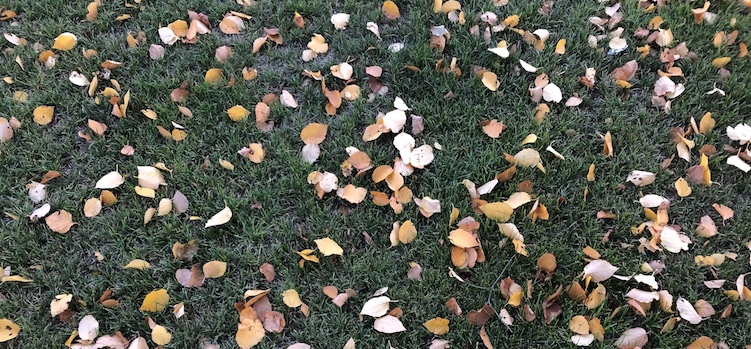
Once a story has become a truth, it can be easy to find observations that bolster that truth. I sat outside under a large birch in my front yard last week, on September 21st, the last day of summer. The air was cool in the shade, and I moved to the sun to be more comfortable. Some of the leaves were changing color but only a handful had fallen to the grass below. A week later and firmly into the fall season, I sat under the birch again. It was sunny, and there was a light breeze. This time, the grass was covered in orange leaves, and more fell quietly as I sat. Summer had turned to fall and the leaves acted accordingly.

Of course, as the years pass and climate change disrupts known weather patterns, those branches  may well hold on to their leaves a little longer, and we may need to adjust our story about the coming of fall. 

This tree is the subject of another climate story, too. During this summer’s heat wave, temperature records were broken across British Columbia and the Pacific Northwest. In Golden, where I live, temperatures were in the high thirties (celsius) for over a week. It was not weather that residents were used to or prepared for. To my great luck, the birch tree stood to the south of our house and acted as a giant shade. It provided effective natural cooling for our home during the heat wave (an event that will surely happen again in the future). This gave me a first-hand perspective on the idea that, as climate change intensifies, planting trees like this birch could provide much-needed shade in the face of rising temperatures.

Perhaps the birch in my front yard can help me to tell climate stories in my day-to-day life. How do I find the voice to give life to these stories? Bayer and Hettinger (2019) asserted that storytelling comes naturally to humans. How do I tap into that innate skill to tell climate stories more often? After all, Hayhoe (2019) argued that one of the most critical things that we can do to combat climate is to simply talk about it. I find that climate is a difficult subject to broach, and I often wonder what tools I could use to help me navigate the topic in conversation. 

References

Bayer, S., & Hettinger, A. (2019). Storytelling: A natural tool to weave the threads of science and community together. Bulletin of the ecological society of America, 100(2), 1-6. https://doi.org/10.1002/bes2.1542

Hayhoe, K. (January 11, 2019). The most important thing you can do to fight climate change: talk about it [Video]. TED. https://www.youtube.com/watch?v=-BvcToPZCLI&t=14s

Perez Herranz, C. (October 24, 2014). Why everything is a story [Video]. TEDxMadrid. https://www.youtube.com/watch?v=3InAj96h06k 

Tiny Ecology Project #1: Stories we tell Read More »