
Canada’s Changing Climate: A primer for Canadian Architects
August 30, 2021
The IPCC 6th Assessment Report confirms unequivocal evidence on the magnitude and speed of climate change (IPCC, 2021, p.5) presenting unprecedented risks to ecosystems, our society, and our economy. Vulnerable populations and Indigenous peoples are disproportionately impacted by climate change, and will bear the highest of impacts (Alston, 2019, para. 11 & Boyd, 2019, para. 48) raising significant human rights concerns. Mainstream architectural practice has not yet fully recognized the urgency of the climate crisis, the disproportionate climate impacts on the most vulnerable in society, and the necessity of design for both adaptation and mitigation.
While mitigation measures such as increasing energy efficiency are broadly understood, efforts towards low or zero carbon buildings are the exception in practice, and adaptation literacy is low. Accelerating the transition to a low-carbon and climate-resilient built environment requires enhanced literacy on climate change and its associated risks, tools to link building science and climate science, and design for climate risk adaptation and mitigation.
Canada’s Climate is Changing
Globally, the concentration of atmospheric CO2, the primary driver of climate warming, is now greater than Earth has experienced for over 800,000 years (Emanuel, 2020, p. 48). If we continue our current emissions’ intensive growth, by 2100 we will quadruple atmospheric CO2 equivalent over pre-industrial levels. This level of atmospheric CO2 has not been seen for 50 million years, a time when sea level was 70 meters higher than today, and alligators inhabited Greenland. (Emanuel, 2020, p. 29).
Canada is warming at twice the global average with the north warming fastest followed by the western provinces (Bush et al., 2019a, 125). Canada’s Changing Climate Report (Bush et al., 2019b) provides future projected warming scenarios using different Representative Concentration Pathways (RCPs). By 2100 the low warming scenario (RCP2.6) forecasts an average Canadian temperature of 1.7o Celsius (C) over 1986-2005 (p. 6). The high warming scenario (RCP8.5) forecasts an approximate 6.3o C average warming over 1986-2005 (p. 6). Under this scenario the Canadian climate and ecosystems will be unrecognizable. Such changes will impact human and ecosystem health as well as the ability of our built infrastructure to provide fundamental safety and protection. How then do design professions respond?
Climate Action Includes Mitigation and Adaptation
Effective climate action requires both adaptation and mitigation practices and the speed at which we reduce atmospheric greenhouse gas (GHG) emissions (mitigation) directly influences the magnitude of future climate risks and scale of adaptation necessary.
Mitigation in building design refers to actions that reduce the release of GHG emissions and in turn future warming. To hold warming to below 2o C requires a rapid transition to net-zero carbon new and existing buildings, including both operational and embodied carbon in materials. Land use changes are the second largest driver of global warming. As we consider the embodied carbon in building materials and the land impacts of material harvesting and extraction, the importance of retrofitting existing buildings over new builds becomes much more evident.
Adaptation to climate change is defined as an “…adjustment in the ecological, social, or economic systems in response to actual or expected climatic stimuli and their effects and impacts.” (IPCC, n.d.). Architects engage in adaptation when they design projects with improved resilience to the projected future climate change and its impacts. This requires asking questions such as: how will average temperature and precipitation trends change over the lifespan of this building; what range of extreme weather events may impact this project; how will climate change impact human health and comfort, building energy use, energy and water availability, and building envelop performance; how will the design of this project anticipate these changes?
As current building codes are based on outdated historical climate data, architects and allied design professionals must look to climate science projections to guide planning and set project design parameters. An increasing number of tools are now available to bridge climate science to building science.
Tools to Bridge Climate Science and Building Science
The RCPs identify potential projected climate warming pathways, but how do we translate this to improve the resilience of buildings and their sites? ClimateData.ca offers temperature and precipitation projections based on the RCPs for Canadian cities (ClimateData.ca, n.d.). For example, Figure 1 below highlights projected increases in Cooling Degree Days (CDDs) for Calgary based on different RCPs scenarios. This graph can be used to support a science-informed discussion on what level of warming a project should be designed for to maintain human health and comfort over a 50–80-year building lifespan. By 2100 under a high warming scenario, Calgary may see an increase of well over 700% in CDDs from a 2005 baseline, while the low scenario estimates a 50% increase. Both scenarios are linked to significant increases in wildfire risks with resultant impacts on air quality. A precautionary approach would be to design for the high impact scenario, particularly for core health care and other social service buildings where the consequences of an inability to maintain necessary indoor air quality and temperatures are high.
Figure 1.
Illustrates projected increases in cooling degree days for Calgary, Alberta

Note. The red line is RCP8.5 Median, green is RCP4.5 Median, blue is RCP2.6 Median, and grey is Modeled Historical. The inset box provides Cooling Degree Day data for the selected year, in this example 2100 and a 2005 (ClimateData.ca, n.d., harvested August 30, 2021)
Low-Carbon and Climate-Resilient Buildings
Architects swear an oath to protect the public. Given the severity of climate change impacts and resultant risks to human health and human rights, architects have a direct responsibility to advance a rapid transition to a low-carbon and climate-resilient built environment. The Marrakesh Partnership provides a framework to keep global warming under 2o C and preferably 1.5 o C in alignment with the Paris Agreement. Within the built environment there are two focuses areas (Marrakesh Partnership, 2021, p. 2). The first is whole-life carbon mitigation, which encompasses both operational carbon and embodied carbon in building material flows across the full life cycle from extraction through ultimate material reuse and recycling. The second is adaptation and resilience, which addresses the importance of strengthening the resilience of the built environment to chronic and acute climate change impacts.
Figure 2 demonstrates the pathway to low-carbon and climate-resilient buildings, which necessitates a focus on both whole-life carbon mitigation and design for adaptation. One without the other leaves assets and communities at risk.
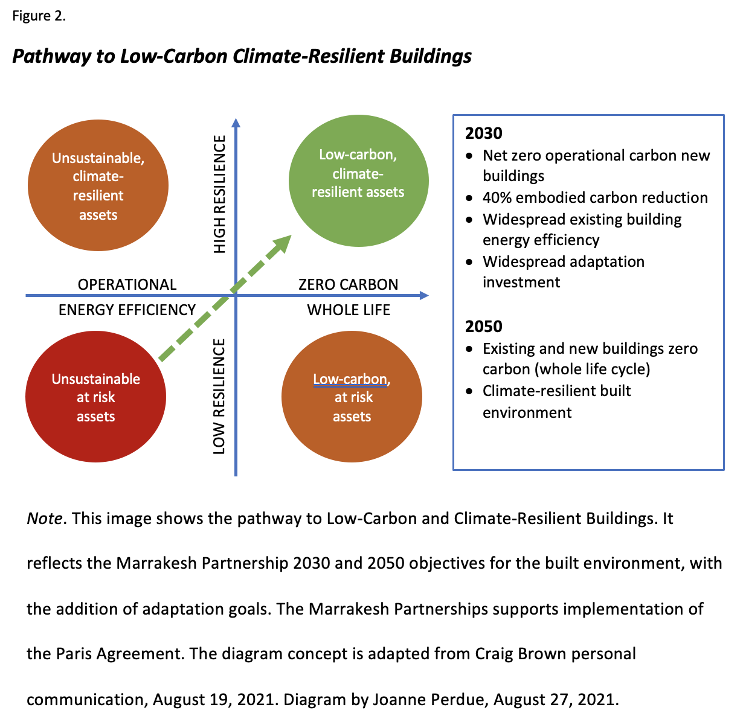
The built environment is a significant contributor to anthropogenic CO2 emissions, conversely it is also a powerful pathway to the mitigation of future warming and increased resilience to climate change impacts. Climate scientists have provided the evidence of unprecedented levels of climate change and tools to help bridge climate science to building science. Increasing climate literacy and awareness of available tools to integrate climate-science in building design is a key step to accelerate the transition to a low-carbon and climate-resilient built environment.
References
Alston, P. (2019). Climate change and poverty: Report of the Special Rapporteur on extreme poverty and human rights. UN Human Rights Council. https://digitallibrary.un.org/record/3883131?ln=en
Boyd, D.R. (2019). Safe Climate: A Report of the Special Rapporteur on Human Rights and the Environment. UN Human Rights, Office of the High Commissioner. Report to UN General Assembly. https://www.ohchr.org/Documents/Issues/Environment/SREnvironment/Report.pdf
Bush, E., Gillett, N., Watson, E., Fyfe, J., Vogel, F., Swart, N. (2019a). Understanding Observed Global Climate Change; Chapter 2 in Canada’s Changing Climate Report. Government of Canada. https://changingclimate.ca/site/assets/uploads/sites/2/2020/06/CCCR_FULLREPORT-EN-FINAL.pdf
Bush, E., Gillett, N., Bonsal, B., Cohen, S., Derksen, C., Flato, G., Greenan, B., Shepherd, M., Zhang, X. (2019b). Canada’s changing climate report – Executive summary. https://changingclimate.ca/site/assets/uploads/sites/2/2019/03/CCCR_ExecSummary.pdf
Climatedata.ca. (n.d.). Climate Data for a Resilient Canada. https://climatedata.ca/
Emanuel, K.A. (2020, May 15). Climate Science, Risk & Solutions. Massachusetts Institute of Technology. https://climateprimer.mit.edu/climate-science-risk-solutions-1220.pdf
Intergovernmental Panel on Climate Change. (2021). Summary for Policymakers. In: Climate Change 2021: The Physical Science Basis. Contribution of Working Group I to the Sixth Assessment Report of the Intergovernmental Panel on Climate Change. https://www.ipcc.ch/report/ar6/wg1/downloads/report/IPCC_AR6_WGI_SPM.pdf
Intergovernmental Panel on Climate Change. (n.d.). What do adaptation to climate change and climate resilience mean? https://unfccc.int/topics/adaptation-and-resilience/the-big-picture/what-do-adaptation-to-climate-change-and-climate-resilience-mean
Marrakesh Partnership. (2021) Climate Action Pathway: Human Settlements Action Table https://unfccc.int/sites/default/files/resource/HS_ActionTable_2.1.pdf
Canada’s Changing Climate: A primer for Canadian Architects Read More »
