
CALS 502 Assignment 4 – Double Remix – Part 1
CALS 502 Assignment 4 – Double Remix – Part 1 Read More »
October 20, 2021
In Episode 5 of the Post Carbon Institute’s podcast series entitled What could possibly go right? (2020), Suzanne Moser shares a compelling perspective on the importance of hope in hard and uncertain times, and how uncertainty itself lays the foundation for hope. Moser highlights two core ingredients of hope. The first is getting a real assessment of the current state – what I refer to as ‘facing the facts’ and the uncertainties for the future they present, and second is then searching together for what could possibly be a better way forward (Moser, 2020, 5:34). I found this perspective intriguing because in many ways it brings together the core content of CALS500 – Climate Science, Impacts, and Services, and CALS501 – Leading Climate Action in Society. Climate Science provides us the means for ‘facing the facts’ and getting a real assessment of the current state, and Leading Climate Action in Society focuses us on the art of supporting and empowering others for climate action. This led me to the questions: what are the core ingredients to convening and engaging others in climate action?
Climate action leadership entails working with diverse groups at organizational or community levels to find new ways forward. These groups comprise individuals with diverse life experiences, values and worldviews. Experiences, values and worldviews directly shape how individuals receive and respond to information about climate change (Hodson, 2019, p. 2). Views about climate change can be very different, and like vaccines and masks in the context of the COVID-19 pandemic, views on climate change can be highly polarized. The first core ingredient to convening and engaging others in climate action is then to find common ground from which to begin.
In organizational work, this might begin with working from common organizational values. For example, framing climate action in risk mitigation or business continuity. In community work common values may not be as easily identified. Here lies a second core ingredient which is an initial step in design thinking: to gain understanding and empathy. Crichton and Carter (2017) highlight that we can “gain empathy for a situation by developing understanding of the concerns, insights, lived experiences, and/or needs of others.” (p. 47). Through asking generative questions, perhaps also respectfully asking provocative questions, and then actively listening we gain understanding and empathy. From this learning emerges shared values or shared hopes and worries around which we can begin to collectively engage. Further, through inquiring more systemically and more deeply, we can begin to understand the “assumptions that underpin existing structures and ways of doing things.” (Lonsdale and Turner, 2015, p. 21). Perhaps even belief systems that hold current approaches in place. What then is the next core ingredient to move forward?
The magnitude of the climate crises and the complexity of addressing the climate change challenge can be overwhelming. Research has shown that providing climate change facts to motivate action has limited effectiveness in changing attitudes (Hodson, 2019 p. 2) and can lead to responses such as “doom, dissonance or denial” (Stoknes, 2017). So how then do we work with the tension between facing the facts and supporting and enabling others in climate action? This highlights the next core ingredient: find shared positive aspiration to ignite hope and the human capacity for innovation.
Positive framing around climate action has been shown to promote hope and a sense of self-efficacy (Armstrong et al., 2018). Adaptation refers to “adapting to life in a changing climate” (NASA, n.d.) and offers a more positive framing for climate action. For example, working together to protect shared community assets or a beloved regional ecosystem. Grounding climate action in community-based or organizationally-based adaptation approaches enables people to collaborate around shared positive aspiration and promotes hope.
As climate leadership professionals, climate science grounds our work in evidence and provides us with a real assessment of the current situation. It allows us to consider the diverse and far-reaching impacts of climate change; for example, impacts to human health and human rights, ecosystem health and food systems, and risks to core infrastructure and our communities. Each of these in-turn provides a pathway to talking about climate change. These impacts provide the basis for new conversations about how we might work together to protect what we value and love. Herein lies the balance between being grounded in the scientific facts and igniting the human capacity for empathy, creativity, collective action, and hope.
References
Armstrong, A. K., Schuldt, J. P., & Krasny, M. E. (2018). Establishing trust. Communicating climate change: A guide for educators. Cornell University Press. https://cornellopen.org/9781501730795/communicating-climate-change/
Crichton, S., & Carter, D. (2017) Taking Making Into Classrooms: A Toolkit for Fostering Creativity and Imagination. British Columbia Ministry of Education. file:///Users/jperdue/Downloads/Taking_Making_into_ClassroomsBC2018.pdf
Hodson, J. (2019). An ecological model of climate marketing: A conceptual framework for understanding climate science related attitude and behavior change. Cogent Social Sciences 5(1), 1-15. https://doi.org/10.1080/23311886.2019.1625101
Lonsdale, K., Pringle, P., Turner, B. (2015). Transformative adaptation: what it is, why it matters & what is needed. UK Climate Impacts Programme, University of Oxford, Oxford, UK. www.ukcip.org.uk
Moser, S. (2020, July 2). What Could Possible Go Right? [Video]. YouTube. https://www.youtube.com/watch?v=4bJTCOROhsA&t=1s
NASA (n.d.). Global Climate Change, Solutions. https://climate.nasa.gov/solutions/adaptation-mitigation/
Stoknes, P.E. (2017, December 8). How to transform apocalypse fatigue into action on global warming [Video]. YouTube. https://www.youtube.com/watch?v=F5h6ynoq8uM
CALS501 Assignment 4: Unit 2 Read More »
October 7, 2021

The brilliant crimson-red berry clusters of the Mountain Ash hang in contrast to her masses of green and yellow leaves. The leaves are like a watercolour painting, yellow bleeding into green, red emerging, a new painting each day as the cool nights enrich the palette. This splendid medley of the colours in my front yard reminds me that Autumn has come, a time of fast and intense change, a final majestic display before the quiet slumber of winter with its protective blanket of snow.
As Adrienne Maree Brown so poignantly writes in Emergent Strategy (2017), “Change is divine and constant” (p. 56). The spectacular changes of Autumn are a reminder that nature is in a perpetual state of change; reoccurring cycles of growth, splendor, decline, and rest. How different this is from our western socio-economic system with its perpetual pursuit of growth, taking without concern for rest or replenishing. How did we become so disconnected from the very ecosystems that sustain us and of which we are a part of? How do we rebuild connection?
In Returning the Gift, Robin Wall Kimmerer (2014) reminds us of the importance of paying attention as an “ongoing act of reciprocity” (par. 17). Paying attention to the natural world sharpens my seeing and connection to the gifts that surround me. It reminds me of the incredible beauty of Earth, how infinitely interconnected all of life is, and how blessed I am to be sustained by the abundance of nature every day. This gives me a clarity of purpose in the caring for these gifts that sustain life on Earth, it shapes me. Paying attention also reminds me that change is always occurring providing fresh perspective on the changes in my life. Perhaps paying attention can also offer fresh perspective on our response to the rapid pace and scale of climate change and biodiversity loss.
In her TED Talk, The most important thing you can do to fight climate change: talk about it, climate scientist Katherine Heyhoe (2019) underscores that the foremost thing we need to do is to talk about climate change and that this conversation must start with finding common values and things we care about. Hodson (2019) also affirms the importance of “attitudes, emotions, norms and values” (p. 2) in shaping beliefs about climate change information. Regardless of our socio-political views, we are all moved by the spectacular beauty of Autumn. Near where I live, tens of thousands of people go to the mountains each fall to view the larch forests turning yellow, setting the mountain side ablaze in colour. In my neighbourhood people walk more in Autumn and we stop to chat about how beautiful the colours are. Can this shared value of love for our natural environment provide an antidote to depolarize climate conversations? Can talking about what we love provide connection and an entry point for working together to protect what we love?
This Fall I am intentionally creating space is my daily conversations to pause and comment on the gifts of Autumn. My observation is that this sparks an immediate shared moment of gratitude, a moment of emotional connection. It also changes how we talk and what we talk about. I am learning a little more about people and what they care about. I find myself reflecting again on the power of nature’s beauty as a starting point for finding connection with one another through sharing stories about what we love and for initiating a conversation about the intensity of changes underway in our environment. In her ecological model for climate communications, Hodson (2019) highlights the importance of allies in climate communications for reaching broader audiences, increasing influence and building trust (p. 9). This leads me to ponder the role of nature herself in telling the story of climate change; perhaps she is our most powerful ally.
Here again, the poetic words of Robin Wall Kimmerer (2014) from her essay Returning the Gift offer wise council:
Paying attention to the more-than-human world doesn’t lead only to amazement; it leads also to acknowledgment of pain. Open and attentive, we see and feel equally the beauty and the wounds, the old growth and the clear-cut, the mountain and the mine. Paying attention to suffering sharpens our ability to respond. To be responsible.
This, too, is a gift, for when we fall in love with the living world, we cannot be bystanders to its destruction. Attention becomes intention, which coalesces itself to action. (pars. 17 and 18)
Fall has come and great change is also upon us. What can paying attention teach us about building connection with others and about vulnerability and resilience in the face of the profound change?
References
Brown, A.M. Emergent Strategy: Shaping Change, Changing Worlds. AK Press. 2017.
Hodson, J. (2019). “An ecological model of climate marketing: A conceptual framework for understanding climate science related attitude and behavior change.” Cogent Social Sciences 5(1), 1-15. https://doi.org/10.1080/23311886.2019.1625101. Accessed 7, October 2021.
Heyhoe, Katherine. (2019). “The most important thing you can do to fight climate change: talk about it.” YouTube, uploaded by TED, 11 January 2019, , https://www.youtube.com/watch?v=-BvcToPZCLI&t=14s.
Kimmerer, R. W. (2014). “Returning the Gift.” Center for Humans and Nature. Minding Nature: Spring 2014, Volume 7, Number 2 https://www.humansandnature.org/returning-the-gift-article-177.php. Accessed 7, October 2021.
August 30, 2021
The IPCC 6th Assessment Report confirms unequivocal evidence on the magnitude and speed of climate change (IPCC, 2021, p.5) presenting unprecedented risks to ecosystems, our society, and our economy. Vulnerable populations and Indigenous peoples are disproportionately impacted by climate change, and will bear the highest of impacts (Alston, 2019, para. 11 & Boyd, 2019, para. 48) raising significant human rights concerns. Mainstream architectural practice has not yet fully recognized the urgency of the climate crisis, the disproportionate climate impacts on the most vulnerable in society, and the necessity of design for both adaptation and mitigation.
While mitigation measures such as increasing energy efficiency are broadly understood, efforts towards low or zero carbon buildings are the exception in practice, and adaptation literacy is low. Accelerating the transition to a low-carbon and climate-resilient built environment requires enhanced literacy on climate change and its associated risks, tools to link building science and climate science, and design for climate risk adaptation and mitigation.
Canada’s Climate is Changing
Globally, the concentration of atmospheric CO2, the primary driver of climate warming, is now greater than Earth has experienced for over 800,000 years (Emanuel, 2020, p. 48). If we continue our current emissions’ intensive growth, by 2100 we will quadruple atmospheric CO2 equivalent over pre-industrial levels. This level of atmospheric CO2 has not been seen for 50 million years, a time when sea level was 70 meters higher than today, and alligators inhabited Greenland. (Emanuel, 2020, p. 29).
Canada is warming at twice the global average with the north warming fastest followed by the western provinces (Bush et al., 2019a, 125). Canada’s Changing Climate Report (Bush et al., 2019b) provides future projected warming scenarios using different Representative Concentration Pathways (RCPs). By 2100 the low warming scenario (RCP2.6) forecasts an average Canadian temperature of 1.7o Celsius (C) over 1986-2005 (p. 6). The high warming scenario (RCP8.5) forecasts an approximate 6.3o C average warming over 1986-2005 (p. 6). Under this scenario the Canadian climate and ecosystems will be unrecognizable. Such changes will impact human and ecosystem health as well as the ability of our built infrastructure to provide fundamental safety and protection. How then do design professions respond?
Climate Action Includes Mitigation and Adaptation
Effective climate action requires both adaptation and mitigation practices and the speed at which we reduce atmospheric greenhouse gas (GHG) emissions (mitigation) directly influences the magnitude of future climate risks and scale of adaptation necessary.
Mitigation in building design refers to actions that reduce the release of GHG emissions and in turn future warming. To hold warming to below 2o C requires a rapid transition to net-zero carbon new and existing buildings, including both operational and embodied carbon in materials. Land use changes are the second largest driver of global warming. As we consider the embodied carbon in building materials and the land impacts of material harvesting and extraction, the importance of retrofitting existing buildings over new builds becomes much more evident.
Adaptation to climate change is defined as an “…adjustment in the ecological, social, or economic systems in response to actual or expected climatic stimuli and their effects and impacts.” (IPCC, n.d.). Architects engage in adaptation when they design projects with improved resilience to the projected future climate change and its impacts. This requires asking questions such as: how will average temperature and precipitation trends change over the lifespan of this building; what range of extreme weather events may impact this project; how will climate change impact human health and comfort, building energy use, energy and water availability, and building envelop performance; how will the design of this project anticipate these changes?
As current building codes are based on outdated historical climate data, architects and allied design professionals must look to climate science projections to guide planning and set project design parameters. An increasing number of tools are now available to bridge climate science to building science.
Tools to Bridge Climate Science and Building Science
The RCPs identify potential projected climate warming pathways, but how do we translate this to improve the resilience of buildings and their sites? ClimateData.ca offers temperature and precipitation projections based on the RCPs for Canadian cities (ClimateData.ca, n.d.). For example, Figure 1 below highlights projected increases in Cooling Degree Days (CDDs) for Calgary based on different RCPs scenarios. This graph can be used to support a science-informed discussion on what level of warming a project should be designed for to maintain human health and comfort over a 50–80-year building lifespan. By 2100 under a high warming scenario, Calgary may see an increase of well over 700% in CDDs from a 2005 baseline, while the low scenario estimates a 50% increase. Both scenarios are linked to significant increases in wildfire risks with resultant impacts on air quality. A precautionary approach would be to design for the high impact scenario, particularly for core health care and other social service buildings where the consequences of an inability to maintain necessary indoor air quality and temperatures are high.
Figure 1.
Illustrates projected increases in cooling degree days for Calgary, Alberta

Note. The red line is RCP8.5 Median, green is RCP4.5 Median, blue is RCP2.6 Median, and grey is Modeled Historical. The inset box provides Cooling Degree Day data for the selected year, in this example 2100 and a 2005 (ClimateData.ca, n.d., harvested August 30, 2021)
Low-Carbon and Climate-Resilient Buildings
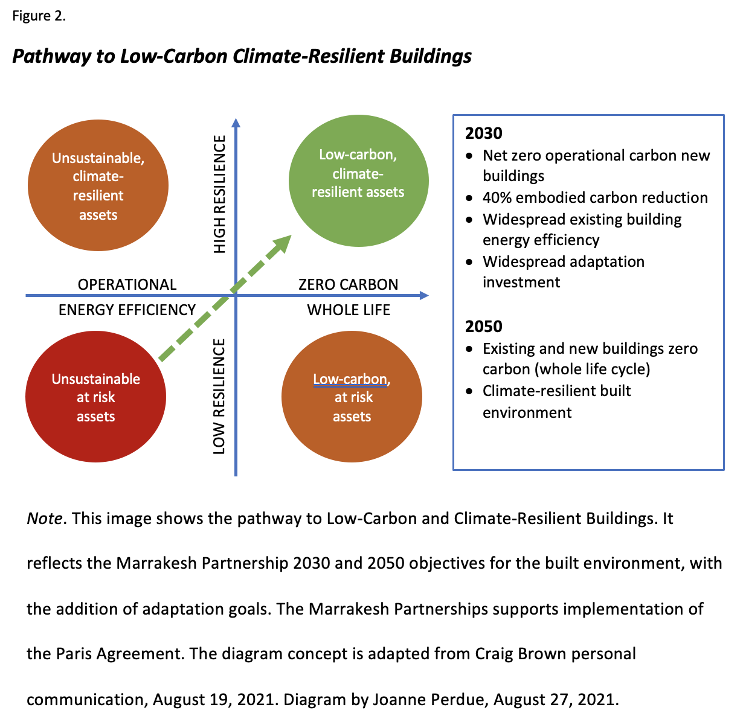
Architects swear an oath to protect the public. Given the severity of climate change impacts and resultant risks to human health and human rights, architects have a direct responsibility to advance a rapid transition to a low-carbon and climate-resilient built environment. The Marrakesh Partnership provides a framework to keep global warming under 2o C and preferably 1.5 o C in alignment with the Paris Agreement. Within the built environment there are two focuses areas (Marrakesh Partnership, 2021, p. 2). The first is whole-life carbon mitigation, which encompasses both operational carbon and embodied carbon in building material flows across the full life cycle from extraction through ultimate material reuse and recycling. The second is adaptation and resilience, which addresses the importance of strengthening the resilience of the built environment to chronic and acute climate change impacts.
Figure 2 demonstrates the pathway to low-carbon and climate-resilient buildings, which necessitates a focus on both whole-life carbon mitigation and design for adaptation. One without the other leaves assets and communities at risk.
The built environment is a significant contributor to anthropogenic CO2 emissions, conversely it is also a powerful pathway to the mitigation of future warming and increased resilience to climate change impacts. Climate scientists have provided the evidence of unprecedented levels of climate change and tools to help bridge climate science to building science. Increasing climate literacy and awareness of available tools to integrate climate-science in building design is a key step to accelerate the transition to a low-carbon and climate-resilient built environment.
References
Alston, P. (2019). Climate change and poverty: Report of the Special Rapporteur on extreme poverty and human rights. UN Human Rights Council. https://digitallibrary.un.org/record/3883131?ln=en
Boyd, D.R. (2019). Safe Climate: A Report of the Special Rapporteur on Human Rights and the Environment. UN Human Rights, Office of the High Commissioner. Report to UN General Assembly. https://www.ohchr.org/Documents/Issues/Environment/SREnvironment/Report.pdf
Bush, E., Gillett, N., Watson, E., Fyfe, J., Vogel, F., Swart, N. (2019a). Understanding Observed Global Climate Change; Chapter 2 in Canada’s Changing Climate Report. Government of Canada. https://changingclimate.ca/site/assets/uploads/sites/2/2020/06/CCCR_FULLREPORT-EN-FINAL.pdf
Bush, E., Gillett, N., Bonsal, B., Cohen, S., Derksen, C., Flato, G., Greenan, B., Shepherd, M., Zhang, X. (2019b). Canada’s changing climate report – Executive summary. https://changingclimate.ca/site/assets/uploads/sites/2/2019/03/CCCR_ExecSummary.pdf
Climatedata.ca. (n.d.). Climate Data for a Resilient Canada. https://climatedata.ca/
Emanuel, K.A. (2020, May 15). Climate Science, Risk & Solutions. Massachusetts Institute of Technology. https://climateprimer.mit.edu/climate-science-risk-solutions-1220.pdf
Intergovernmental Panel on Climate Change. (2021). Summary for Policymakers. In: Climate Change 2021: The Physical Science Basis. Contribution of Working Group I to the Sixth Assessment Report of the Intergovernmental Panel on Climate Change. https://www.ipcc.ch/report/ar6/wg1/downloads/report/IPCC_AR6_WGI_SPM.pdf
Intergovernmental Panel on Climate Change. (n.d.). What do adaptation to climate change and climate resilience mean? https://unfccc.int/topics/adaptation-and-resilience/the-big-picture/what-do-adaptation-to-climate-change-and-climate-resilience-mean
Marrakesh Partnership. (2021) Climate Action Pathway: Human Settlements Action Table https://unfccc.int/sites/default/files/resource/HS_ActionTable_2.1.pdf
Canada’s Changing Climate: A primer for Canadian Architects Read More »
July 20, 2021
The evidence of climate warming is unequivocal (IPCC, 2014a, p.4). A significant source of global greenhouse gas (GHG) emissions is building construction and operations, which represent nearly 40% of total global energy use and carbon dioxide (CO2) emissions (International Energy Agency, 2019, p. 9). This weighs heavy on me as an architect. Architects protect public safety and play a key role in shaping the built environment, but practice is not yet aligned with climate science. The following climate science primer for Canadian architects.
Canada’s Changing Climate
The scale of human generated climate change is unprecedented. The concentration of atmospheric CO2, the primary forcing factor of climate warming, is now greater than Earth has experienced in over 800,000 years (Emanuel, 2020, p. 48). If this path continues, by 2100 we will quadruple atmospheric CO2 equivalent over pre-industrial levels. This level has not been seen for 50 million years, a time when sea level was 70 meters higher than today, and alligators inhabited Greenland. (Emanuel, 2020, p. 29).
Canada is warming at twice the global average with the north warming fastest followed by the western provinces (Bush et al., 2019, 125). Canada’s Changing Climate Report highlights climate change to date and future projections depending on the choices we make (Bush et al., 2019). These projections are illustrated through Representative Concentration Pathways (RCPs) scenarios. By 2100 the low warming scenario under RCP2.6 forecasts an average temperature of 1.7o Celsius over 1986-2005 (p. 6). This is the only scenario that can hold average warming to below 2o Celsius relative to pre-industrial levels and meet the aspirational goals of the Paris Agreement (p. 6). This scenario requires significant reductions in global CO2 emissions over the next few decades and attaining near zero annual anthropogenic CO2 emissions by 2100 (IPCC, 2014b, p. 20). The high warming scenario under RCP8.5 forecasts an approximate 6.3o Celsius average warming over 1986-2005 (p. 6). Under this scenario the Canadian climate and ecosystems will be unrecognizable. Such changes will impact human and ecosystem health as well as the ability of our built infrastructure to provide fundamental safety and protection.
Tools to Bridge Climate Science to Practice
Climate science can be overwhelming with its many acronyms, complex scenario graphs, and evolving models. The following are a few frameworks and tools that make it easier to bridge climate science to practice.
The RCPs provide a picture of potential climate warming pathways based on different GHG concentration scenarios. But how do we translate this to improve the resilience of buildings and their sites? The new Climate Data for a Resilient Canada website offers temperature and precipitation projections based on RCPs for Canadian cities (Climate Data for Canada, n.d.). For example, Figure 1 below highlights projected increases in ‘cooling degree days’ for Calgary based on different RCPs scenarios. This graph can be used to support a science-informed discussion on what level of warming the project should be designed for to maintain human health and comfort over a 50–80-year building lifespan.
Figure 1
Illustrates projected increases in cooling degree days for Calgary, Alberta

Note. The red line is RCP8.5 Median, green is RCP4.5 Median, blue is RCP2.6 Median, and grey is Modeled Historical. Inset boxes with degree data appear based on the year highlighted (Climate Data for a Resilient Canada, n.d., harvested July 18, 2021)
The Shared Socioeconomic Pathways (SSPs) are another helpful framework to aid climate policy planning. The SSPs offer five scenarios with narrative descriptors of possible futures. Each differ in their socioeconomic assumptions such as the rate of population growth, urbanisation, and technological development (Hausfather, (2018) What are the SPPs? section, para. 4). The socioeconomic variables help expand climate policy from an emphasis on technological change (e.g., more stringent building energy codes) to include socioeconomic change (e.g., access to education as a determinant of fertility and population growth) (E. Pond, personal communication, July 14, 2021). RCPs and SSPs provide possible trajectories to help us understand potential futures under varying conditions. When combined with a precautionary approach, these trajectories can help inform climate-responsive design.
Adaptation Versus Mitigation
Adaptation is “an adjustment in the ecological, social or economic system in response to observed or expected changes in the climatic stimuli and their effects and impacts in order to alleviate adverse impacts of change…” (IPCC (2001) as cited in Adger et al., 2005, p. 78). Architects engage in adaptation when they design projects with improved resilience to climate change and its related impacts. Adaptation also refers to the adaptative capacity of individuals, groups, and organizations (Adger et al, 2005, p. 78). The profession of architecture will itself need to adapt to maintain relevancy in a rapidly changing climate. Mitigation refers to actions taken to reduce GHG emission reductions and in turn future warming. To meet the RCP2.6 pathway, a rapid transition to net-zero carbon buildings is needed, including both operational and embodied carbon in materials.
The built environment is a significant contributor to anthropogenic CO2 emissions, conversely it is also a powerful pathway to mitigation of future warming and adaptation to the impacts of our changing climate. Climate scientists have provided the evidence of unprecedented levels of climate change and tools to help bridge climate science to building science. Increasing climate literacy and awareness of available tools among architects and other design professionals is a necessary step to closing the gap between the rate of climate change and the building industry’s response.
References:
Adger, W.N., Arnell, N.W., and Tompkins, E.L. (2005). Successful adaptation to climate change across scales. Global Environmental Change, 15(2), 77-86. https://doi.org/10.1016/j.gloenvcha.2004.12.005.
Bush, E., Gillett, N., Bonsal, B., Cohen, S., Derksen, C., Flato, G., Greenan, B., Shepherd, M., Zhang, X. (2019). Canada’s Changing Climate Report: Executive Summary. Government of Canada. https://changingclimate.ca/site/assets/uploads/sites/2/2019/03/CCCR_
ExecSummary.pdf
Climate Data for Canada. (n.d.). Climate data to help build a more resilient Canada V1.8 [Interactive data trends]. Retrieved July 17, 2021, from https://climatedata.ca/
Emanuel, K.A. (2020, May 15). Climate Science, Risk & Solutions. Massachusetts Institute of Technology. https://climateprimer.mit.edu/climate-science-risk-solutions-1220.pdf
Hausfather, Z. (2018). Explainer: How ‘Shared Socioeconomic Pathways’ explore future climate change. Carbon Brief. https://www.carbonbrief.org/explainer-how-shared-socioeconomic-pathways-explore-future-climate-change
Intergovernmental Panel on Climate Change. (2014a). Summary for Policy Makers:Climate Change 2014 Synthesis Report Fifth Assessment Report. https://www.ipcc.ch/site/assets/uploads/2018/02/ipcc_wg3_ar5_summary-for-policymakers.pdf
Intergovernmental Panel on Climate Change. (2014b). Climate Change 2014: Synthesis Report https://www.ipcc.ch/site/assets/uploads/2018/02/SYR_AR5_FINAL_full.pdf
International Energy Agency and the United Nations Environment Programme. (2019). 2019 Global status report for buildings and construction: Towards a zero-emissions, efficient and resilient buildings and construction sector. https://www.ipcc.ch/site/assets/
uploads/2018/02/iphttps://www.unep.org/resources/publication/2019-global-status-report-buildings-and-construction-sector
Canada’s Changing Climate: A primer for Canadian Architects Read More »
June 14, 2021
A key determinant of our continued slow pace towards a just transition to rebuild ecosystem health and respond to the climate crisis can be found in our affinity for quick solutions; to achieve more transformational change we need to more deeply understand the problems we are seeking to solve and develop our capacity for complexity thinking.
Climate action in Western society is largely focused on incremental quick solutions with success determined in near term and local scales, often at a component level. This can lead to a false sense of progress and pre-empt the capacity for more transformative change. For example, a broadly considered climate change mitigation strategy is the rapid transition of cities to energy efficient buildings powered by renewable energy generation systems. However, in the absence of considering different spatial or temporal scales in the determination of success (Adger et al., 2005) we often fail to consider the socio-ecological consequences of scaling such solutions. For instance, the production of renewable energy systems and building materials have their own climate change consequences as a result of their extraction and production processes. Given the Earth’s finite resources, can this solution be delivered in an equitable way across all global communities? When we spend more time on exploring the problem and develop our capacity for complexity thinking, we see beyond the local contexts and begin to consider connections across and within interconnected socio-ecological systems (Dixon, 2017). In the city infrastructure example, considering Earth’s finite resources and a need for resource equity, might then lead to more transformative solutions such as developing regional circular material solutions or rethinking city planning and core energy needs. By centering our efforts on deepening problem understanding and developing the capacity for complexity thinking we increase the potential to attain more effective solutions and transformative change.
So how then do we refocus our thinking? The integration of Indigenous ways of knowing in climate action leadership contributes to the process of Reconciliation and provides a key pathway to recalibrate the predominate Western worldview and affinity for quick solutions. For example, gaining an understanding of traditional ecological knowledge and “the relationships of living beings (including humans) with one another and their environment” (Berkes, 1999, p. 8, as cited in Alexander, 2011, p. 477). can help shift Western perspectives from a predominant disassociation with the natural systems on which we depend. Further, In the exploration of a “…more relational disposition to collaborative knowledge creation and sharing.” (Goodchild, 2021, p. 79)., Melanie Goodchild contrasts the Western analytical pursuit of knowledge to the Indigenous practice of the pursuit of ‘wisdom in action’ (Goodchild, 2021, p. 79). Indigenous oral histories and storytelling can teach us how to listen more deeply, shift our worldview, increase our capacity to engage with complexity and thereby reflect more deeply on problem definition.
In the context of Reconciliation and climate action, resilience is an important determinate in shaping how systems respond to change. This is applicable at individual and community scales as well as within ecological and socio-economic systems. Béné’s three typologies of resilience (Béné et al., 2012, as cited in Lonsdale et al., 2015) include persistence, incremental adjustment and transformational responses. This provides a helpful way of thinking about different dimensions of resilience. For example, the persistence of social or economic structures to change can lock in unsustainable or colonial practices. At the other end of the spectrum, Christine Nieve’s TedMED 2018 talk on lessons post-Hurricane Maria demonstrates both individual and community level transformational responses in the face of severe disruptive change. A precondition for transformational responses is the degree of “…openness, adaptability and flexibility within the system.” (Dovers & Handmer, 1992, as cited in Lonsdale et al., 2015, p. 15). Thus, openness to Indigenous ways of knowing, flexibility to embrace change and the capacity for adaptive thinking are determinates in attaining transformative change.
Transformational change in the context of climate action requires a significant shift from quickly devised localized solutions to a deeper framing and understanding of the core problems with all their extended complexity. Reconciliation can provide an important pathway in broadening the Western mindset and exploring more deeply. Resilience thinking, particularly openness and adaptive thinking, establishes the conditions conducive to transformation change at individual and community scales. Such reflective change lays the path to transformative climate action.
References
Adger, W.N., Arnell, N.W., and Tompkins, E.L. (2005). Successful adaptation to climate change across scales. Global Environmental Change, 15(2), 77-86. https://doi.org/10.1016/j.gloenvcha.2004.12.005.
Alexander, C., Bynum, N., Johnson, E.G., King, U., Mustonen, T., Neofotis, P., Oettlé, N., Rosenzweig. C., Sakakiabara, C., Shadrin, V., Vicarelli, M., Waterhouse, J., & Weeks, B.C. (2011). Linking Indigenous and Scientific Knowledge of Climate Change. BioScience, 61(6), 477-484.
Dixon, T.H. (2011). “Complexity Science,” Oxford Leadership Journal, 2(1),1-15.
Goodchild, M., Senge, P., Scharmer, C.O., Roronhiakewen (He Clears the Sky), D.L., Kahontakwas, D.L., Hill, R., & Ka’nahsohon (A Feather Dipped in Paint), K.D. (2021). Relational Systems Thinking: That’s how change is going to come, from Our Mother Earth. Journal of Awareness Based Systems Change 1(1), 75-103. https://doi.org/10.47061/jabsc.v1i1.577
Lonsdale, K., Pringle, P. & Turner, B. (2015). Transformative adaptation: what it is, why it matters & what is needed. UK Climate Impacts Programme, University of Oxford, Oxford UK. www.ukcip.org.uk.
MACAL 501 Learning Intensive Reflection Read More »
Thanks to the MACAL leadership team and the inaugural MACAL cohort for a wonderfully rich first week in the Learning Intensive. Recalling the words of Mike Lickers, RRU Indigenous Scholar in residence, from our Tuesday session: “connectedness is co-created”. Thank you all for creating such strong connectedness over such a short period of time. I look forward to our journey together and continuing to learn from and be inspired by all of you.
Learning Intensive Thanks Read More »