One of the most discussed topics in the field of climate change is communication. There are as many ways to communicate as there are audiences. In CALS 502: Communication for climate action led by Shandell Shoulden, we get the chance to learn about several communication principles. For the past assignment, we were tasked to create communication content on something that we care about and that is related to climate change. Therefore, I decided to practice my skills in creating a video to engage the Royal Roads University community in the importance of getting a food garden on campus. I targeted the staff and faculty which represent about 500 people. I used important data from an internal survey to better understand how the community wants the institution to take action on climate change. The video seems like a great way to connect with the audience because the President uses it weekly.
The words of Armstrong et al. (2018) guide my ideas: “educators should prioritize programs that inspire hope and help build participants confidence in their capacity to be part of feasible climate solutions.” This is the reason why this time, I continue with the food garden project on the lands of Royal Roads University, however, the strategy aims to reach two new audiences: adolescents and young children.
Instagram and a Pop-Up theater will be further explored. These mediums seem more appropriate for a younger crowd than my first assignment. My goal is to motivate and move these audiences into collaborating and believing in the project.
Here is the vision!
Audience 1 – The Youth:
The United Nations defines the youth as the citizens between 15 and 24 years old. They represent 16% of the global population with 1.2 billion individuals.
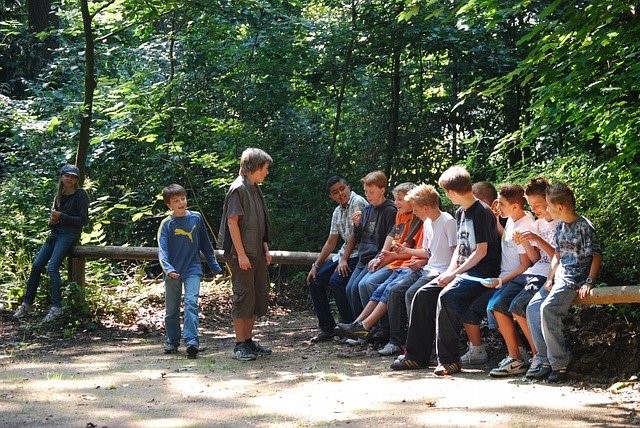
Youth – pixabay.com
If we recall the Global Climate Strike in 2019 millions of young people in 183 countries followed the example of the 16-year-old climate activist Greta Thunberg (Holthaus, 2020). They took to the streets and asked world leaders to urgently act. We see the same actions at the COP26 happening right now in Glasgow.
Youth have an enormous power to create change. Their roles “as “critical agents of change” become apparent (UN, 2019). They see what has worked in the past and what did not. They are a ray of light and hope in our society: they might not have been touched by the pessimism and capitalism that we experience as adults.
With the food garden project at Royal Roads University, the youth would most likely benefit from it. Creating the gardens would take many years which means that at its full potential -in 5 to 10 years- the youth would be in the age to collect and enjoy the fruits of their labour.
A more local and targeted audience could be the children of the staff and faculty and the ones living on the Westshore. After all, Armstrong et al. suggest that the effectiveness of building concern for an intergenerational program (parents with their kids) can be successful when done properly.
Instagram to connect with the audience
The posts on Instagram bring that “real-life” experience to the readers to make them feel engaged, empowered, and connected. As per Altinay (2017), images have powerful effects referred to as picture superiority. She mentions the place attachment as an influential tool to create change. By showing pictures of the space, youth would relate to it. In a similar way, her research concludes that the engagement with mitigation actions is improved upon people who express a connection to the place. Often you can hear youth on campus mentioning how much they appreciate the space: the attachment is there to open room for discussion.
Instagram seems like a great medium to make use of images for teenagers. The application ranked third for American teenagers, after Snapchat and Tik Tok. (Statista) The campaign should be adapted to these two other mediums.
Instagram allows visually impaired users to listen to the posts which is important to promote equity and justice.
The campaign – which can be organic or sponsored depending on funding – includes a post per day. A new account would be created by the university and handled by the food garden committee members. The name could be “royalroadssustainable” to align with the existing accounts of royalroadsu, royalroadsstudentsservices, and rruinterntational. It should start with royal roads for an easy find in the research options of Instagram and to be connected with the institution’s prestige.
The key message
Climate change is real and growing food on campus can be a lifesaver. The three values of the university are featured because they are relevant to the environment: be creative, be courageous. , and be caring.
13 first days
Each daily post promotes a letter. The first 13 posts to show RRU FOOD GARDEN in the Instagram gallery. Not a lot of words: only the power of a picture.
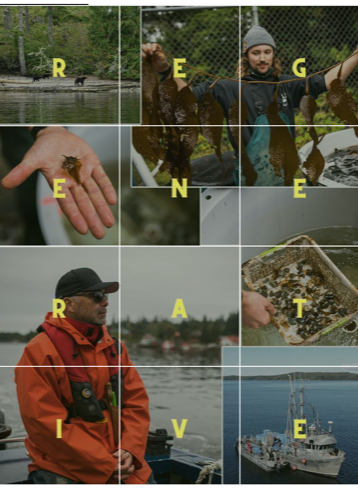
Example from Instagram
Cascadia Seaweed account on Instagram (Regenerative)
Day one with the picture of the land as it is now. Letter N in big. It is important to show the current site to connect the youth with the place. Message to display: Be creative. Can you envision a food garden that feeds our community right here? #foodgarden #rrufoodgarden #becreative
The post is shared as a story as well with a poll option and the question: how cool would it be to get a food garden on campus? Popular young music catches the attention and makes it more accurate for the audience.
Day two with the picture of an Indigenous youth who participates in the food garden project. Letter E in big. It is important to show the people of the same age who are involved: it can make the audience curious to learn more about the other volunteers. Message to display: Caring for the planet and the generations to come. Will you be part of it? #foodgarden #rrufoodgarden #caring
The post is shared as a story as well with a poll option and the question: Will you be part of it?
Day three with a reel/video of youth people gardening. Letter D in big. IT is crucial to demonstrate a school/community that works together to create something. The audience can see themselves as the actors in the video. Message to display: The courage to act. What can you do? #foodgarden #rrufoodgarden #courageous
14 days after
We use pictures of the fruits, herbs, vegetables, nuts, and products that will be grown on-site and explain their value to the audience. The use of trendy hashtags speaks to the youth. We tell them what they can cook with the products to impress their friends and family. We create a quiz to test their knowledge of local food and engage in the conversation. We ask them to post selfies with their favorite fruit or vegetable and to tell us more about the advantages of growing it yourself.
3 days after
We come back with three powerful letters -YOU – and use one per day. We show videos and pictures of local influencers and artists who garden. We connect the dots that it is cool to garden with the feasibility to do it at Royal Roads on campus. We invite the youth to comment.
Audience 2 – The Kids
Children represent almost 2 billion people on earth and Statista (2019) predicts the number to continue rising over the 4 next decades. This audience will be the leaders of tomorrow. The population that we need to think about when we act and take decisions today. Like the Seventh Generation Principle. Kids also have the power to influence their parents. They learn then they share. That sounds like a wonderful way to pass on information on climate change.
Theater SKAM to engage with them
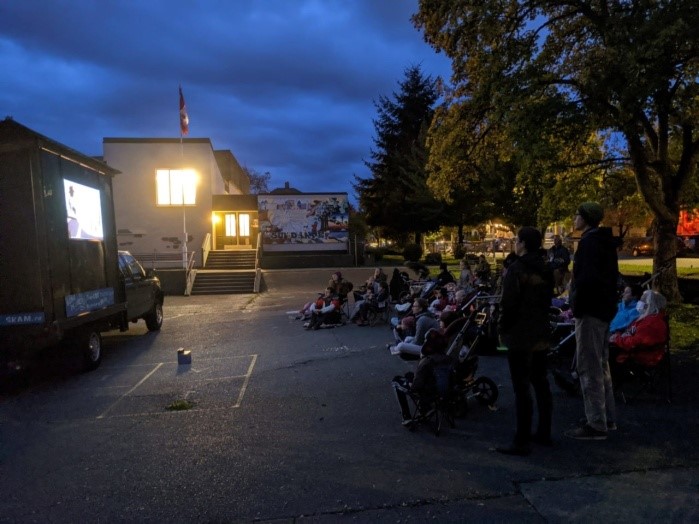
Skam Theater from website
On November 1st, 2021, I had the chance to watch a story shared by Theater SKAM at Summit Park. I immediately fell in love with the medium and its potential.
Their pop-up show, presented from the back of a truck, brought together at least 50 people, kids to adults. The power of being outdoors together, was genuine: a nice way to let the imagination takes over for a 10-15 minutes presentation. The kids around me were actively listening to the story of a fox being friends with the moon. The story was frankly simple, with no other sound heard: everybody was captivated.
Based on Schroth et al.’s (2014) recommendations on how to achieve a new perception of climate change, using local information in a community context with a local landscape and room for local solutions that citizens engage with can be the way to go. They mention keeping the communication local, visual, and connected (2014). Theater SKAM seems like a perfect medium to achieve these goals! After all, the company’s vision statement is “to produce high-quality provocative theatre for audiences in Victoria and on tour, working to create dialogue and partnership with like-minded arts practitioners (professional & non-professional), community groups and local experts.” Through dialogue and language, we can likewise create impact as climate actions communicators.
The key message
Theater SKAM can create a show that unites the power of growing our own food to fight climate change.
I imagine the story of a crow (the messenger from the spirit world in many native traditions) flying over the campus and seeing the impacts of climate changes (sea-level rise, drought, sad kids not able to get fresh produces because of the food supply being broken). Then, the crow meets with some kids and they all decide to plant seeds on the lands as the Indigenous peoples were doing thousands of years ago. What a miracle! Things grow and provide enough for the youth, their families, and friends. They get together on the land and enjoy being in the space.
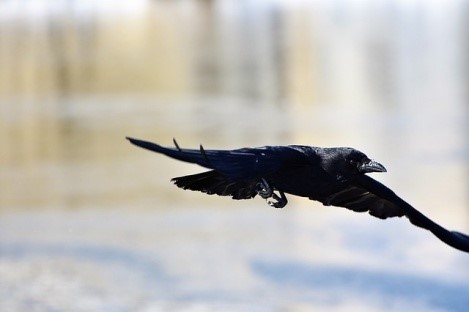
Crow flying – pixabay.com
The pop-up theater is a great way to integrate Kimmerer’s notion of relatives -instead of using natural resources- to talk about non-humans species and the use of she and he when referring to nature. The theater script employs metaphors to teach new words and ways of thinking.
Also, by using storytelling and characters, the audience acquires information and doesn’t overthink it! Bayer and Hettingter (2019) validate that “part of being human is sharing stories. And, in doing so, connections and perhaps even trust can be built.” The kids watching the pop-up theater would be able to reflect on the learning and share it with others.
The show can have its premiere at Royal Roads University at the exact spot where the committee wants to start the food garden. Then it can be presented in elementary schools on the Westshore (locally connected to the place).
In the end, there is hope that the next generations – youth and kids – will understand the importance of climate actions and act better than us in order to take care of mother earth. I concur with the author Eric Holthaus in his book “Future Earth” when he suggests that we need a revolution, that it is up to us to create a new world because the old one is dead, and that lasting change involves a future in which everyone matters.
References
Altinay, Z.(2017) Visual communication of climate change: Local framing and place attachment. Coastal Management. 45:4, 293-309, DOI:10.1080/08920753.2017.1327344
Armstrong, A. K., Schuldt, J. P., & Krasny, M. E. (2018). Using metaphor and analogy in climate change communication. In Communicating climate change: A guide for educators. Cornell University Press. https://cornellopen.org/9781501730795/communicating-climate-change/
Bayer, S. & Hettinger, A. (2019). Storytelling: A natural tool to weave the threads of science and community together. The Bulletin of the Ecological Society of America. https://doi.org/10.1002/bes2.1542
Holthaus, E. (2020). The future earth: A radical vision for what’s possible in the age of warming. HarperOne. USA.
Kimmerer, R. W. (2017). Speaking of nature: Finding language that affirms our kinship with the natural world. Orion Magazine. https://orionmagazine.org/article/speaking-of-nature/
Schroth, O., Angel, J., Sheppard, S., & Dulic, A. (2014) Visual climate change communication: From iconography to locally framed 3D visualization. Environmental Communication. 8:4, 413-43. DOI:10.1080/17524032.2014.906478
Statista (July 2021). Distribution of Instagram users worldwide as of July 2021, by age and gender. https://www.statista.com/statistics/248769/age-distribution-of-worldwide-instagram-users/
Statista (August 2019). Total number of people aged 0 to 14 worldwide from 1950 to 2100. https://www.statista.com/statistics/678737/total-number-of-children-worldwide/
United Nations. Department of Economic and Social Affairs. Young people are changing the world (2019, April 8). https://www.un.org/development/desa/en/news/intergovernmental-coordination/young-people-are-changing-the-world.html#.YZGzUHr_05M.mailto
United Nations. Peace, dignity and equality on a healthy planet. https://www.un.org/en/global-issues/youth Consulted on November 10, 2021.
Leave a Reply