
As global warming continues to impact our climate, I recently noticed the lack of understanding of the science behind it. For instance, Bennet et al (2021) state despite widespread concern for climate change in Canada, “the public is still not clear about the major causes of climate change” (p. 1). So, while I addressed effective approaches to climate communication in my previous blog post, I now realise how this lack of understanding may also leave an audience failing to grasp the urgency of the climate crisis and empower climate action. This provides an additional challenge but if the science is broken down in a way that is easy to understand then I think this can be avoided. Accordingly, for this to happen we need to help one another understand our climate system, our human relationship to it, and how we can project our future climate.
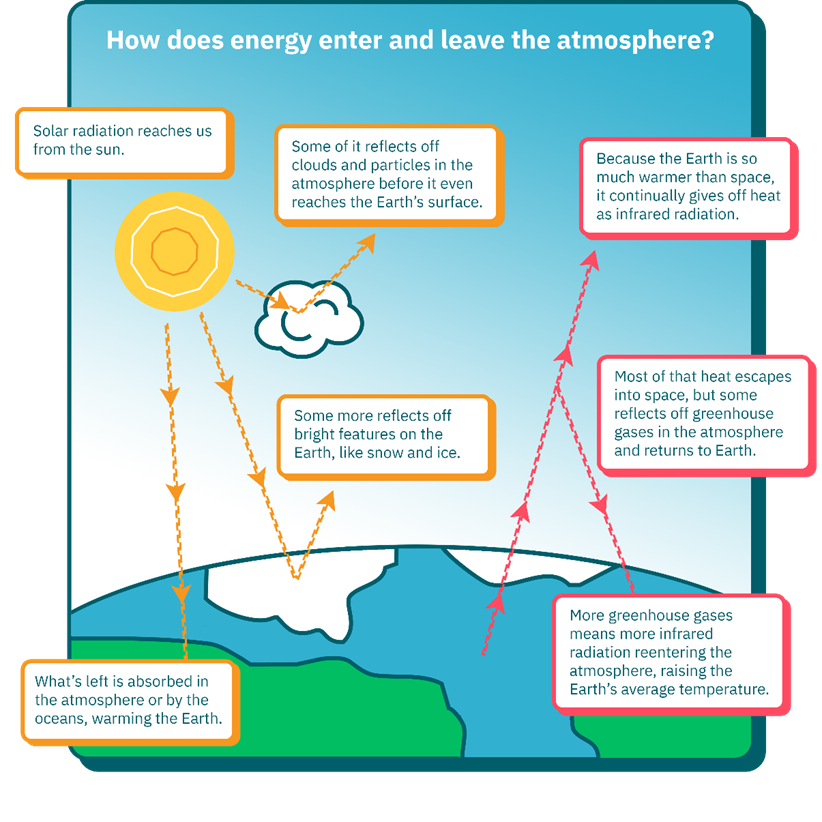
By understanding the primary functions of our climate system, one can better understand global warming. Now I could go into the weeds on the likes of jet streams, carbon sinks and tipping points but for the purpose of this blog I’ll focus on radiative forcing or energy. So, according to the Climate Primer by MIT (2020), earth receives energy from the sun and then reemits it from the earths surface. However, most of this energy is trapped from escaping the atmosphere by naturally occurring greenhouse gases (GHG) in the atmosphere such as water vapour, carbon dioxide and methane. This process is known as radiative forcing and can be seen in Figure 1. In addition, one may note how energy entering and leaving the atmosphere is also affected by the albedo affect, which is the reflection of energy from surfaces such as clouds and ice. But, as “each of the last four decades has been successively warmer than any decade that preceded it since 1850” (IPCC, 2021, p. 5), these ice sheets melt leaving less surface area available to reflect the suns energy which ultimately leads to greater warming of the earth. This is evidence that further warming of our planet needs to be reduced, but what is the primary cause of this warming?
Figure 1
How does Energy Enter and Leave the Atmosphere?
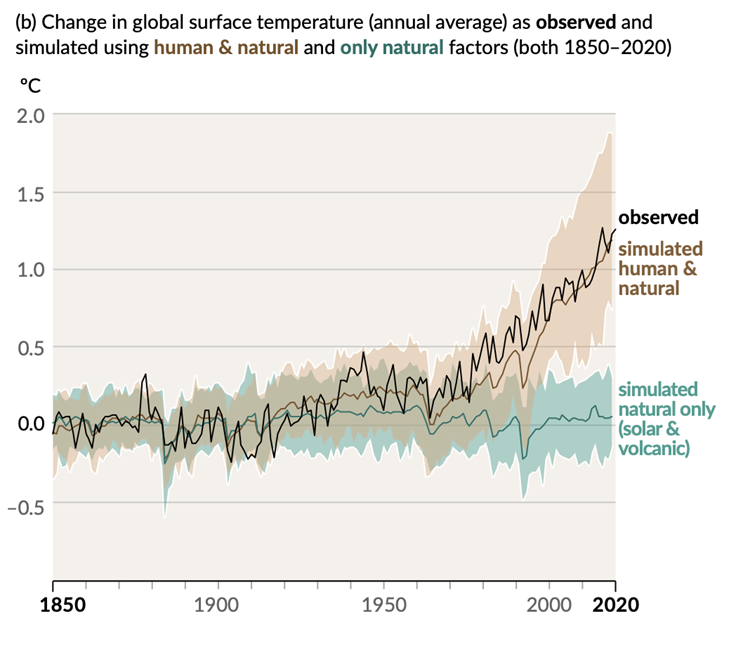
Well unfortunately for all the humans in the audience, you are the primary driver of global warming. This is clearly indicated in Figure 2 whereby human activity, primarily in the form of carbon dioxide emissions, has greatly influenced the warming of the planet. And sadly, things are not looking any rosier as according to the IPCC (2021) “in 2019, atmospheric CO2 concentrations were higher than at any time in at least 2 million years” (p. 8). So, as the concentration of carbon dioxide and other GHG’s increase in the atmosphere, this leads to increasing levels of radiative forcing that continue to warm the planet. Therefore, “it is unequivocal that human influence has warmed the atmosphere, ocean and land” (IPCC, 2021, p. 4). Consequently, we drastically need to reduce the burning of fossil fuels such as oil, natural gas, and coal as they are major contributors of carbon dioxide emissions (UNFCCC, 2000). But, while Figure 2 clearly indicates the influence human activity has had on the warming of our planet, how can we project future emissions and warming?
Figure 2
Changes in Global Surface Temperature relative to 1850-1900
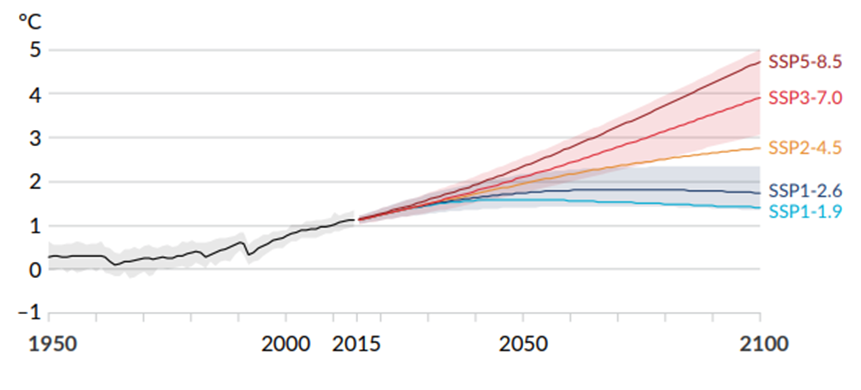
Climate scenarios provide us with an idea of both our future climate and future concentrations of GHG’s, but how is this done? Well, as we know GHG emissions cause the planet to warm one could say that “future emissions cause future additional warming, with total warming dominated by past and future CO₂ emissions” (IPCC 2021, p. 13). Consequently, scenarios are developed as plausible emissions pathways. To illustrate, Figure 3 displays a series of shared socio-economic pathway’s (SSP) along with the projected impacts on global surface temperature. These, SSP’s “make assumptions of how population, education, energy use, technology – and more – may change over the next century and couple them with assumptions about the level of ambition for mitigating climate change” Climate Data Canada (n.d.). In other words, what are the outcomes should society choose to follow the sustainability focused pathway of SSP1, or the high emissions pathway heavily centered on fossil fuels of SSP5? Again, these are plausible but as climate science has struggled to communicate global warming and the urgency to act, scenarios now benefit these discussions on the relationship between human activity and its impacts on global warming. Indeed, the decision now lies with us as to how we want to move forward and understanding the science is integral to that.
Figure 3
Global surface temperature change relative to 1850–1900
In summary, through greater awareness of this science we are better informed of the need for mitigation and the potential demands on adaptation no matter our background or discipline. By acknowledging how our climate system works and the influence human activity has, one can emphasize the importance of making climate action central to decision making. Furthermore, realizing impacts have been set in motion due to the concentration of GHG’s already present in our atmosphere makes us recognize the dangers of adding further emissions. And at the end of the day, that’s just it, our future climate doesn’t care about what pathway we take, only the GHG concentration when we get there. So, as the drivers of this change can we steer ourselves away from a warmer world?
References
Bennet, A., Hatch, C., & Pike, C. (2021). Climate messaging that works. Climate Narratives Initiative. https://climateaccess.org/sites/default/files/Climate%20Messaging%20that%20Works%20%20Talking%20Energy%20Transition%20and%20Climate%20Change%20in%20Canada.pdf
Chandler, D. (September 25, 2020). Radiative Forcing. MIT Climate Portal. https://climate.mit.edu/explainers/radiative-forcing
Climate Data Canada. (n.d.). Understanding Shared Socio-economic Pathways (SSPs)—Climate Data Canada. Retrieved December 17, 2022, from https://climatedata.ca/resource/understanding-shared-socio-economic-pathways-ssps/
IPCC. (2021). Summary for policymakers. In V. Masson-Delmotte, P. Zhai, A. Pirani, S. L. Connors, C. Péan, S. Berger, N. Caud, Y. Chen, L. Goldfarb, M. I. Gomis, M. Huang, K. Leitzell, E. Lonnoy, J. B. R. Matthews, T. K. Maycock, T. Waterfield, O. Yelekçi, R. Yu, and B. Zhou (Eds.), Climate change 2021: The physical science Basis. Contribution of Working Group I to the sixth assessment report of the Intergovernmental Panel on Climate Change, (pp. 1−32). Cambridge University Press. https://www.ipcc.ch/report/ar6/wg1/
M.I.T. (2022). Climate Science, Risk & Solutions. https://climateprimer.mit.edu/climate-science-risk-solutions.pdf UNFCCC. (2000, July 18). Climate Change Information Sheet 22: How human activities produce greenhouse gases. Information Unit for Conventions. https://unfccc.int/cop3/fccc/climate/fact22.htm#:~:text=Carbon%20dioxide%20from%20the%20burning,gas%20emissions%20from%20human%20activities