Sitting on this bench, I see a park full of life and a community that thrives around it. My neighbourhood has a new family of geese that just moved into the park, and while their presence has affected life at the park (so much geese poop you wouldn’t even believe), after a few days we all got used to it and things went back to business as usual. Today I’m sitting here after having read “The Uninhabitable Earth” by Wallace-Wells (2017), and when I look around, seeing people go about their regular business, I can’t help but wonder “how can anybody live life as normal when we are headed towards a climate catastrophe?”
I notice these thoughts are driven by my own fear. If Wallace-Wells (2017) is right, and things are actually worse than we think, why wouldn’t I be scared? In fact, when I think about the fact that “two degrees of warming used to be considered the threshold of catastrophe… [and] now two degrees is our goal”, I am terrified (Wallace-Wells, 2017). I feel a sudden urge to do something about climate change, and yet, I am sitting here, writing a school assignment, going about my regular business. I am experiencing the very phenomenon that has stunted climate action and has prompted many researchers to question the efficacy of a fear-based approach (Ettinger, Walton, Painter, & DiBlasi, 2021). What will it take for me to act in response to fear?
Reading “The Uninhabitable Earth” made me react in three different ways. First, I was scared. As predicted by Ettinger, et al., (2021), “The Uninhabitable Earth” achieved its intended emotional impact: to cause fear. The fear appeal presented throughout the article provided me with a strong feeling of fear; one that kept me engaged in what the article was saying and strengthened my belief in the need for immediate climate action. This feeling remained consistent throughout the article, and even occupied my mind after finishing reading it. However, this feeling did not last long. The slightest distraction from how scared I was about the climate crisis made this feeling fade away. As soon as I opened my phone, started texting, and scrolled through social media, my concern about a climate apocalypse simply vanished. I began thinking about plans with my friends. We couldn’t have a picnic at the park near my house because it was infested geese poop. I then saw a news article about the removal of the tent city in Downtown East Vancouver and made me want to do something to show my disapproval. Finally, a car ad reminded me that I need to make an appointment to go get an oil change this weekend, and with that, I was transported back to ‘reality’.
My second reaction was in motion, which was, for lack of a better word, disregard. With so many things going on in my life, the feelings of fear and urgency to act were pushed to the back of my mind. When a new event came up, the topic of a climate apocalypse was replaced and my attention was focused on more immediate threats (e.g., if I don’t get an oil change soon my car could breakdown and I would not be able to drive places). This is a well-documented self-preservation response, which can be explained by the distant aspect of climate change. When faced with events in our daily lives, our natural instinct makes us focus on more immediate concerns, which ironically places bigger threats, such as the potential end of the world, as less of a priority simply because they are further away in the future (Stoknes, 2015). This natural response did not make my fear about a climate apocalypse disappear, but it did undermine it and crippled my motivation to do something about it. Since I’m pretty sure that climate change is not going to destroy life as we know it before next week, but I’m still going to need to go to work, my priority today is to make sure I get an oil change so I can drive to work.
My final reaction was dismissal. The reason I am able to concentrate and write this assignment is because my unraveling thoughts led me to the cynical conclusion that “the climate is already f**ked, so why even bother.” This is the type of thought that I often criticize and I find myself battling with family, friends, co-workers, and even myself about it. But how can you blame me? The unwavering doom and gloom scenario that Wallace-Wells (2017) illustrates forces you to think that way. From unquestionable scientific evidence pointing towards the apocalypse, to the examples of experts concluding that “no plausible program of emissions reductions alone can prevent climate disaster”, the feeling of fear soon becomes a state of despair (Wallace-Wells, 2017). From here, as explained by many psychologists (e.g., Stoknes, 2015), our natural instinct is to resolve the dissonance generated by this information by returning to the safety of our daily lives. In other words, going back to business as usual.
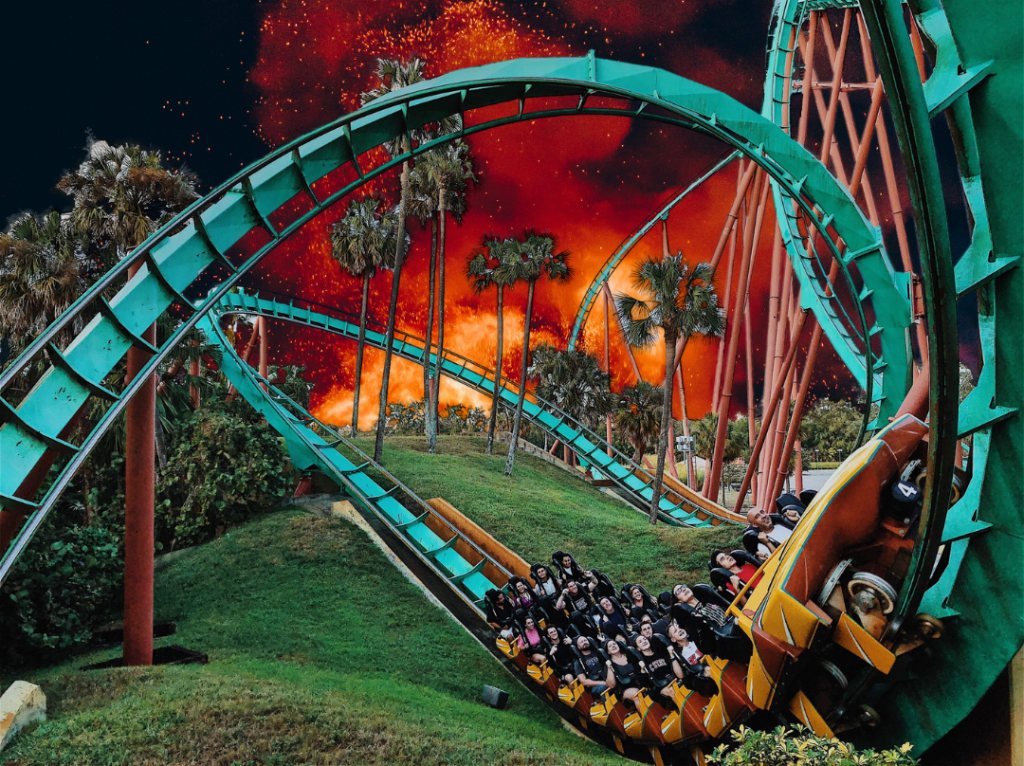
In a single afternoon, I have gone through what I can only describe as a rollercoaster. While reading “The Uninhabitable Earth”, the anxious anticipation of imagining a climate apocalypse felt like riding up a very tall rollercoaster, and the fear of reaching the top knowing you are only inches away from free-falling felt just like realizing we are headed towards an unlivable future. What came next was a state of distraction. The constant stream of new events distracting me from the climate crisis felt like riding the rollercoaster after realizing I wasn’t going to die. Just like when riding a rollercoaster your attention drifts to the turns, curves and feeling of adrenaline, the many events happening in my life captured my attention away from the concern of a climate apocalypse. In the end, stepping out of the rollercoaster at the end of the ride gives you a feeling of relief that is very similar to the one you get when you stop worrying about something. Convincing myself that there is no point in worrying about climate change today felt like talking myself into riding the rollercoaster again, even when I knew it is not something I want to do again. Writing this assignment has made me realize that, in fact, I have ridden this rollercoaster many times, and every time I have been just as frightened.
I take another look around, seeing people still going about their regular business, and I can’t help but wonder if they have ever ridden the same rollercoaster. After riding this rollercoaster form this park bench, I am still not anywhere closer to understanding what it would take for me to act in response to fear. However, I am now beginning to think that as long as I have more immediate concerns in my life than climate change, I am afraid I may keep going back to business as usual.
References
Ettinger, J., Walton, P., Painter, J., & DiBlasi, T. (2021). Climate of hope or doom and gloom? Testing the climate change hope vs. fear communications debate through online videos. Climatic Change, 164(1–2), 19. https://doi.org/10.1007/s10584-021-02975-8
Stoknes, P., E. (2015). What we think about when we try not to think about global warming: Toward a new psychology of climate action. Chelsea Green Publishing.
Wallace-Wells, D. (2017). The Uninhabitable Earth, Annotated Edition. Intelligencer. https://nymag.com/intelligencer/2017/07/climate-change-earth-too-hot-for-humans-annotated.html