Introduction
Climate change is the defining crisis of our time, yet despite decades of scientific breakthroughs and bold policy promises, global climate efforts remain insufficient. Why, with all our technology and scientific understanding, are we still struggling to make real progress? The answer lies in what’s missing: human connection. Climate action has traditionally been structured around two primary spheres: mitigation—reducing greenhouse gas emissions, and adaptation—strengthening resilience to climate impacts. While essential, these approaches largely target the environmental and physical aspects of the crisis, often overlooking the social, psychological, and cultural factors that shape how people understand, engage with, and act on climate issues.
Without addressing these human elements, even the most advanced climate solutions will struggle to achieve the transformative impact needed. Climate change is more than just a scientific or technical problem; it’s a deeply human challenge, and tackling it effectively requires a dedicated approach to climate communication that can bridge the gaps between science, public understanding, and meaningful change.
The Case for a Triad Approach to Climate Action
Throughout my studies in the Master of Arts in Climate Action and Leadership (MACAL) program at Royal Roads University, I had the opportunity to explore the complex challenges limiting effective climate action. While mitigation and adaptation target the physical impacts of climate change, these areas do not address the human dimensions of the crisis—how people think about, feel about, and ultimately respond to climate change. Climate communication, however, does just that. It reaches the human side of the issue, mobilizing public understanding, shifting attitudes, and inspiring action.
In Environmental Communication (2004), Dr. Alexander Flor argues that effective environmental action requires more than just scientific facts; it needs to resonate with people’s values, emotions, and cultural beliefs. This insight is rooted in the concept of deep ecology, which promotes a holistic view of the world, emphasizing the intrinsic value of nature and our interdependence with it. Recognizing climate communication as a third, core sphere of climate action allows us to integrate these perspectives, building an approach to climate action that goes beyond technical solutions to engage the deeper values that motivate change.
Defining Climate Communication
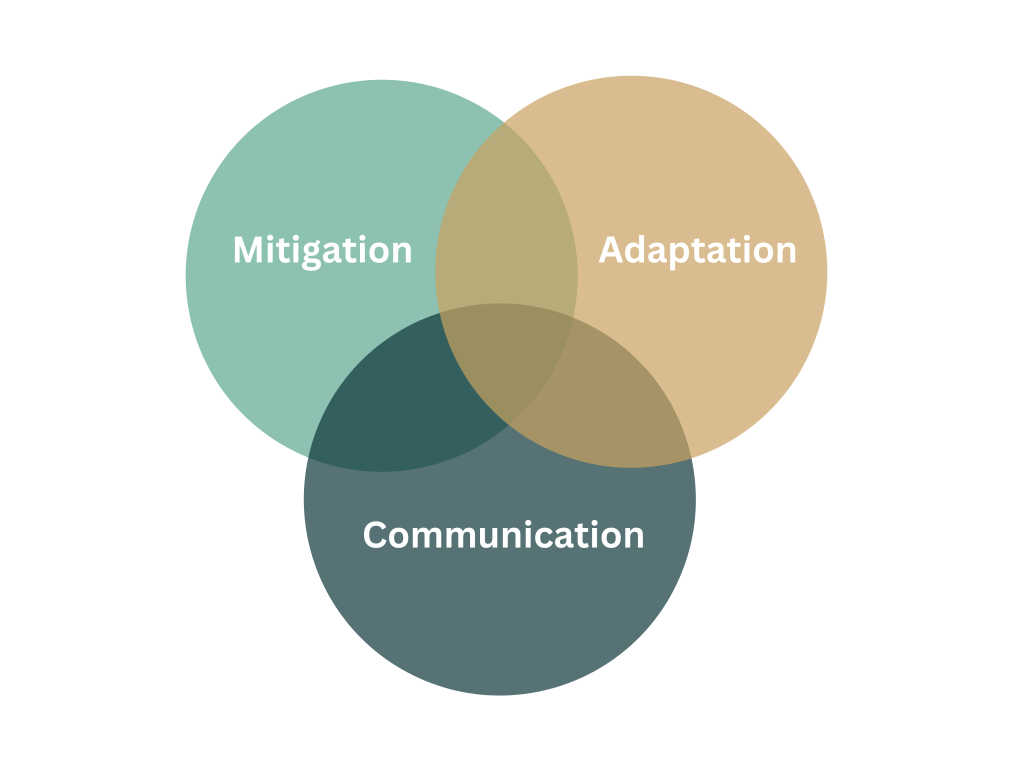
Currently, the United National defines climate action as encompassing efforts to reduce greenhouse gas emissions (mitigation) and build resilience to climate impacts (adaptation). Expanding this approach to include climate communication adds a critical third dimension: mobilizing society to understand, support, and engage in climate action.
Flor (2004) defines climate communication as the strategic application of communication principles to inspire environmental action. This involves engaging audiences through social, psychological, and cultural channels to foster real and lasting change. It’s more than just delivering facts; it’s about speaking to people’s experiences, values, and daily lives in ways that are relatable and impactful. This approach is grounded in transdisciplinarity, a principle that calls for integrating diverse forms of knowledge—including scientific, social, cultural, and Indigenous insights—to make climate solutions relevant and transformative. Effective transdisciplinary work relies on knowledge co-production—the shared creation of knowledge by different communities and disciplines. By incorporating climate communication as a third sphere of climate action and drawing from multiple disciplines, the proposed framework moves beyond the “information deficit model” and instead adopts an approach that speaks to people’s beliefs, values, and lived experiences. This shift is essential to creating the lasting public commitment needed for meaningful climate action.
Addressing the Gaps in the Current Framework
Integrating climate communication as a third sphere addresses several critical gaps in the existing climate action framework.
Narrow Focus of Current Climate Frameworks:
The existing framework, built around mitigation and adaptation, fails to engage the social dimensions that shape how people perceive climate change. While mitigation reduces emissions and adaptation builds resilience, neither approach addresses the beliefs, emotions, and cultural norms that determine how people respond to climate issues. Climate communication bridges this gap, making climate action more personal and relevant. Through the lens of deep ecology, it fosters a broader understanding of the interconnectedness between humans and nature, encouraging individuals to take ownership of environmental stewardship.
The Knowledge-Action Gap:
Too often, scientific knowledge fails to inspire public action. Research in this area reveals a gap between what we know and what we do, often due to the technical nature of climate science. Climate communication closes this gap by making science accessible, meaningful, and actionable. The principle of transdisciplinarity emphasizes the need to integrate insights from multiple epistemologies to create messages that resonate across different social and cultural contexts. By translating science into relatable concepts, climate communication can empower communities to engage in climate issues, enhancing the overall impacts of mitigation and adaptation efforts.
Human-Centric Barriers:
Human-centred barriers, such as cultural values, societal norms, and emotional resistance can further obstruct effective climate action. Climate communication directly targets these barriers by tailoring messages that align with community values and beliefs. Through polycentric governance, the proposed framework promotes collaboration across different governance levels, from local communities to national organizations. This decentralized approach allows for culturally sensitive strategies that resonate with local audiences, creating stronger buy-in and fostering resilience that is essential for the success of climate action.
Misallocation of Resources:
Finally, the current climate framework suffers from a misallocation of resources. Although social sciences are critical for understanding and overcoming behavioral barriers to climate action, most climate funding is directed toward technical solutions, leaving engagement efforts disproportionally underfunded. Recognizing climate communication as a core sphere of climate action can help legitimize the role of social science within climate efforts, encouraging a redistribution of resources that supports local, community-driven climate initiatives that speak to the unique needs of diverse communities.
Theoretical Foundations of Climate Communication
The proposed triad approach to climate action—mitigation, adaptation, and communication—is grounded in three core principles that strengthen and expand our response to the climate crisis: transdisciplinarity, deep ecology, and polycentric governance.
Transdisciplinarity promotes collaboration across disciplines, creating a more inclusive approach to climate solutions that respects scientific, social, and cultural knowledge. Effective transdisciplinary efforts rely on knowledge co-production, which is based on the shared creation of knowledge by diverse actors. This approach is not about simple knowledge integration; it’s about fostering what Klenk and Meehan (2015) call “ontological friction,” where differing perspectives challenge each other, leading to innovative, context-sensitive solutions. In the proposed climate action framework, climate communication strengthens adaptation and mitigation strategies by incorporating multiple perspectives, enhancing cultural relevance, and increasing accessibility to diverse communities. This inclusivity breaks down barriers between disciplines and fosters a broader understanding of climate challenges, making scientific insights actionable across varied social and cultural contexts.
Deep Ecology, a concept articulated by Naess (1989) and expanded upon by Flor (2004), instills respect for nature’s intrinsic worth, encouraging a mindset shift from viewing the environment solely as a resource to understanding it as an interconnected system that includes us. Through values-based communication, deep ecology fosters a public commitment to sustainable practices, amplifying the impact of both mitigation and adaptation efforts. Integrating deep ecology into climate action fosters a sense of shared ecological responsibility, inspiring individuals and communities to engage in long-term, engage in sustainable practices.
Polycentric Governance supports a decentralized, adaptive approach where multiple centres of decision-making operate across local, regional, and national levels. In the context of climate action, polycentric governance allows diverse actors across multiple governance levels to collaborate while responding to local needs and contexts, promoting locally adaptive solutions while ensuring alignment with broader climate strategies. This principle strengthens climate action by enabling multi-level engagement and coordination. Within the triad approach, climate communication becomes a vehicle for connecting localized actions with broader policy goals, promoting scalable solutions that resonate at grassroots levels while feeding into national and global policies. By supporting local adaptation and mitigation while maintaining an overarching strategy, polycentric governance makes the climate action framework more resilient and adaptable.
Rooted in these principles, the proposed triad approach aims to build on ecological values, foster innovative strategies, and mobilize coordinated efforts across diverse governance levels.
Benefits of Establishing Climate Communication as a Core Sphere
Recognizing climate communication as a core sphere of climate action brings multiple benefits.
First, it enables a strategic redistribution of resources to support social science research that addresses critical social challenges. By legitimizing climate communication, the expanded framework aligns funding priorities with the realities of climate challenges, supporting solutions beyond technical fixes.
Another key benefit is bridging the science-practice gap. Climate communication transforms research into practical applications, ensuring that scientific insights reach the public in an understandable and impactful way. This alignment between knowledge and action strengthens the reach of climate science, making it more likely that communities will take informed action.
Finally, climate communication is central to fostering public support and driving behavioural change. By delivering targeted, culturally relevant messages, climate communication cultivates broad societal commitment to climate action, creating a foundation for sustainable change. As a core sphere, climate communication not only supports mitigation and adaptation goals but amplifies them by creating a culture of resilience and climate awareness across all levels of society.
Conclusion
Incorporating climate communication as a third sphere of climate action is essential for addressing the full scope of the climate crisis. By focusing on the social dimensions of climate change, this approach bridges knowledge gaps, nurtures ecological values, and builds a foundation for transformative, sustainable solutions. Expanding the climate action framework to include climate communication aligns public understanding with scientific goals, creating a comprehensive, people-centred response that enhances climate resilience across all levels of society.
Climate change isn’t just a scientific problem—it’s a human one. By recognizing climate communication as a core sphere of climate action, we can inspire the collective commitment needed to secure a sustainable future for generations to come.
References
Arteaga, et al. (2023). Unpacking the theory-practice gap in climate adaptation. Climate Risk Management, 42, 100567.
Baker et al. (2020). The social structure of climate change research and practitioner engagement: Evidence from California. Global Environmental Change.
Brulle, R. J. (2018). The climate lobby: A sectoral analysis of lobbying spending on climate change in the USA, 2000 to 2016. Climatic Change, 149(3–4), 289–303.
Flor, A., G. (2004) Environmental communication: Principles, approaches and strategies of communication applied to environmental management. UP Open University.
Jordan, et al. (Eds.). (2018). Governing Climate Change: Polycentricity in Action? (1st ed.). Cambridge University Press.
Klenk, N., & Meehan, K. (2015). Climate change and transdisciplinary science: Problematizing the integration imperative. Environmental Science & Policy, 54, 160–167.
Mooney et al. (2022). The demise of the knowledge–action gap in climate change education, 103, 10. Bulletin of the American Meteorological Society.
Moser, S. C. (2016). Reflections on climate change communication research and practice in the second decade of the 21st century: What more is there to say? WIREs Climate Change, 7(3), 345–369.
Naess, Arne (1989). From ecology to ecosophy, from science to wisdom. World Futures.
NASA. (n.d.). Responding to climate change. NASA Science.
Overland, I., & Sovacool, B. K. (2020). The misallocation of climate research funding. Energy Research & Social Science, 62, 101349.
Stoknes, P. E. (2014). Rethinking climate communications and the “psychological climate paradox.” Energy Research & Social Science, 1, 161–170.
Stoknes, P., E. (2015). What we think about when we try not to think about global warming: Toward a new psychology of climate action. Chelsea Green Publishing.
United National Development Programme [UNDP]. (n.d.). FAQ-Enhancing human security through local climate actions. UNDP Nepal.