
When it comes to solving long-term problems, setting targets can be a beneficial strategy. Targets are designed to guide an individual or group towards achieving a measurable objective, which involves establishing an action plan and committing to following the steps towards an ultimate goal (Knittel, & Jones, 2021). Climate change is one of those challenges where setting targets is necessary if we are to measure our progress. Perhaps one of the most well-known climate targets is the key goal set for the Paris Agreement. That is, “holding the increase in the global average temperature to well below 2°C above pre-industrial levels and pursuing efforts to limit the temperature increase to 1.5°C above pre-industrial levels, recognizing that this would significantly reduce the risks and impacts of climate change” (UNFCCC, 2015, p. 4). In other words, the Paris Agreement aims to keeping global warming under 2°C above pre-industrial levels, but hopes to keep it under 1.5°C. Adopted by the vast majority of countries (United Nations, 2022), the Paris Agreement has been a landmark pact meant to inspire climate action across the globe. However, setting global temperature targets to guide climate action is perhaps not the most practical approach.
A common misconception is the idea that if global warming exceeds the 2°C mark at any given time, then we have failed to meet the Paris Agreement target. The reality is that the global surface temperature is unsteady, and it’s determined by the radiative forcing in the atmosphere generated by a variety of different factors, such as greenhouse gas (GHG) emissions, anthropogenic aerosols, solar radiation, volcanic activity, as well as internal climate variability (Allan, et al., 2021). These climate variables are found in a constant state of flux, which causes temperatures to fluctuate from year to year (Figure 1). Historical records suggest that annual fluctuations in global surface temperature are to be expected and will continue to follow a near-linear relationship with cumulative GHG emissions (Figure 1; Allan, et al., 2021). However, this trend is measured as the average in global surface temperature, meaning some years are expected to be warmer while others are expected to be cooler than the projected trend. The Paris Agreement target of 2°C is also set as an average in global surface temperature, which effectively assumes that there will be years in which global temperatures exceed our designated target of 2°C above pre-industrial levels. Theoretically, as long as the global average warming does not exceed 2°C, we would be successful in achieving the Paris Agreement goal, even if in some years the global temperature increases beyond 2°C above pre-industrial levels. However, the climate system presents additional complications to achieving a temperature target.
Figure 1
Global Temperature and Cumulative CO2 Emissions Projections for 2050
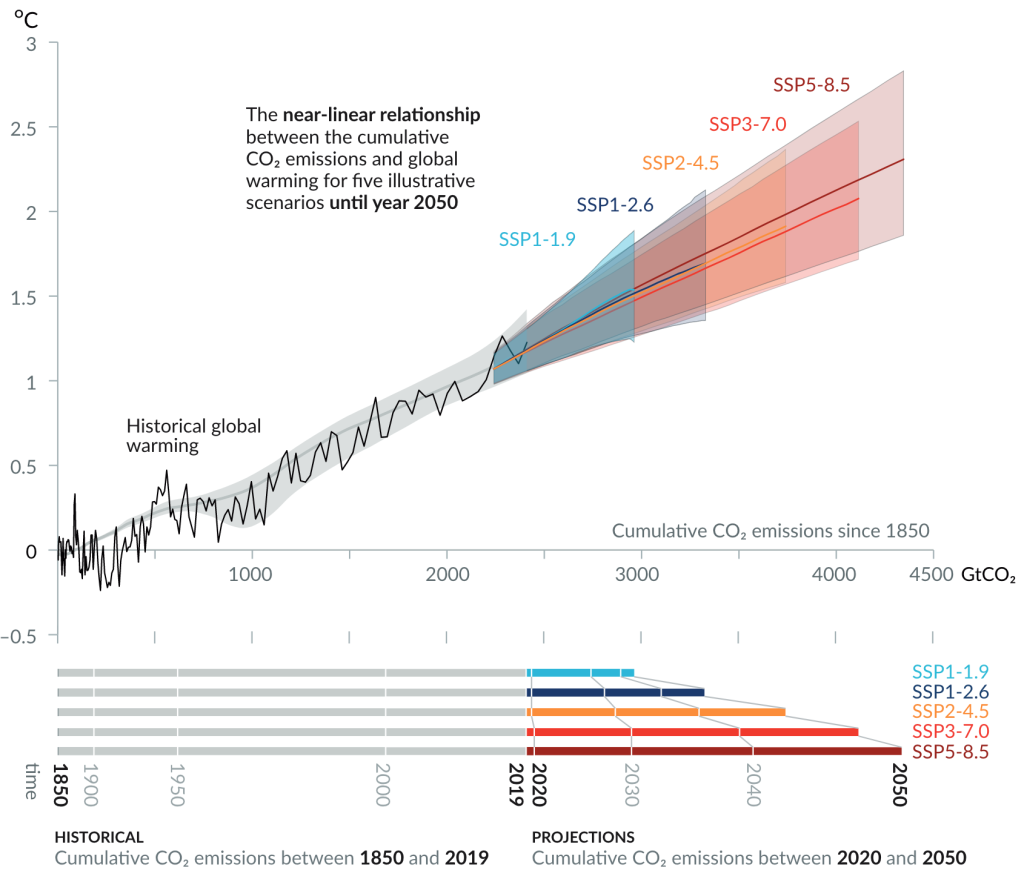
Note. This figure displays historical global warming since 1850 and SSP projections for 2050.
First, the dynamic interactions between climate variables create a level of uncertainty that not even the best climate models are able to bypass. Currently, in order to meet the Paris Agreement goal, the world would need to take the green road scenario (SSP1-2.6), which estimates global temperature to increase by 1.3°C to 2.4°C above pre-industrial levels towards the end of the century (Allan, et al., 2021). Under this Shared Socioeconomic Pathway (SSP), “the world [would] shift gradually, but pervasively, toward a more sustainable path” (Riahi, et al., 2017, p. 157). Unfortunately, following SSP1-2.6 does not guarantee we will reach, or even maintain, global warming to a specific degree. In fact, the latest report from Intergovernmental Panel on Climate Change (IPCC) presents the very likely possibility that under the SSP1-2.6 scenario, the global average temperature will increase anywhere between 1.3°C and 2.4°C above pre-industrial levels (Allan, et al., 2021). This means that even if the world strictly followed the green road scenario, it would be just as likely for the world to keep global warming under 2°C above pre-industrial levels as failing to meet the 2°C Paris Agreement target.
A second challenge to achieving the Paris Agreement goal is the irreversible nature of some climate impacts. Due to the longevity of anthropogenic climate drivers in the atmosphere, past GHG emissions have committed the world to future warming (Allan, et al., 2021). This means that even after reaching net-zero, the global average temperature would continue to rise until reaching a stable point. Continued GHG emissions would significantly increase the likelihood of irreversible global warming, or climate overshoot (Allan, et al., 2021; Arias, et al., 2021). Climate overshoot refers to the period in which the global average temperature increases beyond climate targets before stabilizing (Graves, 2019). In other words, if the world exceeds the 2°C average warming threshold, it would take decades, or even centuries, to restore the global average temperature to below the 2°C target. The moment Earth surpasses the 2°C average warming threshold, the world would fail to achieve the Paris Agreement target.
Despite being the mainstream climate goals, targets measured in degrees of warming are impractical for guiding humanity towards addressing climate change. In addition to creating confusion among the general public that leads to uninspiring headlines such as There’s a good chance we’ll miss our climate goals. So what’s the point in setting them? (Chung, 2021), current climate targets are susceptible to abundant uncertainty and dangerous tipping points that make specific temperature increases difficult to predict (Hopkin, 2007; Lenton, et al., 2019). Although warming targets, such as the Paris Agreement goal, may be easy to associate with climate change, for practical applications they provide unclear guidance. In contrast, setting global climate targets using carbon budgets or energy (radiation) budgets may provide a more pragmatic approach to achieving them by providing measurements that are more closely related with effective climate interventions (e.g., reduction in GHG emissions) (Froster, 2021; Hausfather, 2021). For this reason, I argue that alternative climate targets, such as the examples mentioned above, can offer better guidance for establishing action plans that set us up for success.
References
Allan, R. P., Cassou, C., Chen, D., Cherchi, A., Connors, L., Doblas-Reyes, F. J., Douville, H., Driouech, F., Edwards, T. L., Fischer, E., Flato, G. M., Forster, P., AchutaRao, K. M., Adhikary, B., Aldrian, E., & Armour, K. (2021). Summary for Policymakers. In: Climate Change 2021: The Physical Science Basis. Contribution of Working Group I to the Sixth Assessment Report of the Intergovernmental Panel on Climate Change. Cambridge University Press. 3–32. doi: 10.1017/9781009157896.001.
Arias, P. A., Bellouin, N., Coppola, E., Jones, R. G., Krinner, G., Marotzke, J., Naik, V., Palmer, M. D., Plattner, G.-K., Rogelj, J., Rojas, M., Sillmann, J., Storelvmo, T., Thorne, P. W., Trewin, B., Achuta Rao, K., Adhikary, B., Allan, R. P., Armour, K., Bala, G., Barimalala, R., Berger, S., Canadell, J. G., Cassou, C., Cherchi, A., Collins, W., Collins, W. D., Connors, S., Corti, S. D., Cruz, F., Dentener, F. J., Dereczynski, C., Di Luca, A., Diongue Niang, A., Doblas-Reyes, F. J., Dosio, A., Douville, H., Engelbrecht, F., Eyring, V., Fischer, E., Forster, P., Fox-Kemper, B., Fuglestvedt, J. S., Fyfe, J. C., Gillett, N. P., Goldfarb, L., Gorodetskaya, I., Gutierrez, J. M., Hamdi, R., Hawkins, E., Hewitt, H. T., Hope, P., Islam, A. S., Jones, C., Kaufman, D. S., Kopp, R. E., Kosaka, Y., Kossin, J., Krakovska, S., Lee, J.-Y., Li, J., Mauritsen, T., Maycock, T. K., Meinshausen, M., Min, S. K., Monteiro, P.M.S., Ngo-Duc, T., Otto, F., Pinto, I., Pirani, A., Raghavan, K., Ranasinghe, R., Ruane, A. C., Ruiz, L., Sallée, J.-B., Samset, B. H., Sathyendranath, S., Seneviratne, S. I., Sörensson, A. A., Szopa, S., Takayabu, I., Tréguier, A.-M., van den Hurk, B., Vautard, R., von Schuckmann, K., Zaehle, S., Zhang, X., & Zickfeld, K. (2021). Technical Summary. In Climate Change 2021: The Physical Science Basis. Contribution of Working Group I to the Sixth Assessment Report of the Intergovernmental Panel on Climate Change. Cambridge University Press. 33−144. doi: 10.1017/9781009157896.002.
Chung, E. (2021, November 4). There’s a good chance we’ll miss our climate goals. So what’s the point in setting them?. CBC News. https://www.cbc.ca/news/science/climate-change-targets-faq-1.6237074
Forster, P., Storelvmo, T, Armour, K., Collins, W., Dufresne, J. L., Frame, D., Lunt, D. J., Mauritsen, T., Palmer, M. D., Watanabe, M., Wild, M., and Zhang, H. (2021). The Earth’s Energy Budget, Climate Feedbacks, and Climate Sensitivity. In Climate Change 2021: The Physical Science Basis. Contribution of Working Group I to the Sixth Assessment Report of the Intergovernmental Panel on Climate Change. Cambridge University Press. 923–1054, doi: 10.1017/9781009157896.009.
Hausfather, Z. (2021). Analysis: What the new IPCC report says about when world may pass 1.5C and 2C. Carbon Brief. https://www.carbonbrief.org/analysis-what-the-new-ipcc-report-says-about-when-world-may-pass-1-5c-and-2c/
Hopkin, M. (2007). Climate sensitivity ‘inherently unpredictable’. Nature. https://doi.org/10.1038/news.2007.198
Knittel, C., & Jones, S. (2021, December 16). Climate Targets. MIT Climate Portal. https://climate.mit.edu/explainers/climate-targets#:~:text=Targets%20are%20the%20limits%20that,caps%20on%20greenhouse%20gas%20emissions.
Lenton, T. M., Rockström, J., Gaffney, O., Rahmstorf, S., Richardson, K., Steffen, W., & Schellnhuber, H. J. (2019). Climate tipping points—Too risky to bet against. Nature, 575(7784), 592–595. https://doi.org/10.1038/d41586-019-03595-0
Riahi, K., van Vuuren, D. P., Kriegler, E., Edmonds, J., O’Neill, B. C., Fujimori, S., Bauer, N., Calvin, K., Dellink, R., Fricko, O., Lutz, W., Popp, A., Crespo Cuaresma, J., KC, S., Leimbach, M., Jiang, L., Kram, T., Rao, S., Emmerling, J., Ebi, K., Hasegawa, T., Havlik, P., Humpenöder, F., Aleluia Da Silva, L., Smith, S., Stehfest, E., Bosetti, V., Eom, J., Gernaat, D., Masui, T., Rogelj, J., Strefler, J., Drouet, L., Krey, V., Luderer, G., Harmsen, M., Takahashi, K., Baumstark, L., Doelman, J., Kainuma, M., Klimont, Z., Marangoni, G., Lotze-Campen, H., Obersteiner, M., Tabeau, A., & Tavoni, M. (2017). The Shared Socioeconomic Pathways and their energy, land use, and greenhouse gas emissions implications: An overview. Global Environmental Change, 42, 153-168. https://doi.org/10.1016/j.gloenvcha.2016.05.009
UNFCCC. (2015). Paris Agreement. United Nations Framework Convention on Climate Change. https://unfccc.int/sites/default/files/resource/parisagreement_publication.pdf
United Nations. (2022, October 24). Status of Treaties: Chapter XXVII 7d. Treaty Collection, vol. 3156. https://treaties.un.org/Pages/ViewDetails.aspx?src=TREATY&mtdsg_no=XXVII-7-d&chapter=27&clang=_en
Graves, K. (2019, December 11). What is climate overshoot and why does it matter? World Wildlife Fund (WWF). https://www.worldwildlife.org/stories/what-is-climate-overshoot-and-why-does-it-matter#:~:text=The%20period%20of%20time%20in,stabilizing%20at%201.5%C2%B0C.