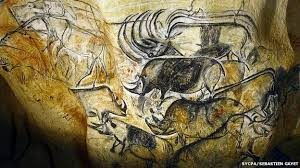
 Virtually touring Chauvet Caves raised some interesting questions for me about the purpose and role of communication as it pertains to the artist. Art does not to fit into the framework of Ong’s “divided line” – this intellected difference between how we think between oral and literate communication technologies. Art seems to me to be a communication that transcends those noetic boundaries.
I attended an exhibition of Inuit Art recently. The artists/curator spoke of the long winter months, of how creating art and song were ways of relieving tension, and alleviating social difficulties in confined spaces. Whittling became a kind of meditative process where the artist would sing the song of a profitable hunt, perhaps will it into being by creating the piece, sing the songs of ancestor exploits while carving, or imagine/relate the stories of sacred beings, or merely to busy the hands and minds in long boring stretches of confinement. I imagine the Cro-Magnon people of the Chauvet Caves would have created with similar experiences as we currently do in these geographies and landscapes.
 However, it is interesting that the Chauvet caves were never inhabited – there was no midden, no sign of regular use, and can be interpreted as a sacred site :Paintings. We can debate, trade archaeological facts and argue what the Chauvet caves might have meant, we can never actually “know”its particular import, these people and their culture are lost to us. But, we can agree that it is “Art”, that it was not mere decoration in a living space, it is not directions to a hunting ground or a shopping list, and we can recognize that “Art” is a particular kind of communication. There is something sublime or non-instrumental about our need to produce it.
I think it is a mistake to view the Chauvet caves through the lens of contemporary digital communications – of secondary orality. I argue that those cave drawings were not created to be specific communications but more open interpretive expressions. Visual Representation in the digital age is used as ways of shortening communication, of summing up and immediately conveying information: as visual stimulus designed to be enticing, or as symbolic representation of value – logo’s, certificates etc.; used to improve our personal brand or be quantified by likes; attached to, and validated by, the consumption of products.Visual art – in the context of fine art – is a complex “ask” – you have to examine, deconstruct, interpret meaning, it is a slow and difficult process, whose end goal does not provide immediate or definable satisfaction. Whose meaning and import lie in the aura and aesthetic moment in relation to the work of Art, in the connection and interior reflection of the beholder. I think the Chauvet caves need to be understood in this context – a context that transcends a noetic change arising from Gutenberg’s press or Mcluhans Global Village in the digital age.
In reading Havelock and Ong, I’d be tempted to argue that “Art” is an anachronism of a literate society – that fostered the analytical deconstruction of meaning – that the aesthetic value of Art has become increasingly hard for us to understand and quantify in the digital age. Yet I think the Chauvet caves, as an example of expressive Art in a primary oral culture, indicate that the value of this communication is deeper and more ancient than that – and that it points to something inherent and important in cultural expression – of what Art means to who and what we are. Technological determinism is not a useful construct in defining and interpreting the Chauvet Caves.