The Cumberland Community Forest is the most profound personal example I have of civil society in action. ‘On the ground’ activism, on-line engagement, the strong ties of community, the weak ties of visitors and tourists, and the long tail of social media came together to create change. Without all of these layers of engagement, the forest would not still stand.
Jonah Lehrer states in his article Weak Ties Twitter and Revolutions the internet cannot provide the “discipline and strategy” necessary to politically engage civil society – this must come from social actors working directly on the ground. However, he also argues that innovation created by the interaction of diverse parties via the internet is an important aspect of civil engagement. “Our acquaintances — not our friends — are our greatest source of new ideas and information” he argues, and I can see how this concept at play in the growing ‘friends’ and connections of the Cumberland Forest; the voice and reach of the project was broadened and emboldened by the ‘clickers’ of the digital sphere.
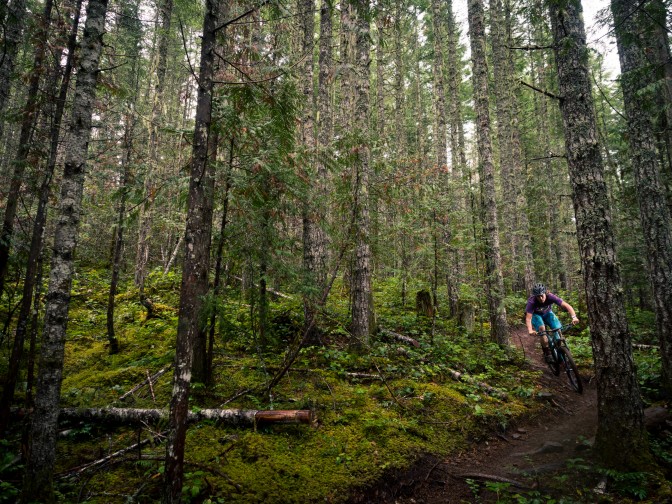 The Cumberland Forest is the story of a community who reimagined its prosperity through forest preservation. Primarily championed by residents attempting to strike a new economic path out of the end of old growth logging, the spin off created by digital technologies/social media have been strikingly effective. The forest has become a symbol of a mountain biking brand or social positioning. Powerful twitter hashtags build narratives that feature community’s shared identity: Political – #restore the commons – relating to the reemergence of the private versus public ethic in reclaiming crown land; Consumer – #buyabeersaveaforest – launched by the local brewery which donates a dollar from each beer; and Historical – #whatwouldgingerdo – in reference to labour hero “Ginger Goodwin”, who led the town through the Great Coal Mining Strike of 1912.
A possey of German and Australian mountain bikers rode the perseverance trail wearing t-shirts emblazoned with the face of Ginger Goodwin and slogans declaring the Republic of Cumberland; how incredibly heart-warming. There is a whole linkage of weak ties fostering the forest preservation project of this tiny rural village of 3000. We are truly connected to the Global village.
 Some argue that clicking on a social cause can be more of an escape, a mirage of political engagement, which creates a placebo effect that inoculates us from further activism. They call it slacktivism. However, I think the Cumberland Forest shows that we can be more hopeful for the clickers. Others have argued that abstracted on-line engagement can stimulate more meaningful action. Clay Shirky’s notion of cognitive surplus is just one example; Shirky expounds that “while we’re busy editing Wikipedia, posting to Ushahidi (and yes, making LOLcats), we’re building a better, more cooperative world”. The internet relies on a certain amount of human generosity to motivate change. Moreover, I think the Cumberland Forest exemplifies the kind of hope we can have in the long tail of social connection and the interaction of diverse social ties. Without the momentum created by social media and the growing number of tweets or on-line media presence, the Cumberland Forest would not have gained enough momentum to sustain fundraising efforts, reach granting bodies, and stir its array of social engagement.
I think we can find our physical feet in our digital universe; we just need to get our mitts in there.