Almost exactly a year ago I wrote my first blog post regarding the beginning of my journey in the MACAL program, and first thoughts of the design challenge process. A few of the same feelings have remained constant throughout the year- the excitement and intrigue about the potential of this methodology to create solutions- and the strive to embrace issues from as wide of a transdisciplinary lens as possible.

One question I postered in my first reflection was wondering “what the next step is, and how this process can be transcribed into action. I believe this is a valuable tool to explore in the quest to climate adaptation, but I need to learn more about testing and implementation as steps in the process.”

Which is exactly what happened. Through the various steps of the design thinking process- prototyping, ideating, testing, more iteration and collaboration, I feel like I know exactly what the next steps would be for our design.

Along with the overall success of the design thinking challenge many things occurred which I did not anticipate. First and foremost, the fractality of diving deeply into an issue, and being so intentional about the process. And to my surprise, after hours and hours of brainstorming, testing and feedback- it was often the simplest ideas and concepts that held the most potential. Something as simple as sharing a story could be a solution.

From a practical level, the duration of the assignment and weight of the question were draining at times. There was undoubted value in having the design thinking challenge question in the back of our minds while taking each subsequent course, however after about six months of it, it began to become quite wearing. Tackling this process as a team was an absolute necessity, the intelligence and resilience of my teammates were exemplified at every step.

I would probably have to write a whole novel to relay all the revelations, reflections and learnings that occurred this past year. However, since presenting our final design framework last week there has been one concept that has overwhelmingly been a part of my reflections- that of right relations.

Looking back now, the first reading we were assigned was about right relations and decolonization practices in climate action work. In research from Gram-Hanssen et al. (2021) they share that “[t]ending to these relations is a prerequisite for tending to climate change itself.” In CALS 503, before diving into risk assessment methodology we unpacked Indigenous New Zealand author Linda Tuhiwai Smiths work “Decolonizing Methodologies: Research and Indigenous Peoples” where she illustrates the incongruencies with advocating for Indigenous voices in Western research paradigms (Hall & Smith, 2000). Beginning to understand how positionally, and unknowingly I may be perpetuating colonial systems made me completely rethink our design thinking challenge. And now I feel like I have a better foundation for understanding how Indigenous practices can be and should be incorporated into climate action work.

Storytelling became an integral part of my team’s prototype, and the basis for establishing trust and connections with participants in hopes to bridge gaps and focus on commonalities. This practice, which we didn’t necessarily have a name for- but we understood the intention of and potential result of was later defined by Michael Lickers. In our Unit 4 seminar, Mike shared a traditional Haudenosaunee greeting practice called a “Thanksgiving Address” which involves attendees to share and ultimately unite the group on common ground (Lickers, Personal Communication, March 14, 2022). This intentional practice, to reframe a conversation before it had even begun was exactly the type of practice we wanted create in our prototype. Sharing stories is something everyone does, and yet somehow this practice seems to be largely absent in professional settings. As Gram-Hanssen et al. (2021) said, addressing relationality is paramount to addressing climate change as they share root causes. After a year of reflecting how this can be done- and spur action, sharing stories to connect people to how they are similar rather than different is approach I would recommend to anyone willing to listen.

Our awareness can grow bigger than our disturbance”- Young (2020)

References

Gram-Hanssen, I., Schafenacker, N., & Bentz, J. (2021). Decolonizing transformations through ‘right relations.’ Sustainability Science, 17(2), 673–685. https://doi.org/10.1007/s11625-021-00960-9

Hall, T. D., & Smith, L. T. (2000). Decolonizing Methodologies: Research and Indigenous Peoples. Contemporary Sociology, 29(3), 567. https://doi.org/10.2307/2653993

Repairing emotional isolation by reawakening deep nature connection | Jon Young | TEDxGrandPark. (2020, April 23). YouTube. Retrieved June 10, 2022, from https://www.youtube.com/watch?v=QMWSvUp0CYk&t=476s
CALS 504: Blog 2

Transformative or Incremental Adaptation?

Should We All Go Vegan? | Biomedical Odyssey
Creator: DisobeyArt | Credit: Getty Images/iStockphoto

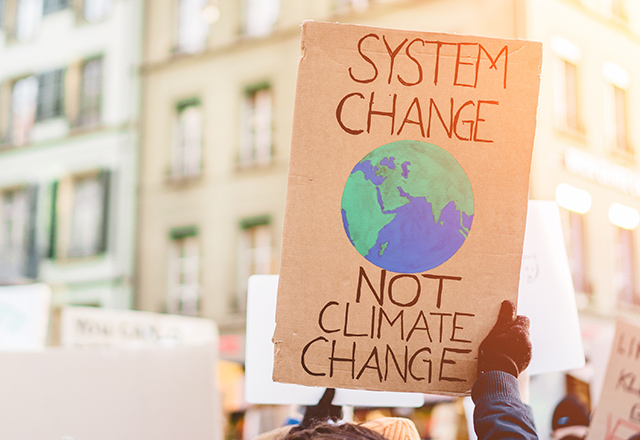
We cannot solve a crisis without treating it as a crisis. And if solutions within the system are so impossible to find, then maybe we should change the system itself. -Greta Thunberg

I remember listening to a speech from climate activist and youth leader Greta Thunberg sharing a powerful analogy regarding the logic of ending fossil fuel production (Thunberg, 2019). She relayed it to if you saw your bathtub overflowing and what your instinctive reaction would be- you would turn off the water rather than mopping up the floor (Thunberg, 2019). This message hit home for me, but it wasn’t until reading about incremental vs transformative adaptation that I understood why. I think in her analogy it’s perfectly clear why you would immediately go to the source of the mess and stop it and then clean up the spill rather than try to clean up the water faster than it was overflowing. However, turning off a shower tap is much easier than dismantling the fossil fuel industry.

In this blog post I will explore the differences between transformational and incremental climate adaptation and explore how Indigenous ways of thinking may relate to or be supported by either of these strategies. Over the course of the MACAL program, it has become quite clear that we can no longer follow a business-as-usual approach. We continue to see how current systems foster environmental degradation and promote vast inequities. Transformative adaptation refers to the process of addressing the root vulnerabilities leading to these inequities (Fedele et al. 2019). This would be the turning off the bathwater approach, or more realistically overhauling the entirety of the plumbing infrastructure leading to that tap. However idealistic this may sound to address the issues leading to climate change, it is important to consider what harm or further inequities could be created by such a ginormous undertaking. Along with the practically of who would do it? And how could they?

Authors studying this adaptation approach foster further questions regarding the parameters of transformative change, and what stipulations are relevant.

 “Transformation raises the stakes in adaptation decision-making, bringing into focus many ethical and procedural questions: who—or what processes—determine the dominant mode for adaptation, and selects objects for change? What are the contexts within which adaptation pathways emerge and how do they move?” (Pelling et al. 2014).

In choosing courses of action, whether it be coping mechanisms, incremental adaptation or full out transformative adaptation I believe the focus must include to be the promotion of Indigenous practices and traditional knowledge.

Incremental adaptation is the more familiar practice in Western cultures, making smaller scale adjustments to address an issue. Fedele et al. (2019) illustrate that this is often exemplified in agricultural practices, where farmers may adjust crop variety, irrigation systems or fertilizers to preserve yields in variable conditions.

From my perspective, incremental adaptation fits within the pedagogy of colonial settler western practices. Whereas transformational, or systemic adaptation looking at a whole system and the route values. Similar to many Indigenous ways of knowledge, where ecosystems as a whole are valued above the individual. I see transformative adaptation as a vessel in which Indigenous practices may be disseminated and adopted to promote overarching sustainability.

However, I recognize that this is not feasible overnight. As coping mechanisms, along with incremental adaptation measures may be less fruitful, they are likely more achievable. Fedele et al. (2019) talk about how incremental approaches are more easily adopted as transformative approaches are less familiar, however incremental approaches may be reaching their limit of effectiveness.

Moving forward, a blend of these approaches should ideally be used to promote change and foster resilience. Climate change is not an issue with a silver bullet solution, rather a plethora of socio-ecological changes that may provide us a route from vulnerability to sustainability.

References

Fedele, G., Donatti, C. I., Harvey, C. A., Hannah, L., & Hole, D. G. (2019). Transformative adaptation to climate change for sustainable social-ecological systems. Environmental Science & Policy, 101, 116–125. https://doi.org/10.1016/j.envsci.2019.07.001

Greta Thunberg full speech at UN Climate Change COP25 – Climate Emergency Event. (2019, December 17). YouTube. https://www.youtube.com/watch?v=Eo_-mxvGnq8

Pelling, M., O’Brien, K., & Matyas, D. (2014). Adaptation and transformation. Climatic Change, 133(1), 113–127. https://doi.org/10.1007/s10584-014-1303-0