CALS 504: Blog 2

Transformative or Incremental Adaptation?
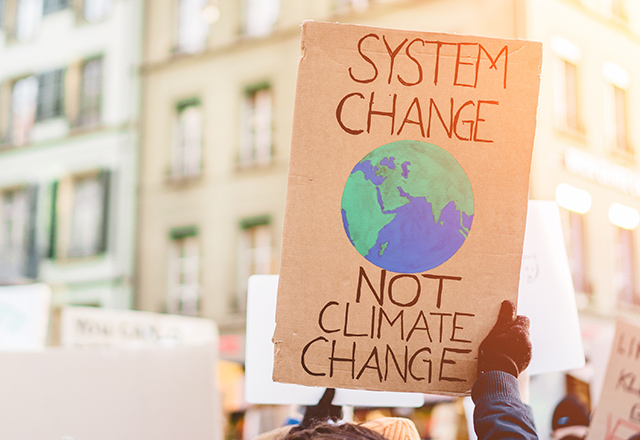
Should We All Go Vegan? | Biomedical Odyssey
Creator: DisobeyArt | Credit: Getty Images/iStockphoto

We cannot solve a crisis without treating it as a crisis. And if solutions within the system are so impossible to find, then maybe we should change the system itself. -Greta Thunberg

I remember listening to a speech from climate activist and youth leader Greta Thunberg sharing a powerful analogy regarding the logic of ending fossil fuel production (Thunberg, 2019). She relayed it to if you saw your bathtub overflowing and what your instinctive reaction would be- you would turn off the water rather than mopping up the floor (Thunberg, 2019). This message hit home for me, but it wasn’t until reading about incremental vs transformative adaptation that I understood why. I think in her analogy it’s perfectly clear why you would immediately go to the source of the mess and stop it and then clean up the spill rather than try to clean up the water faster than it was overflowing. However, turning off a shower tap is much easier than dismantling the fossil fuel industry.

In this blog post I will explore the differences between transformational and incremental climate adaptation and explore how Indigenous ways of thinking may relate to or be supported by either of these strategies. Over the course of the MACAL program, it has become quite clear that we can no longer follow a business-as-usual approach. We continue to see how current systems foster environmental degradation and promote vast inequities. Transformative adaptation refers to the process of addressing the root vulnerabilities leading to these inequities (Fedele et al. 2019). This would be the turning off the bathwater approach, or more realistically overhauling the entirety of the plumbing infrastructure leading to that tap. However idealistic this may sound to address the issues leading to climate change, it is important to consider what harm or further inequities could be created by such a ginormous undertaking. Along with the practically of who would do it? And how could they?

Authors studying this adaptation approach foster further questions regarding the parameters of transformative change, and what stipulations are relevant.

 “Transformation raises the stakes in adaptation decision-making, bringing into focus many ethical and procedural questions: who—or what processes—determine the dominant mode for adaptation, and selects objects for change? What are the contexts within which adaptation pathways emerge and how do they move?” (Pelling et al. 2014).

In choosing courses of action, whether it be coping mechanisms, incremental adaptation or full out transformative adaptation I believe the focus must include to be the promotion of Indigenous practices and traditional knowledge.

Incremental adaptation is the more familiar practice in Western cultures, making smaller scale adjustments to address an issue. Fedele et al. (2019) illustrate that this is often exemplified in agricultural practices, where farmers may adjust crop variety, irrigation systems or fertilizers to preserve yields in variable conditions.

From my perspective, incremental adaptation fits within the pedagogy of colonial settler western practices. Whereas transformational, or systemic adaptation looking at a whole system and the route values. Similar to many Indigenous ways of knowledge, where ecosystems as a whole are valued above the individual. I see transformative adaptation as a vessel in which Indigenous practices may be disseminated and adopted to promote overarching sustainability.

However, I recognize that this is not feasible overnight. As coping mechanisms, along with incremental adaptation measures may be less fruitful, they are likely more achievable. Fedele et al. (2019) talk about how incremental approaches are more easily adopted as transformative approaches are less familiar, however incremental approaches may be reaching their limit of effectiveness.

Moving forward, a blend of these approaches should ideally be used to promote change and foster resilience. Climate change is not an issue with a silver bullet solution, rather a plethora of socio-ecological changes that may provide us a route from vulnerability to sustainability.

References

Fedele, G., Donatti, C. I., Harvey, C. A., Hannah, L., & Hole, D. G. (2019). Transformative adaptation to climate change for sustainable social-ecological systems. Environmental Science & Policy, 101, 116–125. https://doi.org/10.1016/j.envsci.2019.07.001

Greta Thunberg full speech at UN Climate Change COP25 – Climate Emergency Event. (2019, December 17). YouTube. https://www.youtube.com/watch?v=Eo_-mxvGnq8

Pelling, M., O’Brien, K., & Matyas, D. (2014). Adaptation and transformation. Climatic Change, 133(1), 113–127. https://doi.org/10.1007/s10584-014-1303-0

CALS 504: Modelling the Business Case for Climate Action-Blog 1

Economic self interest and climate action at first read sounds all too oxymoronic to me. After nearly a year of the MACAL program learning about the intersections between climate science, communication, leadership and risks, this course focuses on building the business case for climate action. However, from what I know- self interest, specifically economic self interest manifesting as unbridled capitalism is the smoking gun in the room when looking at the current environmental crisis. Over consumption and globalization have created unthinkable amounts of pollution, and resources are being used at an unsustainable rate in the name of profit. So, how does an economic system which has foregone the ‘environmental costs’ of operations remedy them?

“A business case defines the value a project will deliver” (Herman & Siegelaub, 2009). Businesses aim to measure their progress, and aspire to success by analyzing how efficient their operations are. A business case provides a structure to map out the who, what, why, when, where and how of a project, and can further identify possible benefits and opportunities as well as risks and disadvantages along with timelines and most importantly, the price tag. Success is measured by the ability to follow a business plan and achieve the predetermined deliverables (Herman & Siegelaub, 2009). Costs and benefits are key metrics of a business case, and align with the businesses self-interest to achieve a return on investment, increase value, address a strategic goal, conduct research, increase efficiency or maintain compliance (Herman & Siegelaub, 2009). These same principles may be evident on different scales as well, such as national economic self-interest. Julie Nelson depicts how countries may pursue climate action if it aligns with their economic best interests as well, but ultimately there is little hope for purely altruistic collective action. 

Understanding self-interest provides some insight into motivations behind previous actions and cognizance for predicting future actions. Humans are inherently preoccupied with their own well being, and will often act in ways which ultimately benefit themselves. Similarly do businesses, organizations, and governments. So the question becomes “how do we align sustainable behaviors with maximum personal benefit?”. The microeconomics concept of ‘Mechanism Design’ describes this as a way businesses could reach favorable economic or social outcomes despite the individual’s predisposed likelihood of exhibiting self interest. 

“Researchers in the field of “mechanism design,” while still maintaining the assumption of self-interest, search for ways in which as enlightened planner could make people behave in desired ways by creating systems of incentives that align individual self-interest with broader enterprises or social goals.” (Nelson, 2019).

This unfortunately hasn’t been seen as  feasible by social scientists, and the real ‘solution’ is bound to be more complex. Self-interest isn’t the only motivating factor when it comes to climate change action. Being sympathetic to the potential impacts of climate change, making commitments to action as well as accepting that it is the morally right thing to do and feeling responsible are all reasons that someone may pursue action (Nelson, 2019). Nelson also touches on how decision making may be motivated by social meaning- and that people may choose to do something as to appear more favorably to others around them preserving their character (2019). Which may just ultimately be another form of self interest. 

When I first began to think about what would motivate a business to pursue sustainable practices, money was the first thing that crossed my mind. Rebates for upgrades to energy efficient light bulbs, or reducing emissions to avoid paying additional taxes. However, I  also thought about how social pressure can affect actions as well and how a recent “green” pressure has encouraged businesses to operate more environmentally friendly- or at least appear to be.

I now believe we will ultimately hit a point of necessity- where nations will have to take bolder steps to combat climate change. 

References

Herman, B. & Siegelaub, J. M. (2009). Is this really worth the effort? The need for a business case. Paper presented at PMI® Global Congress 2009—North America, Orlando, FL. Newtown Square, PA: Project Management Institute.

Nelson, J.A. (2019). Chapter 6: Climate change and economic self-interest. In Kanbur, R., & Shue, H. (Eds.). Climate justice:  Integrating economics and philosophy.  Oxford University Press.  (pp. 113- 122)