
Assignment 4: Double Content Remix
For the climate communication creation assignment, I chose to focus on young NunatuKavut children as my primary audience. There are numerous resources to educate children on what climate change is, the impacts, and tips for action (Government of Canada, n.d.; For Our Kids, n.d.; Clean Foundation, n.d.; Earth Guardians, n.d.; NASA’s Jet Propulsion Laboratory, n.d.; National Geographic Kids, n.d.). However, I felt that they lack the ability to inspire action within NunatuKavut since most resources take a national or global approach. To speak to the hearts of NunatuKavut members, specifically children, and to awaken a drive to protect our homeland, I drafted a fictional children’s book based on climate change impacts that are felt within NunatuKavut. The book would be rooted in reclaiming our Inuit culture, telling a story of how climate change is impacting the story characters, and end with a list of other impacts and tips to help mitigate and adapt to climate change. This project would be developed through NunatuKavut Community Council (NCC) and therefore edited by several departments prior to being released.
Draft Book Synopsis – How the siku almost ruined our trip!
Liam and Logan are so excited to visit poppy who will be taking them on a puijik (seal) hunting trip this spring. However, their exciting plans to learn about a piece of their culture were ruined with the unpredictable siku (sea ice). Poppy tried to explain why the sea ice is so unpredictable these days to his disappointed grandsons. As the resilient Inuk that poppy is, he saves the day by bringing them on another cultural learning experience. (Kippenhuck, 2021, Book Synopsis section)
Remix Content
Part 1: Book Launch
When we think of book launches, we usually think they would be held in bookstores or libraries. The book launch would usually include reading and/or signing of the book. It would also usually be tailored to the intended audience of the book. What I am proposing is something a little different.
In this first remix of the climate change content, the intended audience would be resident NunatuKavut Inuit, other community members, and school children. As with previous products developed by NCC, there will be community gatherings and/or school visits to launch the products. I am proposing to do both community gatherings and school visits.
The school visits would include the reading of the book, a question and answer session, and a short book report to be completed by the students. Six copies of the book would be brought to each school free of charge – two to be left with the school and four prize draws for the classroom. With this localized framing of the book, students would be able to connect the story to their communities since the setting is their homeland (Altinary, 2017; Macibach et al., 2011; Dupar et al., 2019; Wibeck, 2014; Sundin et al., 2018). They would learn about one way that climate change is impacting their community. During the question-and-answer session, students will be able to think about things that they and their parents can do to help reduce the impacts (Rotmann, 2017).
| Figure 1
Example of the school visit book report |
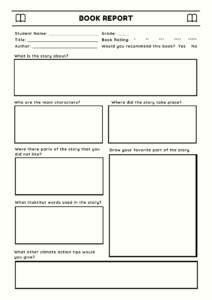 |
| Note. This is an example of an activity that can be completed with students once the book was read to the class. It can be completed individually or as a class exercise. |
The community gatherings would take place in the evenings to ensure a community turnout. Like the school events, four books would be given as prize draws but will be also available for purchase. A light meal or finger foods would be available at each community gathering, which would be another incentive to draw people out to the launch event. Rather than a reading of the book, there would be a short skit that would be performed by community members. The storyline from the book would be brought to life through this live skit to emotionally engage the audience. This engagement would ensure that the audience would remember the event as well as the messages behind the story. The audience would also engage in additional discussions of the changes that they are seeing as well as spur suggestions for adaptations and/or mitigations for important activities (Wibeck, 2014; Sundin et al., 2018). As Dill-Shackleford et al. (2016) concluded that there is a connection between our fictional world of stories and motivations to act in our lives. The live theatre format would reach a wider audience than a children’s book reading.
Part 2: Climate Change Poster Series Campaign
In the second remix of the climate change content, the intended audience would be resident and non-resident NunatuKavut Inuit. To coincide with the book launch, I would propose to also launch a climate change poster series campaign. The campaign would include printed and digital media to ensure that members would be able to see the posters even if they cannot access the internet. NCC has both a Facebook and Twitter account as well as a webpage where the posters series can be posted. The posters would also be printed in various sizes (24×36, 18×24, and 8.5×11) to be available for different venues within NunatuKavut. For instance, 8.5×11 would be used on community bulletin boards, schools could choose between the two larger sizes, and the 24×36 posters would be used at NCC events.
While the children’s book would focus on one impact, the poster series would draw attention to other impacts that are being felt within NunatuKavut. The poster series campaign would be a way that NCC could summarize what they have heard from members. The local visual framing would connect members with their land, sea, and ice which will start the dialogue to discuss climate change at the local level (Altinay, 2017; Wibeck, 2014).
The poster would feature scenes from NunatuKavut that are impacted by climate change such as the bakeapple, wharves, and sea ice. The campaign will include a consistent set of climate change impacts themes with easy-to-understand icons (cultural, health, food security, water security, heat security, environment, transportation, economy, and infrastructure). The first poster in the campaign would feature the general impacts that NunatuKavut are seeing and feeling. The second poster includes a list of changes that members have identified. The third poster would feature a few activities that NunatuKavut is doing well in grey lettering and some things that we could improve on in green lettering.
| Figure 2
Example of the first poster in the climate change poster series campaign |
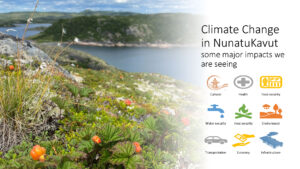 |
| Note. The proposed climate change poster series campaign would include three posters featuring scenes from NunatuKavut. Posters would focus on impacts being seen, what members are reporting, and actions being taken by NunatuKavut. The first poster would focus on the specific areas where climate change impacts are being felt within NunatuKavut. |
| Figure 3
Example of the second poster in the climate change poster series campaign |
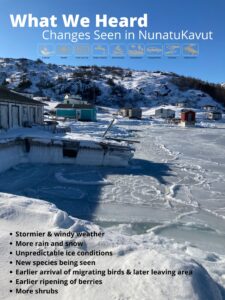 |
| Note. The proposed climate change poster series campaign would include three posters featuring scenes from NunatuKavut. Posters would focus on impacts being seen, what members are reporting, and actions being taken by NunatuKavut. The second poster would focus on changes that NunatuKavut members are reporting. |
| Figure 4
Example of the third poster in the climate change poster series campaign |
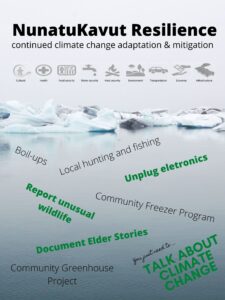 |
| Note. The proposed climate change poster series campaign would include three posters featuring scenes from NunatuKavut. Posters would focus on impacts being seen, what members are reporting, and actions being taken by NunatuKavut. The third poster would focus on the resilience of NunatuKavut in the face of climate change. Black words would indicate action areas where members are excelling and the green words would indicate action areas where members could improve their activity. |
Conclusion
A localized climate change communication would be the best approach to motivate local action towards climate change (Altinary, 2017; Macibach et al., 2011; Dupar et al., 2019; Wibeck, 2014; Sundin et al., 2018; Rotmann, 2017). A NunatuKavut inspired children’s book could kick start a climate change discussion within NunatuKavut. This would translate into community-based inspired climate change actions with the schools and communities within the territory. The book, community events, and poster series campaign would be edited and approved by the Environment and Natural Resources Department, Research, Education, and Culture Department, and the Communications Department before being released. This is consistent with other NunatuKavut products and activities.
References
Altinay, Z. (2017). Visual communication of climate change: Local framing and place attachment. Coastal Management, 45(4), 293-309. https://go.openathens.net/redirector/royalroads.ca?url=https%3A%2F%2Fdoi.org%2F10.1080%2F08920753.2017.1327344
Clean Foundation. (n.d.). Tools and Resources. https://cleanfoundation.ca/tools-resources/
Dill-Shackleford, K.E., Vinney, C., & Hopper-Losenicky, K. (2016). Connecting the dots between fantasy and reality: The social psychology of our engagement with fictional narrative and its functional value. Social and Personality Psychology Compass, 10(11), 634-646. https://go.openathens.net/redirector/royalroads.ca?url=https%3A%2F%2Fdoi.org%2F10.1111%2Fspc3.12274
Dupar, M., McNamara, L., & Pacha, M. (2019). Communicating climate change: A practitioner’s guide. Climate and Development Knowledge Network. https://unfccc.int/sites/default/files/resource/Communicating%20climate%20change_Insights%20from%20CDKNs%20experience.pdf
Earth Guardians. (n.d.). Get Educated. https://www.earthguardians.org/eg-resources
For Our Kids. (n.d.). Welcome. https://www.forourkids.ca/
Government of Canada. (n.d.). Climate Kids. https://climatekids.ca/
Kippenhuck, S. (2021, October 31). Assignment 3: Climate content – creation [Unpublished assignment]. Faculty of Environment & Sustainability, Royal Roads University.
Maibach, E., Nisbet, M., & Weathers, M. (2011). Conveying the human implications of climate change: A climate change communication primer for public health professionals. George Mason University Center for Climate Change Communication. https://www.climatechangecommunication.org/wp-content/uploads/2016/04/Climate-Communication-Primer-for-Public-Health-Professionals-1.pdf
NASA’s Jet Propulsion Laboratory. (n.d.). Climate Kids. California Institute of Technology. https://climatekids.nasa.gov/
National Geographic Kids. (n.d.). Home page. https://kids.nationalgeographic.com/
Rallo, A., Forest, E., Kuo, J., Boutilier, R., and Li, E. (2019). Access Ability 2: A practical handbook on accessible graphic design. (2nd ed.). The Association of Registered Graphic Designers. https://www.rgd.ca/database/files/library/RGD_AccessAbility2_Handbook_2019_06_01(1).pdf
Rotman, S. (2017). “Once upon a time…” Eliciting energy and behaviour change stories using a fairy tale story spine. Energy Research & Social Science, 31, 303-310. https://go.openathens.net/redirector/royalroads.ca?url=https%3A%2F%2Fdoi.org%2F10.1016%2Fj.erss.2017.06.033
Sundin, A., Andersson, K. & Watt, R. (2018). Rethinking communication: integrating storytelling for increased stakeholder engagement in environmental evidence synthesis. Environmental Evidence, 7(6), 1-6. https://environmentalevidencejournal.biomedcentral.com/articles/10.1186/s13750-018-0116-4
Wibeck, V. (2014). Enhancing learning, communication and public engagement about climate change – some lessons from recent literature. Environmental Education Research, 20(3), 387-411. https://www.tandfonline.com/doi/full/10.1080/13504622.2013.812720