
Tiny Ecology Post 1
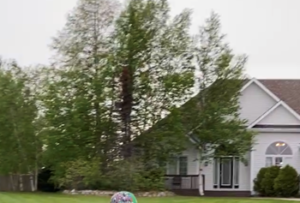
I liked and disliked the concept of having a sit spot to reflect on our readings for the CALS501 Communication for Climate Action. In my eyes, to sit in one spot in nature to see the changes over 10 weeks of the course was an exercise or experiment to show how things can change on the micro-level, to help focus your mind on the course work, and to bring to light how small actions can have a big impact. That’s great right?
However, choosing a sit spot was somewhat difficult for me. My most favorite place is Square Islands and I have a great sit spot where I love to go. There just isn’t a place in Happy Valley-Goose Bay that compares to it! Not only that, I am always working or with my boys so finding a quiet time that’s not in the middle of the night proved to be difficult as well. I ended up picking our front yard where there is a kind of natural environment surrounded by a lawn.
In this little natural environment, there are a couple of big birch trees, a couple of small spruce trees, some alters (or witties as we call them), partridge berry bushes, along with a few other ground plants. Until this summer it also had a big dead spruce tree. I finally caved and allowed my spouse to cut it down along with some of the branches of the birch trees. The branches of the birch trees were shading our house and dropping sap on our small deck making it look a little dirty. Also, my spouse, one of my boys, and I always suffer from allergies and birch is one of the main culprits. I hated to cut anything as I like the natural look; it all grows together harmoniously and intertwined – beautiful. The town and house I grew up in had lots of natural forests and that is what I love. There were no manured lawns or landscaped property as we had the forest in our front and back yards. My spouse grew up in a similar outport town in Newfoundland, but he would prefer a natural environment that is tidy and not overgrown.
As I reflect on the discussions that my spouse and I had over the small natural spot in our yard, I realized that I didn’t really consider his point of view until this summer when I caved (please don’t tell him that as he won’t let me live that down! LOL). My gratitude, as Kimmerer (2014) put it, for the natural undisturbed environment was overshadowing my spouse’s view or story. I believe in his mind he was protecting our little natural environment as well as our property. I didn’t see how the trees were impacting our house. In essence, I was blinded by my own beliefs and desires (again, please don’t tell him that!).
I also believe that this type of situation occurs quite often when talking about climate change and its impacts. As Kraub and Bremer stated, “climate change happens everywhere”, but depending on where you live you may not view it as a priority for action. For instance, a community that has an immediate need for heat security of the diesel plant may not be ready to discuss unproven off-diesel actions. However, by discussing local concerns and impacts (place-based narratives) within the communities, actions that can help alleviate both community concerns and climate change impacts can be determined. An example would be community gardens or greenhouses that would provide food security and cut down on the carbon footprint of food transportation.
The question that I am always contemplating is what is the best approach to open people’s minds to view climate change as an important issue to action.
References
Kimmerer, R. W. (2014). Returning the gift. Minding Nature, 7(2). https://www.humansandnature.org/returning-the-gift-article-177.php
Krauß, W., & Bremer, S. (2020). The role of place-based narratives of change in climate risk governance. Climate Risk Management, 28, 100221. https://www.sciencedirect.com/science/article/pii/S2212096320300115
Zuroski, E. (2020, January 27). Where do you know from? An exercise in placing ourselves together in the classroom. MAI feminism and visual culture. https://maifeminism.com/where-do-you-know-from-an-exercise-in-placing-ourselves-together-in-the-classroom/