
In the Northern Hemisphere, the first day of fall is September 22. Of course, the concept of fall is a construct, but it is based on the observations humans have made about the natural world. It is a story we tell ourselves to help make sense of changing weather throughout the year. It is a “truth, [which] is largely a story everyone agrees on” (Perez Herranz, 2014, 5:08). Enough of us have bought into the concept of seasons that they have become fact; it was a story told and retold until it became a truth. Even though weather changes all throughout the year, between and during any given season, we agree that summer turns to fall abruptly on a specific day (and the same occurs for each change of season).
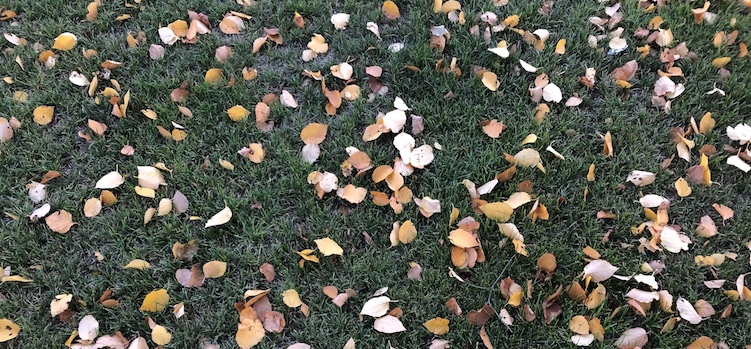
Once a story has become a truth, it can be easy to find observations that bolster that truth. I sat outside under a large birch in my front yard last week, on September 21st, the last day of summer. The air was cool in the shade, and I moved to the sun to be more comfortable. Some of the leaves were changing color but only a handful had fallen to the grass below. A week later and firmly into the fall season, I sat under the birch again. It was sunny, and there was a light breeze. This time, the grass was covered in orange leaves, and more fell quietly as I sat. Summer had turned to fall and the leaves acted accordingly.
Of course, as the years pass and climate change disrupts known weather patterns, those branches may well hold on to their leaves a little longer, and we may need to adjust our story about the coming of fall.
This tree is the subject of another climate story, too. During this summer’s heat wave, temperature records were broken across British Columbia and the Pacific Northwest. In Golden, where I live, temperatures were in the high thirties (celsius) for over a week. It was not weather that residents were used to or prepared for. To my great luck, the birch tree stood to the south of our house and acted as a giant shade. It provided effective natural cooling for our home during the heat wave (an event that will surely happen again in the future). This gave me a first-hand perspective on the idea that, as climate change intensifies, planting trees like this birch could provide much-needed shade in the face of rising temperatures.
Perhaps the birch in my front yard can help me to tell climate stories in my day-to-day life. How do I find the voice to give life to these stories? Bayer and Hettinger (2019) asserted that storytelling comes naturally to humans. How do I tap into that innate skill to tell climate stories more often? After all, Hayhoe (2019) argued that one of the most critical things that we can do to combat climate is to simply talk about it. I find that climate is a difficult subject to broach, and I often wonder what tools I could use to help me navigate the topic in conversation.
References
Bayer, S., & Hettinger, A. (2019). Storytelling: A natural tool to weave the threads of science and community together. Bulletin of the ecological society of America, 100(2), 1-6. https://doi.org/10.1002/bes2.1542
Hayhoe, K. (January 11, 2019). The most important thing you can do to fight climate change: talk about it [Video]. TED. https://www.youtube.com/watch?v=-BvcToPZCLI&t=14s
Perez Herranz, C. (October 24, 2014). Why everything is a story [Video]. TEDxMadrid. https://www.youtube.com/watch?v=3InAj96h06k
Wonderful post, Hanna. You made me travel and dream for a few minutes 🙂 I can see myself out there sitting with you under that tree. I believe that this course -and the entire program – will bring us some confidence to share more stories that inspire others. I am with you, not sure yet of my capacity at that level! Thank you for sharing.
Nancy
I enjoyed reading your post, Hanna. What really resonated with me was this idea of seasons and what shifting weather patterns and climate alterations mean to that idea, one that you so eloquently note is constructed by the human race. Like you mentioned in your post, leaves may stay on trees longer, but they may in fact fall off earlier as well. This past summer, the dramatic heat caused most trees on my property to fall significantly earlier than I recall in years past. The Japanese maple, that resides a stones throw from my kitchen window, didn’t even change color this year because its leaves had fallen off significantly before the start of fall. The heat disrupted the ‘seasonal’ change it undergoes. Where I grew up in California, we would always say there were really only two seasons. The weather just stayed so consistent. Nowadays it looks more and more like one continual season. Heat, dry, and more drought.
Thanks for sharing your thoughts. I encourage you to continue to dive into the storytelling part of yourself. I think that through storytelling we connect more with our natural world, our own story, and those around us. And who knows, maybe you’ll begin to encourage those around you to rediscover the storytelling part of themselves as well.
Lovely post, thanks Hanna! I appreciate that through your sit spot and the observation of the birch tree, you’ve been able to tell a place-based story about the effects of and adaptation to climate change. This is exactly what I’d hoped for in terms of bridging place and story! I would suggest continuing in that vein for finding your voice. In my experience, voice comes out of the land — and Indigenous languages from around the world demonstrate this as well. As Kimmerer described, giving attention is one of the most powerful things we can do. And when we do so, we are in relation which in turn informs what we can create and offer the world, as the world around us moves through us.