November 2021

Stack-It Green: Part Two

Making sure everyone has a seat at the table

As Stack-It moves forward with our corporate sustainability plan and goals, it is important that the company, as a whole, moves forward together. The only way to ensure that we can all take that step forward is to make certain that we meet certain accessibility standards. This is because, if we cannot give everyone a seat at the table, we—as an organization—will never reach our sustainability goals (or any goals for that matter). We understand the importance of making “new climate change policies [that] recognize” particular barriers or impediments of new policies for disabled persons (Dines, 2016). In the past, “many of the positive changes made to habits and lifestyle, changes that could contribute to minimising climate change and rehabilitating the environment, are difficult or impossible for disabled people to do” (Wright, 2020). This is why Stack-It has formed a Corporate Sustainability Committee that will oversee the creation of communication content in order to make certain that it is meeting accessibility standards.

Below are the three areas that we will be focusing on going forward:

1. All written communication will come with an accompanying video/multi-media component.

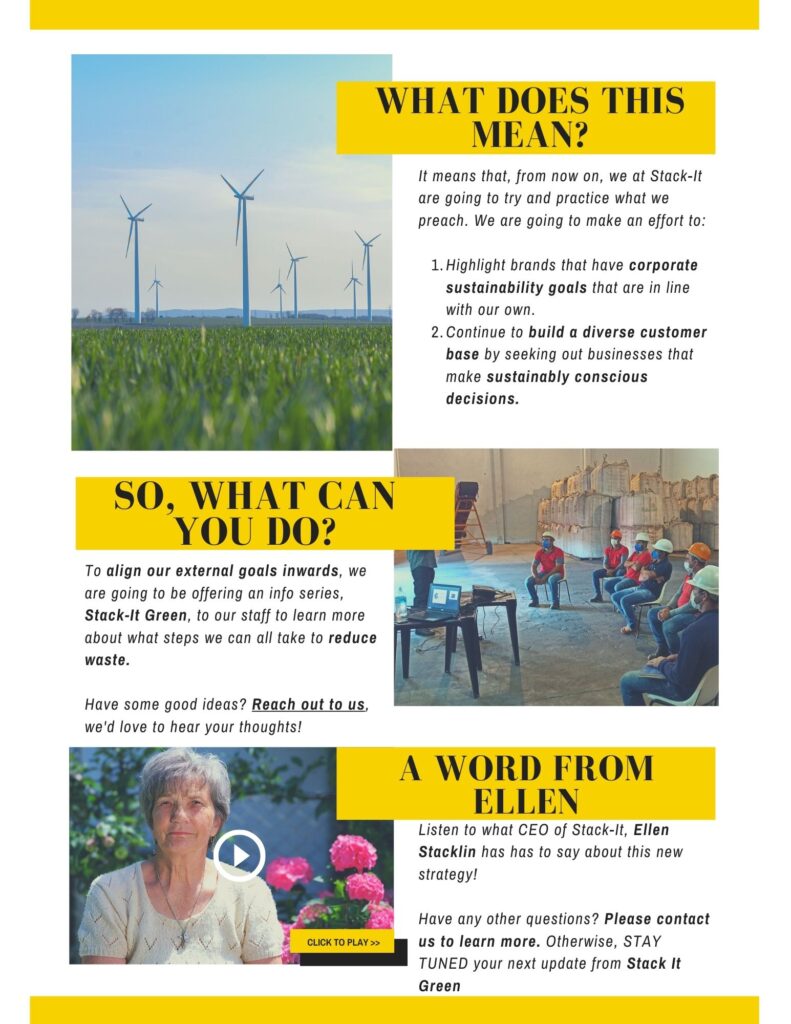
We understand that having information available in various formats allows a broader audience to engage with said information. For example, our eblasts series that we will be sending out to all staff will always be accompanied by a video. This video will include subtitles as well as someone signing in American Sign Language (ASL). The video will cover all components that are covered within the eblast itself.

As we have locations in different regions within North American, subtitles will also be available in French and Spanish. The understanding is to push out the message on diverse platforms and multiple formats. Not only will this make the message more accessible, but it will also offer more opportunities for the messages to be engaged with.

2. All company websites going forward will meet standard accessibility regulations

A large proponent of our digital marketing team is website maintenance and creation. As it is already in the marketing plan to rebuild all websites to meet our current best practices, an additional section has been included to make our websites meet Web Content Accessibility Guidelines (WCAG) 2.1 (Rallo, et. al., 2019). Some considerations will include:

  • Making certain all information can easily be picked up by a screen reader or braille terminal.
  • Ensuring a large enough colour contrast between background and foreground graphics.
  • Using legible topography (font size and style)
  • Inclusion of alternative text to accompany all unexplained or non-text elements

This will affect Stack-It Green’s promotional material as we will be building out a series of pages on Stack-It’s website outlining our corporate sustainability goals and actions. It will be another place where this information can be accessed by our employees as well as current or potential customers.

3. E-meets hosted by the Corporate Sustainability Committee

In an effort to provide an inclusive platform for our employees, Stack-It’s Corporate Sustainability Committee will put on a number of e-meets that are open to Stack-It employees. This will give everyone the opportunity to weigh in on any future corporate sustainability goals. We see this activity as providing a safe forum for staff to voice their concerns or suggestions for the best way forward. As we want to make certain that everyone has a space at the table, we believe that hearing from our staff will give each of us a better perspective on what barriers might exist to some sustainability initiatives (such as single-use plastic bans).

After each session, we will send out an anonymous survey to all staff. This way, if some members did not feel comfortable voicing their opinions, the survey will hopefully give them the opportunity to do so in a safe (anonymous) environment. Contact information will also be easily accessible so that staff can get in contact with members of the Corporate Sustainability Committee.

Moving forward together

In uncertain times, Stack-It believes that it is important that we go forward in unity. Corporate sustainability is something that we believe to be an important aspect of our organization, but only if it is something that is applicable to all members of our Stack-It community.

Please click the following link for a video explanation of all the above initiatives mentioned. For any further questions, please do not hesitate to reach out to the Corporate Sustainability Committee. We are all in this together!

References

Dines, H. (2019). The climate revolution must be accessible – this fight belongs to disabled people too. The Guardian. https://www.theguardian.com/commentisfree/2019/oct/15/climate-revolution-disabled-people-activism

Rallo, A., Forest, E., Juo, J., Boutilier, R., & Li, E. (2019). Access Ability 2: A practical handbook on accessible graphic design. Revised + Supersized Second Edition. The Association of Registered Graphic Designers.

Wright, E. (2020). Climate Change, Disability, and Eco-Ableism: Why we need to be inclusive to save the planet. UX Collective. https://uxdesign.cc/climate-change-disability-and-eco-ableism-why-we-need-to-be-inclusive-when-trying-to-save-the-88bb61e82e4e

Stack-It Green: Part Two Read More »
Flower fields, place attachment, and maybe something about a dinosaur (if you’re lucky)

My sitting spot is not far from a main road. What this means is that it is incredibly noisy. As we are nestled in a burgeoning metropolis, my sit spot, as well, is surrounded by cement buildings, paved streets, metal signs. It is such a wonderful combination of my urban reality and wilderness. As wild as a few boulevard trees, some grass, and a bunch of bushes can get, at least! However, over the last few months, I have become accustomed to the noise of this place. I have grown a somewhat new or unused sense to what wild-ness resides around here (whether that be a noisy gull or an unbothered squirrel). Life unfolds around me here. The thing about a sit spot is it absolutely demands a slower pace. Even my breathing slows down. As I sit and observe, the cares of that day shed off my back like a snake sheds its skin (at least for a time) and I can view the world in a Spielberg-kind of slow-motion. People walk and carry on about their day, others meander out onto the decks for a quick smoke, and I sit—or stand—and take everything in. It is a rather wild experience. And although shared with a whole world of other beings, it is not a shared experience in the way that a rave may be considered one. It is so distinctive to me. To the point where, I could take a thousand pictures of this space, but to my understanding it will not take with it my experiences gained during this activity. It would not carry “the complexity” of the experience (Schroth, et. al., 2014, p. 416).

Herein, I believe, lies the problem. Visual local framing, although potentially, an effective method for communicating about the environment, relies heavily on how it is digested by each individual audience member. This is not to say, that local framing is not worth exploring, along with place attachment, which is what I will be getting a bit more into in this blog post.

A little bit more about local framing and place attachment

Local framing, according to Altinay (2017), “has been found to increase cognitive and emotional engagement in environmental issues by situating consequences in a local context to which the public can relate” (p. 295). In other words, local framing, brings the climate crisis home. I can see how framing the climate crisis through a local lens would be an effective form of engagement. Instead of climate change being this seemingly global and far-off issue (intangible, in fact), by using a local frame, you bring the problem home. For example, the heat wave that British Columbian’s experienced this last summer (2021) is a shared experienced. No matter who you talk to, everyone has a story to tell about that time. So, if we were to tie climate change and an increase in local temperatures (as opposed to global temperatures) to the heat dome, this could become a more significant approach to communicating about the environment. At least, to a local audience. I believe that the downside to this form of framing is that it is incredibly specific to location. So, not easily transmittable to a larger and more broad audience.

On the other hand (or perhaps the same hand, but a different finger), we have place attachment. This is a far more intangible concept as it is tied to a personal’s emotional attachment to a place. It is “defined as the bond between a person and a place” (Altinay, 2017, p. 296). I do, indeed, see how this is an impactful tool for communicating about the environment. If someone is attached, on a personal level, to place, they are going to have an invested interest in what happens or what is happening to that place or location. However, I struggle with this one simply because I do not fully understand if this is something that is easily communicable. Are we not, in some ways, preaching to the converted if we are targeting an audience that is open to the idea of place attachment? Let’s worry this idea for a little bit longer…

A sticky thought

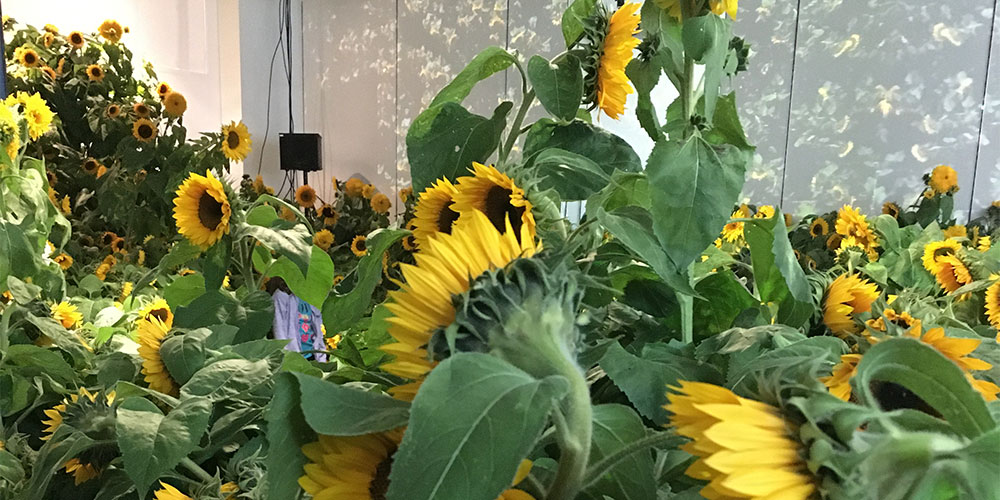
A few months ago, in September of this year, I—with a little bit of extra time on my hands—took a few moments to check out a local attraction at Willowbrook Mall in Langley, BC. The attraction was, aptly, called Flower Field. And, true to its name, the experience was quite literally a room full of sunflowers. It was an immersive, multimedia display that utilized not only live flowers, but also a projection of more sunflowers in a field, which was accompanied by relaxing spa-type music mingled with outdoor-themed white noise (e.g. birdsong). All-in-all, a completely immersive experience that transported me to a magical realm. As if I had accidently (or completely on-purpose) taken a bite out of an “eat-me” cookie that transformed me to no larger than the size of thimble.

Willowbrook Mall describes this manufactured experience as “an immersive floral experience…that will transport you into an oasis of sunflowers. Designed to spark joy for our guests, the surprise and delight floral moment will provide a unique picture-perfect experience for the whole family” (Willowbrook, 2021, November 13). Was this effective? For me, absolutely. I walked through the pathway of flowers as if I had just been confronted with a living and breathing dinosaur; mouth hung open, slight smile tugging at the corner of my lips. For those few moments, I was naturally able to suspend my disbelief enough to take from it what the experience offered. However, was that true for every person that walked into that Flower Field? Certainly not. Indeed, my rather dorky reverie was completely interrupted by a young couple walking in some minutes after I had. What they got from the experience was incredibly different from my own. They laughed and jeered at the overall display, finding (from their very vocal and, not to mention, colourful remarks) no satisfaction in the experience. Except, maybe, at the joy of making fun of it (along with people, like myself, for finding enjoyment in it).

This moment—a gift—was incredibly educational for me. I’m sure we have all, at one point, heard the proverb “you can take a horse to water, but you can’t make it drink.” I was able to see, firsthand, how applicable this is to all areas of life (not just your stubborn horse). My sitting spot is meaningful to me and in ways that I cannot even fully verbalise. However, that is because I consciously made the choice to have this experience; to be open to whatever experiences may arise within the time I spend in it. I believe that it is something that cannot be manufactured.

So, what does this do to my understanding of environmental communication?

Personally, I think that it is important to understand how local framing can help in the transmission of climate change messaging. If it is applied to the right situation. Do I believe that this will be effective in all situations? No. Purely based on my experience in the Flower Field, I can see how everyone is different. Here is a situation where a group of people were gifted with a visual and immersive experience, yet because each individual was different, what they got out of that experience was different. Therefore, this type of framing (making the problem local) will only be effective if someone is able to accept the information being offered.

Along that same thread, place attachment is something that is incredibly meaningful to me. However, if I invited someone new to my sit spot, there is no guarantee that they would have the same wild and magical experiences that I have had (no matter how visual it becomes).

I feel that I just need to be open to utilizing different methods of communication to educate others about the environment. Whether that be focusing on gain or loss frames, online and informal platforms, visual local framing or encouraging place attachment. It is my job, as a communicator, to be open and understanding. To accept that not everyone is going to walk into a field of flowers and imagine themselves in Wonderland.

References

Altinay, Z. (2017). Visual communication of climate change: Local framing and place attachment. Coastal Management 45(4), 293-309. https://doi.org/10.1080/08920753.2017.1327344

Schroth, O., Angel, J., Sheppard, S., Dulic, A. (2014). Visual climate change communication: From iconography to locally framed 3D visualization. Environmental Communication 8(4), 413-432. https://doi.org/10.1080/17524032.2014.906478

Willowbrook. (2021, November 13). Flower field. Willowbrook. https://www.shopwillowbrook.com/flowerfield/

Flower fields and place attachment Read More »

Stack-It Green: Part One

ecology, globe, concept-6513805.jpg
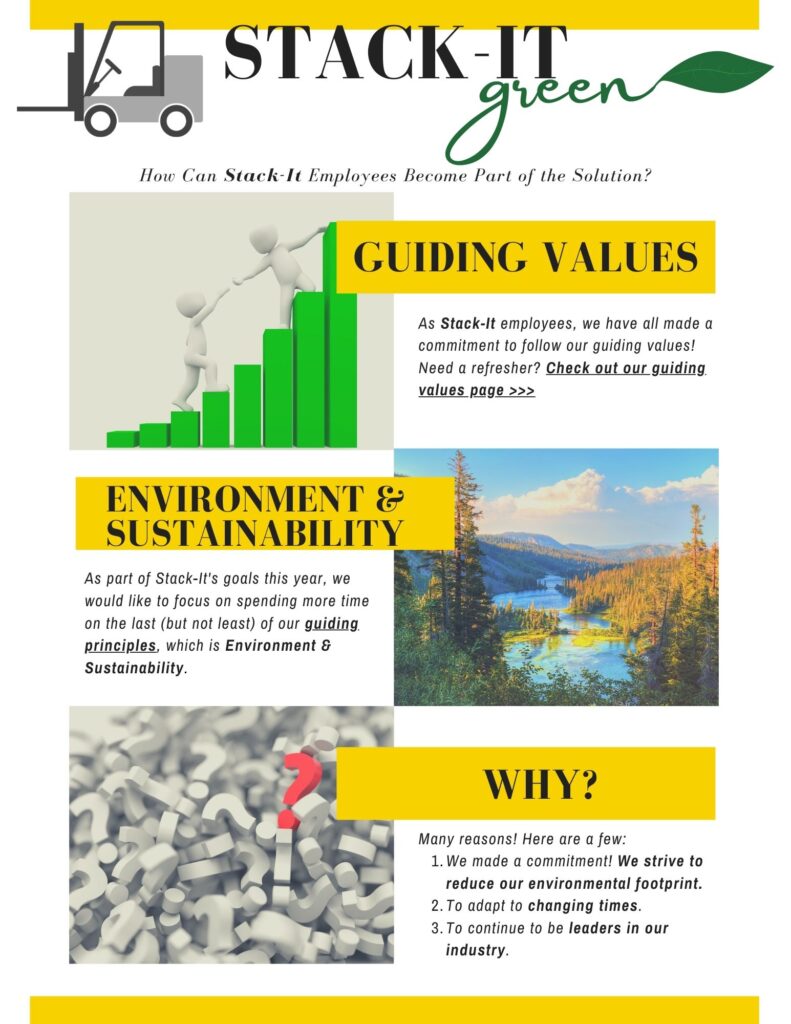
At the end of October, I submitted an assignment/potential proposal to a local (Canadian) company in the heavy equipment industry. I presented them with an opportunity to work on their corporate sustainability, which will, in turn, give them a competitive edge within the industry. Now, I would like to turn this communication piece around and present this same opportunity to employees within the company to encourage them to adopt waste reduction strategies (professionally and personally) that will align with the company’s corporate sustainability goals. This message will be presented in two parts. Part One will be an email blast (eblast) that will be disseminated to all staff within the company. Part Two will incorporate a combination of multi-media to make the communication piece more accessible to all members of the community. For the purposes of this post—and to maintain a level of privacy—I will be referring to the company as “Stack-It.”

Getting Stack-It employees on board the train

As Stack-It is a North America-wide company, with many locations across Canada and the United States, they have a diverse group of employees. This means that the messaging will be reaching a wide demographic of people. From service persons working in machine shops, to office-workers on the corporate side, messaging will need to factor in all working environments and communication levels.

Using principles adapted from Anne K. Armstrong, Marianne E. Krasny, and Jonathon P. Schuldt’s (2018) Communicating Climate Change, the “climate change outcomes [I] want to achieve” are to encourage action within the Stack-It company community (p. 4). For my messaging, I would like to focus more heavily on gain-framing as opposed to loss-framing (Hine et. al., 2016). This is because “if a person believes that climate change poses a serious threat to human society, including a direct personal threat, that person may experience the emotion of fear and demonstrate fearful attitudes,” which “might also result in a terror management response” that could reduce the chances of someone “engag[ing] in pro-environmental behavior” (Armstrong et. al., 2018, p. 27). This is why it is integral in this messaging to encourage our Stack-It audience with positive messaging that will promote “a strong sense of self-efficacy” that may result in them [Stack-It employees] “expending more effort in the face of obstacles like climate change” (Armstrong et. al., 2018, p. 28).

Eblasting it out of the station

The medium that I will be using—an eblast—is going to be created using ClickDimensions, which is a cloud-based marketing technology service. This will allow me to measure the success of this initial campaign. ClickDimensions offers analytics reporting services on each eblast sent that will record such stats as open rate and click rate (including unique—or new clicks). This program also offers a heat map that will track what links were clicked on in the eblast versus what links were not clicked on (or clicked on the least). Using this medium will allow me to measure the success of this initiative for any such future initiatives in this campaign.

Another benefit of employing this method of communication is that it is heavily based on visuals over text. To have an appealing eblast usually means making the written communication as pithy and engaging as possible. This will hopefully appeal to a wider and more diverse audience who may favor images over text (and vice-versa). “Visual message framing is [also] a powerful communication strategy for influencing risk perceptions and issue engagement” that can be used to encourage our audience into action (Altinay, 2017, p. 294). We also have the ability to, with ease, change messaging to focus on more local factors (e.g. for employees operating out of a branch in Texas, use local framing). As Schroth et. al. (2014) says, “climate change becomes more salient by bringing relevant information down to the local level, putting it into a community context that people care about, using the local landscape to express climate issues, and engaging citizens in developing local solutions” (p. 417).

The local frame train

The intentions behind employing local framing methods is based on the understanding that “many studies have found that engaging the public in discussion and action on environmental issues requires creating meaningful messages that matter to people personally (Altinay, 2017, p. 294). The way to engage with people—in this case Stack-It employees—is to create local messaging that will “build on [their] existing attitudes toward” their local environment (Altinay, 2017, p. 294).

For the purposes of this first eblast, I will address all staff that work within Stack-It. This first blast will be an introduction to a series of eblasts entitled Stack-It Green where the company will provide staff with little snippets of education and activities that they can do at work or at home to reduce their environmental footprint.

Introducing Stack-It Green

References

Altinay, Z. (2017). Visual communication of climate change: Local framing and place attachment. Coastal Management 45(4), 293-309. https://doi.org/10.1080/08920753.2017.1327344

Armstrong, A. K., Krasney, M. E. & Schuldt, J. P. (2018). Establishing trust. Communicating climate change: A guide for educators. Cornell University Press. [ebook] https://cornellopen.org/9781501730795/communicating-climate-change/

Hine, W. D., Philips, W. J., Cooksey, R., Reser, J. P., Nunn, P., Marks, A. D. G., Loi, N. M., Watt, E. S. (2015). Preaching to different choirs: How to motivate dismissive, uncommited, and alarmed audineces to adapt to climate change. Global Enviornmental Change, 36, 1-11. https://dx.doi.org/10.1016/j.gloenvcha.2015.11.002

Schroth, O., Angel, J., Sheppard, S., Dulic, A. (2014). Visual climate change communication: From Iconography to Locally Framed 3D Visualization. Environmental Communication 8(4), 413-432. https://doi.org/10.1080/17524032.2014.906478


All images are curtsey of pixabay

Stack-It Green: Part One Read More »

A moment in my sit spot: A season of grief

Photo credit: Pixabay

It is cold and damp today. Much the same as every day this week, really. The difference is, although there is certainly the promise of rain (with a sky that looks like a jar full of cotton balls), it is not currently raining. Instead, the city is glazed in ambient light delivered by a muted sun.

For some moments, I watch in fascination as bronzed leaves dance lethargically in a seemingly careless breeze. They flit this way and that and I find myself envious of their experience. This sort of synchronous gliding, as if the air was textured enough to walk on—and wouldn’t I love to, with the grace of a ballet dancer, pas de chat through the sky on my toes!

Now, when I look over the world of my sit spot, I see more than just leaves dancing. Like an ensemble cast, the local environment moves to some unknown (at least to me) symphony. The wind, the conductor, instructs not only leaves, but branches, blades of grass, bushes, the water that makes up puddles in the street. Indeed, not even I am exempt from this. My hair, a nest of brown waves and twists, is also swept up in this music. It is a reminder to me that I am a part of, not separate, from this world. It is a grateful reminder—just like these moments are bathed in gratitude. It is a prompt to take a moment and pause; to breathe. And these beings—the more than human—are just as much teachers as my human ones.

So, what did they have to teach me today? An age-old lesson, for sure. One, that, I require constant reminders of. Especially around this time of year.

Regarding the world through the eyes of other.

It is such an interesting time of year. When I say this, what I mean is, just as Spring is somewhat the herald of new life and growth, I feel the fall to be a celebration of death. A reminder of the impermanence of life or the cyclical nature of all things. So, I take a moment to see it mirrored in my natural surroundings.

The sidewalks remain splattered with leaves. Now, their colour is closer to a reddish-brown rather than the vibrancy often seen at the beginning of fall. The tree directly in front of me resembles ground zero of some sort of explosion, as leaves are haloed around the base of the trunk. Yet, there remains a handful of leaves continuing to cling on to their branches. Not quite ready for change. Not quite ready to let go and free fall. I can relate to this. There is no telling where they will end up if they let go.

The wind is up, it brushes through branches like the teeth of a fine-toothed comb. It whispers a promise to each leaf in turn. A promise of adventure. One final adventure before it finds its final resting place. This could mean falling straight to the ground and nestling amongst hundreds of other fallen brethren. Or, somewhere entirely different. Somewhere far off. Far away. Somewhere new. The trick is the choice of the two is not open for discussion. Such is the spontaneity of life. What choice is available is simple, however. You (in this case the leaves), can choose to stay in the world that you know by continuing to cling on to the branch that grew you. Or you can choose to leave it. Jump into the void of the unknown. Only one way—like those leaves—will lead to new growth.

Let me gather my thoughts.

So, in this case, loss, although sad and worthy of tears and sadness, also leads to growth and new life. These leaves will die, but the memory of them will encourage new growth. There is praise in that, which is why grief and praise go hand in hand.

To further dismantle this thought, loved ones that I have lost are gone, and my sorrow—like the fall—requires space to reflect. I am allowed a season of grief, just as all the seasonal life around me requires this transitory time.

To deconstruct again further, these thoughts, as environmental communicators, it is not about turning away from the sorrows of our world (loss of habitat, excessive deforestation etc.). It is actually about looking at and acknowledging those losses—mourning them. Using the above as an example, acknowledging and making space for what we have lost is really the only way that we can turn a loss-frame into a grain-frame. Like yin and yang, we must accept the darkness to fully enjoy the light or, as Marilyn Krysl said, “The moon knowns that if you deny the dark, you make a mockery of the light.”

Not bad insight for a handful of leaves, eh?

A moment in my sit spot: A season of grief Read More »