
Flower fields, place attachment, and maybe something about a dinosaur (if you’re lucky)
My sitting spot is not far from a main road. What this means is that it is incredibly noisy. As we are nestled in a burgeoning metropolis, my sit spot, as well, is surrounded by cement buildings, paved streets, metal signs. It is such a wonderful combination of my urban reality and wilderness. As wild as a few boulevard trees, some grass, and a bunch of bushes can get, at least! However, over the last few months, I have become accustomed to the noise of this place. I have grown a somewhat new or unused sense to what wild-ness resides around here (whether that be a noisy gull or an unbothered squirrel). Life unfolds around me here. The thing about a sit spot is it absolutely demands a slower pace. Even my breathing slows down. As I sit and observe, the cares of that day shed off my back like a snake sheds its skin (at least for a time) and I can view the world in a Spielberg-kind of slow-motion. People walk and carry on about their day, others meander out onto the decks for a quick smoke, and I sit—or stand—and take everything in. It is a rather wild experience. And although shared with a whole world of other beings, it is not a shared experience in the way that a rave may be considered one. It is so distinctive to me. To the point where, I could take a thousand pictures of this space, but to my understanding it will not take with it my experiences gained during this activity. It would not carry “the complexity” of the experience (Schroth, et. al., 2014, p. 416).
Herein, I believe, lies the problem. Visual local framing, although potentially, an effective method for communicating about the environment, relies heavily on how it is digested by each individual audience member. This is not to say, that local framing is not worth exploring, along with place attachment, which is what I will be getting a bit more into in this blog post.
A little bit more about local framing and place attachment
Local framing, according to Altinay (2017), “has been found to increase cognitive and emotional engagement in environmental issues by situating consequences in a local context to which the public can relate” (p. 295). In other words, local framing, brings the climate crisis home. I can see how framing the climate crisis through a local lens would be an effective form of engagement. Instead of climate change being this seemingly global and far-off issue (intangible, in fact), by using a local frame, you bring the problem home. For example, the heat wave that British Columbian’s experienced this last summer (2021) is a shared experienced. No matter who you talk to, everyone has a story to tell about that time. So, if we were to tie climate change and an increase in local temperatures (as opposed to global temperatures) to the heat dome, this could become a more significant approach to communicating about the environment. At least, to a local audience. I believe that the downside to this form of framing is that it is incredibly specific to location. So, not easily transmittable to a larger and more broad audience.
On the other hand (or perhaps the same hand, but a different finger), we have place attachment. This is a far more intangible concept as it is tied to a personal’s emotional attachment to a place. It is “defined as the bond between a person and a place” (Altinay, 2017, p. 296). I do, indeed, see how this is an impactful tool for communicating about the environment. If someone is attached, on a personal level, to place, they are going to have an invested interest in what happens or what is happening to that place or location. However, I struggle with this one simply because I do not fully understand if this is something that is easily communicable. Are we not, in some ways, preaching to the converted if we are targeting an audience that is open to the idea of place attachment? Let’s worry this idea for a little bit longer…
A sticky thought
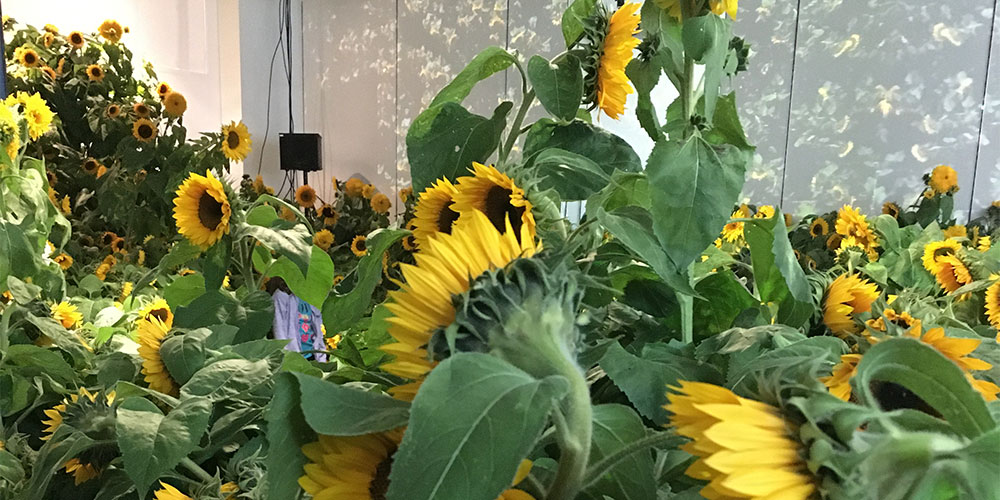
A few months ago, in September of this year, I—with a little bit of extra time on my hands—took a few moments to check out a local attraction at Willowbrook Mall in Langley, BC. The attraction was, aptly, called Flower Field. And, true to its name, the experience was quite literally a room full of sunflowers. It was an immersive, multimedia display that utilized not only live flowers, but also a projection of more sunflowers in a field, which was accompanied by relaxing spa-type music mingled with outdoor-themed white noise (e.g. birdsong). All-in-all, a completely immersive experience that transported me to a magical realm. As if I had accidently (or completely on-purpose) taken a bite out of an “eat-me” cookie that transformed me to no larger than the size of thimble.
Willowbrook Mall describes this manufactured experience as “an immersive floral experience…that will transport you into an oasis of sunflowers. Designed to spark joy for our guests, the surprise and delight floral moment will provide a unique picture-perfect experience for the whole family” (Willowbrook, 2021, November 13). Was this effective? For me, absolutely. I walked through the pathway of flowers as if I had just been confronted with a living and breathing dinosaur; mouth hung open, slight smile tugging at the corner of my lips. For those few moments, I was naturally able to suspend my disbelief enough to take from it what the experience offered. However, was that true for every person that walked into that Flower Field? Certainly not. Indeed, my rather dorky reverie was completely interrupted by a young couple walking in some minutes after I had. What they got from the experience was incredibly different from my own. They laughed and jeered at the overall display, finding (from their very vocal and, not to mention, colourful remarks) no satisfaction in the experience. Except, maybe, at the joy of making fun of it (along with people, like myself, for finding enjoyment in it).
This moment—a gift—was incredibly educational for me. I’m sure we have all, at one point, heard the proverb “you can take a horse to water, but you can’t make it drink.” I was able to see, firsthand, how applicable this is to all areas of life (not just your stubborn horse). My sitting spot is meaningful to me and in ways that I cannot even fully verbalise. However, that is because I consciously made the choice to have this experience; to be open to whatever experiences may arise within the time I spend in it. I believe that it is something that cannot be manufactured.
So, what does this do to my understanding of environmental communication?
Personally, I think that it is important to understand how local framing can help in the transmission of climate change messaging. If it is applied to the right situation. Do I believe that this will be effective in all situations? No. Purely based on my experience in the Flower Field, I can see how everyone is different. Here is a situation where a group of people were gifted with a visual and immersive experience, yet because each individual was different, what they got out of that experience was different. Therefore, this type of framing (making the problem local) will only be effective if someone is able to accept the information being offered.
Along that same thread, place attachment is something that is incredibly meaningful to me. However, if I invited someone new to my sit spot, there is no guarantee that they would have the same wild and magical experiences that I have had (no matter how visual it becomes).
I feel that I just need to be open to utilizing different methods of communication to educate others about the environment. Whether that be focusing on gain or loss frames, online and informal platforms, visual local framing or encouraging place attachment. It is my job, as a communicator, to be open and understanding. To accept that not everyone is going to walk into a field of flowers and imagine themselves in Wonderland.
References
Altinay, Z. (2017). Visual communication of climate change: Local framing and place attachment. Coastal Management 45(4), 293-309. https://doi.org/10.1080/08920753.2017.1327344
Schroth, O., Angel, J., Sheppard, S., Dulic, A. (2014). Visual climate change communication: From iconography to locally framed 3D visualization. Environmental Communication 8(4), 413-432. https://doi.org/10.1080/17524032.2014.906478
Willowbrook. (2021, November 13). Flower field. Willowbrook. https://www.shopwillowbrook.com/flowerfield/