
Stack-It Green: Part One

Getting Stack-It employees on board the train
As Stack-It is a North America-wide company, with many locations across Canada and the United States, they have a diverse group of employees. This means that the messaging will be reaching a wide demographic of people. From service persons working in machine shops, to office-workers on the corporate side, messaging will need to factor in all working environments and communication levels.
Using principles adapted from Anne K. Armstrong, Marianne E. Krasny, and Jonathon P. Schuldt’s (2018) Communicating Climate Change, the “climate change outcomes [I] want to achieve” are to encourage action within the Stack-It company community (p. 4). For my messaging, I would like to focus more heavily on gain-framing as opposed to loss-framing (Hine et. al., 2016). This is because “if a person believes that climate change poses a serious threat to human society, including a direct personal threat, that person may experience the emotion of fear and demonstrate fearful attitudes,” which “might also result in a terror management response” that could reduce the chances of someone “engag[ing] in pro-environmental behavior” (Armstrong et. al., 2018, p. 27). This is why it is integral in this messaging to encourage our Stack-It audience with positive messaging that will promote “a strong sense of self-efficacy” that may result in them [Stack-It employees] “expending more effort in the face of obstacles like climate change” (Armstrong et. al., 2018, p. 28).
Eblasting it out of the station
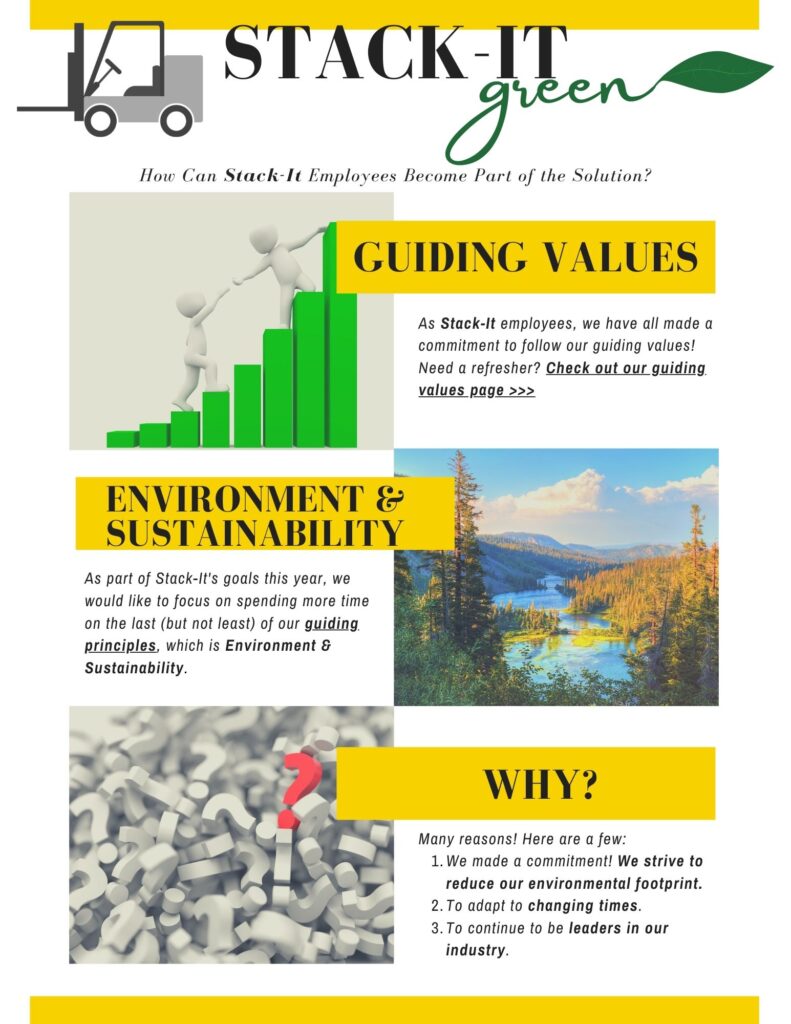
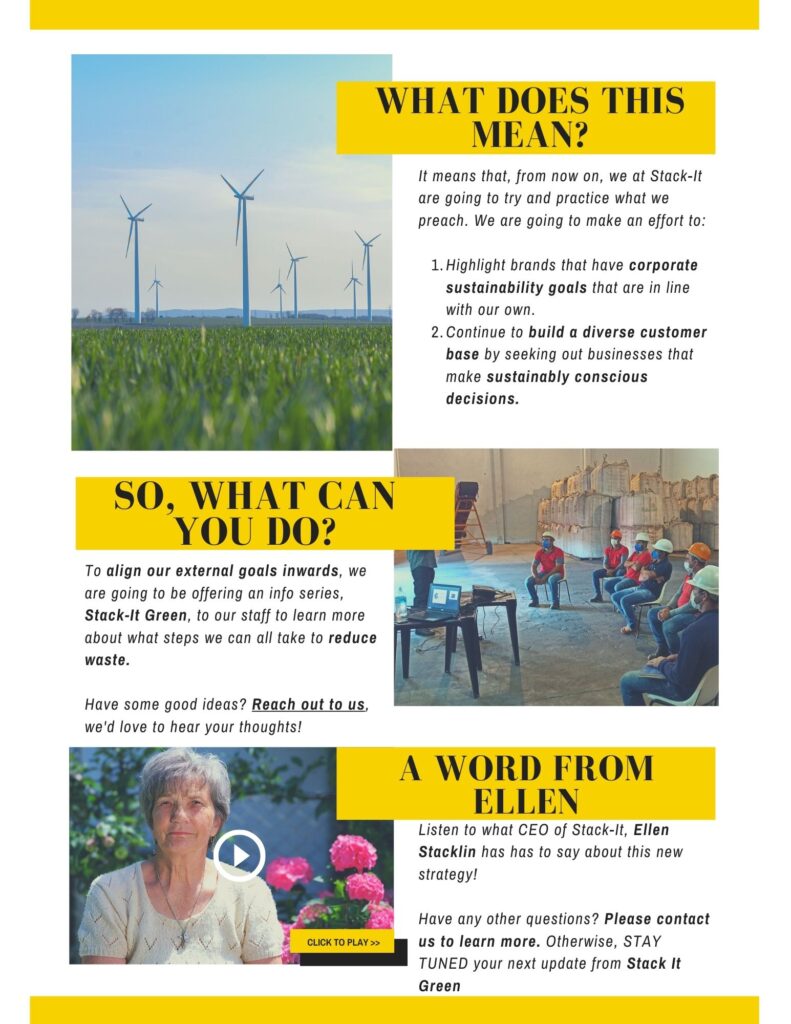
The medium that I will be using—an eblast—is going to be created using ClickDimensions, which is a cloud-based marketing technology service. This will allow me to measure the success of this initial campaign. ClickDimensions offers analytics reporting services on each eblast sent that will record such stats as open rate and click rate (including unique—or new— clicks). This program also offers a heat map that will track what links were clicked on in the eblast versus what links were not clicked on (or clicked on the least). Using this medium will allow me to measure the success of this initiative for any such future initiatives in this campaign.
Another benefit of employing this method of communication is that it is heavily based on visuals over text. To have an appealing eblast usually means making the written communication as pithy and engaging as possible. This will hopefully appeal to a wider and more diverse audience who may favor images over text (and vice-versa). “Visual message framing is [also] a powerful communication strategy for influencing risk perceptions and issue engagement” that can be used to encourage our audience into action (Altinay, 2017, p. 294). We also have the ability to, with ease, change messaging to focus on more local factors (e.g. for employees operating out of a branch in Texas, use local framing). As Schroth et. al. (2014) says, “climate change becomes more salient by bringing relevant information down to the local level, putting it into a community context that people care about, using the local landscape to express climate issues, and engaging citizens in developing local solutions” (p. 417).
The local frame train
The intentions behind employing local framing methods is based on the understanding that “many studies have found that engaging the public in discussion and action on environmental issues requires creating meaningful messages that matter to people personally (Altinay, 2017, p. 294). The way to engage with people—in this case Stack-It employees—is to create local messaging that will “build on [their] existing attitudes toward” their local environment (Altinay, 2017, p. 294).
For the purposes of this first eblast, I will address all staff that work within Stack-It. This first blast will be an introduction to a series of eblasts entitled Stack-It Green where the company will provide staff with little snippets of education and activities that they can do at work or at home to reduce their environmental footprint.
Introducing Stack-It Green
References
Altinay, Z. (2017). Visual communication of climate change: Local framing and place attachment. Coastal Management 45(4), 293-309. https://doi.org/10.1080/08920753.2017.1327344
Armstrong, A. K., Krasney, M. E. & Schuldt, J. P. (2018). Establishing trust. Communicating climate change: A guide for educators. Cornell University Press. [ebook] https://cornellopen.org/9781501730795/communicating-climate-change/
Hine, W. D., Philips, W. J., Cooksey, R., Reser, J. P., Nunn, P., Marks, A. D. G., Loi, N. M., Watt, E. S. (2015). Preaching to different choirs: How to motivate dismissive, uncommited, and alarmed audineces to adapt to climate change. Global Enviornmental Change, 36, 1-11. https://dx.doi.org/10.1016/j.gloenvcha.2015.11.002
Schroth, O., Angel, J., Sheppard, S., Dulic, A. (2014). Visual climate change communication: From Iconography to Locally Framed 3D Visualization. Environmental Communication 8(4), 413-432. https://doi.org/10.1080/17524032.2014.906478
All images are curtsey of pixabay.