
When you say to someone put your back into it, of course you are not actually asking them to shove their back into something. However, for someone who does not have background knowledge of this idiom, they may not understand that you are simply asking them to work hard. Now, imagine someone tells you: ponte las pilas. If you were to translate this from Spanish, you may be confused to find out that someone is asking you to: put your batteries on. Without understanding the context or background of this phrase, one would not be able to easily decipher that ponte las pilas actually means: put your back into it (i.e., work hard). The problem here is that terms, phrases and ideas can change meaning when translated to and from other languages, which can lead to confusion or misunderstandings. This is not only the case with languages. Terms, phrases, concepts and ideas can also change meaning when used across disciplines. A common example of this issue is the definitional differences between climate science and climate practice.
While climate scientists and climate practitioners may have the same underlying goal of solving climate change, they often follow contrasting approaches to climate information. Climate scientists follow a pure scientific approach that is primarily concerned with the pursuit of truth (Natural Resources Canada, 2014). Ultimately, climate scientists aim to develop information that aids in understanding, predicting or explaining natural phenomena. Climate practitioners, on the other hand, follow an applied science approach that is concerned with developing practical solutions to identified problems (Natural Resources Canada, 2014). Their main focus is on developing interventions to alter events or conditions. Although climate scientists are interested in producing the most correct and accurate information, climate practitioners are willing to sacrifice a certain amount of precision in order to use information that is sufficiently accurate for a particular objective.
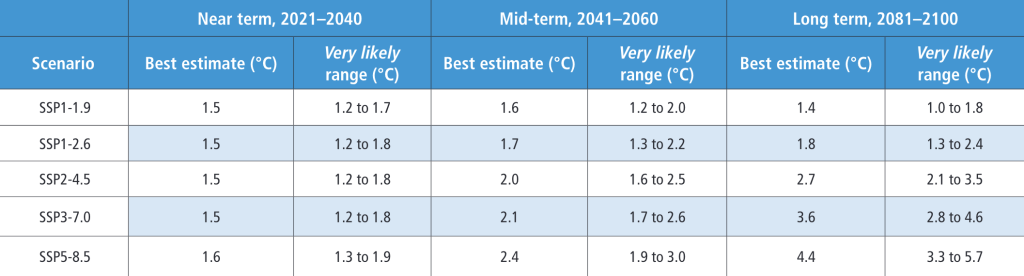
These contrasting approaches to climate information can often create conflict between climate scientists and climate practitioners. Perhaps the primary source of confusion is the way in which climate projections are reported. Due to the nature of climate data, which is derived from multiple climate models and influenced by several factors (known as climate drivers), climate projections are generally given as a range, where every point on that range is equally likely. Because working with one value often facilitates the application of such projections, climate scientists tend to offer the median value of a range as the best estimate for a given climate projection (Allan, et al., 2021). While climate scientists understand that the best estimate is just as likely to occur as any other value on that range, climate practitioners may interpret the range as a confidence interval where the best estimate (the median) is the most likely outcome, and the other values on that range get progressively less likely as they move further away from the middle (Natural Resources Canada, 2014). For example, in the IPCC’s latest Working Group I Summary for Policymakers, the authors provide Table SPM.1, which displays the projected global surface temperature change for five different emissions scenarios relative to the 1850-1900 baseline period (Allan, et al., 2021, p. 4). This table shows both the best estimate [left] and the complete range of possible outcomes [right] for three 20-year periods. Given the way the information is presented on this table, it is common for climate practitioners to misinterpret the best estimate value as the most accurate or probable outcome. However, it is imperative to understand the basic methodology behind these projections in order to interpret the table correctly and understand that each value on the range is just as likely.
Table SMP.1
Changes in Global Surface Temperature Under Five Separate Emissions Scenarios
In fact, misinterpreting even the smallest detail can lead to widely different conclusions. A BBC article from earlier this year highlights exactly how misinterpreting climate information can lead to dangerous outcomes (McGrath, 2022). This article discusses how most media outlets misinterpreted a section from the IPCC’s latest Working Group III Summary for Policymakers, which states:
“Global GHG emissions are projected to peak between 2020 and at the latest before 2025 in global modelled pathways that limit warming to 1.5°C (>50%) with no or limited overshoot and in those that limit warming to 2°C (>67%) and assume immediate action.” (Shukla, et al., 2022, p. 21)
This statement was misconstrued to mean that carbon emissions could continue to rise up until 2025 and the world would still be able to limit global warming to 1.5°C (McGrath, 2022). However, the article clarifies that this statement actually intends to communicate that emissions must decrease between 2020 and 2025 in order for the world to keep global warming below 1.5°C (McGrath, 2022). By misinterpreting this statement, climate practitioners may plan for emissions to peak in 2025, which would be too late for the world to meet the Paris Agreement target of 1.5°C. Therefore, even when a statement is written to convey the most accurate representation of climate findings, lack of context or limited background in a certain discipline can produce misinterpretations of facts that can lead to dangerous conclusions.
Despite the tireless efforts from scientists to produce the most accurate representation of our climate, climate information continues to be widely misunderstood (Quackenbush, 2022). A major challenge of communicating climate information is that simplified media reports of these events often have more influence than the science itself (McGrath, 2022). One explanation for this is that climate information can often get lost in translation from one discipline to another, which regularly leads to misinformation. In order to prevent this conflict, climate scientists and climate practitioners must recognize that not everyone speaks the same language. For example, while climate practitioners may use the terms accuracy and precision interchangeably, climate scientists understand these two term to be fundamentally different (Natural Resources Canada, 2014). Therefore, anyone working within the field of climate change should take further steps towards understanding those who may have a different professional approach than their own.
References
Allan, R. P., Cassou, C., Chen, D., Cherchi, A., Connors, L., Doblas-Reyes, F. J., Douville, H., Driouech, F., Edwards, T. L., Fischer, E., Flato, G. M., Forster, P., AchutaRao, K. M., Adhikary, B., Aldrian, E., & Armour, K. (2021). Summary for Policymakers. In: Climate Change 2021: The Physical Science Basis. Contribution of Working Group I to the Sixth Assessment Report of the Intergovernmental Panel on Climate Change. Cambridge University Press. https://www.ipcc.ch/site/assets/uploads/sites/2/2022/06/SPM_version_report_LR.pdf.
McGrath, M. (2022, April 16). Climate Change: Key UN Finding Widely Misinterpreted. BBC News. https://www.bbc.com/news/science-environment-61110406
Natural Resources Canada. (2014). Developing Effective Dialogue between Practitioners of Climate Change Vulnerability-Risk Assessments. Government of Canada. https://www2.gov.bc.ca/assets/gov/driving-and-transportation/environment/climate-action/climate_data_discussion_primer.pdf
Shukla, P. R., Skea, J., Slade, R., Al Khourdajie, A., van Diemen, R., McCollum, D., Pathak, M., Some, S., Vyas, P., Fradera, R., Belkacemi, M., Hasija, A., Lisboa, G., Luz, S., and Malley, J. (2022). Summary for Policymakers. In: Climate Change 2022: Mitigation of Climate Change. Contribution of Working Group III to the Sixth Assessment Report of the Intergovernmental Panel on Climate Change. Cambridge University Press. https://www.ipcc.ch/report/ar6/wg3/downloads/report/IPCC_AR6_WGIII_SPM.pdf
Quackenbush, C. (2022, May 20). The Climate Scientists Are Not Alright. Washington Post. https://www.washingtonpost.com/climate-environment/2022/05/20/climate-change-scientists-protests/