We have had a lot of discussion about how big our university should be. It is an interesting question but not easy to get any kind of definitive answer. It is said that small universities are more intimate, have smaller class sizes and care for the students; larger institutions have more depth, more research but are impersonal. Of course, these are all generalizations and probably not true, students can have a great experience at any size university.
Is class size an issue? Interestingly, it appears that the effect is greatest for very small classes and very large classes and not for the class sizes between, the drop in performance is also greatest for the top-performing students. A graduate student moving from a class of 10 to 150 can be expected to suffer a loss of 50% of the overall variation in exam marks the student gets in all her courses. (ref) Of course, there are many proven techniques for dealing with large class sizes.
But back to overall university size and a surprising paucity of information. In 1973 a paper published by Sutherland seems to suggest that the optimum size for efficiency is 5,000 – 15,000 students. (Sutherland, G. (1973). Is There an Optimum Size for a University? Minerva, 11(1), 53-78. ).
Another paper suggests that efficiency simply improves with size. (Bonaccorsi, A., Daraio, C., Räty, T., & Simar, L. (2007). Efficiency and university size: Discipline-wise evidence from European universities.)
Another suggests that universities that are under 10,000 students offer a better sense of community. (Lounsbury, J. W., & DeNeui, D. (1996). Collegiate psychological sense of community in relation to size of college/university and extroversion. Journal of Community Psychology, 24(4), 381-394.)
An interesting recent study looking at European universities during the significant European Union alignment of post-secondary education found that universities less than 3,500 were most easily able to adapt to change. (Schubert, Torben, and Guoliang Yang. “Institutional change and the optimal size of universities.” Scientometrics 108.3 (2016): 1129-1153.)
All that leaves me the sense that around 5,000 students you should be able to preserve a sense of community and culture, be reasonably efficient and be nimble enough to rapidly respond to change.
I recently spent a few days at Arizona State University, arguably one of the most innovative universities in the world right now. It is a very large university, around 85,000 students depending on who you ask, which probably makes it one of the largest universities around. As part of its reinvention, the disciplines as departments were eliminated and the whole structure reimagined around the creation of 17 themed and interdisciplinary colleges with names such as The New College of Interdisciplinary Arts and Sciences or the College of Integrative Sciences. While they all have somewhat different sizes, the average size is about 5,000. Each Dean of a college is empowered to be entrepreneurial and create new programs within a framework of principles.
Maybe 5,000 is the right number.


 ost-secondary education is in need of a significant shake up. So add this book to the many other calling for educational reform. What makes this book at least slightly different is that the author certainly has the experience to make this claim and its somewhat optimistic tone. She writes two particularly compelling chapters on technophobia and technophilia. In the former she shows several examples of how avoiding technology use in the classroom can limit the active learning possibilities for students. In the latter she warns that the use of technology needs to be anchored in grounded academic thinking while at the same time tossing a few bricks at the for-profits with a serious nod towards the work of Tressie Cottom in “Lower Ed”.
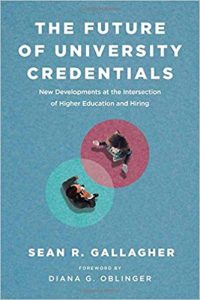 This is a great book by Sean Gallagher, the Chief Strategy Officer for Northeastern University’s Global Network. It is easy to read and well written and researched. If offers an historic overview of university credentialing and an up-to-date look (2016) at the current state of the game.