
Over the last few months, I have spent quite some time reading, researching and visiting a number of institutions that claim some kind of academic innovation. In many cases, I was frustrated to find that the innovation touted in papers and conferences, in fact did not amount to much or in some cases had simply disappeared. So this is my list of things that I found interesting. Continue reading “Learning Innovation”
How Big?
We have had a lot of discussion about how big our university should be. It is an interesting question but not easy to get any kind of definitive answer. It is said that small universities are more intimate, have smaller class sizes and care for the students; larger institutions have more depth, more research but are impersonal. Of course, these are all generalizations and probably not true, students can have a great experience at any size university.
Is class size an issue? Interestingly, it appears that the effect is greatest for very small classes and very large classes and not for the class sizes between, the drop in performance is also greatest for the top-performing students. A graduate student moving from a class of 10 to 150 can be expected to suffer a loss of 50% of the overall variation in exam marks the student gets in all her courses. (ref) Of course, there are many proven techniques for dealing with large class sizes.
But back to overall university size and a surprising paucity of information. In 1973 a paper published by Sutherland seems to suggest that the optimum size for efficiency is 5,000 – 15,000 students. (Sutherland, G. (1973). Is There an Optimum Size for a University? Minerva, 11(1), 53-78. ).
Another paper suggests that efficiency simply improves with size. (Bonaccorsi, A., Daraio, C., Räty, T., & Simar, L. (2007). Efficiency and university size: Discipline-wise evidence from European universities.)
Another suggests that universities that are under 10,000 students offer a better sense of community. (Lounsbury, J. W., & DeNeui, D. (1996). Collegiate psychological sense of community in relation to size of college/university and extroversion. Journal of Community Psychology, 24(4), 381-394.)
An interesting recent study looking at European universities during the significant European Union alignment of post-secondary education found that universities less than 3,500 were most easily able to adapt to change. (Schubert, Torben, and Guoliang Yang. “Institutional change and the optimal size of universities.” Scientometrics 108.3 (2016): 1129-1153.)
All that leaves me the sense that around 5,000 students you should be able to preserve a sense of community and culture, be reasonably efficient and be nimble enough to rapidly respond to change.
I recently spent a few days at Arizona State University, arguably one of the most innovative universities in the world right now. It is a very large university, around 85,000 students depending on who you ask, which probably makes it one of the largest universities around. As part of its reinvention, the disciplines as departments were eliminated and the whole structure reimagined around the creation of 17 themed and interdisciplinary colleges with names such as The New College of Interdisciplinary Arts and Sciences or the College of Integrative Sciences. While they all have somewhat different sizes, the average size is about 5,000. Each Dean of a college is empowered to be entrepreneurial and create new programs within a framework of principles.
Maybe 5,000 is the right number.
The Perfect Undergraduate Curriculum
The holy grail of university education still remains elusive and maybe that is as it should be. Why should one size fit all, the assumption that there is one perfect undergraduate experience at university seems deeply flawed to me. However, that has not stopped armies of academics and commentators writing about it and it is not going to stop me. Continue reading “The Perfect Undergraduate Curriculum”
The Future of University Credentials
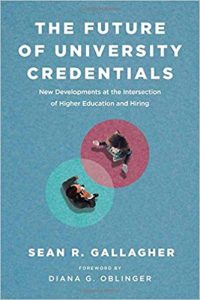 This is a great book by Sean Gallagher, the Chief Strategy Officer for Northeastern University’s Global Network. It is easy to read and well written and researched. If offers an historic overview of university credentialing and an up-to-date look (2016) at the current state of the game.
The book confirms that the university credential is alive and well, HR leaders and recruiters still use the bachelors or masters degree as the number one indicator of competence, despite increasing amounts of rhetoric to the contrary. Continue reading “The Future of University Credentials”
Undergrad Curriculum Based on Happiness?
Perhaps you have read about Bhutan and its measurement of Gross National Happiness an idea that definitely has my support. At a recent visit to Technologico de Monterrey in Mexico as well as its sister institution Universidad TecMilenio, I was somewhat surprised to find that they have taken institutional ownership of the concept of happiness in a serious way. A brief search on happiness reveals a mixture of results from fairly serious articles on positive psychology to some shall we say less peer reviewed views on what makes for happy people. However, no doubt that many people are taking the whole concept of happiness very seriously indeed. Continue reading “Undergrad Curriculum Based on Happiness?”
Disciplines RIP?

All the talk these days is about interdisciplinary studies. Not new, in particular, but the volume seems to be increasing. The disciplines are accused of producing graduates that too narrowly focussed and unable to think particularly critically. The poor old engineers seem to have been particularly pigeon-holed, especially by the humanities (who have of course been likewise scoffed at by the engineers) – good old academic disciplinary rivalry one might think. Increasingly this is seen as a bad not a good and I am tempted to agree. Continue reading “Disciplines RIP?”