November 2021

Tiny Ecology 4: What do I fear?

Nov 19, 2021

The prompt I am examining this week asks me to consider the impacts of fear in climate change communication. If and how does it move me and my local community to action?

The question of fear seems impossible to answer without also talking about hope. In a way, hope and fear are two sides of the same coin. Hope seems necessary only if there is something to fear. If the future were certain, we wouldn’t need to draw on stores of hope – we would just be content with knowing.

Heglar (2019) calls for more emotional nuance when talking about climate. On the side of hope, I see plenty of nuanced discussion. Eco-philosopher Joanna Macy calls for “active hope” (Macy & Johnstone, 2012), while climate scientist Katherine Hayhoe encourages people to lean into “rational hope” (2019). Marlon et al. (2019) talk about “constructive hope” (based on human intervention) in the context of political action, and psychologist Elissa Epel speaks of her “robust hope” in the face of climate change (Chakrabarti, 2021). It seems hope can be active, rational, constructive, robust, and likely manifests in dozens of other ways. 

What about the nuances of fear? How does this manifest? There are the direct fears in the face of climate change: the loss of livelihood or property, loss of life, loss of species, and more. But there are indirect fears as well: fear of the unknown and loss of security. Climate anxiety coach Olive Dempsey highlights that people are grappling with “what we thought our life might be, or grieving the loss of having a safe and reliable future for ourselves, for our children, for our grandchildren” (Razavi, 2021, para. 14).

A lot of traditional climate communication has drawn on fear as a motivator: trying to instill a sense of urgency to motivate action (Ruiter et al., 2014). Yet as the impacts of climate change accelerate and become more obvious, it seems communicators are tasked instead with responding to fear. In a way, communicators no longer need to rely on fear-based messaging, because the climate is doing it for us. Perhaps it is our role to help communities process this fear, by shifting from fear-based messaging to fear-attuned listening.

I decided to practice fear-attuned listening in my sit spot this week. I asked myself: “what do I fear?” while sitting on my now-familiar bench in Poplar Park. I was comforted by the fact that beside my sit spot is a little free mystery library – a great place for fear-based inspiration if I needed it.

Little free library beside Poplar Park, Calgary. Photo provided by author.

But I didn’t need the inspiration. Although climate change is front and centre in my mind, what is occupying most of my emotional energy these days is a personal worry. A person I love is waiting for medical test results – and I fear those results. My fear is distracting. I even catch myself shaking my head when I think about it, as though I am physically trying to dodge it.

So, I decided to consider what this fear can teach me about climate communications.  

I realized the worst part of my current fear is the waiting. The unknown, the uncertainty. I dread hearing the results of that test, yet hearing the results would also bring an end to this period of distraction and anxiety. All I want is certainty. Perhaps that’s the hardest part about climate change too: we have predictions, but no certainty. We can read the reports, stay on top of the research, engage with our communities, and yet we don’t really know what the future will look like. We will have to wait and see what unfolds. And many people in British Columbia are experiencing another excruciating wait: the wait to see what damage has unfolded as the flood waters recede. When dealing with climate change, it seems we have to balance urgency with patience. That makes the waiting especially difficult.

My fear is teaching me to respect the distracting power of anticipation. It’s teaching me that fear is not something we should exploit needlessly. If I am going to use fear as a communications technique, I need to be mindful (perhaps even responsible) for the emotional reactions that occur. With that in mind, how can we support communities who may be grappling with multiple types of fear?

References

Chakrabarti, M. (Host). (2021, October 29). The pessimistic generation: How grown-ups can grow up and give kids some hope Audio podcast episode. In On Point. Wbur. https://www.wbur.org/onpoint/2021/10/29/kids-pandemic-pessimism-politics-teens-future-social-media

Hayhoe, K. (2019, January 11). The most important thing you can do to fight climate change: talk about it [Video]. TED. https://www.youtube.com/watch?v=-BvcToPZCLI&t=14s  

Heglar, M.A. (2019, September 12). Home is Always Worth It. Medium Environment. https://medium.com/@maryheglar/home-is-always-worth-it-d2821634dcd9

Macy, J., & Johnstone, C. (2012). Active Hope: How to Face the Mess We’re in without Going Crazy. New World Library.

Marlon, J.R., Bloodhart, B., Ballew, M.T., Rolfe-Redding, J., Roser-Renouf, C., Leiserowitz, A., & Maibach, E. (2019). How hope and doubt affect climate change mobilization. Frontiers in Communication 4. doi.org/10.3389/fcomm.2019.00020

Razavi, K. (2021, November 19). Anxious about climate change Here’s what you need to know about ‘ecological grief’. Global News. https://globalnews.ca/news/8380734/climate-change-anxiety/

Ruiter, R.A.C., Kessels, L.T.E., Peters, G.J.Y., & Kok, G. (2014). Sixty years of fear appeal research: current state of the evidence. International Journal of Psychology 49(2), 63-70. doi.org/10.1002/ijop.12042

Tiny Ecology 4: What do I fear? Read More »

Tiny Ecology 3: Perspectives

Nov 8, 2021

Instead of approaching my sit spot from the north (as I almost always do), today I approached from the east. Almost immediately, I noticed a bird feeder hanging from a tree that I had never seen before, despite visiting my sit spot many times. That small surprise inspired me to continue exploring the space from new perspectives.

Normally, I sit on my bench and let my attention drift. Today, I intentionally looked at my space through different angles. I gazed down and saw a series of cigarette butts below me. I laid down on the bench and stared at the sky. I examined the space from the perspective of a child: would this park be good for a game of kick-the-can? [As a person with extensive kick-the-can experience, I decided no, this park would not be good for kick-the-can, as there were too few places to hide].

Bird feeder, sky view, and cigarette butts in Poplar Park, Calgary. Photos by author.

My new vantage points made me realize how many different stories – and versions of stories – that could be told about this place. I decided to explore this idea by writing two versions of my sit spot story.  

***

Version #1

Once upon a time, Poplar Park was created in west Calgary. It was a small park, tucked between an elementary school and a row of houses. It had a mix of trees and shrubs, with two benches set perpendicular to one another underneath a large poplar tree.

Every day, a neighbour to the park would visit and ensure that the bird feeder they had placed in one of the trees was full.

Until one day, that person stopped visiting. Life got very busy, and they no longer had time to visit the park. The bird feeder quickly emptied, leaving the birds hungry.

Because of that, the birds stopped visiting. People would still visit but they would leave cigarette butts on the ground when they left. In autumn, the leaves began to fall.

Until finally, the large poplar in the middle of the park no longer held any of its leaves. The branches were bare.

And every day after that, the space felt empty. With the leaves and birds gone, why would any one visit?

Version #2

Once upon a time, Poplar Park was created in west Calgary. It was a small park, tucked between an elementary school and a row of houses. It had a mix of trees and shrubs, with two benches set perpendicular to one another underneath a large poplar tree.

Every day, a neighbour to the park would visit and ensure that the bird feeder they had placed in one of the trees was full. They loved to see the variety of birds that visited the area and felt that this was their way of giving back to the community they loved. Other than the birds, normally the park was empty.

Until one day, the neighbour noticed a stranger sitting by themselves in the middle of the park. They seemed upset. The neighbour decided not to refill the feeder and instead walked up to the stranger and asked if they could sit on the bench across from them.

Because of that, the stranger shared their story. It was a sad story, but the stranger was comforted by the presence and attention of the neighbour. The two listened and talked and held space for one another. Sunlight shone down through the empty branches of the poplar and warmed them.

Until finally, the stranger thanked the neighbour, put out their cigarette and left, feeling better than when they had arrived. Other neighbours had been observing the interaction from their windows.

And every day after that, the benches became a meeting place for neighbours. People knew it was a place to go if you needed comfort or just the companionship of a stranger.

***

Now, which story did you prefer? Both had the same elements: an empty bird feeder, cigarette butts, and a leafless poplar. Both stories have kernels of truth but take artistic license.

It made me happy to see the bird feeder, and to think about the person who put it there. But when I saw it was empty, I wondered if the birds missed the food. When I first saw the cigarette litter, I was disappointed. But then it made me realize that someone had sat where I sat, at least for a few minutes; it made me wonder what they had thought about. I felt oddly connected to that unknown person. When I first looked up at the sky and saw the empty branches, I felt sad. But then I noticed the sky beyond it and realized with the leaves gone I could see the beauty of the clouds. There were at least two stories that I could think of for each of these experiences.

I wrestled with these two competing narratives – the story of absence (no food in the feeder, no leaves, no one willing to pick up their litter) – and the story of presence (birds, sky, and an unknown companion). Which was the ‘right’ story, the ‘true’ story? I know that the second one was more fun to write, likely more pleasant to read, and much more hopeful. But the second story also felt idealistic.

Our prompt asked us to write about an experience from our sit spot that utilizes a gain or loss frame. Research has found that focusing on the benefits of climate action (gain-frames) produce greater motivations for change than focusing on the harms of climate change (loss-frames) (Morton et al., 2011). Yet, when I reflect on the stories that move and motivate me, they are the stories that have elements of both. Framing climate action through only losses or gains seems too simplistic. Perhaps its more about framing things in terms of absence and presence, hope and pain, loss and beauty. A narrative that evokes both seems more real, somehow.

In group discussions, one person will often take on the role of “devil’s advocate” – exploring the potential downsides or unintended consequences of an idea. This role can be important, despite its negative reputation. Yet we never hear about the “angel’s advocate” approach. Perhaps this perspective could explore the potential upsides or unintended positive consequences of an idea. Perhaps this approach could choose to see beauty, presence, and hope, even when it feels like there is none.

How could this mixed approach (drawing on both gains and losses) deepen our climate communications work?

***

The story structure I used, known as the story spine, was taken from work by Cunningham Bigler (2017), who relied on the original idea developed by Kenn Adams in his book How to Improvise a Full-Length Play: The Art of Spontaneous Theater. I also want to take a moment and give credit to my classmate, Mal, as her blog “A Little Thing Called Framing” was part of the inspiration for this piece.  

References

Cunningham Bigler, K. (March 1, 2017). Jumpstart your story with the story spine. Curiographic. https://www.curiographic.com/blog/2017/2/18/jumpstart-your-story-with-the-story-spine

Morton, T.A., Rabinovich, A., Marshall, D., Bretschneider, P. (2011). The future that may (or may not) come: How framing changes responses to uncertainty in climate change communications. Global Environmental Change 21(1), 103-109.

Tiny Ecology 3: Perspectives Read More »

Emotional Downscaling

November 5, 2021

This blog post is for assignment 4 in the CALS501 course.

The twenty-sixth meeting of the Conference of the Parties (COP 26) to the United Nations Framework Convention on Climate Change is currently taking place in Glasgow, Scotland. This has relevance for me, not only as a burgeoning climate leader, but also as a person who called Scotland home for a year. As someone who has walked the streets of Glasgow many times, I can visualize the conference taking place in front of my eyes from thousands of kilometers away. This global-yet-local view of Glasgow I’m experiencing mirrors one of the central challenges for climate leaders: reconciling the need to communicate impacts at a personal level with the uncertainty inherent in global climate models.

I lived in Edinburgh from 2015 – 2016, visiting Glasgow frequently. In a funny family coincidence, my brother also found his way to Scotland in 2015 and made Glasgow his home. The sounds, smells, weather, and personalities of these cities have stayed with me upon returning to Canada. Scotland will always hold a piece of my heart.

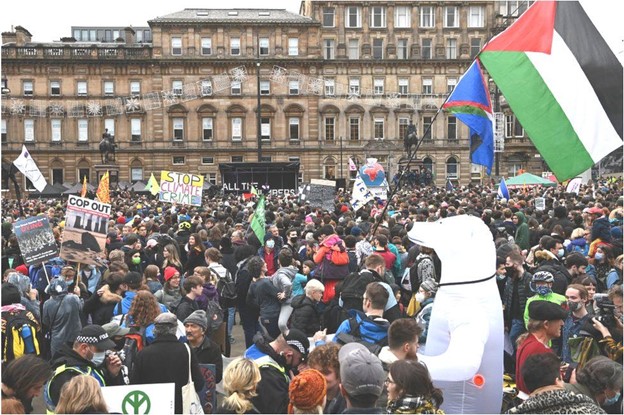
When my brother shares that he must go through a police checkpoint to access his office because the COP 26 conference is happening across the street, I can picture his commute. When he shares photos of police officers lining the roads, I recognize Argyle Street and think about the nearby parks I have enjoyed with my nephew. When I see photos of the youth rally in George Square, I remember a delicious lunch I had around the corner. These places are alive for me.

Argyle Street, Glasgow. November 1, 2021. Photo provided to author by Joel Spark.

The field of emotional geography explores the relationship between an environment and its emotional content; how environments facilitate emotion, and how emotions play out in different environments (Davidson et al., 2007). For me, the emotional geography of the COP 26 conference is mediated through my own lived experience and the experiences of my family in that city. My interpretation of the events and outcomes are happening through a lens of familiarity and nostalgia. For Glaswegians, the event is taking place right where they work, live, and play in real time. I wonder if this helps the climate conversation feel more real there. It’s tangible – it’s blocking their access to work. It’s hard not to pay attention to the conversations happening at one’s doorstep.

Youth climate march, George Square, Glasgow. November 5, 2021. BBC.

Locale is also important when talking about climate impacts, not just climate conferences. Climate communications research has found that effective messages are personalized to fit audiences (Dupar et al., 2019) and clearly demonstrate the impacts of climate change in people’s day-to-day experiences (O’Sullivan, 2019). As Altinay (2017) summarizes, “The strength of local framing comes from its ability to counteract the need for psychological distancing by localizing the consequences and heightening risk perceptions by giving personal, local meanings to global issues” (p. 295). In my view, this localizing and personalizing often relies on the emotional geography of a place: triggering memories of shared experiences and local events. For example, I often hear Albertans talk about the heat dome and heavy smoke from forest fires this past summer. Sharing these experiences with one another reminds us of the hazy views from our windows, and the smoke in our lungs when we went outside. Home didn’t look or smell like home anymore.  

This focus on the local also occurs in climate science through a process called downscaling. This is a statistical procedure by which information from global climate models are translated to smaller geographic scales (Murdock et al., 2014). Downscaling extrapolates from larger patterns to show how climate will impact specific regions. Unfortunately, downscaling can often introduce uncertainty since there is limited high-resolution data (Pyle, 2021). The smaller the scale, the more difficult it is to predict precisely what will happen.

This puts climate communicators in a difficult situation. Research tells us that in order to be effective, we need to communicate how climate change will impact daily experiences. Yet climate models don’t allow the level of precision that might be meaningful to individuals due to the statistical consequences of downscaling. We can anticipate large-scale patterns of change; however, we never know how it will impact individuals on a day-to-day basis. Will climate change impact my commute? Will my favourite restaurant go bankrupt due to food prices? Will my house be flooded? It’s impossible to predict how an individual may be locally impacted by climate change because they themselves are complex beings living within complex systems.

I am beginning to realize this is the challenge for climate leaders more broadly (and our cohort specifically for the CALS501 design challenge): to work through this discrepancy and find ways to translate through the uncertainty. It’s our role to find and connect with the emotional threads and memories that people rely on to make meaning out of their local environments. This is a type of ‘downscaling’, yet one that requires creativity and empathy instead of statistical models.

References

Altinay, Z. (2017). Visual Communication of Climate Change: Local Framing and Place Attachment. Coastal Management 45(4), 293-309.

British Broadcasting Corporation (BBC) (2021). The march culminated in a rally at the city’s George Square [Photograph]. BBC. https://www.bbc.com/news/uk-scotland-59179181

Davidson, J., Bondi, L., & Smith, M. (2007). Emotional Geographies. Ashgate Publishing Limited.

Dupar, M., McNamara, L., & Pacha, M. (2019). Communicating climate change: A practitioner’s guide. Insights from Africa, Asia and Latin America. Climate and Development Knowledge Network. https://unfccc.int/sites/default/files/resource/Communicating%20climate%20change_Insights%20from%20CDKNs%20experience.pdf

Murdock, T., Cannon, A. & Sobie, S. (2014). Statistical downscaling of future climate projections for North America. Pacific Climate Impacts Consortium. https://www.pacificclimate.org/data/statistically-downscaled-climate-scenarios

O’Sullivan, F. (2019). To survive climate change we’ll need a better storyBloomberg CityLab. https://www.bloomberg.com/news/articles/2019-11-11/meet-sweden-s-chief-storyteller-for-climate-change 

Pyle, L. (2021, February 18). Climate Models [Course lecture]. Science and Impacts of Climate Change Course, Royal Roads University, Victoria, BC, Canada.

Emotional Downscaling Read More »