CALS 501

Credibility

June 12, 2022

This blog post is for assignment 6 in the CALS501 course.

I remember lying in my bed as a child, listening to my parents sing bedtime songs:

“Five little ducks went out one day, over the hills and far away… Momma duck said ‘quack, quack, quack quack’, but only four little ducks came back.”

I was so concerned about what happened to the ducks as they disappeared, one by one. I would imagine the lives and adventures of the ducks: were they hiding, or lost? Were the missing ducks together or alone? At the end of the song when “all of the five little ducks came back”, I could finally relax and drop off to sleep.

During one of the interviews for our design challenge (in which we were tasked to inspire citizens to take climate adaptation actions), Mike Lickers emphasized how powerful songs and storytelling can be as communication tools (M. Lickers, personal communication, December 15, 2021). It reminded me of the duck song of my childhood, along with hundreds of other tunes I have listened to, sung, and relied on for emotional support through the years.

What has become clear to me as I reflect on the MACAL program is that in the climate action sector, stories and numbers have a dialectical relationship. Both stories and climate data can hold inherent truth and have power on their own, yet they function best as a partnership. Even the duck song is based on numbers. Listening to the number of ducks decline and then rebound was what brought the story to life.

The weaving together of emotions and data is the art of crafting a narrative, “which is significantly more effective in engaging a listener than data alone” (Dahlstrom, 2014, as cited in Bayer & Hettinger, 2019, p. 1). We observed this effectiveness of narrative-building when testing our design prototype. In front of a test audience, we shared photoshopped images of familiar landscapes that had been altered to show the projected future based on climate data (see example by the City of Edmonton, 2018, below). The numerical projections were also listed at the bottom of the image. One of the participants remarked: “The numbers don’t mean much to me… but they provide credibility to the image” (N. Schaper, personal communication, March 24, 2022). The image was powerful, but it became more powerful when it became clear that the image (a form of visual storytelling) was based on scientific data.

Edmonton river valley, projected to change from tree cover to grassland due to climate change. City of Edmonton (2018, p. 20).

The mere presence of stories and numbers aren’t enough, however. It appears the worthiness of the information is scrutinized as well. When crafting a business case, Messner (2013) suggests that “anything far-fetched, exotic, complicated, or generally unknown does not make a good story” (p. 334). Both the financial argument and the story built around that argument need to be credible for the narrative that binds them to be effective.

Unfortunately, trust in the credibility of governments and other public leaders is at an all-time low in Canada (Proof Strategies, 2022). How can climate leaders fill this trust gap? In our society we tend to venerate leaders that are strong, smart, and visionary. Yet when I reflect on the types of leaders that I see making the most change in their communities, I see leaders that are trustworthy, reliable, steadfast, and sincere. In a word, leaders that are credible. Part of their credibility comes from their reliance on rigorous data and meaningful – yet not overblown – stories.

In what ways have you seen credibility (or lack thereof) impact a climate leader? How can leaders enhance their credibility?

References

Bayer, S., & Hettinger, A. (2019). Storytelling: A natural tool to weave the threads of science and community together. The Bulletin of the Ecological Society of America 100(2), 1-6. https://doi.org/10.1002/bes2.1542

City of Edmonton. (2018). Climate resilient Edmonton: Adaptation strategy and action plan. https://www.edmonton.ca/sites/default/files/public-files/assets/Climate_Resilient_Edmonton.pdf?cb=1655095823

Dahlstrom, M.F. (2014). Storytelling in science. Proceedings of the National Academy of Sciences USA 111, 13614-13620.

Messner, W. (2013). Making the compelling business case: Decision-making techniques for successful business growth. Palgrave Macmillan.

Proof Strategies. (2022). 2022 results report CanTrust index. https://getproof.com/what-we-do/cantrust/
Credibility Read More »

The Conundrum of Localizing Risks

February 15, 2022

This blog post is for assignment 5 in the CALS501 course.

In a post from November 2021, I coined the term ‘emotional downscaling’ to describe what I see as a core task for climate leaders: translating complex global climate projections into relevant information for the lives of their intended audience (O’Sullivan, 2019). Statistical downscaling is the process of translating global climate models into smaller geographic scales (Murdock et al., 2014), while ‘emotional’ downscaling emphasizes the importance of making this data relevant to people. With this in mind, my peers and I decided to incorporate the idea of localizing climate data into our CALS501 design challenge. In theory, this localization seems straightforward: determine the projected local hazards and resulting impacts, engage with the community, conduct a risk assessment, and develop a plan to respond to these risks (CCME, 2021). Upon reflection however, I am realizing that the complexity of risk makes this hyper-locality more challenging. Risks don’t live within well-defined boundaries of a community. Taking a holistic view of risk means looking beyond the local.

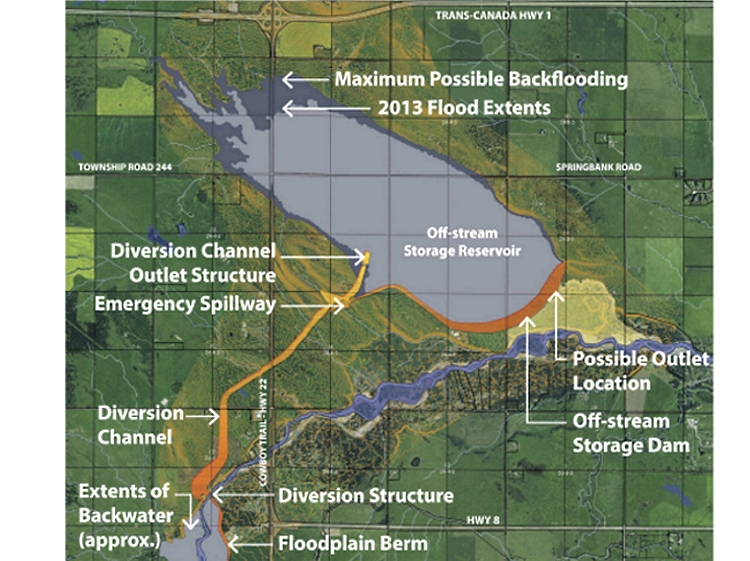
A case study from Calgary may help illustrate my point. The Springbank Off-stream Reservoir (also known as a dry dam) is a climate adaptation project west of Calgary designed “to accommodate water volumes equal to the 2013 flood on the Elbow River” (Government of Alberta, 2022, para. 1). Once completed, the dry dam will fill with water during high precipitation events, preventing flooding downstream. Five properties will be directly impacted by the dam, including private landowners and a summer camp for underprivileged youth (Jabbal et al., 2020). The 2016 environmental impact assessment highlighted potential declines in fish and grizzly populations due to habitat loss, disruption of sacred sites for local Indigenous groups, and more (Government of Canada, 2016). There are real-life impacts of this adaptation strategy for individuals, communities, and the ecosystem. However, the project is moving ahead because the risk to infrastructure downstream in Calgary outweighs the risks of the dam construction (Jabbal et al., 2020).   

Forthcoming Springbank dry dam project west of Calgary. August 4, 2017 (Edey, 2017).

Herein lies the conundrum of risk. Those that may experience the worst risks from climate change (and adaptation to it) may not be in control of the mechanisms to mediate that risk. Or, they may have mechanisms to reduce their risk (ie: building a dam upstream), but their actions may impact other communities’ or species’ abilities to adapt (ie: access to traditional medicine sites). The current residents of Springbank, the children attending summer camp, wildlife, and the Indigenous communities in the area will all be impacted by the dam to varying degrees. Whereas Calgarians who will benefit from the dam… well, their lives won’t change except they won’t have to deal with a potential future flood. The burden of change falls to those living outside the community at risk. As Smit and Wandel highlight, “the adaptive capacity of individuals or households is shaped and constrained by social, political, and economic processes at higher scales” (2006, p. 284). By overlooking how these processes at higher scales influence local adaptive capacity, we may externalize risk onto other communities.

Our prototype for the design challenge has been based on the idea that localizing climate data is important to start engaging citizens on climate adaptation. We are focusing our prototype on the community of Leduc in central Alberta. Yet, if we ignore the regional complications of risk, we may jeopardize the adaptation strategies of other communities. For instance, by only focusing on Leduc and not the surrounding context, we may develop a robust adaptation plan for the community of Leduc that in turn impacts the ability of the nearby Maskwacis Nation to adapt.

As climate practitioners, we need to find a way to localize, yet not lose sight of the regional complexity of risk and adaptation. This seems to be the essence of systems thinking: to understand the individual components, but not lose sight of how those components interact with one another. One way we are playing with this idea in our prototype is to lead the community of Leduc through a systems-mapping exercise. Perhaps encouraging citizens to think in systems will lead to adaptation strategies that are beneficial to people outside of Leduc in addition to those within it.

References

Canadian Council of Ministers of the Environment (2021). Guidance on Good Practices in Climate Change Risk Assessment. https://ccme.ca/en/res/riskassessmentguidancesecured.pdf 

Edey, N. (2017, August 4). Springbank dam EIA to be submitted in October. Cochrane Now. https://cochranenow.com/articles/springbank-dam-eia-to-be-submitted-in-october

Government of Alberta (2016). Environmental assessment – Springbank Off-stream Reservoir. Springbank Off-stream Reservoir. https://calgaryjournal.ca/2020/07/14/against-the-current-both-sides-of-the-sringbank-dam-argument/

Government of Alberta. (2022). About Springbank Off-stream Reservoir. Springbank Off-stream Reservoir. https://www.alberta.ca/about-springbank-off-stream-reservoir.aspx#jumplinks-5

Jabbal, S., Atwood, B., & Gonzalez, D. (2020, July 14). Against the current: Both sides of the Springbank dam argument. Calgary Journal. https://calgaryjournal.ca/2020/07/14/against-the-current-both-sides-of-the-sringbank-dam-argument/

Murdock, T., Cannon, A. & Sobie, S. (2014). Statistical downscaling of future climate projections for North America. Pacific Climate Impacts Consortium. https://www.pacificclimate.org/data/statistically-downscaled-climate-scenarios

O’Sullivan, F. (2019). To survive climate change we’ll need a better storyBloomberg CityLab. https://www.bloomberg.com/news/articles/2019-11-11/meet-sweden-s-chief-storyteller-for-climate-change 

Smit, B., & Wandel, J. (2006). Adaptation, adaptive capacity, and vulnerability. Global Environmental Change 16, 282-292. https://doi.org/10.1016/j.gloenvcha.2006.03.008

The Conundrum of Localizing Risks Read More »

Emotional Downscaling

November 5, 2021

This blog post is for assignment 4 in the CALS501 course.

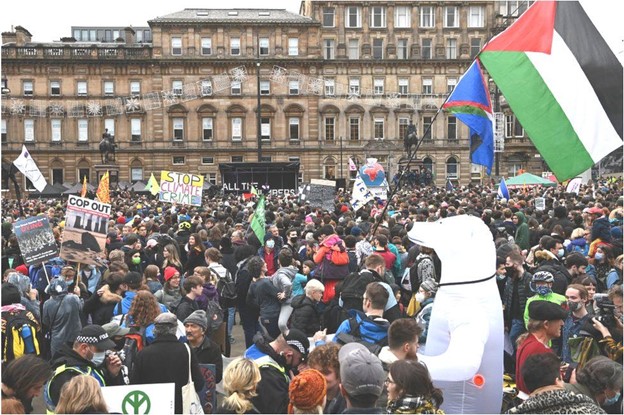
The twenty-sixth meeting of the Conference of the Parties (COP 26) to the United Nations Framework Convention on Climate Change is currently taking place in Glasgow, Scotland. This has relevance for me, not only as a burgeoning climate leader, but also as a person who called Scotland home for a year. As someone who has walked the streets of Glasgow many times, I can visualize the conference taking place in front of my eyes from thousands of kilometers away. This global-yet-local view of Glasgow I’m experiencing mirrors one of the central challenges for climate leaders: reconciling the need to communicate impacts at a personal level with the uncertainty inherent in global climate models.

I lived in Edinburgh from 2015 – 2016, visiting Glasgow frequently. In a funny family coincidence, my brother also found his way to Scotland in 2015 and made Glasgow his home. The sounds, smells, weather, and personalities of these cities have stayed with me upon returning to Canada. Scotland will always hold a piece of my heart.

When my brother shares that he must go through a police checkpoint to access his office because the COP 26 conference is happening across the street, I can picture his commute. When he shares photos of police officers lining the roads, I recognize Argyle Street and think about the nearby parks I have enjoyed with my nephew. When I see photos of the youth rally in George Square, I remember a delicious lunch I had around the corner. These places are alive for me.

Argyle Street, Glasgow. November 1, 2021. Photo provided to author by Joel Spark.

The field of emotional geography explores the relationship between an environment and its emotional content; how environments facilitate emotion, and how emotions play out in different environments (Davidson et al., 2007). For me, the emotional geography of the COP 26 conference is mediated through my own lived experience and the experiences of my family in that city. My interpretation of the events and outcomes are happening through a lens of familiarity and nostalgia. For Glaswegians, the event is taking place right where they work, live, and play in real time. I wonder if this helps the climate conversation feel more real there. It’s tangible – it’s blocking their access to work. It’s hard not to pay attention to the conversations happening at one’s doorstep.

Youth climate march, George Square, Glasgow. November 5, 2021. BBC.

Locale is also important when talking about climate impacts, not just climate conferences. Climate communications research has found that effective messages are personalized to fit audiences (Dupar et al., 2019) and clearly demonstrate the impacts of climate change in people’s day-to-day experiences (O’Sullivan, 2019). As Altinay (2017) summarizes, “The strength of local framing comes from its ability to counteract the need for psychological distancing by localizing the consequences and heightening risk perceptions by giving personal, local meanings to global issues” (p. 295). In my view, this localizing and personalizing often relies on the emotional geography of a place: triggering memories of shared experiences and local events. For example, I often hear Albertans talk about the heat dome and heavy smoke from forest fires this past summer. Sharing these experiences with one another reminds us of the hazy views from our windows, and the smoke in our lungs when we went outside. Home didn’t look or smell like home anymore.  

This focus on the local also occurs in climate science through a process called downscaling. This is a statistical procedure by which information from global climate models are translated to smaller geographic scales (Murdock et al., 2014). Downscaling extrapolates from larger patterns to show how climate will impact specific regions. Unfortunately, downscaling can often introduce uncertainty since there is limited high-resolution data (Pyle, 2021). The smaller the scale, the more difficult it is to predict precisely what will happen.

This puts climate communicators in a difficult situation. Research tells us that in order to be effective, we need to communicate how climate change will impact daily experiences. Yet climate models don’t allow the level of precision that might be meaningful to individuals due to the statistical consequences of downscaling. We can anticipate large-scale patterns of change; however, we never know how it will impact individuals on a day-to-day basis. Will climate change impact my commute? Will my favourite restaurant go bankrupt due to food prices? Will my house be flooded? It’s impossible to predict how an individual may be locally impacted by climate change because they themselves are complex beings living within complex systems.

I am beginning to realize this is the challenge for climate leaders more broadly (and our cohort specifically for the CALS501 design challenge): to work through this discrepancy and find ways to translate through the uncertainty. It’s our role to find and connect with the emotional threads and memories that people rely on to make meaning out of their local environments. This is a type of ‘downscaling’, yet one that requires creativity and empathy instead of statistical models.

References

Altinay, Z. (2017). Visual Communication of Climate Change: Local Framing and Place Attachment. Coastal Management 45(4), 293-309.

British Broadcasting Corporation (BBC) (2021). The march culminated in a rally at the city’s George Square [Photograph]. BBC. https://www.bbc.com/news/uk-scotland-59179181

Davidson, J., Bondi, L., & Smith, M. (2007). Emotional Geographies. Ashgate Publishing Limited.

Dupar, M., McNamara, L., & Pacha, M. (2019). Communicating climate change: A practitioner’s guide. Insights from Africa, Asia and Latin America. Climate and Development Knowledge Network. https://unfccc.int/sites/default/files/resource/Communicating%20climate%20change_Insights%20from%20CDKNs%20experience.pdf

Murdock, T., Cannon, A. & Sobie, S. (2014). Statistical downscaling of future climate projections for North America. Pacific Climate Impacts Consortium. https://www.pacificclimate.org/data/statistically-downscaled-climate-scenarios

O’Sullivan, F. (2019). To survive climate change we’ll need a better storyBloomberg CityLab. https://www.bloomberg.com/news/articles/2019-11-11/meet-sweden-s-chief-storyteller-for-climate-change 

Pyle, L. (2021, February 18). Climate Models [Course lecture]. Science and Impacts of Climate Change Course, Royal Roads University, Victoria, BC, Canada.

Emotional Downscaling Read More »

Latent Environments

June 13, 2021

The two-week learning intensive for the inaugural Climate Action Leadership program ended recently, leaving me with many ideas to unpack. At the June 8 webinar titled Designing with Policy in Mind, panelist Beth Gibbons, Executive Director of the American Society of Adaptation Professionals, introduced the concept of working within “enabled environments” when advocating for stronger climate policy (Gibbons et al., 2021). In this context, enabled policy environments are spaces in which elected officials have the willpower and ability to draft and pass strong climate policy.

Yet what happens when the political will to act on climate is not present? Or politicians are met with partisan obstacles (such as a minority government)? Or politicians are downright hostile toward climate action? Before this panel I considered these periods to be major setbacks in the journey of climate action. Upon reflection however, perhaps ‘non-enabled’ policy environments (which I will refer to as ‘latent’ environments) hold the key for long term resilience.

Cycles of intense productivity followed by latency are commonly found in nature. Consider how a tree drops its leaves for the winter only to regrow them again in spring, or a cicada enters a cyclical period of dormancy before emerging above ground in the billions. These periods of rest – or perceived inaction – are critically important to the health of ecosystems. Without rest, organisms can begin to suffer. For example, artificial light in urban areas can result in foliar damage (leaf injury) because the artificial light tricks trees into retaining their leaves late into the winter (Bennie et al., 2016). Retaining leaves out of season can be harmful for trees, as it prevents the tree from investing in repair and defence processes that are critical for long term health (Vollsnes et al., 2009). Periods of rest are vital for long term resilience in ecosystems.

Leaves closest to artificial light will take longer to drop in the autumn.
Source: https://knowyourmeme.com/photos/1691440-mildly-interesting

Perhaps periods of latency are just as critical for long term climate action resilience. Teika Newton from the Climate Action Network suggests these periods provide “an important moment to build a network and build a movement” (Gibbons et al., 2021). Effective policy should not be drafted quickly for the sake of efficiency. Rather, for policy to be truly effective, it requires research, diversity of thought, and meaningful consultation. In a personal conversation with Michael Lickers, the Indigenous Scholar in Residence at Royal Roads University, Michael encouraged us to take an extremely thoughtful approach to policy and decision making, recognizing that rushed policy is a colonial approach to a wicked problem (M. Lickers, personal communication, June 7, 2021). Cameron (2012) points out that colonial history “is replete with examples of sweeping interventions that were justified precisely through their urgency” (p. 112). In the climate sphere, fast policy is not necessarily effective or decolonial policy.

So, although enabled policy environments are times when strong policy can be mobilized into action, latent periods provide time for meaningful policy formation. By taking the time to research, reflect on past mistakes, and engage in meaningful dialogue, the policy that is eventually mobilized when the opportunity arises will likely be much more valuable than policy undertaken in a frantic environment.

Yet, in the climate sphere, even periods of latency feel laced with urgency. I argue that meaningful policy formation requires a dismantling of toxic productivity culture. Researchers Bellezza et al. (2017) assert that the practice of busyness has become a status symbol, as society shifts focus away from the scarcity of goods to the scarcity of skilled individuals. I see this myth of scarcity in my climate advocacy work: fellow colleagues and volunteers working tirelessly, under the belief that they are among the few that take the problem of climate seriously enough. They believe there are not enough people to get the job done, so those who are working on climate need to work even harder. Feeding into productivity culture – believing the work will not happen without you or that your value comes from what you produce – is an excellent way to become jaded, cynical, or burned out. It is hard to develop well crafted policies and relationships when you are working frantically alone.

Meaningful policy formation requires network weaving, movement building, research, dialogue, consultation, and analysis, but above all – it requires a culture of trust. It asks individuals to trust one another, trust the institutions they are part of, and trust themselves. Engaging in meaningful policy formation requires the ability to see beyond the urgency and trust the challenges, the setbacks, and the latent periods.

As I move through the rest of my time at Royal Roads, I aim to deepen my trust so I can meaningfully engage – whether the policy environment I am working in is enabled or latent.

References

Gibbons, B., Milne, K., Morrison, D.L., Netwon, T., & Reed, G. (2021, June 8). Climate Action: Designing with Policy in Mind [webinar]. Royal Roads University webinar series, Victoria, Canada. https://www.youtube.com/watch?v=hUQHld3k4to

Bellezza, S., Paharia, N., & Keinan, A. (2017). Conspicuous Consumption of Time: When Busyness and Lack of Leisure Time Become a Status Symbol. Journal of Consumer Research 44(1), 118-138.

Bennie, J., Davies, T.W., Cruse, D., & Gaston, K.J. (2016). Ecological effects of artificial light at night on wild plants. Journal of Ecology 104(3), 611-620.

Cameron, E.S. (2012). Securing Indigenous politics: a critique of the vulnerability and adaptation approach to the human dimensions of climate change in the Canadian Arctic. Global Environmental Change 22, 103-114.

Vollsnes, A.V., Eriksen, A.B., Otterholt, E., Kvaal, K., Oxaal, U., & Futsaether, C.M. (2009). Visible foliar injury and infrared imaging shows that daylength affects short-term recovery after ozone stress in Trifolium subterraneum. Journal of Experimental Botany 60, 3677-3686.

Latent Environments Read More »

Entanglements

June 5, 2021

This week we explored the concept of transdisciplinary leadership in terms of climate action. Since the concept of transdisciplinarity is “at once between disciplines, across disciplines, and beyond all disciplines” (Nicolescu, 2014, p. 187), what does this mean for leaders working at the forefront of climate change? Especially when it can be difficult for practitioners to stay on top of the knowledge being cultivated and shared within a single discipline, let alone multiple disciplines.

Corman and Cox (2020) identify eight qualities of transdisciplinary leaders, including “valuing doubt and resistance to new ideas” and “understanding the need for constant adaptation” (p. 13). On the surface, these qualities appear to be contradictory. How can one value resistance to new ideas while also embracing new solutions and adopting a future-orientation? It reminds me of the conversations I have with my two-year-old nephew: “Do you want to go on the slide?”. His response: an emphatic “no!” while running toward the slide.

I have come to realize his answer is somewhere in the middle: “Yes, I want to go on the slide – but I want to do it my way – not your way.” The “no” is really a “yes”, and yet his “no” needs to be respected.

I have been reflecting on how this messy middle may be a keystone of climate action.

Climate is not the first discipline to tackle this messiness. Quantum physics embraces the messy middle enthusiastically: for example, the foundational principle of ‘wave-particle duality’, which suggests that any entity may be described as either a particle or wave. So, if particles can also be waves, and a “yes” can simultaneously be a “no”; then perhaps effective climate action can be equally resistant and welcoming to new ideas.

Until this week, I had not considered climate action through the lens of physics. Upon reflection however, I thought of another relevant quantum property – ‘entanglement’. Philip Ball describes this property as what happens “when two quantum particles interact… their quantum states are inter-dependent… they somehow transmit some kind of influence” even when separated in space (The Royal Institution, 2019). There is an invisible thread holding the particles together and dictating their actions. Scientists are still trying to determine how the two particles remain entangled, even when they are not physically connected.

What would entanglement look like at the climate action scale? Perhaps it means that the action of one leader in one part of the world has unseen, unmeasurable ripple effects on leaders in other parts of the world. As ideas are shared, processes are developed, old narratives are taken apart and replaced with new ones, an intangible change seems to be occurring. Perhaps transdisciplinary leaders are the ones that can translate these intangible connections into tangible actions.  

As you can tell, this is a metaphor in development, and any feedback would be welcome. Does the concept of ‘entanglement’ resonate as a leadership strategy? Where do you see the ‘messy middle’ or contradictory strategies at play in the climate sphere?  

References

Corman, I., & Cox, R. (2020). Transdiciplinarity: A Primer. Royal Roads University. https://commons.royalroads.ca/macal/wp-content/uploads/sites/88/2021/04/MACAL_Transdisciplinary_Thinking03-31-21-3.pdf

Nicolescu, B. (2014). Methodology of Transdisciplinarity. World Futures 70(3-4), 186-199.

The Royal Institution. (2019, February 13). Understanding Quantum Entanglement – with Philip Ball [Video]. YouTube. https://www.youtube.com/watch?v=5_0o2fJhtSc

Entanglements Read More »