Uncategorised

False Solutions

January 7, 2024

This is a final reflective blog for Assignment 3 in CALS 601 (Leading Climate Action in Society Part 2)

The final learning intensive of the MACAL program (aligned with RRU’s Climate Week) invited us to consider the type of leader we want to be, and the solutions we work for.

The theme of “false solutions” came up in various contexts throughout the week. Eriel Techekwie Deranger first used the term during the Indigenous Climate Action: Decolonizing Solutions webinar in terms of carbon-based market mechanisms (2023). Then Dr. Vanessa de Oliveira Andreotti used the term “soft reform” (versus radical reform) in her Climate, Complexity, and Relational Accountability workshop to describe small changes over time (2023). Finally, during the Climate Action Leadership Accelerator led by Solvable, facilitators adapted Bill Sharpe’s Three Horizons framework (n.d.). This framework assumes that dominant cultures change over time. Between the dominant paradigm (labelled Horizon 1 or H1 for short) and alternative paradigms (H3), there are interventions (H2). Interventions were categorized as H2 plus (H2+) and H2 minus (H2-), with H2- being false or incomplete solutions. All these ideas were reminiscent the debate between transformational and incremental change (which was explored in depth during our Modelling a Business Case for Climate Action, CALS504 course).

One recurring example of a false solution (aka soft reform or H2-) was the transition to electric vehicles (EVs). Although EVs reduce the amount of greenhouse gas from vehicle travel, they still encourage us to design our cities in car-centric ways and expand the extraction of rare earth metals. In turn, the extraction of these metals can directly or indirectly harm Indigenous communities through land grabs or pollution, and promote resource-based conflicts around the globe. EVs are a solution that “solves” one problem while ignoring or creating new problems and extending colonialism.

While I completely agree that many proposed climate solutions create or exacerbate existing inequalities and allow the western world to continue to over-consume, I still found myself challenged by the concept of false solutions. Partially because the climate solution that I presented as part of my final poster and video presentation for the Leading Climate Action in Society Part 2 course (CALS601) is a false solution. In my work at Bow Valley College, we recently negotiated a contract amendment with a private company (Atlantica) on the carbon market to decarbonize our heat. No real emissions were reduced, and nothing really changed. Certainly, this project isn’t contributing to decolonization or restoring ecosystems.

Yet part of me still believes in this solution. By Bow Valley College paying a green fee for carbon neutral district energy, we are sending a signal to the company’s investors that clients care and are willing to pay for climate solutions. In turn, this gives the company confidence that it is worth investing in technology to decarbonize the heat they sell to their clients. In fact, Atlantica recently piloted blending hydrogen into their natural gas boilers, and they are in the process of replacing their natural gas boilers with electric boilers powered by solar. Bow Valley College paying the green fee didn’t cause this transition away from fossil-fuels, but our actions helped speed it up.

So is this a false solution or not? Depending on the day, I waver.

Today, I believe it is both a false solution and also necessary. We know it is crucial that we stop using fossil fuels to power our economy. The tricky part is figuring out how. We need to figure out the first step we need to take, so that we can move onto the second, third, fourth steps, and ultimately heat our buildings without fossil fuels. I don’t believe incremental change within a district energy system is the only climate solution or even the best climate solution, but it is a solution nonetheless (though it’s incomplete and imperfect).

In her blog Pay Attention to the 90%, Jen Lash reminds us that only 10% of a policy or initiative is in the idea – the other 90% is “finding a way to push the existing social structures up a hill to a more just society” (2023, para. 5). In short, 10% of the work is the initial idea, while 90% of the work is implementation. Often, that implementation is not glamourous, easy, or straightforward. Instead, it usually involves working across silos, collaborating across organizations, writing numerous drafts, seeking and incorporating feedback, budgeting, interpreting legal documents, and convincing colleagues or decision-makers.

I’m beginning to see my theory of change as someone who works on the 90%. Alberta has a lot of transitioning to do, and I want to be part of the group of people that are contributing to this transition in tangible ways. That’s not the only work I do – I also advocate for larger-scale change both in my paid and volunteer work. But I have found the healthiest balance for me is working at multiple scales: getting into the weeds and implementing tangible solutions, while working on the radical reform that is required.  

I believe transformative action can be built on strategic incrementalism. My vision for Bow Valley College is an institution that uses zero carbon for heating and electricity. I also have visions for the College to be an emergency cooling centre when Calgarians need it. I have visions for our curriculum to produce graduates that contribute to a climate resilient world, across health care, legal, business, and entertainment arts sectors. But to get there, I need to break these visions into tangible steps.

On many days I feel like this approach to leadership isn’t enough. Yet I am emboldened by Justin Smith, a person just like me who is enacting change from within an organization. In his TEDx Talk From Idealist to Environmental Pragmatist he says, “it requires courage to try and work within a system and change things from inside” (6:09, 2014). Whether the system is a single institution or a province as a whole, I feel up for the challenge.

References

De Oliverira Andreotti, V. (2023, December 13). Climate, complexity and relational accountability [Video]. YouTube Royal Roads University Climate Week – Climate, Complexity and Relational Accountability (youtube.com)

Deranger, E. [Royal Roads University]. (2023, December 13). Indigenous climate action: Decolonizing solutions [Video]. YouTube. Royal Roads University Climate Week – Indigenous Climate Action: decolonizing solutions – YouTube

Lash, J. (2023, December 16). Pay attention to the 90%. WordPress. https://webspace.royalroads.ca/jlash/931-2/

Smith, J. [TEDx Talks]. (2014, September 8). From idealist to environmental pragmatist [Video]. YouTube. https://www.youtube.com/watch?v=POxfKCQywkA

Solvable. (n.d.). Three horizons workshops. Solvable. https://www.solvable.ca/three-horizons

False Solutions Read More »

A Potluck of Learning

January 5, 2024

I always say my favourite food is potlucks. I love potlucks because there is such a variety of food, and usually everyone brings a favourite dish they’ve prepared with love. You get the best of so many cuisines and cooks in one meal. Often the magic of that meal can’t be re-created because you’ll likely never have everyone in the same room with the exact same dishes again. The same way that each iteration of an academic program will never be exactly the same: students, instructors, courses, and the world around the university change over time.

Think of this blog post as a potluck of learning: each reflection I list below is a tasty “course” (pardon the pun) that was presumably created by our instructors with love. I decided to return to my notes from each course over the past three years, to share the best learning I received from each (in chronological order). I hope you’re hungry!

Appetizers: whetting the appetite

SPCC 614: Science and Impacts of Climate Change: For the first time, I understood how climate scientists speak to one another. I learned how to think and speak in terms of future projections and climate scenarios.

CALS 501: Leading Climate Action in Society Part 1: This learning intensive took place during the heat dome in 2021. I physically felt the impacts of climate change as I sat sweltering in my apartment. This was the first time I had applied the theory of change to citizen engagement and climate change. Before, I had only used the theory of change for small projects.

Main course: a well-balanced meal

CALS 502: Communication for Climate Action: Taught me how to sit still and challenged me to speak up in public forums. I am most proud of my blog post where I publicly called out Alberta’s then-Minister of Energy Sonya Savage for spreading disinformation.

CALS 503: Climate Risk Management: Taught me how to prioritize climate work and understand relative risk. I’m directly applying this learning to my work at Bow Valley College where I am about to embark on a College-level climate risk assessment.

CALS 504: Modelling the Business Case for Climate Action: This course had a tremendous impact on me. I now understand financial terms like “net present value” and “discounting” and have used these concepts when building business cases at work. Most importantly, I learned how to articulate and calculate the costs of inaction.

CALS 505: Leading Change in Organizations and Communities: This course focused heavily on traditional leadership practices within organizations, which was a bit of a miss for me. I learned that we need more holistic and community-based models for leadership. We need to think outside traditional organizational structures.

CALS 603: Planning Approaches for Climate Resilience: This course tickled my brain with the various understandings of resilience. It taught me to apply a somewhat nebulous concept to a real-life situation. In our final team assignment, we explored the concept of climate resilience for the outdoor recreation industry.

CALS 691: Designing a Practitioner Portfolio: I learned that I value my portfolio in terms of the reputation and relationships that I build. It isn’t important to me to project a record of my career or achievements to a public audience. But my reputation as a compassionate, collaborative problem solver within my network means a lot to me.

CALS 601: Leading Climate Action in Society Part 2: I applied everything I learned above to a problem in my work: how to decarbonize heat in downtown Calgary. Learn more here.

Dessert: guilt-free calories

ENVR 571: Legal Aspects of Environmental Management: I learned in-depth about provincial and federal jurisdiction, the Canadian Constitution, and how to read legislation. When I read headlines like Liberals will amend Impact Assessment Act after Supreme Court found it unconstitutional (Thurton, 2023), I now understand the nuance and impacts of these legal decisions.

SPCC 615: Climate Policy and Governance: The term “polycentricity” will stick with me for a long time (thank you Dr. Elinor Ostrom, 2009). I understand that leadership and policy happens at all levels, from the local all the way up to the international.

HUMS 653: Environmental and Resource-Based Conflict Management: I learned that conflict is inevitable, but not always destructive or negative. This course made me appreciate all the conflict management professionals out there, because the work they do is not the work I want to do.

My head feels full at the end of this long meal, and I am excited to apply all that I have learned to my career. I am grateful for the many friends and colleagues I have met along the way.

Stay hungry!

References

Ostrom, E. (2009). A polycentric approach for coping with climate change. The World Bank. https://documents1.worldbank.org/curated/en/480171468315567893/pdf/WPS5095.pdf

Thurton, D. (2023, October 26). Liberals will amend impact assessment act after supreme court found it unconstitutional. CBC News. https://www.cbc.ca/news/politics/impact-assessment-act-guilbeault-1.7008932

A Potluck of Learning Read More »

My Climate Action Story

This blog post is for assignment 1 in the CALS691 course.

Photo Collage of Values and Purpose for Climate Action.
Please excuse the poor photo quality (the only way to update to WordPress was to reduce the resolution).

The photo collage above summarizes the values and motivations I hold as an environmental practitioner, and how these influence my approach to climate action work.

The photo at the bottom shows the heavily treed cul-de-sac where I grew up in south Calgary. The cul-de-sac is directly across the street from Fish Creek Provincial Park, the second largest urban park in Canada (Travel Alberta, n.d.). I was surrounded by greenspace as a child, which undoubtedly led me to a career in environmental studies. This photo communicates my deep belief that ecosystems have intrinsic value. Not just value for us as humans, but value as an ecosystem.

In Dare to Lead, Brené Brown provides a list of over a hundred values and invites her readers to choose two values they hold most important (2018, p. 188). The values I ultimately chose were adventure and integrity. The two photos on the left side represent my value of adventure. I enjoy challenging myself and exploring new areas, both physically in the outdoors and mentally in my work.

The photo on in the bottom right corner represents my value of integrity. These are my current walking shoes which I bought in 2015. They are very dirty and tattered yet they still keep my feet warm and dry. I use items and clothes as long as possible because it is important to me to use resources responsibly and live in accordance with my environmental values. I see integrity as living in accordance with your values.

For more details about how these two values influence my work, I invite you to read my blog post on the subject.

My mother bought me the mug that is shown in the centre. It says “I’d rather be forking my compost”. It’s a ridiculous statement, but it reminds me that my environmental advocacy began when I started a composting program at my high school. I believe that we have a responsibility to make change within our spheres of influence, and to maximize (not minimize) our positive influence. As a teenager, my sphere of influence included my high school. At each step in my career, I push myself to expand my influence a bit more.

The context in which I want to work is my hometown of Calgary. The photo at the top of the collage is the view of Calgary in 1913 from Scotsman’s Hill (Glenbow Museum, 1913). A print of this photo hangs in my apartment and reminds me everyday of my history; my great-great-grandparents moved to Calgary in the 1880s. I have a deep love of this land built on generations of family history. Yet I also recognize my responsibilities as a non-Indigenous Treaty 7 person to uphold the rights of Indigenous communities and be reflective as I work and live on this land.

The final photo explains how I wish to work for climate action (CTV News, 2020). During the early days of the pandemic I worked on the Defend Alberta Parks campaign. This was a non-partisan grassroots campaign that pushed back against the Government of Alberta’s announcement to close and remove 175 areas from the park system. Through a volunteer-driven lawn sign and letter writing campaign, we were able to engage thousands of Albertans across the political spectrum, and in Dec 2020 the government walked back the plan. This campaign laid the groundwork for the Alberta Beyond Coal campaign which in turn has influenced conversations about the energy transition.

This campaign exemplifies my approach to climate action. I love to work on projects that are high-impact, community-driven, strategic, and lay the groundwork for future work. I want to provide leadership by living my values, deepening my network, and approaching projects pragmatically.

References

Brown, B. (2018). Dare to lead: Brave work. Tough conversations. Whole hearts. Random House.

CTV News. (2020). Organizations fighting against the Alberta government’s plan to remove almost 200 recreation areas say it will result in those lands becoming inaccessible to Albertans [Photograph]. CTV News. https://calgary.ctvnews.ca/albertans-continue-to-stand-up-for-parks-that-sit-on-the-chopping-block-1.5166701

Travel Alberta. (n.d.). Fish Creek Provincial Park. Travel Alberta. https://www.travelalberta.com/ca/listings/fish-creek-provincial-park-10792/

Glenbow Museum. (1913). View of Ramsay and Inglewood districts, Calgary, Alberta [Photograph]. Glenbow Museum, Calgary, Alberta, Canada. http://ww2.glenbow.org/search/archivesPhotosResults.aspx?AC=GET_RECORD&XC=/search/archivesPhotosResults.aspx&BU=&TN=IMAGEBAN&SN=AUTO8439&SE=1851&RN=0&MR=10&TR=0&TX=1000&ES=0&CS=0&XP=&RF=WebResults&EF=&DF=WebResultsDetails&RL=0&EL=0&DL=0&NP=255&ID=&MF=WPEngMsg.ini&MQ=&TI=0&DT=&ST=0&IR=4484&NR=0&NB=0&SV=0&BG=&FG=&QS=ArchivesPhotosSearch&OEX=ISO-8859-1&OEH=ISO-8859-1

My Climate Action Story Read More »

Anger & Leadership

August 10, 2022

This blog post is for assignment 1C in the CALS505 course

I have been reflecting on the relationship between anger and leadership this week. Usually, when I think of anger in leadership contexts, I think of anger used as a tool in political arenas; a candidate riling up their supporters by showcasing real or feigned anger, for example. This week however I was reflecting on my own anger and how it relates to my leadership.   

On Tuesday, the news story broke that a young woman in Alberta won third prize in a government-sponsored essay contest called “Her Vision Inspires”. The contest – hosted by the legislative assembly – asked young women to describe their vision for Alberta (Bellefontaine, 2022). An essay contest is not usually noteworthy. However, what made the headlines is the bronze medal essay asserted “that women are not equal to men and that their ability to bear children takes priority over trying to break into male-dominated careers” (Bellefontaine, 2022, para. 3). Furthermore, the essay also stated that Canadian women should receive financial incentives to have children to “prevent the import of foreigners to replace ourselves” (Silver, 2022, as cited in Bellefontaine, 2022, para. 5).

After hearing this 24 hours ago, I am still reeling. And I am so angry.

I am not naïve enough to believe that this type of sexism and xenophobia doesn’t exist in Alberta. The author (who has only been identified as S. Silver) is within her right to hold these abhorrent views. What makes me angry is the associate minister for the status of women (MLA Jackie Armstrong-Homeniuk) not only gave these views a platform, but rewardedand legitimized these views by awarding the author a cash prize.  

When these types of sexist and racist views are upheld by people in positions of leadership, it does two things. First, I lose hope that we are on the right track to solving our most pressing challenges. Second, strangely, it makes me uncomfortable to strive to be a leader myself. If being a leader means upholding sexist and racist views, then I don’t want to be considered a leader. Of course, not all elected officials – or leaders in any capacity – uphold these views. Many leaders are compassionate people who are building a world that is better for all. But the news story this week reminded me how many poor leaders currently hold power and are making decisions about our collective future. It made me wonder, when there are such poor examples of leadership in my province, do I really want to step forward and become a leader myself?

Yet Jennifer Shepherd’s words from our class discussion remind me that I get to define what leadership is. MLA Armstrong-Homeniuk is an elected official, but in my mind, she is not a leader. Jennifer invited us to reflect on how we show up as leaders, and what types of relationships we build with each other and non-human elements like water (Shepherd, 2022). Today I am showing up as an angry leader, but a leader that is justifiably angry at racism. I want to figure out how I can channel this type of anger into something productive for climate justice.

References

Bellefontaine, M. (2022, August 9). Alberta cabinet minister disavows racist, sexist essay that won prize. Canadian Broadcasting Corporation. https://www.cbc.ca/news/canada/edmonton/alberta-cabinet-minister-disavows-racist-sexist-essay-that-won-prize-1.6546032

Shepherd, J. (2022, July 28). What is your relationship with water? [Guest lecture for CALS 505 Leading Change in Organizations and Communities]. Unit 6 session, online.

Anger & Leadership Read More »

Social Capital and Resilience

July 27, 2022

This blog post is for assignment 1B in the CALS505 course

Consultation on Canada’s National Adaptation Strategy closed two weeks ago. As a cohort of students in the Climate Action Leadership program at Royal Roads University, eleven of us collaborated on a joint letter to share our priorities for action. There was no formal organizing mechanism behind us, just video calling software, a Google document, a deadline, and our ideas.

I’ve been reflecting on this project a lot over the past few weeks. What I found striking was the process felt joyful. I left our calls feeling energized and restored, and confident in our work. I have written dozens of advocacy letters in my life. I’ve collaborated with people plenty of times. I have had hundreds of video calls. So, what made this experience stand out?

Discovering the description of social capital helped me understand my joy. Social capital is the “trust, mutual understanding, and shared values and behaviours that bind the members of human networks and communities and make cooperative action possible” (Cohen & Prusack, 2001, p. 4). We weren’t just eleven people trying to co-write a piece. I was partnering with ten other people who are values-driven and who walk the talk. We’ve built understanding of one another over difficult assignments, through class discussions, and across multiple time zones. Our submission to the national adaptation strategy provided us a reason to deepen these relationships while we reflected and applied what we have learned throughout the program. So, it wasn’t just the software, a deadline, and our ideas that pulled the letter together. It was really the social capital we have been building over the past thirteen months as a cohort that made the project come together so smoothly.

This realization helped me understand the meaning of relationship building that is so central to decolonization work. Gram-Hanssen et al. (2022) call for “decolonial efforts from non-Indigenous people for society to successfully adapt to climate change in a way that centers equitable relationships between Indigenous and non-Indigenous people” (p. 674). I understand this to mean that relationship building not only prepares us to work together effectively on climate action (as was the case with our cohort), but the relationships themselves are climate adaptations. My understanding of social capital has shifted from seeing it as outcome of working together to a necessary foundation to adaptation.

This idea was reinforced by the explanation of resilience by Ungar (2019), who concluded “the social, political, and natural environments in which we live are far more important to our health, fitness, finances and time management than our individual thoughts, feelings, or behaviours” (para. 29). The way I see it, Ungar (2019) is describing resilience as social capital beyond the organizational scale, but rather at the community scale. Perhaps by building social capital within and between groups, climate resilience can be found for as many people as possible.  

References

Cohen, D., & Prusak, L. (2001). In Good Company. Harvard Business School Press. Boston, MA.  

Gram-Hanssen, I., Schafenacker, N., & Bentz, J. (2022). Decolonizing transformations through ‘right relations’. Sustainability Science 17, 673-685. https://doi.org/10.1007/s11625-021-00960-9

Unger, M. (2019, May 25). Put down the self-help books. Resilience is not a DIY endeavour. The Globe and Mail. https://www.theglobeandmail.com/opinion/article-put-down-the-self-help-books-resilience-is-not-a-diy-endeavour/ 

Social Capital and Resilience Read More »

Adventure & Integrity

July 5, 2022

This blog post is for assignment 1A (excerpt 1) in the CALS505 course

“Ready for an adventure?”

That phrase has become my tagline when picking up my nephews for babysitting. I figure going on an adventure is one of the most exciting things for a child, even if it’s just to a local park. I remember how much I liked going on adventures as a child, and I want to continue cultivating that love for the outdoors with them.

My tagline came to mind as I’ve been reflecting on my values. In Dare to Lead, Brené Brown provides a list of over a hundred values and invites her readers to choose two values they hold most important (2018, p. 188). The two values I ultimately chose were adventure and integrity.

It was cathartic to summarize central aspects of my personality and worldview into two simple words. Yet even though these values feel ‘right’ to me, I began to wonder how they relate to my role as a climate leader. I even began to wonder whether these values were ‘worthy’ for the tough work of climate adaptation. On the one hand, integrity feels easy to justify: I respect integrity in my own leaders (such as politicians) and do my best to work with integrity. In a recent blog, I shared that the leaders I see making the most change in their communities are ones that are trustworthy, reliable, steadfast, and sincere. To me, all these attributes demonstrate integrity-based leadership.

On the other hand, adventure feels a little harder to justify. Do we really have time for adventures when there is so much work to do? In my downtime I enjoy exploring by canoe, by bike, or on foot. These adventures support my mental and physical health and provide a respite from the demands of climate work. Yet, I realized I value not only physical adventures, but working on projects in adventurous ways. I respect leaders that are willing to trust the process – and trust the people they work with – even if they don’t know exactly how the process will end.

With all that said, what are the potential drawbacks of these values? Or rather, what are some things I should be mindful of when embracing these values?

When it comes to integrity, it’s important to remember that standards are not universal. What may be an act of integrity from my perspective may not be an act of integrity to someone else. For instance, Poitras Pratt and Gladue (2022) call for the scope of academic integrity to be redefined and renewed to include Indigenous perspectives such as wholism and interconnectedness. I need to remember that my understanding of integrity is wrapped up in my colonial worldview and personal history.  

Similarly, I need to recognize that my zeal for adventure comes from a place of privilege. I have a safe place to sleep, a steady supply of food, a platform for my voice, and the ability to vote. If I do experience a climate disaster, I will most likely have the means and resources to adapt. I seek out adventures because my daily experiences don’t force me to be adventurous. Although “ready for an adventure?” is something that I ask out of joy, I need to remember that for many, daily life is a scary adventure already.

References

Brown, B. (2018). Dare to lead: Brave work. Tough conversations. Whole hearts. Random House.

Poitras Pratt, Y., & Gladue, K. (2022). Re-defining academic integrity: embracing indigenous truths. Academic Integrity in Canada, 1, 103-123. https://doi.org/10.1007/978-3-030-83255-1_5

Adventure & Integrity Read More »

Credibility

June 12, 2022

This blog post is for assignment 6 in the CALS501 course.

I remember lying in my bed as a child, listening to my parents sing bedtime songs:

“Five little ducks went out one day, over the hills and far away… Momma duck said ‘quack, quack, quack quack’, but only four little ducks came back.”

I was so concerned about what happened to the ducks as they disappeared, one by one. I would imagine the lives and adventures of the ducks: were they hiding, or lost? Were the missing ducks together or alone? At the end of the song when “all of the five little ducks came back”, I could finally relax and drop off to sleep.

During one of the interviews for our design challenge (in which we were tasked to inspire citizens to take climate adaptation actions), Mike Lickers emphasized how powerful songs and storytelling can be as communication tools (M. Lickers, personal communication, December 15, 2021). It reminded me of the duck song of my childhood, along with hundreds of other tunes I have listened to, sung, and relied on for emotional support through the years.

What has become clear to me as I reflect on the MACAL program is that in the climate action sector, stories and numbers have a dialectical relationship. Both stories and climate data can hold inherent truth and have power on their own, yet they function best as a partnership. Even the duck song is based on numbers. Listening to the number of ducks decline and then rebound was what brought the story to life.

The weaving together of emotions and data is the art of crafting a narrative, “which is significantly more effective in engaging a listener than data alone” (Dahlstrom, 2014, as cited in Bayer & Hettinger, 2019, p. 1). We observed this effectiveness of narrative-building when testing our design prototype. In front of a test audience, we shared photoshopped images of familiar landscapes that had been altered to show the projected future based on climate data (see example by the City of Edmonton, 2018, below). The numerical projections were also listed at the bottom of the image. One of the participants remarked: “The numbers don’t mean much to me… but they provide credibility to the image” (N. Schaper, personal communication, March 24, 2022). The image was powerful, but it became more powerful when it became clear that the image (a form of visual storytelling) was based on scientific data.

Edmonton river valley, projected to change from tree cover to grassland due to climate change. City of Edmonton (2018, p. 20).

The mere presence of stories and numbers aren’t enough, however. It appears the worthiness of the information is scrutinized as well. When crafting a business case, Messner (2013) suggests that “anything far-fetched, exotic, complicated, or generally unknown does not make a good story” (p. 334). Both the financial argument and the story built around that argument need to be credible for the narrative that binds them to be effective.

Unfortunately, trust in the credibility of governments and other public leaders is at an all-time low in Canada (Proof Strategies, 2022). How can climate leaders fill this trust gap? In our society we tend to venerate leaders that are strong, smart, and visionary. Yet when I reflect on the types of leaders that I see making the most change in their communities, I see leaders that are trustworthy, reliable, steadfast, and sincere. In a word, leaders that are credible. Part of their credibility comes from their reliance on rigorous data and meaningful – yet not overblown – stories.

In what ways have you seen credibility (or lack thereof) impact a climate leader? How can leaders enhance their credibility?

References

Bayer, S., & Hettinger, A. (2019). Storytelling: A natural tool to weave the threads of science and community together. The Bulletin of the Ecological Society of America 100(2), 1-6. https://doi.org/10.1002/bes2.1542

City of Edmonton. (2018). Climate resilient Edmonton: Adaptation strategy and action plan. https://www.edmonton.ca/sites/default/files/public-files/assets/Climate_Resilient_Edmonton.pdf?cb=1655095823

Dahlstrom, M.F. (2014). Storytelling in science. Proceedings of the National Academy of Sciences USA 111, 13614-13620.

Messner, W. (2013). Making the compelling business case: Decision-making techniques for successful business growth. Palgrave Macmillan.

Proof Strategies. (2022). 2022 results report CanTrust index. https://getproof.com/what-we-do/cantrust/

Credibility Read More »

Is self-interest inherently selfish?

April 10, 2022

“Why are you here tonight?”

This was my question to a room full of women as we sat together in the back room of the Women’s Centre of Calgary in November 2019. The topic we were gathering around was ecological grief, and although the responses to my question varied, most of them centred on the theme of responsibility. For example, “I’m here because I am concerned about the future for my grandchildren. I want them to experience the same great memories of the outdoors that I had as a child.”

I have run several workshops like this, and time and time again, the concept of responsibility to others (often specifically to their own children and grandchildren) is mentioned. This pattern isn’t isolated to women in Calgary. I’ve heard it from non-profit workers, energy professionals, politicians, and radio announcers. In almost all cases, when people share the motivations for why they do what they do, the answer comes back to accountability to their children, grandchildren, or community. Cynically, perhaps people believe that’s the answer others want to hear, yet many of the stories I’ve been told appear genuine. Additionally, I’m not the only person to observe this pattern: Nelson (2019) points out that even one of the staunchest advocates of framing climate action in terms of self-interest, Christiana Figueres, answers the question about her motivation through a story of responsibility to her children. We tend to rely on economic arguments to inspire or explain collective action, but personal anecdotes to explain one’s own motivation.

It’s this dichotomy which makes me struggle so much with the sentiment that we need to communicate climate action in terms of self-interest. When individuals are asked what motivates them to act on climate change, often the answer is altruistic. Yet the function of a business case assumes that what motivates groups of people (businesses, non-profit organizations, etc.) is self-interest (Herman & Siegelaub, 2009). How can individuals and groups composed of those very same individuals have such widely different motivations?

Reflecting on this, I realized that self-interest isn’t necessarily selfish, although I had initially understood it that way. Self-interest isn’t necessarily good or bad for climate action. What is ultimately important is how that self-interest affects the common good. Humanitarian organizations or environmental non-profit organizations have an interest in self-preservation, to ensure their work can continue. They seek projects and funding that will allow their work to endure, because they continue to see an issue to respond to. In this case, self-interest is still operating within a larger system of altruism. Arguably, the organization needs to continue so that they can continue to protect the environment or provide social aid. So, an argument based in self-interest still has an overall positive outcome for the common good.

On the contrary, if a business’ only focus is to create a profit for a small number of actors, then a self-interest argument is unlikely to convince the business leader to take climate adaptation action for the common good. In this case, self-interest is the final goal rather than just a means to continue their work.

For this blog, we were asked to articulate our position on the role of self-interest as an incentive for undertaking climate action. From my experience, individuals are generally motivated to make change because their community matters to them. Whereas, cynically, I tend to view corporate self-interest as inherently selfish. Yet when I consider self-interest within broader context – such as how an organization’s self-interest impacts the wider community – I begin to see a potential path forward. Relying on self-interest framing for a business case does not necessarily mean the wider good has been abandoned. Rather, it is a narrative tool that can be used for the betterment of the common good.  

References

Herman, B., & Siegelaub, J.M. (2009). Is this really worth the effort? The need for a business case. Project Management Institute.

Nelson, J.A. (2019). Chapter 6: Climate change and economic self-interest. In Kanbur, R., & Shue, H. (Eds). Climate justice: Integrating economics and philosophy. Oxford University Press. (pp. 113-122).

Is self-interest inherently selfish? Read More »

The Conundrum of Localizing Risks

February 15, 2022

This blog post is for assignment 5 in the CALS501 course.

In a post from November 2021, I coined the term ‘emotional downscaling’ to describe what I see as a core task for climate leaders: translating complex global climate projections into relevant information for the lives of their intended audience (O’Sullivan, 2019). Statistical downscaling is the process of translating global climate models into smaller geographic scales (Murdock et al., 2014), while ‘emotional’ downscaling emphasizes the importance of making this data relevant to people. With this in mind, my peers and I decided to incorporate the idea of localizing climate data into our CALS501 design challenge. In theory, this localization seems straightforward: determine the projected local hazards and resulting impacts, engage with the community, conduct a risk assessment, and develop a plan to respond to these risks (CCME, 2021). Upon reflection however, I am realizing that the complexity of risk makes this hyper-locality more challenging. Risks don’t live within well-defined boundaries of a community. Taking a holistic view of risk means looking beyond the local.

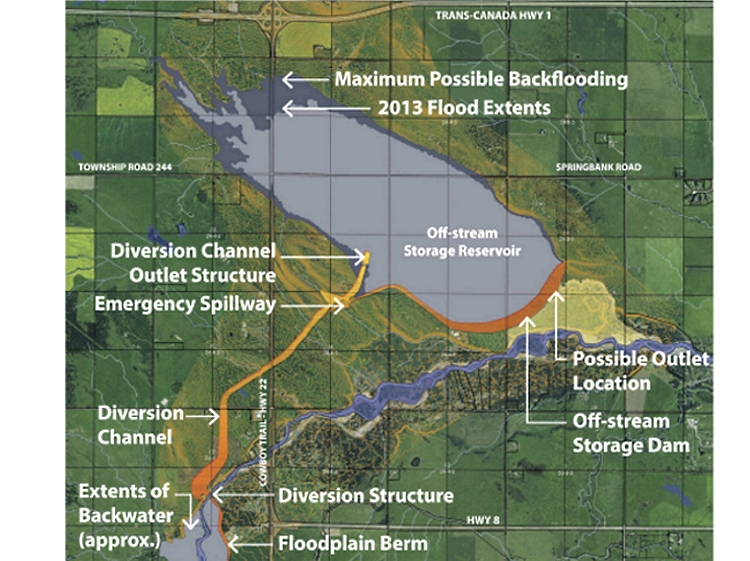
A case study from Calgary may help illustrate my point. The Springbank Off-stream Reservoir (also known as a dry dam) is a climate adaptation project west of Calgary designed “to accommodate water volumes equal to the 2013 flood on the Elbow River” (Government of Alberta, 2022, para. 1). Once completed, the dry dam will fill with water during high precipitation events, preventing flooding downstream. Five properties will be directly impacted by the dam, including private landowners and a summer camp for underprivileged youth (Jabbal et al., 2020). The 2016 environmental impact assessment highlighted potential declines in fish and grizzly populations due to habitat loss, disruption of sacred sites for local Indigenous groups, and more (Government of Canada, 2016). There are real-life impacts of this adaptation strategy for individuals, communities, and the ecosystem. However, the project is moving ahead because the risk to infrastructure downstream in Calgary outweighs the risks of the dam construction (Jabbal et al., 2020).   

Forthcoming Springbank dry dam project west of Calgary. August 4, 2017 (Edey, 2017).

Herein lies the conundrum of risk. Those that may experience the worst risks from climate change (and adaptation to it) may not be in control of the mechanisms to mediate that risk. Or, they may have mechanisms to reduce their risk (ie: building a dam upstream), but their actions may impact other communities’ or species’ abilities to adapt (ie: access to traditional medicine sites). The current residents of Springbank, the children attending summer camp, wildlife, and the Indigenous communities in the area will all be impacted by the dam to varying degrees. Whereas Calgarians who will benefit from the dam… well, their lives won’t change except they won’t have to deal with a potential future flood. The burden of change falls to those living outside the community at risk. As Smit and Wandel highlight, “the adaptive capacity of individuals or households is shaped and constrained by social, political, and economic processes at higher scales” (2006, p. 284). By overlooking how these processes at higher scales influence local adaptive capacity, we may externalize risk onto other communities.

Our prototype for the design challenge has been based on the idea that localizing climate data is important to start engaging citizens on climate adaptation. We are focusing our prototype on the community of Leduc in central Alberta. Yet, if we ignore the regional complications of risk, we may jeopardize the adaptation strategies of other communities. For instance, by only focusing on Leduc and not the surrounding context, we may develop a robust adaptation plan for the community of Leduc that in turn impacts the ability of the nearby Maskwacis Nation to adapt.

As climate practitioners, we need to find a way to localize, yet not lose sight of the regional complexity of risk and adaptation. This seems to be the essence of systems thinking: to understand the individual components, but not lose sight of how those components interact with one another. One way we are playing with this idea in our prototype is to lead the community of Leduc through a systems-mapping exercise. Perhaps encouraging citizens to think in systems will lead to adaptation strategies that are beneficial to people outside of Leduc in addition to those within it.

References

Canadian Council of Ministers of the Environment (2021). Guidance on Good Practices in Climate Change Risk Assessment. https://ccme.ca/en/res/riskassessmentguidancesecured.pdf 

Edey, N. (2017, August 4). Springbank dam EIA to be submitted in October. Cochrane Now. https://cochranenow.com/articles/springbank-dam-eia-to-be-submitted-in-october

Government of Alberta (2016). Environmental assessment – Springbank Off-stream Reservoir. Springbank Off-stream Reservoir. https://calgaryjournal.ca/2020/07/14/against-the-current-both-sides-of-the-sringbank-dam-argument/

Government of Alberta. (2022). About Springbank Off-stream Reservoir. Springbank Off-stream Reservoir. https://www.alberta.ca/about-springbank-off-stream-reservoir.aspx#jumplinks-5

Jabbal, S., Atwood, B., & Gonzalez, D. (2020, July 14). Against the current: Both sides of the Springbank dam argument. Calgary Journal. https://calgaryjournal.ca/2020/07/14/against-the-current-both-sides-of-the-sringbank-dam-argument/

Murdock, T., Cannon, A. & Sobie, S. (2014). Statistical downscaling of future climate projections for North America. Pacific Climate Impacts Consortium. https://www.pacificclimate.org/data/statistically-downscaled-climate-scenarios

O’Sullivan, F. (2019). To survive climate change we’ll need a better storyBloomberg CityLab. https://www.bloomberg.com/news/articles/2019-11-11/meet-sweden-s-chief-storyteller-for-climate-change 

Smit, B., & Wandel, J. (2006). Adaptation, adaptive capacity, and vulnerability. Global Environmental Change 16, 282-292. https://doi.org/10.1016/j.gloenvcha.2006.03.008

The Conundrum of Localizing Risks Read More »

Tiny Ecology 4: What do I fear?

Nov 19, 2021

The prompt I am examining this week asks me to consider the impacts of fear in climate change communication. If and how does it move me and my local community to action?

The question of fear seems impossible to answer without also talking about hope. In a way, hope and fear are two sides of the same coin. Hope seems necessary only if there is something to fear. If the future were certain, we wouldn’t need to draw on stores of hope – we would just be content with knowing.

Heglar (2019) calls for more emotional nuance when talking about climate. On the side of hope, I see plenty of nuanced discussion. Eco-philosopher Joanna Macy calls for “active hope” (Macy & Johnstone, 2012), while climate scientist Katherine Hayhoe encourages people to lean into “rational hope” (2019). Marlon et al. (2019) talk about “constructive hope” (based on human intervention) in the context of political action, and psychologist Elissa Epel speaks of her “robust hope” in the face of climate change (Chakrabarti, 2021). It seems hope can be active, rational, constructive, robust, and likely manifests in dozens of other ways. 

What about the nuances of fear? How does this manifest? There are the direct fears in the face of climate change: the loss of livelihood or property, loss of life, loss of species, and more. But there are indirect fears as well: fear of the unknown and loss of security. Climate anxiety coach Olive Dempsey highlights that people are grappling with “what we thought our life might be, or grieving the loss of having a safe and reliable future for ourselves, for our children, for our grandchildren” (Razavi, 2021, para. 14).

A lot of traditional climate communication has drawn on fear as a motivator: trying to instill a sense of urgency to motivate action (Ruiter et al., 2014). Yet as the impacts of climate change accelerate and become more obvious, it seems communicators are tasked instead with responding to fear. In a way, communicators no longer need to rely on fear-based messaging, because the climate is doing it for us. Perhaps it is our role to help communities process this fear, by shifting from fear-based messaging to fear-attuned listening.

I decided to practice fear-attuned listening in my sit spot this week. I asked myself: “what do I fear?” while sitting on my now-familiar bench in Poplar Park. I was comforted by the fact that beside my sit spot is a little free mystery library – a great place for fear-based inspiration if I needed it.

Little free library beside Poplar Park, Calgary. Photo provided by author.

But I didn’t need the inspiration. Although climate change is front and centre in my mind, what is occupying most of my emotional energy these days is a personal worry. A person I love is waiting for medical test results – and I fear those results. My fear is distracting. I even catch myself shaking my head when I think about it, as though I am physically trying to dodge it.

So, I decided to consider what this fear can teach me about climate communications.  

I realized the worst part of my current fear is the waiting. The unknown, the uncertainty. I dread hearing the results of that test, yet hearing the results would also bring an end to this period of distraction and anxiety. All I want is certainty. Perhaps that’s the hardest part about climate change too: we have predictions, but no certainty. We can read the reports, stay on top of the research, engage with our communities, and yet we don’t really know what the future will look like. We will have to wait and see what unfolds. And many people in British Columbia are experiencing another excruciating wait: the wait to see what damage has unfolded as the flood waters recede. When dealing with climate change, it seems we have to balance urgency with patience. That makes the waiting especially difficult.

My fear is teaching me to respect the distracting power of anticipation. It’s teaching me that fear is not something we should exploit needlessly. If I am going to use fear as a communications technique, I need to be mindful (perhaps even responsible) for the emotional reactions that occur. With that in mind, how can we support communities who may be grappling with multiple types of fear?

References

Chakrabarti, M. (Host). (2021, October 29). The pessimistic generation: How grown-ups can grow up and give kids some hope Audio podcast episode. In On Point. Wbur. https://www.wbur.org/onpoint/2021/10/29/kids-pandemic-pessimism-politics-teens-future-social-media

Hayhoe, K. (2019, January 11). The most important thing you can do to fight climate change: talk about it [Video]. TED. https://www.youtube.com/watch?v=-BvcToPZCLI&t=14s  

Heglar, M.A. (2019, September 12). Home is Always Worth It. Medium Environment. https://medium.com/@maryheglar/home-is-always-worth-it-d2821634dcd9

Macy, J., & Johnstone, C. (2012). Active Hope: How to Face the Mess We’re in without Going Crazy. New World Library.

Marlon, J.R., Bloodhart, B., Ballew, M.T., Rolfe-Redding, J., Roser-Renouf, C., Leiserowitz, A., & Maibach, E. (2019). How hope and doubt affect climate change mobilization. Frontiers in Communication 4. doi.org/10.3389/fcomm.2019.00020

Razavi, K. (2021, November 19). Anxious about climate change Here’s what you need to know about ‘ecological grief’. Global News. https://globalnews.ca/news/8380734/climate-change-anxiety/

Ruiter, R.A.C., Kessels, L.T.E., Peters, G.J.Y., & Kok, G. (2014). Sixty years of fear appeal research: current state of the evidence. International Journal of Psychology 49(2), 63-70. doi.org/10.1002/ijop.12042

Tiny Ecology 4: What do I fear? Read More »