
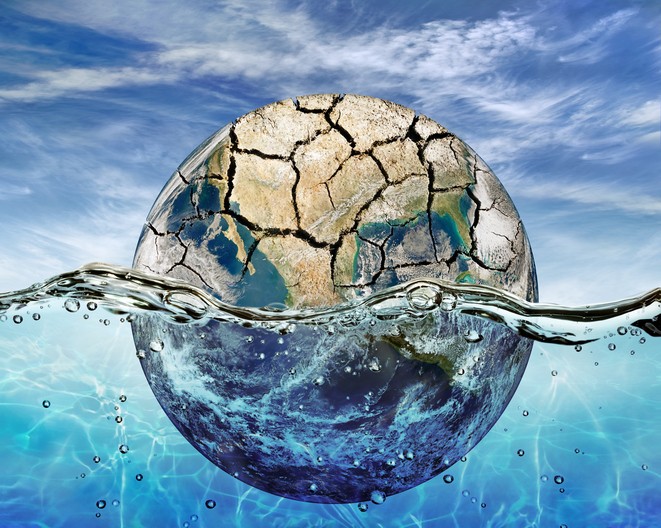
Water supports all life on earth (IPBES, 2019). Every single organism on the planet, every single thing we eat and drink, depends on water to survive. Many complex processes shape our climate, but fundamentally, climate change is a story of water: where it is and where it isn’t, whether or not there is too much or too little, how it functions within the climate system, and how all these factors impact life on the planet. The distribution, movement, amount, and location of water is the primary cycle through which we experience the impacts of climate change and weather (Baede et al., 2001).
The climate system is dynamic and interactive made up of the atmosphere, the ocean and freshwater systems (hydrosphere), ice and snow (cryosphere), soils and land (land surface), and the biosphere (Baede et al., 2001). The water cycle circulates the same amount of water continuously over various timescales (Eagleson, 2000; National Research Council, 2012). While the amount of water in the system doesn’t change, it is always moving and changing states, from vapour to liquid to ice, moving around the atmosphere, evaporating from our oceans and freshwater systems, cycling through the land and biosphere through the trees and soil (Aguado & Burt, 2010; Eagleson, 2000). In some places, it accumulates as snow, freezes, and forms sea ice, glaciers, and ice sheets that reflect radiation from the sun. Ice sheets, glaciers, oceans, and groundwater act as long-term storage systems (Stocker et al., 2013; Aguiado & Burt, 2010). Most water on earth is stored in the oceans, which makes the available freshwater all the more essential to land-based life forms, like humans, that depend on it (USGS, n.d.; IPBES, 2019).
Feedback Effects
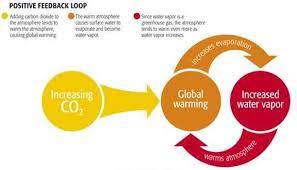
Water vapour is considered the most powerful greenhouse gas because it accounts for a large percentage of warming due to the greenhouse effect (Cook, 2021). Water vapour is an amplifier of warming, but C02 and other greenhouse gases are the drivers. Water vapour concentrations are controlled by temperature, not the other way around. Warm air holds more moisture. A small change in temperature from C02 emissions is amplified by water vapour and enhances the heating effect. The warmer the air, the more evaporation from land and oceans occurs, which puts more water vapour into the atmosphere. This is a positive feedback effect in which water vapour amplifies the warming effect of other GHGs that humans emit (Baede et al., 2001; Cook, 2021; Emmanuel, 2020; Stocker et al., 2013).
Source: https://gml.noaa.gov/outreach/info_activities/pdfs/TBI_understanding_feedback_loops.pdf
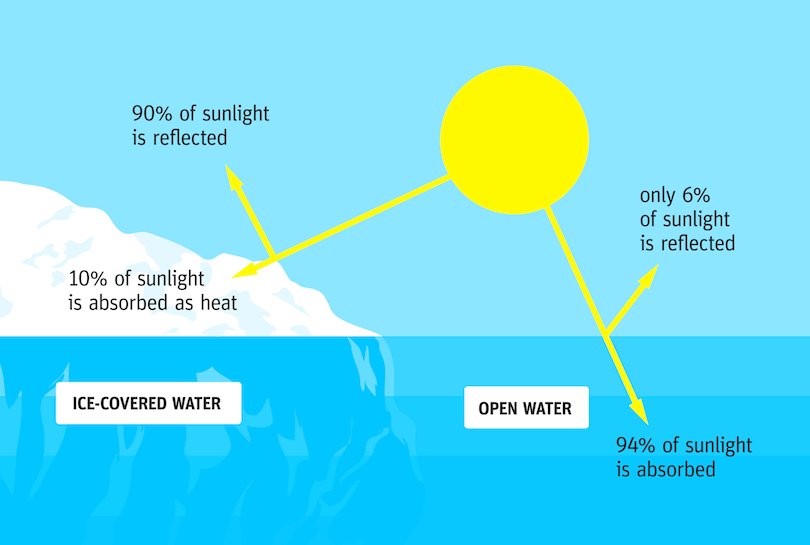
The cryosphere, which is made up of sea ice, ice sheets, glaciers, and permafrost, influences the climate is due to its reflectivity, known as its “albedo” (Baede et al., 2001; Emmanuel, 2020). Light coloured surfaces, like bright white snow and ice, reflect more of the sun’s energy, like a mirror (Figure 2). This has a cooling effect on temperatures across the globe when albedo is high. (de Montreuil, Heidenheim, Hunter & Paul, 2021).
Source: https://www.exploratorium.edu/climate/ice
Warming from increasing GHGs in the atmosphere causes snow and ice to melt, reducing the amount of energy reflected away from Earth. When snow and ice melt, darker surfaces with lower albedo, like ocean water and land surface, are exposed. Those darker surfaces then absorb more of the sun’s energy, which enhances warming and further melts more snow, ice, and permafrost. This is another positive feedback in the climate system (de Montreuil et al., 2021; Emmanuel, 2020).
Some of the most important feedbacks in the climate system involve water: water vapour amplification, ocean circulation, and ice/snow albedo feedback.
Human influence on the climate through GHG emissions has warmed the earth already, and rapid changes have occurred on a global scale that has affected the atmosphere, hydrosphere, cryosphere, and biosphere (IPBES, 2019). Impacts on the water cycle are already affecting weather and extreme events globally, including heavy precipitation events, tropical cyclones, and droughts (IPCC, 2021). These changes will impact ecosystems and communities in different ways. With atmospheric temperatures and circulation patterns shifting, climate change will affect where precipitation falls, in what form (e.g. snow or rain, etc.), and how much. It is expected that there will be substantial differences in the patterns of precipitation from region to region (IPCC, 2018). Climate change brings water-related impacts through flooding and drought, from either too much precipitation or not enough at the right place and the right time of year. Coastal communities are at additional risk due to storm surge and sea-level rise.
A warming climate creates all kinds of changes to the climate system and water cycle. Climate change mitigation (reducing our effect on the climate system), while necessary, will not be a sufficient response to the climate problem. We also need to take bold steps toward adapting to the changes we know are coming, by considering things like intense rainfall events, flooding, droughts, sea-level rise, and lack of precipitation when planning communities, infrastructure, buildings, etc.
Understanding how water functions within the climate system and how water and weather are affected by a warming planet due to human activities must also consider issues of equity and justice. Climate change is exacerbating adverse effects on ecosystems, biodiversity, and human well-being across the world, but we are not all impacted equally (Boyd, 2019; IPBES, 2019; IPCC, 2018 [D]). Climate-related impacts disproportionally affect marginalized people that have contributed least to the problem (Boyd, 2019). In populations already affected by things like resource depletion, conflict, and poverty, climate change brings with it additional stressors, threatening food and water supplies due to drought and flood risks (Boyd, 2019). As we take action on climate change it is critical to consider vulnerable populations who are experiencing negative impacts to their human rights, livelihoods, and health to a much greater extent than the people who have contributed most to the problem in the first place.
References
Aguado, E., & Burt, J. (2010). Understanding weather and climate (5th ed.). Pearson Education Inc.
Baede, A., Ahlonsou, E., & Schimel, D. (2001). The Climate System: An overview. In: Climate Change 2001: The Scientific Basis. Contribution of Working Group I to the Third Assessment Report of the Intergovernmental Panel on Climate Change (p. 881). Cambridge University Press. https://www.ipcc.ch/site/assets/uploads/2018/07/WG1_TAR_FM.pdf
Boyd, D. (2019). Safe Climate: A Report of the Special Rapporteur on Human Rights and the Environment (p. 25). UN Human Rights, Office of the High Commissioner. https://www.ohchr.org/Documents/Issues/Environment/SREnvironment/Report.pdf
Bush, E., & Lemmen, D. (Eds.). (2019). Canada’s changing climate report. Government of Canada. http://publications.gc.ca/collections/collection_2019/eccc/En4-368-2019-eng.pdf
Cook, J. (2021). Explaining how the water vapor greenhouse effect works. Skeptical Science. https://skepticalscience.com/water-vapor-greenhouse-gas-intermediate.htm
de Montreuil, L. Heidenheim, L., Hunter, E., Paul, A. (2021). Ice & climate change: understanding Arctic ice-albedo. Royal Roads University. https://docs.google.com/presentation/d/1T3cFPsoxqFj8Jz4kHubPs315EfneMi8HuU6WZQ05hZo/edit#slide=id.ge773f25937_1_22
Eagleson, P. (2000). The Role of Water in Climate. Proceedings of the American Philosophical Society, 144(1), 33-38. Retrieved from http://www.jstor.org/stable/1515603
Emmanuel, K. (2020). Climate science, risk & solutions: Climate knowledge for everyone. Massachusetts Institute of Technology. https://climateprimer.mit.edu/
IPBES. (2019). Summary for policymakers of the global assessment report on biodiversity and ecosystem services of the Intergovernmental Science-Policy Platform on Biodiversity and Ecosystem Services. S. Díaz, J. Settele, E. S. Brondízio E.S., H. T. Ngo, M. Guèze, J. Agard, A. Arneth, P. Balvanera, K. A. Brauman, S. H. M. Butchart, K. M. A. Chan, L. A. Garibaldi, K. Ichii, J. Liu, S. M. Subramanian, G. F. Midgley, P. Miloslavich, Z. Molnár, D. Obura, A. Pfaff, S. Polasky, A. Purvis, J. Razzaque, B. Reyers, R. Roy Chowdhury, Y. J. Shin, I. J. Visseren-Hamakers, K. J. Willis, and C. N. Zayas (eds.). IPBES secretariat, Bonn, Germany. https://doi.org/10.5281/zenodo.3553579
IPCC. (2018). Summary for Policymakers. In: Global Warming of 1.5°C. An IPCC Special Report on the impacts of global warming of 1.5°C above pre-industrial levels and related global greenhouse gas emission pathways, in the context of strengthening the global response to the threat of climate change, sustainable development, and efforts to eradicate poverty (pp. 24). Cambridge University Press. https://www.ipcc.ch/sr15/chapter/spm/
IPCC. (2021). Summary for Policymakers. In: Climate Change 2021: The Physical Science Basis. Contribution of Working Group I to the Sixth Assessment Report of the Intergovernmental Panel on Climate Change. Cambridge University Press. https://www.ipcc.ch/report/ar6/wg1/downloads/report/IPCC_AR6_WGI_SPM.pdf
National Research Council. (2012). Challenges and Opportunities in the Hydrologic Sciences. The National Academies Press.
Stocker, T., Qin, G., Plattner, L., Alexander, S., Allen, N., Bindoff, F., Bréon, J., Church, U., Cubasch, S., Emori, P., Forster, P., Friedlingstein, N., Gillett, J., Gregory, D., Hartmann, H., Jansen, B., Kirtman, R., Knutti, K., & Krishna Kumar, P. (2013). Technical Summary. In: Climate Change 2013: The Physical Science Basis. Contribution of Working Group I to the Fifth Assessment Report of the Intergovernmental Panel on Climate Change. Cambridge University Press.
USGS. (n.d.). Oceans and Seas and the Water Cycle. USGS Water Science School. https://www.usgs.gov/special-topic/water-science-school/science/oceans-and-seas-and-water-cycle?qt-science_center_objects=0#qt-science_center_objects
Wood, R., & Jackson, L. (2020). Could the Atlantic Overturning Circulation ‘shut down’? Carbon Brief. https://www.carbonbrief.org/guest-post-could-the-atlantic-overturning-circulation-shut-down