
The evidence is unequivocal. We live in a warming world, as evidenced by a steady increase in global average surface temperatures measured over the past 150 or so years (IPCC, 2013).
Right. But the climate has always changed. What makes this so different?
First, let’s dive into a little history because understanding the past is important for understanding our present as well as our future.
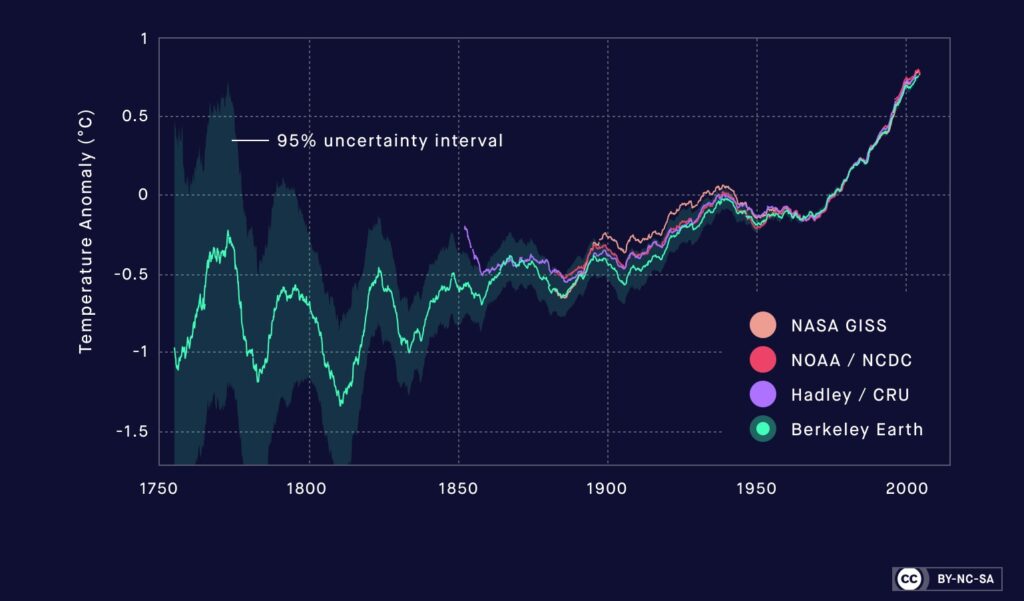
We have instrumental temperature records from the past 150 years, giving us detailed data on temperatures over that period, particularly since the 1970s (Figure 1) (Emanuel, 2020).
We also have paleoclimate reconstructions of climate that reach back millions of years into earth’s climate history and these show the natural warming and cooling cycles (particularly over the past 800,000 years) that occur due to orbital factors that have allowed the development of ice sheets in the mid to high latitudes based on earth’s distance and orientation with the sun (Figure 2) (Emanuel, 2020, p. 19-20).
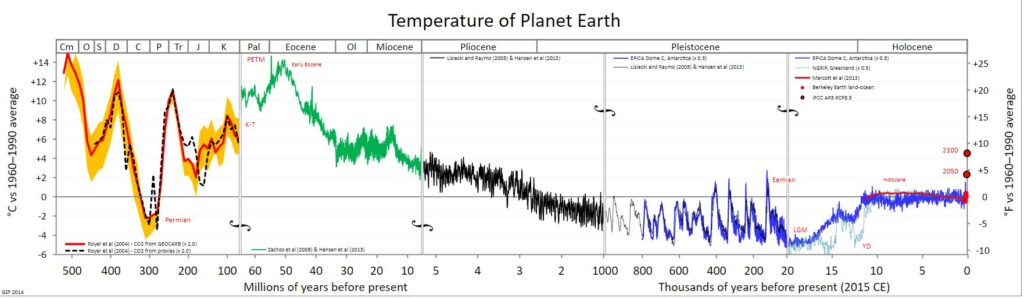
Image source: https://upload.wikimedia.org/wikipedia/commons/5/5f/All_palaeotemps.svg
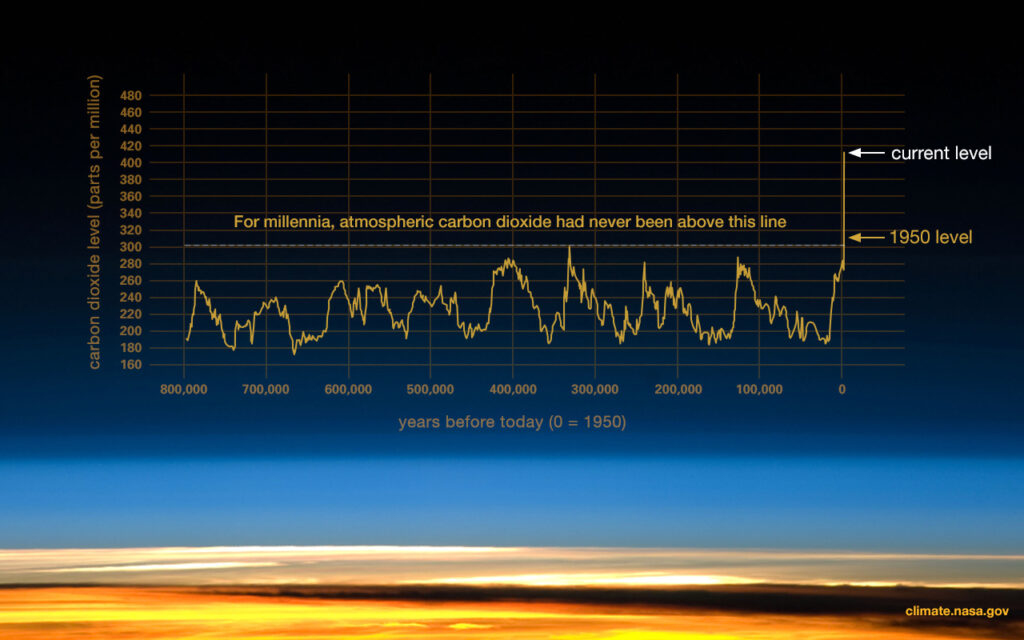
These cycles are many thousands of years long and while the initial warming that occurs coming in and out of an ice age initially tends to rise and fall relatively quickly, the rate of warming over the past century is approximately 10x the average rate of warming coming out of an ice age, and that rate is expected to continue increasing over time (NASA, 2010). In fact, according to those natural climate cycles and relative to the past 10,000 years, earth temperatures were quite stable and moving toward a very slow cooling trend in the mid to high latitudes of the Northern Hemisphere for the last five thousand years. Earth’s average surface temperature has risen about 1-degree Celsius since the late 19th century, a change driven largely by increased carbon dioxide emissions into the atmosphere through the burning of fossil fuels and other human activities like deforestation and agricultural practices (NASA, 2020; IPCC, 2013). These activities have interrupted that cooling cycle by increasing the amount of carbon dioxide in our atmosphere to levels higher than they have been in at least 800,000 years (Figure 3), and will likely delay the next ice age (Stocker et al., 2013, p.37; Emanuel, 2020, p.20; NASA, 2021). If those human activities had not happened, we would currently be in a slow, steady cooling trend over thousands of years, which would eventually lead to a glacial period many more thousands of years from now.
Why is 1 degree a big deal? What does it mean?
It most certainly does not mean that we can expect a uniform experience of any average global temperature increase in our local or regional environments. Global mean temperatures are averages over the entire globe, including land and water, and these do not reflect what that will look like or feel like at a particular time and place seasonally or otherwise (T. Murdock, personal communication, June 23, 2021). It means as global mean temperatures rise, so does the probability of extreme regional temperature anomalies, giving rise to more frequent and longer-duration heatwaves, for example (IPCC, 2013; Bush, et al., 2019). Heatwaves are generally defined as a period of consecutive days where conditions are hotter than normal for the region (Alexander, L. V., et al., 2009).
Ok, so it gets really warm for a few days. So what?
The impacts of a heatwave are now a lived experience for millions of people in Western Canada and the Pacific Northwestern US, and many cascading impacts haven’t necessarily even been felt yet. A few of the immediate impacts have included heat-related illness and death, an intense wildfire that decimated an entire community in less than 30 minutes, and impacts to the economy and food security from loss of crops, etc. With increasing risk of drought and heatwaves into the future, impacts from wildfires, including interface fires with communities and health impacts from smoke, and potential for severe drought leading to further crop losses are possible (Bush, et al., 2019). And that doesn’t even get into impacts to infrastructure, ecosystems, and other economic factors.
Sounds like a nightmare; so what can we do?
As discussed in Canada’s Changing Climate Report, there are opportunities to mitigate impacts through adaptation actions that will increase resilience, reduce risk and costs, and take advantage of potential opportunities for co-benefits (Bush, et al., 2019). Examples related to building resilience for heatwaves include nature-based approaches in cities that would reduce health impacts from heat, adopting adaptation measures within the forestry sector to reduce fuel loading, and increasing community preparedness and response for the inevitable increased risk during fire seasons (Bush, et al., 2019).
The things we can control, like our behaviours and activities that contribute to GHG emissions, who we vote for, and what we support or reject as a society, could be considered our personal mitigation strategy. On the flip side, there are many things we don’t have control over, including GHGs already in the climate system and impacts that can be expected as a result, so we know we need to accept and adapt to those. The things we influence could be through a solid understanding of the likely impacts from hazards arising from climate change, and taking action to mitigate through preparedness and resilience building.
Reductions in greenhouse gas emissions are an incredibly important part of the solution to mitigate further planetary warming, and adaptation efforts will be critical to building resilience for the future warming we are already locked into. I hope that events like the heatwave of June 2021 will increase people’s awareness of the risks related to climate change so they will seek out an understanding of how to use their voice, and ultimately, create space for mitigation efforts required, and be empowered to take action on climate adaptation in their lives.
References
Alexander, L. V., and J. M. Arblaster (2009). Assessing trends in observed and modelled climate extremes over Australia in relation to future projections. International Journal of Climatology. doi:10.1002/joc.1730.
Bush, E., Gillett, N., Bonsal, B., Cohen, S., Derksen, C., Flato, G., Greenan, B., Shepherd, M., & Zhang, X. (2019). Canada’s Changing Climate Report: Executive Summary. Environment and Climate Change Canada.
Emanuel, K. (2020). Climate Science, Risk & Solutions. Massachusetts Institute of Technology. https://climateprimer.mit.edu/climate-science-risk-solutions.pdf
IPCC (2013) Climate Change 2013: The Physical Science Basis. T.F. Stocker, D. Qin, G.-K. Plattner, M. Tignor, S.K. Allen, J. Boschung, A. Nauels, Y. Xia, V. Bex & P.M. Midgley (Eds.), Climate Change 2013: The Physical Science Basis. Contribution of Working Group I to the Fifth Assessment Report of the Intergovernmental Panel on Climate Change. Cambridge University Press. 1535 pp.
NASA. (2010). How is Today’s Warming Different from the Past? https://earthobservatory.nasa.gov/features/GlobalWarming/page3.php
NASA. (2021). Climate change: how do we know?. https://climate.nasa.gov/evidence/