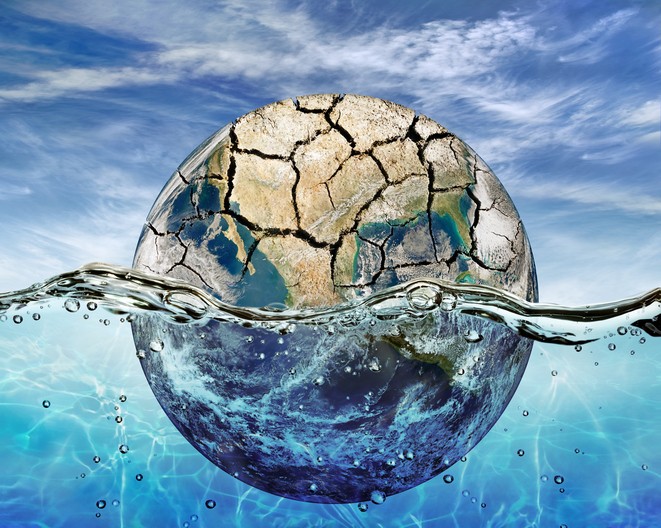
Connections: Water and Climate Change

Image source: https://tinyurl.com/66zscxem ©iStock/Alexandrum79

Water supports all life on earth (IPBES, 2019). Every single organism on the planet, every single thing we eat and drink, depends on water to survive. Many complex processes shape our climate, but fundamentally, climate change is a story of water: where it is and where it isn’t, whether or not there is too much or too little, how it functions within the climate system, and how all these factors impact life on the planet. The distribution, movement, amount, and location of water is the primary cycle through which we experience the impacts of climate change and weather (Baede et al., 2001).

The climate system is dynamic and interactive made up of the atmosphere, the ocean and freshwater systems (hydrosphere), ice and snow (cryosphere), soils and land (land surface), and the biosphere (Baede et al., 2001). The water cycle circulates the same amount of water continuously over various timescales (Eagleson, 2000; National Research Council, 2012). While the amount of water in the system doesn’t change, it is always moving and changing states, from vapour to liquid to ice, moving around the atmosphere, evaporating from our oceans and freshwater systems, cycling through the land and biosphere through the trees and soil (Aguado & Burt, 2010; Eagleson, 2000). In some places, it accumulates as snow, freezes, and forms sea ice, glaciers, and ice sheets that reflect radiation from the sun. Ice sheets, glaciers, oceans, and groundwater act as long-term storage systems (Stocker et al., 2013; Aguiado & Burt, 2010). Most water on earth is stored in the oceans, which makes the available freshwater all the more essential to land-based life forms, like humans, that depend on it (USGS, n.d.; IPBES, 2019). 

Feedback Effects

Water vapour is considered the most powerful greenhouse gas because it accounts for a large percentage of warming due to the greenhouse effect (Cook, 2021). Water vapour is an amplifier of warming, but C02 and other greenhouse gases are the drivers. Water vapour concentrations are controlled by temperature, not the other way around. Warm air holds more moisture. A small change in temperature from C02 emissions is amplified by water vapour and enhances the heating effect. The warmer the air, the more evaporation from land and oceans occurs, which puts more water vapour into the atmosphere. This is a positive feedback effect in which water vapour amplifies the warming effect of other GHGs that humans emit (Baede et al., 2001; Cook, 2021; Emmanuel, 2020; Stocker et al., 2013).
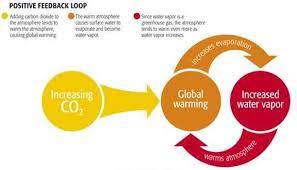
Figure 1: Positive feedback loop: water vapour
Source: https://gml.noaa.gov/outreach/info_activities/pdfs/TBI_understanding_feedback_loops.pdf

The cryosphere, which is made up of sea ice, ice sheets, glaciers, and permafrost, influences the climate is due to its reflectivity, known as its “albedo” (Baede et al., 2001; Emmanuel, 2020). Light coloured surfaces, like bright white snow and ice, reflect more of the sun’s energy, like a mirror (Figure 2). This has a cooling effect on temperatures across the globe when albedo is high. (de Montreuil, Heidenheim, Hunter & Paul, 2021).
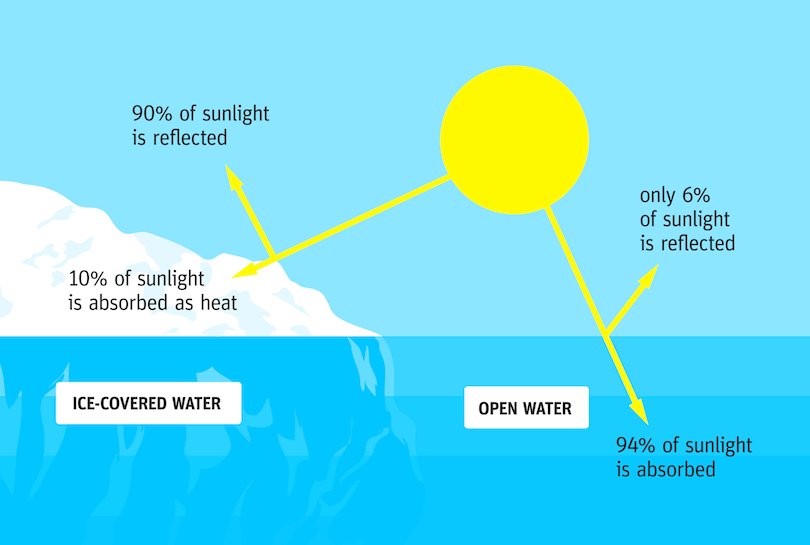
Figure 2: The albedo effect
Source: https://www.exploratorium.edu/climate/ice

Warming from increasing GHGs in the atmosphere causes snow and ice to melt, reducing the amount of energy reflected away from Earth. When snow and ice melt, darker surfaces with lower albedo, like ocean water and land surface, are exposed. Those darker surfaces then absorb more of the sun’s energy, which enhances warming and further melts more snow, ice, and permafrost. This is another positive feedback in the climate system (de Montreuil et al., 2021; Emmanuel, 2020).

Some of the most important feedbacks in the climate system involve water: water vapour amplification, ocean circulation, and ice/snow albedo feedback.

Human influence on the climate through GHG emissions has warmed the earth already, and rapid changes have occurred on a global scale that has affected the atmosphere, hydrosphere, cryosphere, and biosphere  (IPBES, 2019). Impacts on the water cycle are already affecting weather and extreme events globally, including heavy precipitation events, tropical cyclones, and droughts (IPCC, 2021). These changes will impact ecosystems and communities in different ways. With atmospheric temperatures and circulation patterns shifting, climate change will affect where precipitation falls, in what form (e.g. snow or rain, etc.), and how much. It is expected that there will be substantial differences in the patterns of precipitation from region to region (IPCC, 2018). Climate change brings water-related impacts through flooding and drought, from either too much precipitation or not enough at the right place and the right time of year. Coastal communities are at additional risk due to storm surge and sea-level rise.

A warming climate creates all kinds of changes to the climate system and water cycle. Climate change mitigation (reducing our effect on the climate system), while necessary, will not be a sufficient response to the climate problem. We also need to take bold steps toward adapting to the changes we know are coming, by considering things like intense rainfall events, flooding, droughts, sea-level rise, and lack of precipitation when planning communities, infrastructure, buildings, etc.

Understanding how water functions within the climate system and how water and weather are affected by a warming planet due to human activities must also consider issues of equity and justice. Climate change is exacerbating adverse effects on ecosystems, biodiversity, and human well-being across the world, but we are not all impacted equally (Boyd, 2019; IPBES, 2019; IPCC, 2018 [D]). Climate-related impacts disproportionally affect marginalized people that have contributed least to the problem (Boyd, 2019). In populations already affected by things like resource depletion, conflict, and poverty, climate change brings with it additional stressors, threatening food and water supplies due to drought and flood risks (Boyd, 2019). As we take action on climate change it is critical to consider vulnerable populations who are experiencing negative impacts to their human rights, livelihoods, and health to a much greater extent than the people who have contributed most to the problem in the first place.

References

Aguado, E., & Burt, J. (2010). Understanding weather and climate (5th ed.). Pearson Education Inc.

Baede, A., Ahlonsou, E., & Schimel, D. (2001). The Climate System: An overview. In: Climate Change 2001: The Scientific Basis. Contribution of Working Group I to the Third Assessment Report of the Intergovernmental Panel on Climate Change (p. 881). Cambridge University Press. https://www.ipcc.ch/site/assets/uploads/2018/07/WG1_TAR_FM.pdf

Boyd, D. (2019). Safe Climate: A Report of the Special Rapporteur on Human Rights and the Environment (p. 25). UN Human Rights, Office of the High Commissioner. https://www.ohchr.org/Documents/Issues/Environment/SREnvironment/Report.pdf

Bush, E., & Lemmen, D. (Eds.). (2019). Canada’s changing climate report. Government of Canada. http://publications.gc.ca/collections/collection_2019/eccc/En4-368-2019-eng.pdf

Cook, J. (2021). Explaining how the water vapor greenhouse effect works. Skeptical Science.  https://skepticalscience.com/water-vapor-greenhouse-gas-intermediate.htm    

de Montreuil, L. Heidenheim, L., Hunter, E., Paul, A. (2021). Ice & climate change: understanding Arctic ice-albedo. Royal Roads University. https://docs.google.com/presentation/d/1T3cFPsoxqFj8Jz4kHubPs315EfneMi8HuU6WZQ05hZo/edit#slide=id.ge773f25937_1_22

Eagleson, P. (2000). The Role of Water in Climate. Proceedings of the American Philosophical Society, 144(1), 33-38. Retrieved from http://www.jstor.org/stable/1515603

Emmanuel, K. (2020). Climate science, risk & solutions: Climate knowledge for everyone. Massachusetts Institute of Technology. https://climateprimer.mit.edu/

IPBES. (2019). Summary for policymakers of the global assessment report on biodiversity and ecosystem services of the Intergovernmental Science-Policy Platform on Biodiversity and Ecosystem Services. S. Díaz, J. Settele, E. S. Brondízio E.S., H. T. Ngo, M. Guèze, J. Agard, A. Arneth, P. Balvanera, K. A. Brauman, S. H. M. Butchart, K. M. A. Chan, L. A. Garibaldi, K. Ichii, J. Liu, S. M. Subramanian, G. F. Midgley, P. Miloslavich, Z. Molnár, D. Obura, A. Pfaff, S. Polasky, A. Purvis, J. Razzaque, B. Reyers, R. Roy Chowdhury, Y. J. Shin, I. J. Visseren-Hamakers, K. J. Willis, and C. N. Zayas (eds.). IPBES secretariat, Bonn, Germany. https://doi.org/10.5281/zenodo.3553579 

IPCC. (2018). Summary for Policymakers. In: Global Warming of 1.5°C. An IPCC Special Report on the impacts of global warming of 1.5°C above pre-industrial levels and related global greenhouse gas emission pathways, in the context of strengthening the global response to the threat of climate change, sustainable development, and efforts to eradicate poverty (pp. 24). Cambridge University Press. https://www.ipcc.ch/sr15/chapter/spm/

IPCC. (2021). Summary for Policymakers. In: Climate Change 2021: The Physical Science Basis. Contribution of Working Group I to the Sixth Assessment Report of the Intergovernmental Panel on Climate Change. Cambridge University Press. https://www.ipcc.ch/report/ar6/wg1/downloads/report/IPCC_AR6_WGI_SPM.pdf

National Research Council. (2012). Challenges and Opportunities in the Hydrologic Sciences. The National Academies Press.

Stocker, T., Qin, G., Plattner, L., Alexander, S., Allen, N., Bindoff, F., Bréon, J., Church, U., Cubasch, S., Emori, P., Forster, P., Friedlingstein, N., Gillett, J., Gregory, D., Hartmann, H., Jansen, B., Kirtman, R., Knutti, K., & Krishna Kumar, P. (2013). Technical Summary. In: Climate Change 2013: The Physical Science Basis. Contribution of Working Group I to the Fifth Assessment Report of the Intergovernmental Panel on Climate Change. Cambridge University Press.

USGS. (n.d.). Oceans and Seas and the Water Cycle. USGS Water Science School. https://www.usgs.gov/special-topic/water-science-school/science/oceans-and-seas-and-water-cycle?qt-science_center_objects=0#qt-science_center_objects

Wood, R., & Jackson, L. (2020). Could the Atlantic Overturning Circulation ‘shut down’? Carbon Brief.  https://www.carbonbrief.org/guest-post-could-the-atlantic-overturning-circulation-shut-down 
Empowering climate action though increased understanding: A non-technical discussion on climate science and adaptation

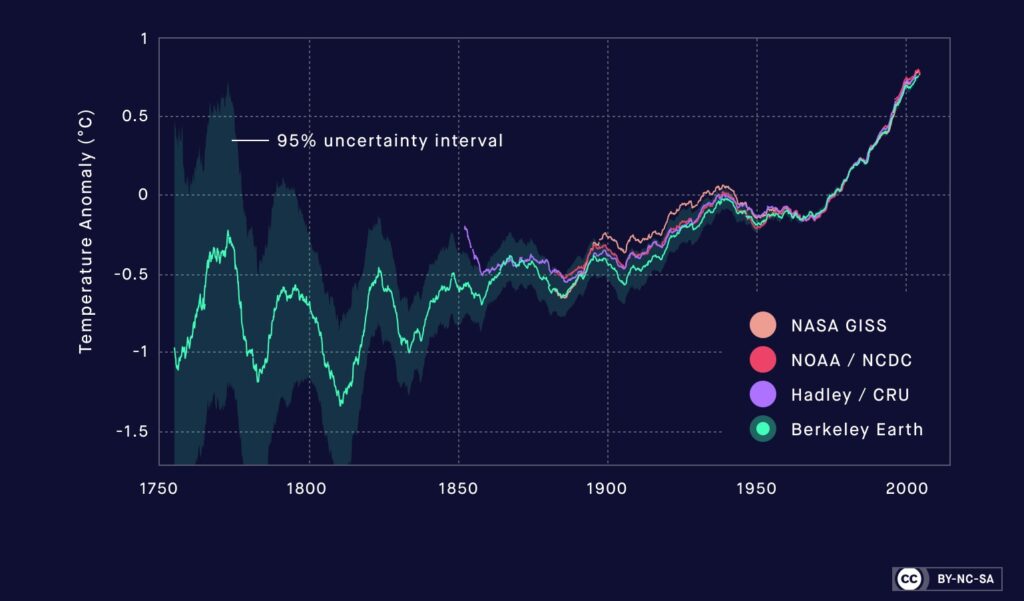
The evidence is unequivocal. We live in a warming world, as evidenced by a steady increase in global average surface temperatures measured over the past 150 or so years (IPCC, 2013). 

Right. But the climate has always changed. What makes this so different?

First, let’s dive into a little history because understanding the past is important for understanding our present as well as our future. 

We have instrumental temperature records from the past 150 years, giving us detailed data on temperatures over that period, particularly since the 1970s (Figure 1) (Emanuel, 2020).

Figure 1: Historical Temperature Record (Emanuel, 2020)

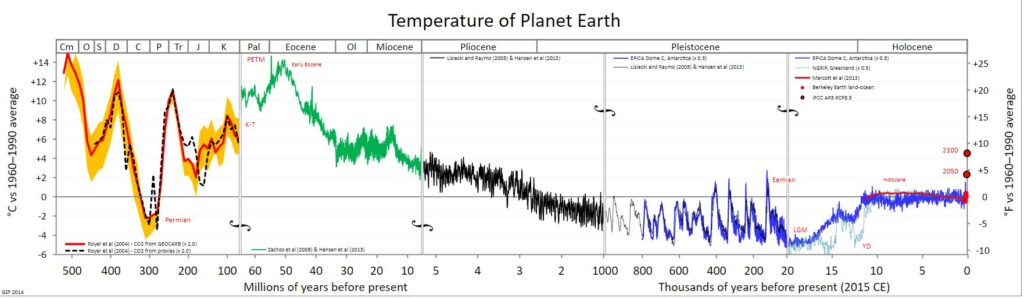
We also have paleoclimate reconstructions of climate that reach back millions of years into earth’s climate history and these show the natural warming and cooling cycles (particularly over the past 800,000 years) that occur due to orbital factors that have allowed the development of ice sheets in the mid to high latitudes based on earth’s distance and orientation with the sun (Figure 2) (Emanuel, 2020, p. 19-20).

Figure 2: Paleoclimate Record: Temperature of Planet Earth
Image source: https://upload.wikimedia.org/wikipedia/commons/5/5f/All_palaeotemps.svg

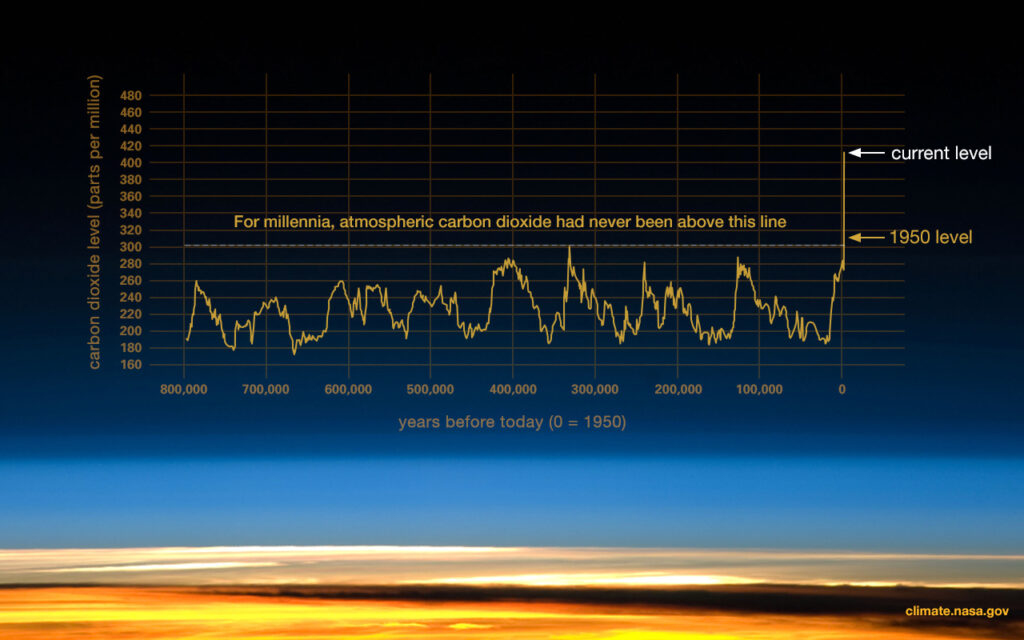
These cycles are many thousands of years long and while the initial warming that occurs coming in and out of an ice age initially tends to rise and fall relatively quickly, the rate of warming over the past century is approximately 10x the average rate of warming coming out of an ice age, and that rate is expected to continue increasing over time (NASA, 2010). In fact, according to those natural climate cycles and relative to the past 10,000 years, earth temperatures were quite stable and moving toward a very slow cooling trend in the mid to high latitudes of the Northern Hemisphere for the last five thousand years. Earth’s average surface temperature has risen about 1-degree Celsius since the late 19th century, a change driven largely by increased carbon dioxide emissions into the atmosphere through the burning of fossil fuels and other human activities like deforestation and agricultural practices (NASA, 2020; IPCC, 2013). These activities have interrupted that cooling cycle by increasing the amount of carbon dioxide in our atmosphere to levels higher than they have been in at least 800,000 years (Figure 3), and will likely delay the next ice age (Stocker et al., 2013, p.37; Emanuel, 2020, p.20; NASA, 2021). If those human activities had not happened, we would currently be in a slow, steady cooling trend over thousands of years, which would eventually lead to a glacial period many more thousands of years from now. 

Figure 3: Atmospheric C02 record (NASA, 2021)

Why is 1 degree a big deal? What does it mean?

It most certainly does not mean that we can expect a uniform experience of any average global temperature increase in our local or regional environments. Global mean temperatures are averages over the entire globe, including land and water, and these do not reflect what that will look like or feel like at a particular time and place seasonally or otherwise (T. Murdock, personal communication, June 23, 2021). It means as global mean temperatures rise, so does the probability of extreme regional temperature anomalies, giving rise to more frequent and longer-duration heatwaves, for example (IPCC, 2013; Bush, et al., 2019). Heatwaves are generally defined as a period of consecutive days where conditions are hotter than normal for the region (Alexander, L. V., et al., 2009). 

Ok, so it gets really warm for a few days. So what? 

The impacts of a heatwave are now a lived experience for millions of people in Western Canada and the Pacific Northwestern US, and many cascading impacts haven’t necessarily even been felt yet. A few of the immediate impacts have included heat-related illness and death, an intense wildfire that decimated an entire community in less than 30 minutes, and impacts to the economy and food security from loss of crops, etc. With increasing risk of drought and heatwaves into the future, impacts from wildfires, including interface fires with communities and health impacts from smoke, and potential for severe drought leading to further crop losses are possible (Bush, et al., 2019). And that doesn’t even get into impacts to infrastructure, ecosystems, and other economic factors.

Sounds like a nightmare; so what can we do?

As discussed in Canada’s Changing Climate Report, there are opportunities to mitigate impacts through adaptation actions that will increase resilience, reduce risk and costs, and take advantage of potential opportunities for co-benefits (Bush, et al., 2019). Examples related to building resilience for heatwaves include nature-based approaches in cities that would reduce health impacts from heat, adopting adaptation measures within the forestry sector to reduce fuel loading, and increasing community preparedness and response for the inevitable increased risk during fire seasons (Bush, et al., 2019). 

The things we can control, like our behaviours and activities that contribute to GHG emissions, who we vote for, and what we support or reject as a society, could be considered our personal mitigation strategy. On the flip side, there are many things we don’t have control over, including GHGs already in the climate system and impacts that can be expected as a result, so we know we need to accept and adapt to those. The things we influence could be through a solid understanding of the likely impacts from hazards arising from climate change, and taking action to mitigate through preparedness and resilience building.

Reductions in greenhouse gas emissions are an incredibly important part of the solution to mitigate further planetary warming, and adaptation efforts will be critical to building resilience for the future warming we are already locked into. I hope that events like the heatwave of June 2021 will increase people’s awareness of the risks related to climate change so they will seek out an understanding of how to use their voice, and ultimately, create space for mitigation efforts required, and be empowered to take action on climate adaptation in their lives.

References

Alexander, L. V., and J. M. Arblaster (2009). Assessing trends in observed and modelled climate extremes over Australia in relation to future projections. International Journal of Climatology. doi:10.1002/joc.1730.

Bush, E., Gillett, N., Bonsal, B., Cohen, S., Derksen, C., Flato, G., Greenan, B., Shepherd, M., & Zhang, X. (2019). Canada’s Changing Climate Report: Executive Summary. Environment and Climate Change Canada.

Emanuel, K. (2020). Climate Science, Risk & Solutions. Massachusetts Institute of Technology. https://climateprimer.mit.edu/climate-science-risk-solutions.pdf

IPCC (2013) Climate Change 2013: The Physical Science Basis. T.F. Stocker, D. Qin, G.-K. Plattner, M. Tignor, S.K. Allen, J. Boschung, A. Nauels, Y. Xia, V. Bex & P.M. Midgley (Eds.), Climate Change 2013: The Physical Science Basis. Contribution of Working Group I to the Fifth Assessment Report of the Intergovernmental Panel on Climate Change. Cambridge University Press. 1535 pp.

NASA. (2010). How is Today’s Warming Different from the Past? https://earthobservatory.nasa.gov/features/GlobalWarming/page3.php

NASA. (2021). Climate change: how do we know?. https://climate.nasa.gov/evidence/

Transdisciplinary Boot Camp: Reflections on the MACAL Intensive 2021

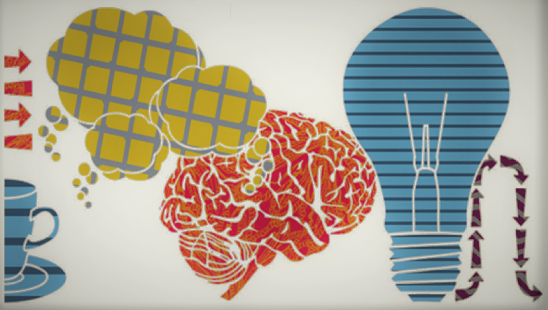
Image source: https://www.unthsc.edu/center-for-innovative-learning/using-design-thinking-higher-education/

Climate change is a complex problem that requires a deep, comprehensive exploration across social and physical science disciplines, multiple worldviews, and lived experiences, in order to integrate multiple knowledge systems, generate new insights and knowledge, and develop a deeper understanding of the roots of the problem (Corman & Cox, 2020; Gram-Hanssen, 2021).  These deep understandings can help generate new ways of thinking and doing that might address the sometimes cavernous gaps between specialist knowledge, local/stakeholder/Indigenous rights holder knowledge and lived histories, and the range of real-world social and economic conditions people are currently experiencing (Gram-Hanssen, 2021; Whyte, 2017). All of these perspectives are complex and layered in and of themselves and need to be considered holistically to examine the deep issues and potential solutions to the wicked problem of climate change

Image source: www.freevector.com.

This brings me to the lens of transdisciplinary thinking. Transdisciplinarity is a concept that helped me understand both complexity and integration in a whole new way. Walker (n.d) uses the metaphor of a cake to explain transdisciplinary thinking by representing disciplines as individual ingredients, that are mixed together and then baked, which transforms the ingredients into something entirely different. The ingredients, or disciplines, are then no longer distinguishable as what they once were in their original form (Choi & Pak, 2006, as cited in Walker, n.d.). As such, the outputs of transdisciplinary thinking can provide entirely new ways of thinking and doing things that wouldn’t otherwise be possible. Corman & Cox (2020) further describe transdisciplinarity as a process of inquiry and reflection; of relating deeply with others through dialogue, and of having a mindset and orientation to blurring boundaries between, across, inside and outside disciplines and worldviews to generate new knowledge and possibilities of solutions to wicked problems. Similarly, transdisciplinary practice echoes characteristics related to the Indigenous conceptualization of relationality, or ‘right relations’, defined by Gram-Hanssen (2021) as a continuous process of reciprocity and responsibility toward other humans, other species, land, and water, etc. Right relations and relational systems thinking include acts of deep listening, the creation of space for different knowledge systems to co-exist while remaining intact, reflective practice, and collaborative dialogue (Goodchild, 2021; Gram-Hanssen, 2021).

Over the past 2 weeks of the MACAL intensive, we’ve essentially been in transdisciplinary boot camp. Not only have we been exposed to multiple ways of thinking about climate change and different worldviews through readings and lectures, but we’ve also been utterly immersed in the experience of transdisciplinarity through daily community-building activities with our instructors and cohort members, engaging activities and assignments, cohort-wide discussions, and discussion and reflection in the context of our design thinking challenge project within our teams. We dove into the theories, backgrounds, and methods of complex systems thinking and design thinking through presentations/lectures by experts, and webinars with climate action leaders and policymakers. Then we explored those methods for ourselves over the course of the intensive in the form of sharing/debriefs within teams and among the entire cohort, establishing reflective writing rituals (like this blog post, along with discussion forum posts), and doing independent research summaries to support our design challenge. Now that I’ve emerged from those two weeks, I can see how this exposure to a number of key ingredients and practices has supported us in starting to bake our complex, emergent transdisciplinary “cakes”. 

In addition to learning and experiencing these methods and ways of thinking about the challenge of addressing climate change, we also had the opportunity to play with them and integrate them as part of our design challenge process. Systems thinking is a holistic approach to analysis that looks at how the individual parts of a system relate to one another within the context of other systems, some of which are complex and adaptive, meaning they are dynamic and evolving, with unpredictable emergent features that are difficult to understand and control (Holland, 1992; Homer-Dixon, 2011). Gaining a better understanding of how social systems and physical systems interact, inform, change and affect each other, really helped me connect the dots toward defining the deep problems underpinning the climate crisis we find ourselves in. 

Our design thinking challenge followed the process of first exploring and defining the problem we wanted to try and solve, which involved a deep dive into the structures of the complex adaptive systems that are giving rise to these “wicked” problems in the first place, namely the socio-economic, colonial and political systems that dominate our global societies (Gram-Hanssen, 2021; Homer-Dixon, 2011; Whyte 2017). The design thinking challenge work we experienced in our teams and the Cascade Institute’s cognitive affective mapping (CAM) tool provided us with ways to explore the practical application of the theoretical concepts of systems thinking and transdisciplinarity (Homer-Dixon, et al., 2014). These applied processes and tools provided a means for us to see ourselves within the context of complex adaptive systems, and develop an appreciation of other perspectives, including worldviews, institutions, and technologies that influence how we think about things, which in turn influences how we do things (Ross & Piereder, 2021). The design thinking approach of involving and empathizing with the people most affected by a particular problem like climate change reinforces and provides a means of practicing transdisciplinarity; ensuring stakeholder involvement from the beginning of the process to explore and define the problem and be co-creators of potential solutions.

The Climate Action Leadership program has us students building a practice of transdisciplinary thinking by baking in the support structures of open learning practices through the crafting of blogs, digital identities, and development of a web presence that supports participatory culture; a space for us to gather our ingredients, practice the art of dialogue, crack open and expand our minds, and be co-creators of content in the climate action space…and then iterate.

REFERENCES

Corman, I. & Cox, R. (2020). Transdisciplinarity: A primer. Royal Roads University. https://commons.royalroads.ca/macal/wp-content/uploads/sites/88/2021/04/MACAL_Transdisciplinary_Thinking03-31-21-3.pdf 

Goodchild, M. (2021). Relational systems thinking: That’s how change is going to come, from our earth mother. Journal of Awareness-Based Systems Change, 1(1), 75-103. https://doi.org/10.47061/jabsc.v1i1.577 

Holland, J. (1992). Complex adaptive systems. Daedalus, 121(1), 17-30. http://www.jstor.org/stable/20025416 

Homer-Dixon, T. (2011). Complexity science. Oxford Leadership Journal, 2(1), 1-15. http://homerdixon.com/wp-content/uploads/2017/05/Homer-Dixon-Oxford-Leadership-Journal-Manion-lecture.pdf 

Homer-Dixon, T., Milkoreit, M., Mock, S. J., Schröder, T., & Thagard, P. (2014). The conceptual structure of social disputes: Cognitive affective maps as a tool for conflict analysis and resolution. SAGE Open, 4(1). DOI:10.1177/2158244014526210 sgo.sagepub.com  

Ross, H. & Piereder, J. (2021, June 10). Belief systems in a complex world: A cognitive-affective mapping tutorial [Lecture recording]. Cascade Institute.

Walker, S. (n.d.). Transdisciplinary learning: all mixed up!. PYP in Practice. https://sites.google.com/isparis.net/conceptualinquiry/transdisciplinary-learning-all-mixed-up 

First, find the problem

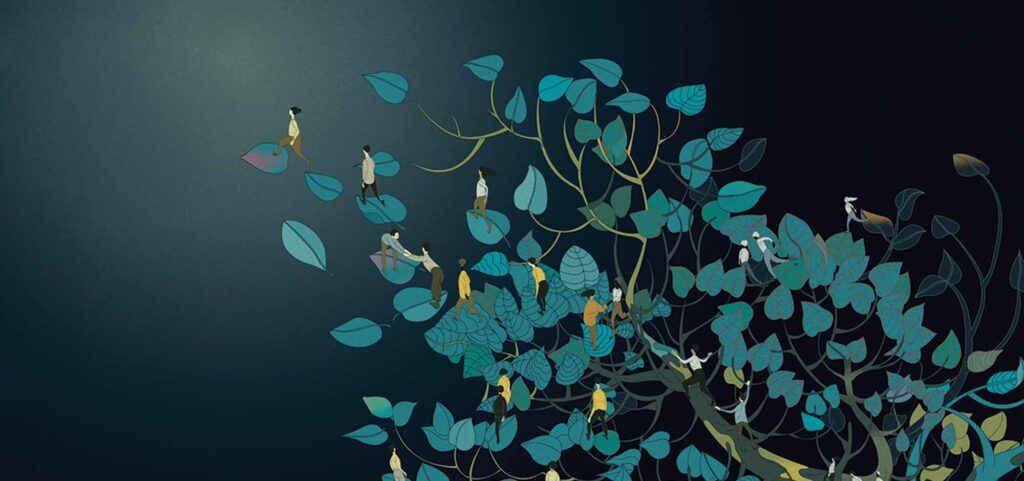
Photo credit: Marcos Chin

In the first week of the MACAL Intensive, we explored different contemporary approaches and ways of thinking about the issues of climate change and climate action leadership. This exploration included an introduction to design thinking, systems thinking, Indigenous ways of knowing/thinking, transdisciplinary thinking, and the concepts of open learning, participatory web, and pro-social web. 

The one, simple idea that really resonated with me was related to design thinking and can be summed up like this: one must invest the time and energy to appropriately define a problem before taking any steps toward finding solutions. The very thought of slowing down my solution-seeking/problem-solving impulse felt very uncomfortable at first. However, after diving into the design thinking exercise, the idea that an intentional and thoughtful exploration of the “real problem” could be the key to developing effective solutions lit up and wove its way back through all the topics discussed throughout the first week of our program, especially topics on Indigenous experiences and ways of knowing, and transdisciplinary thinking. 

This idea of putting much more emphasis on problem-finding rather than problem-solving has challenged me to think more deeply about the “real” problems in our society related to climate change and Indigenous peoples, for example, and giving weight and consideration to the historical factors of colonization which have ultimately produced the climate crisis (Gram-Hanssen et al., 2021). From the Indigenous Ways of Knowing, Being, and Leading Circle we all participated in on June 1st came the suggestion that we really need to slow down, consider solutions in terms of seven generations forward and backward, and take the time to build relationships and trust as a first priority, which reflects the idea of defining the problem first, before jumping to solutions (M. Lickers, personal communication, June 1, 2021). As I continued my reflection on problem-finding, the concept of transdisciplinarity defined as “…a process of inquiry” (Corman & Cox, 2020, p.2), whereby wicked problems can be explored from multiple perspectives through open, productive dialogue aligns with the importance of first orienting to and investigating the problem before leaping into solutions. Both of these perspectives on problem identification take time and effort, and I would argue it is a necessary investment if we have any hope in solving the climate issues at hand.

One of my favourite quotes on climate action is from the book called Drawdown, “If you are traveling down the wrong road, you are still on the wrong road if you slow down” (Hawken, 2017, p. xiii), and I think this is right in line with the idea from the design thinking lens that if you’re answering the wrong problem with the right solution, then that solution isn’t really going to be worth much at all.

Corman, I. & Cox, R. (2020). Transdisciplinary Thinking in the context of the MACAL program. Royal Roads University. https://commons.royalroads.ca/macal/wp-content/uploads/sites/88/2021/04/MACAL_Transdisciplinary_Thinking03-31-21-3.pdf

Gram-Hanssen, I., Schafenacker, N., & Bentz, J. (2021). Decolonizing transformations through ‘right relations.’ Sustainability Science. https://doi.org/10.1007/s11625-021-00960-9 

Hawken, P. (Ed.). (2017). Drawdown: the most comprehensive plan ever proposed to reverse global warming. Penguin Books.