
Academic Metrics

Some hesitation here ……. it seems that there are two schools of thought. 1. You can only manage what you measure and Key Performance Indicators (KPIs) are essential for managing any business and universities are just a business. 2. Metrics cannot be sophisticated enough to manage a complex business like a university that is so dependent on a distributed organizational structure and the interaction between faculty, staff and students.

I sit somewhere between, we need to be very careful what we measure but we would be foolish not be measuring. So then the debate is what to measure? Continue reading “Academic Metrics”
Learning Innovation

Over the last few months, I have spent quite some time reading, researching and visiting a number of institutions that claim some kind of academic innovation. In many cases, I was frustrated to find that the innovation touted in papers and conferences, in fact did not amount to much or in some cases had simply disappeared. So this is my list of things that I found interesting. Continue reading “Learning Innovation”

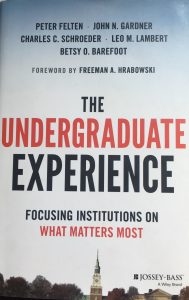
The Undergraduate Experience

A very optimistic look at the future of undergraduate education and a refreshing change from the catalog of books on this subject that are convinced that universities are finished.

The authors (Peter Felten, John Gardner, Charles Schroeder, Leo Lambert and Betsy Barefoot) hail from US universities and colleges of various shapes and sizes. The book is easy to read and crammed full of examples of undergraduate innovation at a multiplicity of institutions.

Continue reading “The Undergraduate Experience”

Block Curriculum

I recently visited Quest University in Squamish, BC. Aside from the most beautiful setting Quest is an interesting university on a number of fronts. Here are a few:

  • It is a private not-for-profit, I believe it is the only Canadian private secular university, but I could be wrong.
  • Tuition is $34,000 and accommodation and meals are additional.
  • It is fully residential (on-campus) for all four years of the undergraduate program.
  • Maximum class size is 20.
  • There is only one program a Bachelor of Arts and Science.
  • Freshman class intake targets around 200 students.
  • About 17% international, 46% Canadian and 37% US (the US and Canadian numbers have just reversed for the Sept 17 intake).
  • Faculty contracts are initially for 1 year, renewable for a further 2 years, then 3 years and then 6 years, there is no tenure and no ranks.
  • They do not have an academic senate but have an academic council.
  • Classes are delivered via  a block curriculum.

Continue reading “Block Curriculum”

Government Assessment

More Paperwork

It is a favourite pastime these days for universities to gripe and complain about the heavy hand of government in their day to day activities. Granted the reporting requirements have increased significantly over the years and also granted that there seems to increasing concern that universities are doing a poor job of preparing their graduates for the modern work force (whatever that means) and in the right applied subject areas. Continue reading “Government Assessment”