
The Gartner Hype Cycle for technologies in 2017 suggests that we should be keeping our eye on artificial intelligence, augmented reality and blockchain technology. Gartner also publishes a version for education and you may be surprised what is on the rise or fall or simply not even understand what some of these things are. Here they are: Continue reading “Technology Thoughts”
Learning Innovation
Over the last few months, I have spent quite some time reading, researching and visiting a number of institutions that claim some kind of academic innovation. In many cases, I was frustrated to find that the innovation touted in papers and conferences, in fact did not amount to much or in some cases had simply disappeared. So this is my list of things that I found interesting. Continue reading “Learning Innovation”
The New Education
In this very recent book, Cathy Davison argues that p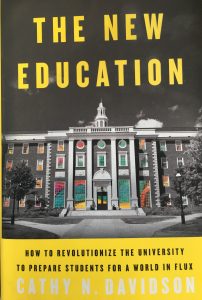 ost-secondary education is in need of a significant shake up. So add this book to the many other calling for educational reform. What makes this book at least slightly different is that the author certainly has the experience to make this claim and its somewhat optimistic tone. She writes two particularly compelling chapters on technophobia and technophilia. In the former she shows several examples of how avoiding technology use in the classroom can limit the active learning possibilities for students. In the latter she warns that the use of technology needs to be anchored in grounded academic thinking while at the same time tossing a few bricks at the for-profits with a serious nod towards the work of Tressie Cottom in “Lower Ed”.
She calls for a lowering in the cost of education and the revision of pedagogy to more active and experiential learning. This I have heard many times before but still remain unconvinced that the strategies presented in this work offer a particularly viable and sustainable path forward. Some time is spent on the firing of Alexander Coward for not conforming to traditional Berkley standards and trying new ways of assessment – she is clearly not a fan of standard testing or grades. I have to agree with the former, standard testing is not a particularly helpful educational technique but I am less sure about eliminating grades (yet!).
The most disappointing for me was the last chapter titled “the future of learning” unfortunately there was little meat, other than some interesting work that Georgetown U is doing that I am not sure was particularly scalable.
If you looking for a book to get you more motivated to try new techniques and abandon standard testing that provides the evidence to do it – then this is it. If you are looking for an answer for the problems and issues facing post-secondary education, then this is not it …. oh and when you find that please let me know.
The Perfect Undergraduate Curriculum
The holy grail of university education still remains elusive and maybe that is as it should be. Why should one size fit all, the assumption that there is one perfect undergraduate experience at university seems deeply flawed to me. However, that has not stopped armies of academics and commentators writing about it and it is not going to stop me. Continue reading “The Perfect Undergraduate Curriculum”
The Future of University Credentials
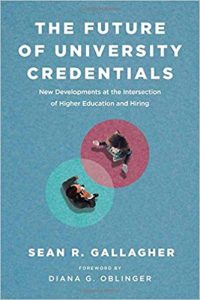 This is a great book by Sean Gallagher, the Chief Strategy Officer for Northeastern University’s Global Network. It is easy to read and well written and researched. If offers an historic overview of university credentialing and an up-to-date look (2016) at the current state of the game.
The book confirms that the university credential is alive and well, HR leaders and recruiters still use the bachelors or masters degree as the number one indicator of competence, despite increasing amounts of rhetoric to the contrary. Continue reading “The Future of University Credentials”
The Undergraduate Experience
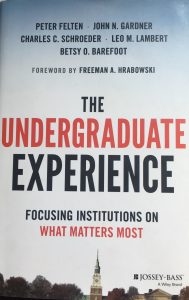 A very optimistic look at the future of undergraduate education and a refreshing change from the catalog of books on this subject that are convinced that universities are finished.
The authors (Peter Felten, John Gardner, Charles Schroeder, Leo Lambert and Betsy Barefoot) hail from US universities and colleges of various shapes and sizes. The book is easy to read and crammed full of examples of undergraduate innovation at a multiplicity of institutions.
Undergrad Curriculum Based on Happiness?
Perhaps you have read about Bhutan and its measurement of Gross National Happiness an idea that definitely has my support. At a recent visit to Technologico de Monterrey in Mexico as well as its sister institution Universidad TecMilenio, I was somewhat surprised to find that they have taken institutional ownership of the concept of happiness in a serious way. A brief search on happiness reveals a mixture of results from fairly serious articles on positive psychology to some shall we say less peer reviewed views on what makes for happy people. However, no doubt that many people are taking the whole concept of happiness very seriously indeed. Continue reading “Undergrad Curriculum Based on Happiness?”
Block Curriculum
I recently visited Quest University in Squamish, BC. Aside from the most beautiful setting Quest is an interesting university on a number of fronts. Here are a few:
- It is a private not-for-profit, I believe it is the only Canadian private secular university, but I could be wrong.
- Tuition is $34,000 and accommodation and meals are additional.
- It is fully residential (on-campus) for all four years of the undergraduate program.
- Maximum class size is 20.
- There is only one program a Bachelor of Arts and Science.
- Freshman class intake targets around 200 students.
- About 17% international, 46% Canadian and 37% US (the US and Canadian numbers have just reversed for the Sept 17 intake).
- Faculty contracts are initially for 1 year, renewable for a further 2 years, then 3 years and then 6 years, there is no tenure and no ranks.
- They do not have an academic senate but have an academic council.
- Classes are delivered via a block curriculum.