 Twin Lakes, Alberta
October 9, 2021
With the dominance of social media in our communication landscape, we don’t hear a lot about the influence of radio. As someone who avoids social media, radio is medium that introduces me to new music and keeps me connected to my city without having to share anything personal about myself. I’m not alone: according to the Canadian Radio-television and Telecommunications Commission (2019), 88% of Canadians over 18 report having listened to the radio in any given month. For this assignment, I am analyzing the impact of the Sustainability Talk program on 106.5 Mountain FM in the Bow Valley of Alberta (Murray, 2021).
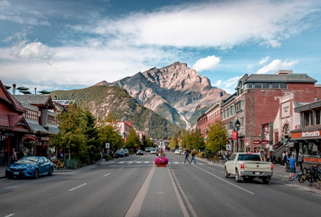
Image source: Louis Paulin from Banff, Unsplash
The radio waves of Mountain FM are short-lived, captured between the peaks of the eastern slopes of the Rocky Mountains. The station’s target audience are the residents of the towns of Banff and Canmore and hamlets of Harvie Heights and Exshaw – collectively known as the Bow Valley. I can attest by personal experience that by the time you have driven past the last peak and onto the plains, Mountain FM is turning to static.
The station highlights the lives of the people in the valley. The focus on the surrounding mountains is reinforced by show titles such as “The Mountain Insider” and “Rocky Mountain Retro Hour”. The description for the Mountain Insider states: “we’re keeping it local, talking about the news and issues affecting Banff, Canmore and the Bow Valley” (Mountain FM, 2021). The station lives up to this promise, hosting interviews with candidates for the upcoming municipal election, sponsoring the Canmore Eagles junior hockey team, and promoting local events. An area of the station’s website is focused on ski conditions. This is a radio station that fully embraces the culture of the tight-knit mountain community.
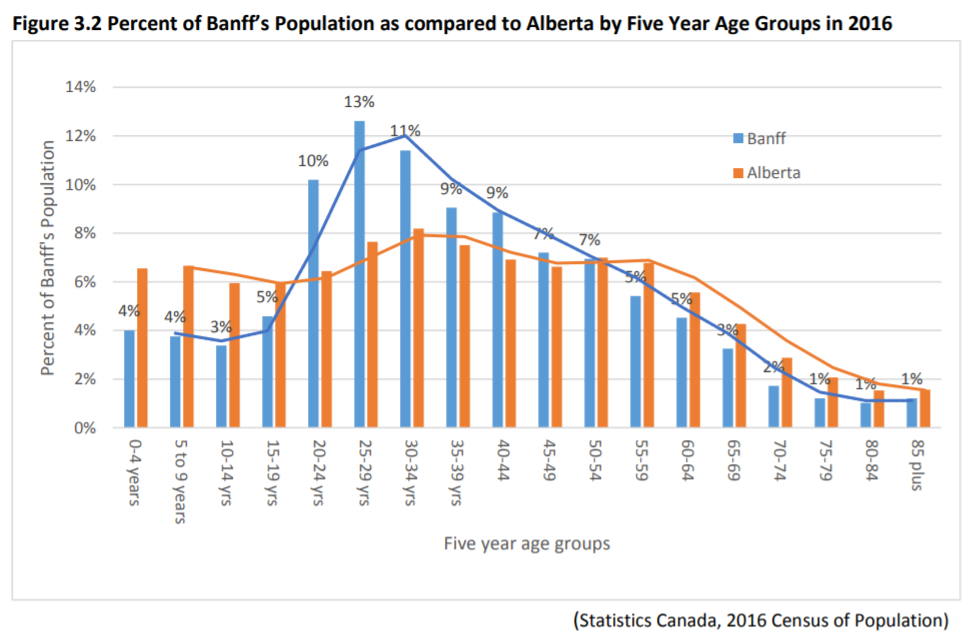
The demographics of the valley are unique. Due to the prevalence of seasonal work at ski hills and tourist attractions, valley residents tend to be younger compared to the rest of Alberta. Over a third of Banff residents are between 20-34 years old, compared to only 20% in the rest of Alberta (Gerrits et al., 2019). Residents are also highly educated: 73% of adults in Banff over the age of 25 have completed some form of postsecondary education, significantly higher than the Alberta average of 55% (Gerrits et al., 2019).
The Sustainability Talk segment launched in November 2019 by host Rob Murray. Each segment (averaging 75 seconds) is composed of a short audio clip by a special guest. At time of writing, there are 29 clips publicly available on the Mountain FM website, published every few weeks. There are no public records on how often or how many times the clips are played over the radio.
While reviewing content for this analysis, I noticed the first 26 segments draw upon similar techniques for audience engagement (outlined in the chart below). However, two of the most recent posts had a distinctly different tone than the earlier clips. For this analysis, I will focus on the clip titled Responsibility and Vulnerability in detail. That said, it is important to assess this segment in the context of the rest of the radio show.
The Sustainability Talk show frequently draws upon the following four techniques to engage its audience on climate change:
| Technique | Examples from Sustainability Talk | Supporting research |
| Tailor messages to a local audience | In the first clip, the guest speaker uses the Bow River as a metaphor to describe materials that “constantly flow through our lives” to make a point about recycling. The speaker uses a local natural feature to draw people into the topic. In one clip, a local grocery store is celebrated for the efforts they have taken to reduce food waste in their operations. The first 12 segments of the show were sponsored by a Bow Valley-based recycling company. | Dupar et al. (2019) encourage speakers to tailor information to specific stakeholder groups. In this case, the content is tailored specifically to the Bow Valley community by emphasizing local landmarks and businesses. |
| Provide tangible solutions and actions community members can take | Several clips highlight specific actions residents can take, such as installing solar panels and applying for local rebates, participating in events, purchasing green electricity, reducing food waste, etc. | When messages give specific adaptation advice, it increases intentions for action in audiences (Hine et al., 2016). |
| Emphasize co-benefits | Climate change is a common theme among the clips, regardless of the specific topic. A consistent narrative is woven into discussions of energy, waste, and biodiversity. For example, one speaker states: “diverting food waste away from landfill helps to meet Canmore’s climate action goals”. Economic development is a common co-benefit referenced in several clips. For example, one speaker emphasized the growth in jobs in the recycling sector by diverting more waste from landfill. | Maibach et al. (2011) recommend emphasizing “win-win” solutions as this approach tends to engage a broader cross-section of audiences. Further, Connor et al. (2016) emphasize that focusing on the benefits of mitigation inspires more action than focusing on the negative impacts of inaction. |
| Rely on trusted messengers | The show draws heavily on residents, experts, and trusted community members (for example, local business owners, municipal staff, high school students, and politicians). Only one speaker in the entire series is from outside Alberta. When it is unclear whether a speaker is from the valley by their title alone, the announcer will emphasize their ties to the valley. For example, when introducing a speaker from the Pembina Institute, the announcer emphasizes that she is “Canmore-based”. The announcer and producer, Rob Murray, is “well respected and well connected in the community”, which builds credibility for the show as a whole (C. Bitz, personal communication, October 8, 2021). | Armstrong et al. (2018) emphasize that people tend to trust messengers who hold similar views and values. Seemingly small details (like emphasizing someone’s “local” status) can affect the credibility of a messenger. Lewandowsky (2020) highlights that “elite cues” (such as press from politicians) is the greatest determinant of public concern about climate change. By featuring a local politician, the show demonstrates that elected representatives care about climate. |
The segment Responsibility and Vulnerability is unique and deserves more focused analysis. It is one of only two clips that has a more philosophical or academic approach, whereas earlier clips make clear real-world connections between climate change and the community (for example, encouraging people to sign up for a local solar rebate). In contrast, Responsibility and Vulnerability talks about climate change in a more abstract manner. The speaker, Dr. Andreanne Doyon, states “we are more responsible [for climate change] than smaller countries and countries that have lower socio-economic status”. This segment is the first clip in the series to highlight climate justice, which is a large concept to digest in 90 seconds. The audience is also left with no specific suggested action to take.
Despite this difference in tone, the clip does draw on one similar technique: the emphasis of the local. Although Dr. Doyon is based at Simon Fraser University, she is described as a “Canmore local”. Additionally, she spends the second half of her interview emphasizing how climate injustice and vulnerability can play out theoretically at local levels (for example, if someone cannot move away from the flood plain). The emphasis on localizing the content is still there, although it is done in a more abstract way.
With these observations in mind, at first glance the Responsibility and Vulnerability clip seems to be less effective than the previous clips. There is a more ambiguous connection to the local context and no tangible actions presented. However, when seen in context of the show as a whole and analyzed through the ecological model by Hodson (2019), it begins to make more sense.
The ecological model of climate marketing positions “attitudes and behaviours change at multiple, increasingly broad levels of interaction around the individual” (Hodson, 2019, p. 6). People’s individual attitudes and behaviours are influenced by their one-on-one relationships, community, and society as a whole; and vice versa: society is influenced by individual and collective actions and beliefs. Most of Sustainability Talk’s clips are focused on influencing the community (meso) level. Yet, Responsibility and Vulnerability begins to pull people outside of their own community and introduce them to concepts like international climate justice (macro level).

Sustainability Talk has been a recurring communication channel in the Bow Valley community for almost two years. The show has taken its time to build familiarity with climate change by relying on local messengers, weaving the narrative of climate into multiple topics, and emphasizing tangible actions. Now that the radio show has the trust of the local community, they can begin to take listeners on a journey outside of their comfort zone. They have built a foundation on which more abstract and justice-focused communications can begin to take place. If the Responsibility and Vulnerability clip were transplanted to a new town without the previous context or trust-building, I doubt it would be successful. However, the holistic approach of emphasizing tangible actions as a first step and then building abstract ideas onto that foundation creates a more complete narrative of climate action.
With that said, there are two things that could make Sustainability Talk more effective. None of the 29 clips used storytelling as a technique. As Bayer & Hettinger (2019) demonstrate, storytelling is more effective in engaging a listener than relying on data alone. Additionally, although Mountain FM has an active Facebook page and Twitter account, rarely are either used to promote Sustainability Talk. Communicators are encouraged to create content that is easy to share and promote across multiple platforms (Dupar et al., 2019). Sustainability Talk could amplify their clips on their existing social media platforms to reach a broader audience; specifically, the high proportion of young adults living in the valley.
People often listen to the radio while engaged in other activities: while driving, cooking, or cleaning. It is a unique opportunity for climate communicators to reach people that are not intentionally seeking out climate information. Sustainability Talk on Mountain FM does this well for the Bow Valley community, although they could deepen their influence by emphasizing stories over information. It would be interesting to see if a similar approach would work for larger communities like the nearby city of Calgary.
References
Armstrong, A.K., Schuldt, J.P., & Krasny, M.E. (2018). Establishing trust. Communicating climate change: A guide for educators. Cornell University Press. Ebook.
Bayer, S, & Hettinger, A. (2019). Storytelling: A natural tool to weave the threads of science and community together. Bulletin of the ecological society of America, 100(2), 1-6.
Canadian Radio-television and Telecommunications Commission. (2019). Communications Monitoring Report 2019. https://crtc.gc.ca/eng/publications/reports/policymonitoring/2019/cmr5.htm
Connor, P., Harris, E., Guy, S., Fernando, J., Shank, D., Kurz, T., Bain, P., & Kashima, Y. (2016). Interpersonal communication about climate change: How messages change when communicated through simulated online social networks. Climatic Change 136(3-4), 463-476. doi: 10.1007/s10584-016-1643-z
Dupar, M., McNamara, L., & Pacha, M. (2019). Communicating climate change: A practitioner’s guide. Cape Town: Climate and Development Knowledge Network. https://unfccc.int/sites/default/files/resource/Communicating%20climate%20change_Insights%20from%20CDKNs%20experience.pdf
Gerrits, A., Harrison, J., & Pryor, R. (2019). Community Social Assessment. Town of Banff. https://banff.ca/DocumentCenter/View/6315/2018-Banff-Community-Social-Assessment
Hine, D.W., Phillips, W.J., Cooksey, R., Reser, J.P., Nunn, P., Marks, A.D.G, Loi, N.M., & Watt, S.E. (2016). Preaching to different choirs: How to motivate dismissive, uncommitted, and alarmed audiences to adapt to climate change? Global Environmental Change 36, 1-11. doi: 10.1016/j.gloenvcha.2015.11.002
Hodson, J. (2019). An ecological model of climate marketing: A conceptual framework for understanding climate science related attitude and behavior change. Cogent Social Sciences 5(1), 1-15.
Lewandowsky, S. (2020). Climate change disinformation and how to combat it. Annual Review of Public Health 42, 1-21. https://www.annualreviews.org/doi/abs/10.1146/annurev-publhealth-090419-102409
Maibach, E., Nisbet, M., & Weathers, M. (2011). Conveying the Human Implications of Climate Change: A Climate Change Communication Primer for Public Health Professionals. George Mason University Center for Climate Change Communication. https://www.climatechangecommunication.org/wp-content/uploads/2016/04/Climate-Communication-Primer-for-Public-Health-Professionals-1.pdf
Mountain FM. (2021). The Mountain Insider. Mountain FM Canmore Banff 106.5. https://www.mountainfm.ca/shows/the-mountain-insider/
Murray, R. (Host). (2021, August 4). Responsibility and Vulnerability [Radio]. In Sustainability Talk. Rogers Media 106.5 Mountain FM. https://www.mountainfm.ca/audio/sustainability-talk-responsibility-and-vulnerability/