 Twin Lakes, Alberta
Oct 17, 2021
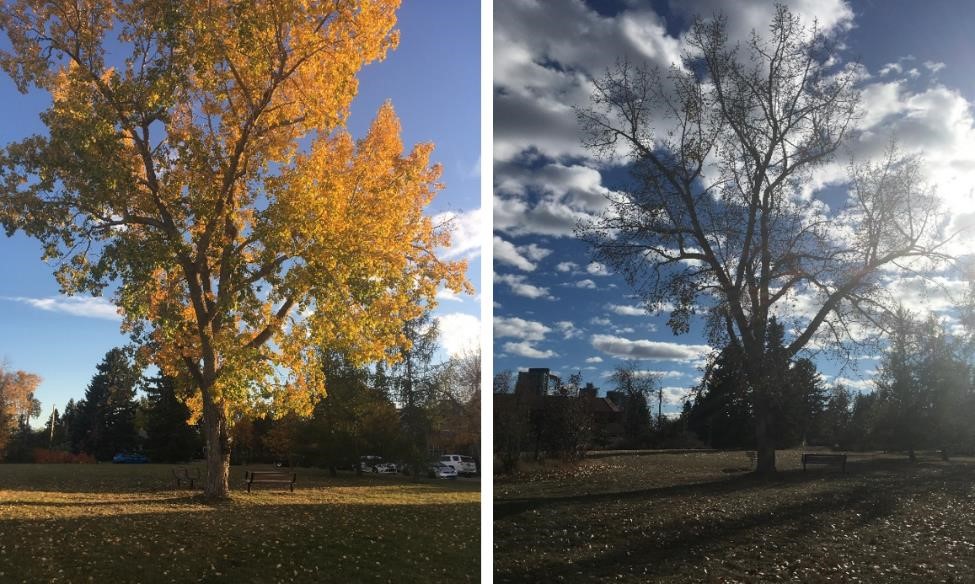
My sit spot is changing quickly. The leaves that had been green fading to yellow only a few short weeks ago are now brown or gone altogether. The bright sunshine is still there but the warmth has disappeared. The spot is graciously reflecting my sour mood. Today I’m in no mood to see the beauty or think deeply. I just want to sit. My notebook – normally full of arrows and thoughts in the margins – today just says “Despondent. Seeing the election signs – ugh. Nostalgia.”
I’m not sure of the exact origin of my bad mood. It might have been too much time in front of the computer, or the latest wave of Covid weariness, or just a sense of feeling lost in turbulent times. Either way, I’m leaning into the process of my sit spot, letting it teach me.
A few weeks ago, I was debriefing the recent federal election with friends. As a politically active person, I was eager to discuss the nuances: the ups, downs and surprises of the snap election. Instead, all I heard was disappointment. My friends were craving strong climate leadership from their elected officials, and were frustrated by the results. Several of them shared sentiments of “I feel surprised every time an election rolls around… why do I even let myself be hopeful?”
Several days after that, I gave a presentation on climate to a local community group. At the beginning, I asked them to share what they were interested in discussing. Most wanted to know what they could do to reduce their carbon footprint. One gentleman, however, was despondent. He told the group he needed to feel hope again. He was so discouraged by the lack of action at the political level and wanted to know what he could do with his anger and hopelessness.
In both these cases, I thought back to my communications training. I remembered the literature emphasizes understanding your audience and shape messaging to fit the audience (Zia & Todd, 2010). So, I started with language to demonstrate I was listening (“I know it is disappointing”) and then talked about specific impacts and actions I thought would resonate. I remembered gain-frames are more effective than loss-frames (Morton et al., 2011). So, I emphasized the progress happening locally and the shift in Alberta attitudes the federal election uncovered. I thought of the six Americas by the Yale Program on Climate Change Communication and remembered that research from Australia found people falling into both the “alarmed” and “uncommitted” categories respond to similar framing (Hine et al., 2016). So, I walked the line of balanced realism, trying to acknowledge that people felt alarmed, but encouraging them to get (or stay) involved. I tried my hardest to communicate by the book.
Unfortunately, in both situations I left the conversation feeling as though my community thought I was naïve for even attempting to frame the climate emergency as an opportunity for positive change.
One of our sit spot prompts was to reflect on a situation in which we need to motivate and inspire two groups with two different versions of the same message. Yet as I sat under the large, rapidly emptying poplar tree earlier this week I realized that perhaps we need to acknowledge various audiences within ourselves. There aren’t only six types of people – there are multiple people within each of us.
I had been communicating as though people were one-dimensional and unchangeable – as though their mental and emotional state doesn’t fluctuate day by day or hour by hour. I saw my friends and this gentleman as part of a group of “alarmed and discouraged”. Yet, I realized that is exactly how I was feeling on my second visit to my sit spot. I was discouraged and despondent and didn’t want to think about climate. I saw the lawn signs for our upcoming municipal election and thought “ugh”, despite being politically active. But I don’t always feel like this – sometimes I feel hopeful and driven – like I did the first time I came to my sit spot. Both versions of myself are there; its just that depending on the day, one tends to be louder than the other.
I went back and read about the six Americas again. One part stood out to me more than it had before: effective engagement must start “with the fundamental recognition that people are different and have different psychological, cultural, and political reasons for acting – or not acting – to reduce greenhouse gas emissions” (Yale, 2020, para. 1). Initially, I had assumed that the psychological state referenced in this statement was static. I only needed to find the right language and right framing to fit someone’s psychological state to be effective. However, I know from my own experience that human psychology is anything but static. It is fluid, changeable, and malleable. Perhaps getting to know one’s audience really means getting to know your audience in this particular moment in time.
The next time I communicate about climate, should I take a step back and ask first, “how are you doing? No, I mean – how are you really doing?” Would our communication efforts be more meaningful and effective if we took the time to understand and incorporate the emotional state of the person we are speaking to?
References
Hine, D.W., Phillips, W.J., Cooksey, R., Reser, J.P., Nunn, P., Marks, A.D.G., Loi, N.M., & Watt, S.E. (2016). Preaching to different choirs: How to motivate dismissive, uncommitted, and alarmed audiences to adapt to climate change? Global Environmental Change 36, 1-11. doi: 10.1016/j.gloenvcha.2015.11.002
Morton, T., Rabinovich, A., Marshall, D., & Bretschneider, P. (2011). The future that may (or may not) come: How framing changes responses to uncertainty in climate change communications. Global Environmental Change 21(1), 103-109.
Yale Program on Climate Change Communication. (2020). Global Warming’s Six Americas. https://climatecommunication.yale.edu/about/projects/global-warmings-six-americas/
Zia, A., Todd, A.M. (2010). Evaluating the effects of ideology on public understanding of climate change science: How to improve communication across ideological divides? Public Understanding of Science 19(6), 743-761. doi: 10.1177/0963662509357871
Amy,
Great post. Thanks for your honesty and openness about how you felt; it led to a learning that will help me and others. I like how you also presented a solution at the end (to ask, “how are you really doing?”).
I wonder if there is climate communication research on moving past the emotions to the underlying values? I know we have to acknowledge emotion first to engage, but then we should be able to, “Understand the intended audience’s knowledge and values. Use framing and language that will resonate with target audiences to evolve understanding of, and contribution to, an issue” (Dupar, et al, 2021, p.9). I have a feeling we’ll know the answer to this by the end of CALS 502!
Dupar, M., McNamara, L.. and Pacha, M. (2019). Communicating climate change: A practitioner’s guide. Cape Town: Climate and Development Knowledge Network.https://unfccc.int/sites/default/files/resource/Communicating%20climate%20change_Insights%20from%20CDKNs%20experience.pdf
Thanks for your comment Kerra! I wonder if part of the relationship between emotions and values is that different emotions are reflecting different values that people hold? We’re all such complicated beings, teasing out the relationship between emotions/values seems difficult, yet really important for the work of meaningful communication.
Really thoughtful writing here, Amy. Untangling emotions and values is difficult business as we can be so emotional about what we value, and in fact our emotions help us identify with great accuracy what it is we actually value. They can act as a way through to assessing where people’s (and our own) values actually lie.
What comes to mind here when you consider asking “how are you doing” is that you are sensing two powerful things, which I’d argue are part of climate communication and action more broadly: first, asking someone this means we have to slow down and listen. While there is urgency for change right now, it needs to be intentional, and slowing down enables that process. It is also about you listening to the stories of others. People need to be heard, especially when they are feeling heavy things. Listen actively, repeat back to them what you are hearing (which you are already doing!), and move from there. In other words, take in their stories and work with that.
Tangentially related, if you do ask questions like this, be prepared to negotiate grief. While not core to this course, there’s a lot of grief work that communicators may be asked to do, so take care of yourself if and as this arises.
Thanks for your comment Shandell. What you say about untangling emotions and values resonates with me. The relationship is never simple, but there is certainly a relationship between what we value and how we emote.
I really enjoy your writing Amy – I find your posts so genuine, evocative and profound. I really appreciated your reflection on how complex we all are – so true and although I agree, I hadn’t thought it through so well so thanks for that. And I empathize with your walking into those interactions with your friends and the gentleman with overly preconceived/simplistic ideas of their values etc, then feeling deflated with how the interaction turned out. When I read about tailoring to audiences, I always find that intimidating: ‘how can I know my audience’s needs?’ I wonder. They are all complex human beings – are their values, priorities and preferences neatly written down in some researchable place? Of course some tendencies and prevalences have been researched, but as you experienced – it’s not that simple.
My approach with every conversation (and this is again a spiritual experience – since you commented on my blog post I’ll tie it back to that) is to feel in the moment and try to respond with all my senses, with a certain spontaneous faith and connection. Sometimes I listen to my gut – sometimes while I’d love to interject, I find myself compelled to hold back. Sometimes, the words come gushing out like a fountain and it feels so right. It also ties completely into Shandell’s comment about slowing down – I slow down, listen to all my senses like I do in the sit spot, and see what comes. I’ve had amazing results with this process – I find that my most powerful conversations have flowed from this space and that I’ve sometimes avoided unproductive or toxic conversations by relying on these gut instincts.
I hope this is helpful, and thanks again for your post.
Thank you for your comment! So thoughtful, as always. I appreciate what you said about listening “to your gut”. Sometimes you have to trust that the right words will come without overthinking it. Thanks for that reminder.