 Twin Lakes, Alberta
February 15, 2022
This blog post is for assignment 5 in the CALS501 course.
In a post from November 2021, I coined the term ‘emotional downscaling’ to describe what I see as a core task for climate leaders: translating complex global climate projections into relevant information for the lives of their intended audience (O’Sullivan, 2019). Statistical downscaling is the process of translating global climate models into smaller geographic scales (Murdock et al., 2014), while ‘emotional’ downscaling emphasizes the importance of making this data relevant to people. With this in mind, my peers and I decided to incorporate the idea of localizing climate data into our CALS501 design challenge. In theory, this localization seems straightforward: determine the projected local hazards and resulting impacts, engage with the community, conduct a risk assessment, and develop a plan to respond to these risks (CCME, 2021). Upon reflection however, I am realizing that the complexity of risk makes this hyper-locality more challenging. Risks don’t live within well-defined boundaries of a community. Taking a holistic view of risk means looking beyond the local.
A case study from Calgary may help illustrate my point. The Springbank Off-stream Reservoir (also known as a dry dam) is a climate adaptation project west of Calgary designed “to accommodate water volumes equal to the 2013 flood on the Elbow River” (Government of Alberta, 2022, para. 1). Once completed, the dry dam will fill with water during high precipitation events, preventing flooding downstream. Five properties will be directly impacted by the dam, including private landowners and a summer camp for underprivileged youth (Jabbal et al., 2020). The 2016 environmental impact assessment highlighted potential declines in fish and grizzly populations due to habitat loss, disruption of sacred sites for local Indigenous groups, and more (Government of Canada, 2016). There are real-life impacts of this adaptation strategy for individuals, communities, and the ecosystem. However, the project is moving ahead because the risk to infrastructure downstream in Calgary outweighs the risks of the dam construction (Jabbal et al., 2020).
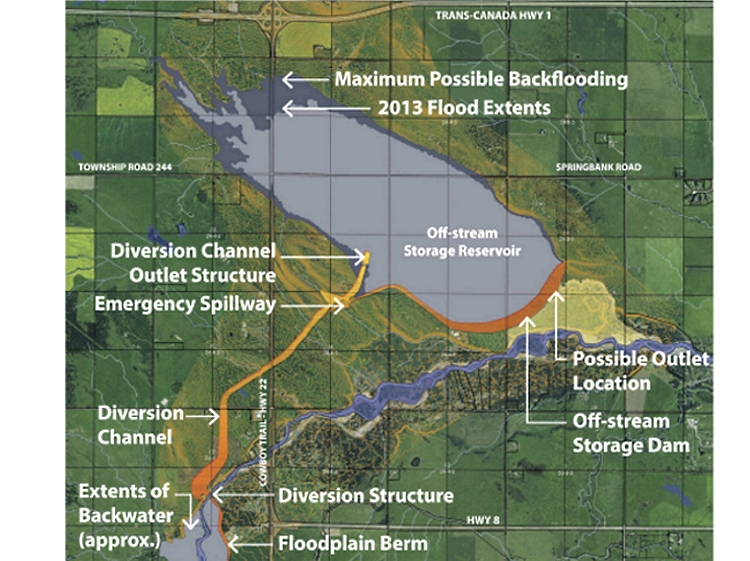
Herein lies the conundrum of risk. Those that may experience the worst risks from climate change (and adaptation to it) may not be in control of the mechanisms to mediate that risk. Or, they may have mechanisms to reduce their risk (ie: building a dam upstream), but their actions may impact other communities’ or species’ abilities to adapt (ie: access to traditional medicine sites). The current residents of Springbank, the children attending summer camp, wildlife, and the Indigenous communities in the area will all be impacted by the dam to varying degrees. Whereas Calgarians who will benefit from the dam… well, their lives won’t change except they won’t have to deal with a potential future flood. The burden of change falls to those living outside the community at risk. As Smit and Wandel highlight, “the adaptive capacity of individuals or households is shaped and constrained by social, political, and economic processes at higher scales” (2006, p. 284). By overlooking how these processes at higher scales influence local adaptive capacity, we may externalize risk onto other communities.
Our prototype for the design challenge has been based on the idea that localizing climate data is important to start engaging citizens on climate adaptation. We are focusing our prototype on the community of Leduc in central Alberta. Yet, if we ignore the regional complications of risk, we may jeopardize the adaptation strategies of other communities. For instance, by only focusing on Leduc and not the surrounding context, we may develop a robust adaptation plan for the community of Leduc that in turn impacts the ability of the nearby Maskwacis Nation to adapt.
As climate practitioners, we need to find a way to localize, yet not lose sight of the regional complexity of risk and adaptation. This seems to be the essence of systems thinking: to understand the individual components, but not lose sight of how those components interact with one another. One way we are playing with this idea in our prototype is to lead the community of Leduc through a systems-mapping exercise. Perhaps encouraging citizens to think in systems will lead to adaptation strategies that are beneficial to people outside of Leduc in addition to those within it.
References
Canadian Council of Ministers of the Environment (2021). Guidance on Good Practices in Climate Change Risk Assessment. https://ccme.ca/en/res/riskassessmentguidancesecured.pdf
Edey, N. (2017, August 4). Springbank dam EIA to be submitted in October. Cochrane Now. https://cochranenow.com/articles/springbank-dam-eia-to-be-submitted-in-october
Government of Alberta (2016). Environmental assessment – Springbank Off-stream Reservoir. Springbank Off-stream Reservoir. https://calgaryjournal.ca/2020/07/14/against-the-current-both-sides-of-the-sringbank-dam-argument/
Government of Alberta. (2022). About Springbank Off-stream Reservoir. Springbank Off-stream Reservoir. https://www.alberta.ca/about-springbank-off-stream-reservoir.aspx#jumplinks-5
Jabbal, S., Atwood, B., & Gonzalez, D. (2020, July 14). Against the current: Both sides of the Springbank dam argument. Calgary Journal. https://calgaryjournal.ca/2020/07/14/against-the-current-both-sides-of-the-sringbank-dam-argument/
Murdock, T., Cannon, A. & Sobie, S. (2014). Statistical downscaling of future climate projections for North America. Pacific Climate Impacts Consortium. https://www.pacificclimate.org/data/statistically-downscaled-climate-scenarios
O’Sullivan, F. (2019). To survive climate change we’ll need a better story. Bloomberg CityLab. https://www.bloomberg.com/news/articles/2019-11-11/meet-sweden-s-chief-storyteller-for-climate-change
Smit, B., & Wandel, J. (2006). Adaptation, adaptive capacity, and vulnerability. Global Environmental Change 16, 282-292. https://doi.org/10.1016/j.gloenvcha.2006.03.008