Climate science informs us that humans have unequivocally caused global warming and details what is driving the warming (Chen et al., 2021, p. 150). For more on that, see my Climate Diagnosis Post. In addition, climate science identifies what planetary systems are changing and what climate impacts are already occurring. More importantly, these impacts can be projected into the future based on how much greenhouse gas is emitted. This gives us a window into various futures depending on our current choices. The troubling part is that in the last 50 years, there has been a rapid increase in greenhouse emissions and, correspondingly, the global surface temperature. Both have risen faster than in any other period in 2000 years (IPCC, 2021, p.8). Also, in the previous 50 years, almost all the world’s glaciers have retreated, which is unprecedented in the last 2000 years. Arctic sea ice has been at its lowest since 1850, and the global mean sea level has risen faster in the last century than any previous one for at least 3000 years. In addition, the increase in sea temperature, oxygen concentrations, and declining global ocean pH (Arias et al., 2021, p.74) all affect the ocean environment, circulation, and coastal shorelines.
Scientists assure us that human-induced climate change has affected every region of the planet with extreme weather and unprecedented climate events (IPCC, 2021, p. 8). Those impacts will increase in frequency, intensity and duration with each incremental degree of warming (IPCC, 2021, p. 18). Although this is alarming, there is more. As warming continues, multiple extreme events will happen simultaneously (IPCC, 2021, p. 25). This will be further exacerbated by the warming rate that increases the occurrence of record-shattering events such as heat waves and droughts (Fischer et al., 2021, p. 692). Figure 2 graphically shows the climate impacts and how they intensify for higher surface temperatures (Arias et al., 2021, p. 89). The warmer it gets, the worse it is and the more inhospitable to human, animal and plant life. There is no motivation to allow warming to rise beyond 1.5°C above pre-industrial levels.
Figure 2
From Arias et al., 2021, p. 89.
As shown in Figure 2, global warming is currently at 1.1oC above preindustrial levels, and the climate impacts on ecosystems and humans have already been widespread, extreme and deadly. To help contextualize this, I found it helpful to think about local impacts. For example, southern Canada is warming at double the global average, with northern Canada warming even faster (Bush et al., 2022, p. 7). The three oceans surrounding Canada have been negatively affected as they warm, lose oxygen below the global average for the Pacific and become more acidic. Regional coastlines are impacted as the global mean sea level (GMSL) rises. Some will have much higher sea levels than the GMSL (Bush et al., p.30). Although precipitation is increasing, this will be from intense rainfall in the winter, while lower rainfall in the summer increases the incidence, duration and intensity of drought (Bush et al., 2022, p.8). Extreme hot temperatures will continue to increase in intensity and frequency, as will heat waves and weather extremes (Bush et al., 2022, p.9). There already is less snowpack, glaciers are rapidly receding, permafrost is thawing, and Arctic Sea ice is melting (Bush et al., 2022, p. 8 & 9). In British Columbia, we have already experienced some significant impacts from climate change, including deadly heat waves, record-breaking wildfire seasons, unprecedented drought, extreme winter storms, heavy unremitting precipitation and devastating floods (MoE, n.d.). It is difficult to imagine it getting worse, but unfortunately, that is the track we are currently on.
But a few things caught my attention as necessary for all to know when we think about climate action. Firstly, every tonne matters, each additional tonne of CO₂ emissions adds to global warming (IPCC, 2021, p. 28), and therefore, each tonne avoided matters. As CO2 is so long living in the atmosphere, our emissions today will be affecting the climate of our great-grandchildren; not a legacy any of us should be leaving, so any effort we make now will make a difference. Secondly, because CH4 has such a high warming potential and is rapidly increasing, getting that under control quickly is essential (Arias et al., 2021, p. 103). We need methane police! Finally, realizing that rapidly reducing GHGs now would make a difference within years and global temperatures would stabilize in twenty years (IPCC, 2021, p. 30) made me wonder why we would want to drag this out any longer than necessary. Getting on this now means most humans alive today will benefit from their efforts. For those that have already experienced climate impacts, that should be motivating.
Note on Citations
The information in the IPCC reports is very dense. To aid in finding the reference for myself, instructors and readers that might want to follow up I have included page numbers.
References
Arias, P.A., N. Bellouin, E. Coppola, R.G. Jones, G. Krinner, J. Marotzke, V. Naik, M.D. Palmer, G.-K. Plattner, J. Rogelj, M. Rojas, J. Sillmann, T. Storelvmo, P.W. Thorne, B. Trewin, K. Achuta Rao, B. Adhikary, R.P. Allan, K. Armour, . . . K. Zickfeld, (2021). Technical Summary. In Climate Change 2021: The Physical Science Basis. Contribution of Working Group I to the Sixth Assessment Report of the Intergovernmental Panel on Climate Change [Masson-Delmotte, V., P. Zhai, A. Pirani, S.L. Connors, C. Péan, S. Berger, N. Caud, Y. Chen, L. Goldfarb, M.I. Gomis, M. Huang, K. Leitzell, E. Lonnoy, J.B.R. Matthews, T.K. Maycock, T. Waterfield, O. Yelekçi, R. Yu, and B. Zhou (eds.)]. Cambridge University Press, Cambridge, United Kingdom and New York, NY, USA, pp. 33−144, https://doi:10.1017/9781009157896
Bush, E., Bonsal, B., Derksen, C., Flato, G., Fyfe, J., Gillett, N., Greenan, B. J. W., James, T. S., Kirchmeier-Young, M., Mudryk, L., & Zhang, X. (2022). Canada’s changing climate report, in light of the latest global science assessment. https://doi.org/10.4095/329703
Chen, D., M. Rojas, B.H. Samset, K. Cobb, A. Diongue Niang, P. Edwards, S. Emori, S.H. Faria, E. Hawkins, P. Hope, P. Huybrechts, M. Meinshausen, S.K. Mustafa, G.-K. Plattner, and A.-M. Tréguier. (2021). Framing, Context, and Methods. In Climate Change 2021: The Physical Science Basis. Contribution of Working Group I to the Sixth Assessment Report of the Intergovernmental Panel on Climate Change [Masson-Delmotte, V., P. Zhai, A. Pirani, S.L., Connors, C. Péan, S. Berger, N. Caud, Y. Chen, L. Goldfarb, M.I. Gomis, M. Huang, K. Leitzell, E. Lonnoy, J.B.R., Matthews, T.K. Maycock, T. Waterfield, O. Yelekçi, R. Yu, and B. Zhou (eds.)]. Cambridge University Press, Cambridge, United Kingdom and New York, NY, USA, pp. 147–286, doi:10.1017/9781009157896.003.
Fischer, E. M., Sippel, S., & Knutti, R. (2021). Increasing probability of record-shattering climate extremes. Nature Climate Change, 11(8), Article 8. https://doi.org/10.1038/s41558-021-01092-9
IPCC. (2021). Summary for Policymakers. In: Climate Change 2021: The Physical Science Basis. Contribution of Working Group I to the Sixth Assessment Report of the Intergovernmental Panel on Climate Change [Masson-Delmotte, V., P. Zhai, A. Pirani, S.L. Connors, C. Péan, S. Berger, N. Caud, Y. Chen, L. Goldfarb, M.I. Gomis, M. Huang, K. Leitzell, E. Lonnoy, J.B.R. Matthews, T.K. Maycock, T. Waterfield, O. Yelekçi, R. Yu, and B. Zhou (eds.)]. Cambridge University Press, Cambridge, United Kingdom and New York, NY, USA, pp. 3−32, https://doi:10.1017/9781009157896.001
Before taking MACAL CALS500 Climate Science, Impacts, and Services, I had the notion that the 2015 Paris target of “limiting global average temperature increase to well below 2°C above preindustrial levels” (Chen et al., 2021, p. 161) would mean the world would be a different but still somewhat safe place. Striving for 1.5°C above pre-industrial levels would be even better. Diving into the Intergovernmental Panel on Climate Change (IPCC) Sixth Assessment Report Working Group I (WGI), it is evident that allowing the global temperature to rise higher than 1.5°C above preindustrial levels will push the planetary systems to inhospitable places for many of the living beings that rely on a functioning biosphere, including humans. Unfortunately, modern humans’ extractive, consumptive lifestyle has not only threatened the climate system but has pushed biodiversity and other planetary boundaries to or beyond safe limits (Chen et al., 2021, p. 161). This is what systems thinkers like Donella Meadows call the tragedy of the commons (Meadows, 2008, p. 118).
The biosphere is the commons as it is not owned or regulated by any one entity. Humans (some more than others) have benefited enormously from extracting resources and dumping waste into the biosphere with little regard for the consequences. The tragedy comes from the lack of feedback to those responsible for the biospheres’ demise until it is too late (Meadows, 2008, p. 121). As dire as this sounds, spending time studying climate science and the WGI report, with contributions from thousands of scientists and researchers collaborating around the world, provided necessary insights. It was like being given a proper diagnosis for a long-endured ailment or essential feedback on the state of the commons. Although the diagnosis is bad news, the treatment provides better news as it leads us towards an equitable, just, safe, biodiverse and healthy path. In this blog post, I will provide some background on how humans caused climate change and how we need a vision of a very low emissions sustainable future to save ourselves.
Background on How We Caused Climate Change
Scientists have proven the cause of global warming through paleoclimate records and climate modelling (IPCC, 2021, p. 4). They have found that “[i]ncreases in well-mixed greenhouse gas (GHG) concentrations since around 1750 are unequivocally caused by human activities” (IPCC, 2021, p. 4). Also, carbon dioxide (CO2) is the most significant contributor to GHGs due to its higher concentration level and long life span (centuries). It has not been at such a high concentration “in at least 2 million years” (IPCC 2021, p. 8). Methane (CH4) and nitrous oxide (N2O) are the next most significant contributors, with concentrations “higher than at any time in at least 800,000 years” (IPCC, 2021, p. 8). CH4 has a shorter life span (decades) in the atmosphere. Still, it has a much higher global warming potential than CO2, so it can have dramatic short-term impacts (IPCC, 2021, p. 27), which is essential to remember when looking at mitigation actions.
Unfortunately, humans have increased the release of all GHGs, but unlike CO2, “land and ocean are not substantial sinks for other [greenhouse gas emissions]”(IPCC, 2021, p. 4). This fact caught my attention as there is so much focus on CO2, yet short-lived emissions could cause problems if not reduced significantly. Unsurprisingly, given how much we rely on it, the primary source of all three of these gases is fossil fuel production, distribution, and combustion for energy, transportation, and industry (Arias, 2021, p.102). Other human activities, such as deforestation and agriculture, also release greenhouse gas emissions (Chen, 2021, p. 244). As a result, the more humans there are and the more we consume, the higher the emissions and concentrations. To date, emission levels and population have only continued to rise (NOAA, 2022, UN, 2022).
The global surface temperature has also risen (Chen, 2021, p. 211). Paleoclimate records show that over the centuries, the rise in global surface temperature has followed the same trajectory as the increase in greenhouse gases in the atmosphere (Chen, 2021, p. 159). Greenhouse gases are so named because they trap heat within the planetary atmosphere, much like the inside of a car on a sunny day that warms up much more than the outside air. Earth’s atmosphere holds heat that would otherwise be reflected out to space. For thousands of years, the atmosphere has been finely tuned with just enough greenhouse gases to balance the heat absorbed from the sun and reflected by the planet (Forster et al.,2021, p. 1021). Figure 1 graphically shows the imbalance today and where the energy is stored, with the majority stored in the ocean.
Figure 1
Incoming and Outgoing Energy Flows and the Current Imbalance Caused by Greenhouse Gases
Note. Before human-caused greenhouse gases started accumulating in the atmosphere, the incoming energy was balanced with the outgoing energy. The atmosphere maintained a stable climate. As greenhouse gases accumulated, the energy balance has shifted, with energy now being stored in the ocean, land, ice and atmosphere. From Forster et al., 2021, p. 1021.
The finely balanced atmosphere and stable climate created a hospitable environment for a thriving biosphere (Holocene, 2022), and living beings evolved to work within the web of life through reciprocity and mutual flourishing (Kimmerer, 2013, p. 382). But that all changed with industrialization and the release of human-caused greenhouse gases. Here lies the tragedy for humans to solve. Our societies, cultures, and economies have developed around the extraction of resources and high levels of waste. It has afforded incredible technological advancements and consumptive lifestyles for those fortunate enough to create and increase wealth. Unfortunately, there is plenty of “bad news” about the damage and impacts already caused by modern-day living and what we can expect if we keep on a high emissions pathway. Please read my “Bad News” post for my reflection on the points that hit home for me. If you prefer only to know our best option for our survival, then skip to the “Better News” section for a reflection of what a very low emissions world could be.
Holding a Vision and Shifting our Mind Set
Holding a vision of a very low emissions future is what is needed. The vision, like a beacon, will guide us in our work. This will be necessary as we untangle the economic system that has led to the demise of the planet’s life-giving complex systems. We need to change the economic systems’ destructive goals, structures, and parameters that focus on unlimited growth, putting humans above all and nature as a resource for human fulfillment (Meadows, 2001, p.163). Ultimately a shift in mindset or paradigm, as system thinker Donella Meadows describes, is one of the most effective ways to change a system (2001, p. 163). Getting that shift requires clear communication about the failures of the status quo and a high-emissions pathway so that the problem is defined (Bennett et al., 2021). Included in that communication must be the vision, goals and benefits of the new low-emissions sustainable world. Looking for and talking about successful transitions and approaches help to demonstrate that this is possible. Indigenous Knowledge Keepers have much to show us in this regard. Reorienting humans’ current trajectory towards the Green Road while implementing the UN Sustainable Development Goals is a legacy we can leave for the next generations. In this way, they will know that we have done the best that we were able to, which is the ultimate act of love.
Note on Citations
The information in the IPCC reports is very dense. To aid in finding the reference for myself, instructors and readers that might want to follow up I have included page numbers.
References
Arias, P.A., N. Bellouin, E. Coppola, R.G. Jones, G. Krinner, J. Marotzke, V. Naik, M.D. Palmer, G.-K. Plattner, J. Rogelj, M. Rojas, J. Sillmann, T. Storelvmo, P.W. Thorne, B. Trewin, K. Achuta Rao, B. Adhikary, R.P. Allan, K. Armour, . . . K. Zickfeld, (2021). Technical Summary. In Climate Change 2021: The Physical Science Basis. Contribution of Working Group I to the Sixth Assessment Report of the Intergovernmental Panel on Climate Change [Masson-Delmotte, V., P. Zhai, A. Pirani, S.L. Connors, C. Péan, S. Berger, N. Caud, Y. Chen, L. Goldfarb, M.I. Gomis, M. Huang, K. Leitzell, E. Lonnoy, J.B.R. Matthews, T.K. Maycock, T. Waterfield, O. Yelekçi, R. Yu, and B. Zhou (eds.)]. Cambridge University Press, Cambridge, United Kingdom and New York, NY, USA, pp. 33−144, https://doi:10.1017/9781009157896
Chen, D., M. Rojas, B.H. Samset, K. Cobb, A. Diongue Niang, P. Edwards, S. Emori, S.H. Faria, E. Hawkins, P. Hope, P. Huybrechts, M. Meinshausen, S.K. Mustafa, G.-K. Plattner, and A.-M. Tréguier. (2021). Framing, Context, and Methods. In Climate Change 2021: The Physical Science Basis. Contribution of Working Group I to the Sixth Assessment Report of the Intergovernmental Panel on Climate Change [Masson-Delmotte, V., P. Zhai, A. Pirani, S.L., Connors, C. Péan, S. Berger, N. Caud, Y. Chen, L. Goldfarb, M.I. Gomis, M. Huang, K. Leitzell, E. Lonnoy, J.B.R., Matthews, T.K. Maycock, T. Waterfield, O. Yelekçi, R. Yu, and B. Zhou (eds.)]. Cambridge University Press, Cambridge, United Kingdom and New York, NY, USA, pp. 147–286, doi:10.1017/9781009157896.003.
Forster, P., T. Storelvmo, K. Armour, W. Collins, J.-L. Dufresne, D. Frame, D.J. Lunt, T. Mauritsen, M.D. Palmer, M. Watanabe, M. Wild, & H. Zhang. (2021). The Earth’s Energy Budget, Climate Feedbacks, and Climate Sensitivity. In Climate Change 2021: The Physical Science Basis. Contribution of Working Group I to the Sixth Assessment Report of the Intergovernmental Panel on Climate Change [Masson-Delmotte, V., P. Zhai, A. Pirani, S.L. Connors, C. Péan, S. Berger, N. Caud, Y. Chen, L. Goldfarb, M.I. Gomis, M. Huang, K. Leitzell, E. Lonnoy, J.B.R. Matthews, T.K. Maycock, T. Waterfield, O. Yelekçi, R. Yu, and B. Zhou (eds.)]. Cambridge University Press, Cambridge, United Kingdom and New York, NY, USA, pp. 923–1054, doi:10.1017/9781009157896.009.
IPCC. (2021). Summary for Policymakers. In: Climate Change 2021: The Physical Science Basis. Contribution of Working Group I to the Sixth Assessment Report of the Intergovernmental Panel on Climate Change [Masson-Delmotte, V., P. Zhai, A. Pirani, S.L. Connors, C. Péan, S. Berger, N. Caud, Y. Chen, L. Goldfarb, M.I. Gomis, M. Huang, K. Leitzell, E. Lonnoy, J.B.R. Matthews, T.K. Maycock, T. Waterfield, O. Yelekçi, R. Yu, and B. Zhou (eds.)]. Cambridge University Press, Cambridge, United Kingdom and New York, NY, USA, pp. 3−32, https://doi:10.1017/9781009157896.001
Khor, N., Arimah, B., Otieno Otieno, R., van Oostrum, M., Mutinda, M., Oginga Martins, J., Godwin, A., Castan Broto, V., Chatwin, M., Dijkstra, L., Joss, S., Sharifi, A., Sverdlik, A., Simon, D., Florio, P., Freire, S., Kemper, T., Melchiorri, M., Schiavina, M., . . . Unnikrishnan, H. (2022). World Cities Report 2022 Envisaging the Future of Cities. United Nations Human Settlements Programme. https://unhabitat.org/wcr/
O’Neill, B. C., Tebaldi, C., van Vuuren, D. P., Eyring, V., Friedlingstein, P., Hurtt, G., Knutti, R., Kriegler, E., Lamarque, J.-F., Lowe, J., Meehl, G. A., Moss, R., Riahi, K., & Sanderson, B. M. (2016). The Scenario Model Intercomparison Project (ScenarioMIP) for CMIP6. Geoscientific Model Development, 9(9), 3461–3482. https://doi.org/10.5194/gmd-9-3461-2016
Many British Columbians (BC) enjoyed the warm, extended summer this fall, but it was also strange for those of us on the west coast used to autumn rains filling the local streams. The extreme drought conditions overshadowed the warm days and, in some regions, lasted into November. Alyssa Charbonneau, a meteorologist with Environment and Climate Change Canada, reported that the length and severity of the drought, accompanied by unseasonably warm temperatures, was influenced by a high-pressure ridge persisting over the region (Romphf, 2022). The high-pressure ridge steered coastal rain storms up to Yukon and Alaska. As summer progressed into autumn, Level 4 drought became Level 5 drought. Level 5 drought is classified as exceptionally dry conditions and is almost sure to adversely impact society and the ecosystem (EmergencyInfoBC, 2022). This year’s drought, following last year’s extended Level 5 drought, has resulted in adverse impacts.
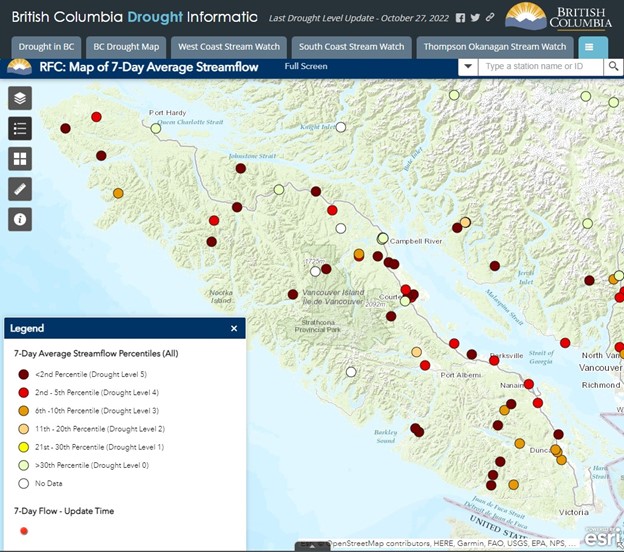
Some of the impacts that made the news are a state of emergency in three BC communities, salmon not able to spawn and dying when they tried, a failed wild mushroom harvest, trees and plants stressed or dying and a late-in-the-year increase in wildfires. BC Hydro also released a report about this year’s “driest and hottest extended periods on record” and the “near-record low water levels in river systems and some of BC Hydro’s smaller watersheds” (BC Hydro, 2022, p.1). This has included the watersheds with BC Hydro dams and generation on Vancouver Island, where I live. Figure 1 shows that for 23 of 52 streams monitored on Vancouver Island, the seven-day average streamflow percentiles were at drought Level 5. It is alarming for spawning salmon and the wildlife that rely on the salmon return, but it also raises concerns about electrical generation capacity at the dam sites.
Are these negative impacts related to climate change? Climate change is top of mind, considering the intensity and duration of the drought and the shift in the season. Fortunately, climate science can help us understand why these droughts and other unprecedented extreme climatic events are occurring with more frequency intensity and lasting longer.
Figure 1
Map of 7-Day Average Streamflow Vancouver Island – October 27, 2022
Climate science has found without a doubt that human-produced greenhouse gases accumulating in the atmosphere are causing rapid global warming (IPCC, 2021b, p.4). Also, warming and biodiversity loss are pushing the climate and planetary systems we depend on to their limit (Chen et al., 2021, p. 161). Recognizing this immense problem, world leaders signed the Paris Agreement in 2015. They agreed to keep the average global temperature rise by the end of the century well below 2oC above pre-industrial levels (1850-1900) and make efforts to keep warming to 1.5oC above pre-industrial levels (Chen et al., 2021, p. 150). Unfortunately, seven years later, the global average temperature is 1.09oC above pre-industrial levels and rising, with the expectation of hitting 1.5oC above pre-industrial before 2050 (Arias et al. 2021, p. 41 & 42).
Therefore, there is an urgent need for action to reduce greenhouse gas emissions, and the critical messages from climate science that pertain to decision-makers, Canadians and those of us pondering the impacts of this latest Level 5 drought are:
Every tonne matters – each additional tonne of CO₂ emissions adds to global warming (IPCC, 2021b, p. 28).
Every fraction of a degree matters – each increment or fraction degree of global warming increases the intensity and frequency of extreme events (IPCC, 2021b, p.18).
Extreme events will be unprecedented, even at 1.5oC of warming above pre-industrial levels (IPCC, 2021b, p.15).
Multiple extreme events happen simultaneously as warming continues, especially heat waves and droughts (IPCC, 2021b, p.25).
The rate of warming matters – the rate of warming increases the occurrence of extreme events (Fischer et al., 2021, p. 692), such as heat waves and droughts.
In summary, as greenhouse gas emissions increase, warming increases, which can cause multiple extreme events, such as heat waves and drought, to happen simultaneously. The faster the warming, the more record-shattering the event. In British Columbia, we are acutely aware that these events are not far off in the future but have already happened. Without substantive emissions reductions, we can expect frequent and extreme drought, heatwaves and wildfire season.
The challenge of our lifetime is to reduce our reliance on oil and gas, the primary source of human-caused greenhouse gas emissions (Arias et al., 2021, p.80). As Island Health Medical Health Officer Dr. Shannon Waters advises, “[t]he gravity of this situation necessitates a fundamental shift: We must place the well-being of our environment at the centre of all our decision-making” (Public Health Agency of Canada, 2022, p. 29). Stopping warming before reaching 2oC above pre-industrial levels is critical to avoid a climate with such hot extremes that a healthy life is not supported (Arias, 2021, p. 120). In addition, deep emissions cuts now would limit the rate of warming and exposure to unprecedented extreme events. In the meantime, until the climate is stabilized, we must also adapt and prepare for the changing climate.
To that end, the province of British Columbia completed a preliminary risk assessment in 2019. At that time, they assessed the impact of a Level 4 drought as high when it “affect[ed] two or more regions of the province and last[ed] two or more months” (BC Risk, 2019, p.40). The report noted that such a scenario could be considered extreme, with 2015 being a recent example. Unfortunately, that extreme was exceeded in 2021, with thirteen regions in BC reaching Level 4 drought for up to three months and four regions reaching Level 5 drought for up to two months (Management Branch, Ministry of Forest, 2022).
Figure 2
Drought Map of British Columbia as of October 27, 2022
Note: The brown areas represent the regions at Level 5 Drought and the red areas at Level 4. The areas comprising Vancouver Island and the lower mainland of BC (southwest portion of the map) showing Level 5 and 4 droughts are historically known for rain and a wet environment. From British Columbia Drought Info, by Management Branch, Ministry of Forests, Government of B.C, 2022. https://governmentofbc.maps.arcgis.com/apps/MapSeries/index.html?appid=838d533d8062411c820eef50b08f7ebc
The summer and fall of 2022 have also been exceptionally dry. As shown on the map in Figure 2 for 2022, the drought was not as long as 2021, but ten regions were in Level 5 drought for a month or more. This is unprecedented, extreme, and gravely concerning for communities whose watersheds are affected. To help communities adapt, the province of BC is funding a watershed security initiative that will work with Indigenous Peoples and various levels of government to collaborate on building healthy watersheds well into the future (B.C. Gov. News, 2022). In addition, the world, including BC, must grapple with its forestry practices that have decimated watersheds and impacted hydrological cycles, causing drought and flooding (Douville et al., 2021, p. 1057). Intact old-growth trees are an essential part of the hydrological cycle for the “wet” coast watersheds and must be retained and expanded (Wood, 2021, p.22). Thus, as the rains arrive, thoughts of drought cannot wash away. British Columbians must prepare for the next time, possibly as soon as next year.
Millstone River waterfall is a mere trickle rather than full and gushing with autumn rain and spawning salmon.
References
Arias, P.A., N. Bellouin, E. Coppola, R.G. Jones, G. Krinner, J. Marotzke, V. Naik, M.D. Palmer, G.-K. Plattner, J. Rogelj, M. Rojas, J. Sillmann, T. Storelvmo, P.W. Thorne, B. Trewin, K. Achuta Rao, B. Adhikary, R.P. Allan, K. Armour, . . . K. Zickfeld, (2021). Technical Summary. In Climate Change 2021: The Physical Science Basis. Contribution of Working Group I to the Sixth Assessment Report of the Intergovernmental Panel on Climate Change [Masson-Delmotte, V., P. Zhai, A. Pirani, S.L. Connors, C. Péan, S. Berger, N. Caud, Y. Chen, L. Goldfarb, M.I. Gomis, M. Huang, K. Leitzell, E. Lonnoy, J.B.R. Matthews, T.K. Maycock, T. Waterfield, O. Yelekçi, R. Yu, and B. Zhou (eds.)]. Cambridge University Press, Cambridge, United Kingdom and New York, NY, USA, pp. 33−144, https://doi:10.1017/978100915789
Chen, D., M. Rojas, B.H. Samset, K. Cobb, A. Diongue Niang, P. Edwards, S. Emori, S.H. Faria, E. Hawkins, P. Hope, P. Huybrechts, M. Meinshausen, S.K. Mustafa, G.-K. Plattner, and A.-M. Tréguier. (2021). Framing, Context, and Methods. In Climate Change 2021: The Physical Science Basis. Contribution of Working Group I to the Sixth Assessment Report of the Intergovernmental Panel on Climate Change [Masson-Delmotte, V., P. Zhai, A. Pirani, S.L., Connors, C. Péan, S. Berger, N. Caud, Y. Chen, L. Goldfarb, M.I. Gomis, M. Huang, K. Leitzell, E. Lonnoy, J.B.R., Matthews, T.K. Maycock, T. Waterfield, O. Yelekçi, R. Yu, and B. Zhou (eds.)]. Cambridge University Press, Cambridge, United Kingdom and New York, NY, USA, pp. 147–286, doi:10.1017/9781009157896.003.
Douville, H., K. Raghavan, J. Renwick, R.P. Allan, P.A. Arias, M. Barlow, R. Cerezo-Mota, A. Cherchi, T.Y. Gan, J. Gergis, D. Jiang, A. Khan, W. Pokam Mba, D. Rosenfeld, J. Tierney, and O. Zolina. (2021). Water Cycle Changes. In Climate Change 2021: The Physical Science Basis. Contribution of Working Group I to the Sixth Assessment Report of the Intergovernmental Panel on Climate Change [Masson-Delmotte, V., P. Zhai, A. Pirani, S.L. Connors, C. Péan, S. Berger, N. Caud, Y. Chen, L. Goldfarb, M.I. Gomis, M. Huang, K. Leitzell, E. Lonnoy, J.B.R. Matthews, T.K. Maycock, T. Waterfield, O. Yelekçi, R. Yu, and B. Zhou (eds.)]. Cambridge University Press, Cambridge, United Kingdom and New York, NY, USA, pp. 1055–1210, https://doi:10.1017/9781009157896.010
Fischer, E. M., Sippel, S., & Knutti, R. (2021). Increasing probability of record-shattering climate extremes. Nature Climate Change, 11(8), Article 8. https://doi.org/10.1038/s41558-021-01092-9
IPCC. (2021a). Annex VII: Glossary [Matthews, J.B.R., V. Möller, R. van Diemen, J.S. Fuglestvedt, V. Masson-Delmotte, C. Méndez, S. Semenov, A. Reisinger (eds.)]. In Climate Change 2021: The Physical Science Basis. Contribution of Working Group I to the Sixth Assessment Report of the Intergovernmental Panel on Climate Change [Masson-Delmotte, V., P. Zhai, A. Pirani, S.L. Connors, C. Péan, S. Berger, N. Caud, Y. Chen, L. Goldfarb, M.I. Gomis, M. Huang, K. Leitzell, E. Lonnoy, J.B.R. Matthews, T.K. Maycock, T. Waterfield, O. Yelekçi, R. Yu, and B. Zhou (eds.)]. Cambridge University Press, Cambridge, United Kingdom and New York, NY, USA, pp. 2215–2256. doi:10.1017/9781009157896.022
IPCC. (2021b). Summary for Policymakers. In: Climate Change 2021: The Physical Science Basis. Contribution of Working Group I to the Sixth Assessment Report of the Intergovernmental Panel on Climate Change [Masson-Delmotte, V., P. Zhai, A. Pirani, S.L. Connors, C. Péan, S. Berger, N. Caud, Y. Chen, L. Goldfarb, M.I. Gomis, M. Huang, K. Leitzell, E. Lonnoy, J.B.R. Matthews, T.K. Maycock, T. Waterfield, O. Yelekçi, R. Yu, and B. Zhou (eds.)]. Cambridge University Press, Cambridge, United Kingdom and New York, NY, USA, pp. 3−32, https://doi:10.1017/9781009157896.001
Seneviratne, S.I., X. Zhang, M. Adnan, W. Badi, C. Dereczynski, A. Di Luca, S. Ghosh, I. Iskandar, J. Kossin, S. Lewis, F. Otto, I. Pinto, M. Satoh, S.M. Vicente-Serrano, M. Wehner, and B. Zhou. (2021). Weather and Climate Extreme Events in a Changing Climate. In Climate Change 2021: The Physical Science Basis. Contribution of Working Group I to the Sixth Assessment Report of the Intergovernmental Panel on Climate Change [Masson-Delmotte, V., P. Zhai, A. Pirani, S.L. Connors, C. Péan, S. Berger, N. Caud, Y. Chen, L. Goldfarb, M.I. Gomis, M. Huang, K. Leitzell, E. Lonnoy, J.B.R. Matthews, T.K. Maycock, T. Waterfield, O. Yelekçi, R. Yu, and B. Zhou (eds.)]. Cambridge University Press, Cambridge, United Kingdom and New York, NY, USA, pp. 1513–1766, doi:10.1017/9781009157896.013.
When reading the Summary of Policy Makers (IPCC, 2021), the word unprecedented caught my attention. In Chapter 11, unprecedented is paired with extremes to convey human-induced climate impacts and the breadth and magnitude of the extremes to be expected from the impacts. Unprecedented extremes are “events not experienced in the past [and] will occur in the future in five different ways” (Seneviratne et al., 2021, p. 1610). FAQ 11.2 Figure 1 shows that an extreme event may be unprecedented when it is more extensive, occurs more frequently, happens in an unexpected location, or at a different time of year and in new combinations.
From: Seneviratne et al., 2021, p. 1610.
References
IPCC. (2021). Summary for Policymakers. In: Climate Change 2021: The Physical Science Basis. Contribution of Working Group I to the Sixth Assessment Report of the Intergovernmental Panel on Climate Change [Masson-Delmotte, V., P. Zhai, A. Pirani, S.L. Connors, C. Péan, S. Berger, N. Caud, Y. Chen, L. Goldfarb, M.I. Gomis, M. Huang, K. Leitzell, E. Lonnoy, J.B.R. Matthews, T.K. Maycock, T. Waterfield, O. Yelekçi, R. Yu, and B. Zhou (eds.)]. Cambridge University Press, Cambridge, United Kingdom and New York, NY, USA, pp. 3−32, https://doi:10.1017/9781009157896.001
Seneviratne, S.I., X. Zhang, M. Adnan, W. Badi, C. Dereczynski, A. Di Luca, S. Ghosh, I. Iskandar, J. Kossin, S. Lewis, F. Otto, I. Pinto, M. Satoh, S.M. Vicente-Serrano, M. Wehner, and B. Zhou. (2021). Weather and Climate Extreme Events in a Changing Climate. In Climate Change 2021: The Physical Science Basis. Contribution of Working Group I to the Sixth Assessment Report of the Intergovernmental Panel on Climate Change [Masson-Delmotte, V., P. Zhai, A. Pirani, S.L. Connors, C. Péan, S. Berger, N. Caud, Y. Chen, L. Goldfarb, M.I. Gomis, M. Huang, K. Leitzell, E. Lonnoy, J.B.R. Matthews, T.K. Maycock, T. Waterfield, O. Yelekçi, R. Yu, and B. Zhou (eds.)]. Cambridge University Press, Cambridge, United Kingdom and New York, NY, USA, pp. 1513–1766, doi:10.1017/9781009157896.013.
When I started reading IPCC reports, I became aware of the various type of droughts. The following is a brief description of the types. Also, a graphic showing the climate drivers of drought and a table showing the primary impacts from the different drought categories.
Drought
The primary contributing factor to drought is the lack of precipitation over a long enough period to cause severe hydrological impacts. See the Figure below for the climate drivers involved.
From: Douville et al., 2021
Meteorological drought
A persistent lack of precipitation over a long enough period causes a meteorological drought (Douville et al., 2021).
Hydrological drought
As the drought persists over time, water supply within soil, streams, lakes and reservoirs decreases(Douville et al., 2021). These can be widespread and affect many eco and social functions, as shown in Table 1 (Loon, 2015).
Agricultural drought
Agricultural drought occurs when soil moisture, due to a lack of precipitation and high atmospheric evaporation demand, becomes so abnormally low that the growing season and crop production are negatively affected (IPCC, 2021 & Douville et al., 2021).
Ecological drought
Like agricultural drought, abnormally low soil moisture affects land or terrestrial ecosystems, including forests (IPCC, 2021). Insufficient moisture in the total soil water column affects tree roots and their ability to transport water and impedes the carbon cycle, weakening and ultimately killing the tree (Seneviratne et al., 2021). The structure of the soil can be damaged as well.
Flash drought
Typically, droughts take time to develop; however, a flash drought can unexpectedly and rapidly evolve (Douville et al., 2021).
Megadrought
Megadrought is a drought that occurs over many years (Douville et al., 2021).
From: Van Loon, 2015.
References
Douville, H., K. Raghavan, J. Renwick, R.P. Allan, P.A. Arias, M. Barlow, R. Cerezo-Mota, A. Cherchi, T.Y. Gan, J. Gergis, D. Jiang, A. Khan, W. Pokam Mba, D. Rosenfeld, J. Tierney, and O. Zolina. (2021). Water Cycle Changes. In Climate Change 2021: The Physical Science Basis. Contribution of Working Group I to the Sixth Assessment Report of the Intergovernmental Panel on Climate Change [Masson-Delmotte, V., P. Zhai, A. Pirani, S.L. Connors, C. Péan, S. Berger, N. Caud, Y. Chen, L. Goldfarb, M.I. Gomis, M. Huang, K. Leitzell, E. Lonnoy, J.B.R. Matthews, T.K. Maycock, T. Waterfield, O. Yelekçi, R. Yu, and B. Zhou (eds.)]. Cambridge University Press, Cambridge, United Kingdom and New York, NY, USA, pp. 1055–1210, https://doi:10.1017/9781009157896.010.
IPCC. (2021). Annex VII: Glossary [Matthews, J.B.R., V. Möller, R. van Diemen, J.S. Fuglestvedt, V. MassonDelmotte, C. Méndez, S. Semenov, A. Reisinger (eds.)]. In Climate Change 2021: The Physical Science Basis. Contribution of Working Group I to the Sixth Assessment Report of the Intergovernmental Panel on Climate Change [Masson-Delmotte, V., P. Zhai, A. Pirani, S.L. Connors, C. Péan, S. Berger, N. Caud, Y. Chen, L. Goldfarb, M.I. Gomis, M. Huang, K. Leitzell, E. Lonnoy, J.B.R. Matthews, T.K. Maycock, T. Waterfield, O. Yelekçi, R. Yu, and B. Zhou (eds.)]. Cambridge University Press, Cambridge, United Kingdom and New York, NY, USA, pp. 2215–2256, https://doi:10.1017/9781009157896.022.
Seneviratne, S.I., X. Zhang, M. Adnan, W. Badi, C. Dereczynski, A. Di Luca, S. Ghosh, I. Iskandar, J. Kossin, S. Lewis, F. Otto, I. Pinto, M. Satoh, S.M. Vicente-Serrano, M. Wehner, and B. Zhou. (2021). Weather and Climate Extreme Events in a Changing Climate. In Climate Change 2021: The Physical Science Basis. Contribution of Working Group I to the Sixth Assessment Report of the Intergovernmental Panel on Climate Change. [Masson-Delmotte, V., P. Zhai, A. Pirani, S.L. Connors, C. Péan, S. Berger, N. Caud, Y. Chen, L. Goldfarb, M.I. Gomis, M. Huang, K. Leitzell, E. Lonnoy, J.B.R. Matthews, T.K. Maycock, T. Waterfield, O. Yelekçi, R. Yu, and B. Zhou (eds.)]. Cambridge University Press, Cambridge, United Kingdom and New York, NY, USA, pp. 1513–1766, https://doi:10.1017/9781009157896.013.
Van Loon, A.F., (2015, July/August). Hydrological drought explained. WIREs Water 2015, 2:359–392. doi: 10.1002/wat2.1085
A CBC article was selected to analyze its use of climate change communication evidence-based techniques. Communicating about climate change has been a complex enterprise for climate scientists as simply providing increasingly alarming information has not generated sufficient action to mitigate the damage done. What climate change communication research has found is there are evidence-based techniques that work well to engage an audience and others that do not. Analyzing the selected article for the evidence-based techniques will demonstrate what worked well, what did not and why. The article chosen for analysis is “What Canadians need to know about how climate change is affecting their health” (Bernstien, 2021). It is part of an initiative by CBC News called “Our Changing Planet.” This initiative intends to increase climate change coverage across the many segments of the corporation’s news and media resources, recognizing that climate change is more than an environmental story. The CBC pledges a “sustained journalistic focus and attention (climate change) deserve(s) at a time most experts describe as an inflection point for the planet” (Fenlon, 2021). This paper will determine if the focus CBC is giving climate change is also effective in engaging their audience.
To do the analysis, it is helpful to understand the target audience for the article. As a public broadcaster, the CBC is mandated by the 1991 Broadcast Act to provide programming at a national and regional level and be accessible to all Canadians (Branch, 2020). Based on the CBC’s annual report for 2020-2021, during a typical month, 78% of Canadians accessed one of CBC’s services (CBC/Radio Canada, 2021). Additionally, according to a 2018 Canadian Viewing Profiles report on CBC audiences, the demographics for all viewing types range from an average age of 37 for those that are predominately online to 61 years old for those who predominantly view television (Media Technology Monitor, 2018). Therefore, climate change articles from the national CBC News department need to have a broad appeal and engage the public across all audience viewpoints as defined by the “Global Warming’s Six America’s” (see Table 1.0 below), where views range from alarmed to dismissive about climate change (Maibach et al., 2011). Further, because of the commitment to the “Our Changing Planet” initiative, the article should demonstrate evidence-based climate change communication techniques to ensure the message engages the public and encourages dialogue. Considering the intended audience and the need for broad appeal, climate change communication research points to a few techniques demonstrated in this article and some that could have been used for better effect.
Table 1.0
“Global Warming’s Six America’s”Audience Type
Global Warming’s Six America’s
Alarmed
Concerned
Cautious
Disengaged
Doubtful
Dismissive
Description of belief in Global Warming
Highest belief, concern, and motivation
Highest belief, concern, and motivation
Many are members of vulnerable communities.
Lowest belief, motivation, or concern
Lowest belief, motivation, or concern
What audience is interested in knowing
What can be done to reduce global warming?
What can be done to reduce global warming?
What harm will global warming cause?
What harm will global warming cause?
Want proof that global warming is occurring.
Want proof that global warming is occurring.
(Maibach et al., 2011, p.16-17)
This article demonstrates several evidence-based climate change communication techniques, including highlighting the scientific consensus. It claims to be based on the 2021 Lancet Countdown, an annual report on health and climate change and is the work “of 93 authors, including climate scientists, economists, public health experts and political scientists” (Bernstien, 2021, p. 2). Highlighting the scientific consensus in developing the Lancet report demonstrates to readers that there is a high level of agreement regarding the data. Surveys have shown that people are unaware of how many scientists agree with the data on climate change and that “highlighting consensus can be an effective means to counter misinformation and raise public awareness” (Lewandowsky, 2021, p. 1).
Another evidence-based climate change communication technique in the article is making it local. Most people are unaware of how climate change impacts them locally and think it is a serious problem but believe it is affecting other people in other places or people in the future (Maibach et al., 2011 & Bennett et al., 2021). As the Lancet Countdown is a technical report for the entire world, the article focuses on information specific to Canada to help Canadians understand local impacts and how they will be affected. The author used the example of the 2021 heat dome in British Columbia to discuss the effects of extreme heat, the 2021 impact of forest fire on Lytton, B.C. and the Lytton First Nations and the 2021 drought impact on farmers in Alberta and Saskatchewan. This lets readers understand that the impacts are already occurring in many places simultaneously within Canada.
The article’s title implies it will tell Canadians how climate change affects their health and therefore is an opportunity to frame climate change as a health issue. Given that health impacts everyone, the article should have a broad appeal and catch the attention of more Canadians than those specifically interested in environmental issues (Maibach et al., 2011). Discussing the health harms that occur from not acting on climate change and the health benefits realized from acting helps to answer the question of how climate change affects the individual (Maibach et al., 2011). Climate change is a complex issue, and it is difficult for people to understand what effects it will have on them. Helping people understand the health impacts the changing environment will have on them connects them to the more complex issue of climate change and that solutions to climate change can benefit their health (Maibach et al., 2011). Although some of the health impacts of extreme heat were described in the article, it did not provide any actions for the reader to take to reduce their risk and likely left them feeling overwhelmed and fearful.
Evidence shows that providing a fearful message and describing the challenge does not lead people to support climate action. They need the connections made to the solutions and the benefits from implementing solutions to remain engaged (Bennett et al., 2021). To keep audiences engaged and help them assimilate the fearful messaging about climate change impacts, Bennett et al. (2021) recommend using a message triangle “to deliver a story that sticks” (p. 2). A message triangle includes three elements; defining the challenge in clear, simple language, presenting the pathway or actions that can be taken to mitigate and adapt to the challenge, and describing the benefits derived from acting. Interestingly the article did not provide any information on pathways to alleviate the problem or the benefits that could be derived from implementing the pathways.
The fearful messages within the article include worsening health impacts, Canada’s failure to develop sufficient mitigation strategies, details of the 2021 deadly heat wave in B.C., impacts from wildfires on First Nations and frequent drought hurting farmers. These messages are likely to elicit fearful emotion in the audience, who consequently may react by rejecting or disengaging from the subject (Hine et al., 2016). Howarth et al. (2020) argue “frightening messages need be to be made personal and manageable and need to present clear solutions to remove the threat” (p. 322). Unfortunately, as noted above, solutions were not provided, not even links to stories about pathways and benefits, which could have provided the reader with some hope. To be fair, the Lancet report does not offer much in the way of pathways or benefits either. However, the Lancet Countdown Policy Brief for Canada does quote the IPCC report that “underscores every fraction of a degree of warming avoided provides critical protection”(Hackett et al., 2021, p. 2). It also promotes the co-benefits of increasing and preserving green space (Hackett et al., 2021). These points were not used in the article.
As noted previously, the Lancet Countdown report is a technical document and is not easily understood. Therefore, to make the story more relatable to the audience, the author of the CBC article used narrative and visual images. The narrative used in the article tells how the impacts of drought and diminishing crop yields affect Prairie farmers. The story is relayed by the director of climate crisis policy and action at the National Farmers Union. Using a local expert’s narrative brings credibility to the claims made by the science (Howarth et al., 2020). Also, “narratives help increase (the) connection between people and give meaning to certain issues, and they enable audiences to make sense of complex issues” (Howarth et al., 2020, p. 323). This was the most relatable part of the article due to the story being told from a local stakeholder’s perspective and the image of the farmer in his fields over two years.
Interestingly, although using images is an evidence-based climate change communication technique, research finds they must be used with care. For example, the farmer in his field, one year lush and green and the following year dry and sparse, does not demonstrate a long-term climate trend, as the Prairies have a history of these types of weather patterns, so it could be misleading (Lewandowsky, 2021). However, researchers also note the “depiction of credible, authentic human subjects have been found to evoke greater concern and motivation to act” (Wang et al., 2018, p. 6). Adding information in the caption about the long-term drought trend expected in the region could help to avoid confusion for those that only look at images and do not read the article. Another compelling image depicts extreme heat impacts by showing a man in shorts packing large water bottles as he walks through a cooling sprinkler. This picture evokes the seriousness of the climate impact on a real person straining to cope with the extreme situation. Such images connect with the reader emotionally and can result in readers feeling “greater concern and motivation to act” (Wang et al., 2018, p. 6).
There are also images in the article that climate communication researchers find are less effective such as a photo of the devastation after the Lytton fire and a picture of climate activist Greta Thunberg. Researchers have found that images of protesters or celebrities do not effectively engage audiences. They can be seen as distant or removed from the audience’s experience and may only resonate with other activists (Wang et al., 2018). The image of Greta may have been included to appeal to younger followers who also need to be engaged. Images of devastation, such as the Lytton, B.C. fire picture, have similar effects as fearful messages and must be accompanied by mitigating actions or solutions (Wang et al., 2018). Researchers have found that “images of distant climate impacts produced flatter emotional responses among those on the political right than the left, whereas solutions images produced positive emotions for both sides” (Wang et al., 2018, p. 8). The CBC article did not provide any solutions images or stories; therefore, the images would be considered ineffective based on climate change communication research. In contrast, the two images of people and the narrative about the drought are examples of effectively using evidence-based climate change communication techniques to deliver the message.
The CBC article was supposed to tell readers how climate change affects Canadian health but only talked about the health impacts of extreme heat and ended up straying from a health focus to talking about the growth of emissions, the impact of wildfire on Indigenous people, and the frequency of drought in the Prairies. The result is a fearful message without any solutions provided or mention of benefits from adopting solutions. Researchers have found that using fear to communicate about climate change is ineffective. As discussed above, “presenting frightening content about threats like climate change elicits fear control processing which leads audiences to disengage or reject threatening messages in an attempt to manage fears” (Hine et al., 2016). Researchers have found that providing applicable and relatable advice about managing the threat “leads people to seek out additional information and develop strategies to reduce or eliminate the threat”(Hine et al., 2016). Hopefully, all climate change communication aims to motivate people to take action to reduce the threat.
Had the article stayed with the intended premise stated in the title and focused on what Canadians need to know about health, there might have been an opportunity to write about some of the climate mitigation solutions and associated health benefits. What the article did do, was focus on many fearful impacts and issues related to climate change. This misses the opportunity to let the readers know what they need to do to prevent their demise or reduce the mental health impacts, such as increasing green space to reduce the heat island effect. This is a solution mentioned in the Canadian policy document supporting the Lancet Countdown report (Hackett et al., 2021). Increasing green space can positively impact people’s mental health, and when a solution is offered that also has benefits, it can lead to more engagement on the topic (Maibach et al., 2011). What the article did well from a climate change communication perspective was highlighting the scientific consensus (Lewandowsky, 2021), localizing the issues (Maibach et al., 2011), and using narrative, albeit the narrative did not talk about health (Howarth et al., 2020). Following a framework such as a message triangle (i.e., challenges, solutions, benefits) has research to support its effectiveness so that climate change communication can motivate the audience (Bennett et al., 2021). In the future, the CBC “Our Changing Planet” initiative, the Lancet Countdown Report and the Canadian Policy report derived from it must consider evidence-based climate change communication to create impactful messages that Canadians will heed.
Hine, D. W., Phillips, W. J., Cooksey, R., Reser, J. P., Nunn, P., Marks, A. D. G., Loi, N. M., & Watt, S. E. (2016). Preaching to different choirs: How to motivate dismissive, uncommitted, and alarmed audiences to adapt to climate change? Global Environmental Change, 36, 1–11. https://doi.org/10.1016/j.gloenvcha.2015.11.002
Howarth, C., Parsons, L., & Thew, H. (2020). Effectively Communicating Climate Science beyond Academia: Harnessing the Heterogeneity of Climate Knowledge. One Earth 2(4), 320-324. https:/doi.org/10.1016/j.oneear.2020.04.01
Maibach, E., Matthew, N.,& Weather, M., (2011) Conveying the Human Implications of Climate Change – A Climate Change Communication Primer for Public Health Professionals. Fairfax, VA: George Mason University Center for Climate Change Communication.
Romanello, M., McGushin, A., Di Napoli, C., Drummond, P., Hughes, N., Jamart, L., Kennard, H., Lampard, P., Solano Rodriguez, B., Arnell, N., Ayeb-Karlsson, S., Belesova, K., Cai, W., Campbell-Lendrum, D., Capstick, S., Chambers, J., Chu, L., Ciampi, L., Dalin, C., … Hamilton, I. (2021). The 2021 report of the Lancet Countdown on health and climate change: Code red for a healthy future. The Lancet, 398(10311), 1619–1662. https://doi.org/10.1016/S0140-6736(21)01787-6
Wang, S., Corner, A., Chapman, D., & Markowitz, E. (2018). Public engagement with climate imagery in a changing digital landscape. WIREs Climate Change, 9(2), e509. https://doi.org/10.1002/wcc.509
Climate change is a complex, pervasive and unprecedented challenge facing all living beings and ecosystems (IPCC, 2022). During MACAL 502 Climate Communications course, I have found that communicating about climate change is as challenging as achieving emissions reduction targets and attaining the necessary adaptation of mindsets, society, and infrastructure. At the very least, I have learnt that providing alarming scientific facts about future events will not spur sufficient action and can cause psychological paralysis, distancing, indifference, or apathy. In addition, and worse, there has been a concentrated, well-funded effort to oppose the science and emissions reduction efforts by those who fear that emissions reduction will impede the growth of their industry (Lewandowsky, 2021; Treen, 2020). If this is not enough of a challenge, different audiences react differently to the information provided and how it is communicated (Hine, 2016). As Howarth et al. (2020) point out, “The choices people make will be guided by government regulations, social practices, and individual decisions, all of which will be shaped by the availability of information and how it is communicated”(p. 320). Fortunately, the science of climate change communications has been developed in a relatively short time and offers insights into what has worked and what might work going forward (Moser, 2016). I am grateful to have been introduced to this body of work that can help me be more effective in my communications. Now, as I write or talk about climate change, I am thinking about the emotions fearful messages create in myself and others, as well as the worldviews and values of the audience, and looking for optimal ways to deliver a message that can effectively motivate positive action.
As I struggle to maintain my sense of hope with the slowness and tepidness of government actions, I have learnt that the perceived lack of action and the complexity of the issue can impact individuals’ willingness (or motivation) to act and increase fear, anxiety, and apathy (Moser, 2016; O’Neill & Nicholson-Cole, 2009). This was brought home to me when I mentioned climate change in a recent conversation with my daughter. She asked why I always talk about climate change, a topic she finds “so depressing”. As a young person, she is not alone in this feeling. A Lancet Medical Journal survey of 10,000 youth on climate anxiety found that 75% think the future is frightening, and 50% felt several negative emotions, including powerlessness and hopelessness (Hickman et al., 2021). In their discussion of the failure of government and those in power to act, the authors are scathing, claiming that “[s]ubjecting young people to climate anxiety and moral injury can be regarded as cruel, inhuman, degrading or even torturous” (Hickman et al., 2021, p. 9). This is also important to consider when delivering climate news. Climate communications researchers found that framing climate change sensationally when communicating with students increased perceptions of risk compared to those reading neutral information (Schuldt et al., 2018). Sensational messages also elicited “stronger negative emotions toward climate change” (Schuldt et al., 2018, p.61). As noted, fearful messages can cause psychological distancing; however, this can be minimized by including a pathway or solution for the audience to deal with the threat (Howarth et al., 2020). I also need to recognize my reaction to fearful or sensational messages as well as the reaction of others so that I can be empathic to the audience and reframe the message to include a pathway forward whenever possible.
Paths forwards can include encouraging audiences to be aware of their mindset. Mary AnnaÏse Heglar’s blog post, Home is Always Worth It (2019), captures her feelings of shock and hopelessness when confronted with bleak and dire proclamations for the future. However, she quite pragmatically points out that we have “no time for nihilism” and that “we can recognize that hopelessness does not mean helplessness”(Heglar, 2019). Similarly, Hannah Richie, in her article Stop Telling Kids They’ll Die From Climate Change notes that she needed a change in mindset (Richie, 2021). She reframes her thinking by acknowledging that the world is slowly moving to lower carbon options and that “we need a new message for climate change … that drives action through optimism” (Richie, 2021). Although I recognize the necessity to acknowledge the feelings of hopelessness, I want to find ways to motivate climate action. To this end, I have looked for ways to include solutions, pathways, and benefits from implementing the solutions in my communications. Thinking about the benefit triangle (Figure 1) has been practical and helpful in achieving this.
Figure 1
Benefit Triangle
Note. The Benefit Triangle is a helpful tool. From: (Bennett, 2021, p. 2).
In Climate Messaging that Works, Bennett et al. (2021) found that when communicating about a challenge, it is effective to connect solutions and benefits with the challenge being communicated. Hence the Benefit Triangle. The authors note that the benefit triangle “allows you to keep things simple amidst all the noise — to connect the dots between what people care about and what can be done” (Bennett et al., 2021, p. 2). The next time the topic of climate change came up between my daughter and me, it was in a conversation about flooding from a local river. I mentioned the municipality’s commitment to restoring the riverbanks as a means of adaptation. This nature-based solution allows nature to provide the infrastructure and many other benefits for the environment instead of a single-purpose retaining wall. This time the message was received with interest. She could see the benefit of this pathway as it improved an essential and valued watershed.
Bennett et al. advise climate communicators to “[h]one in on the benefits of climate action most relevant to audiences by talking about what will improve for their lives … or other things they care about”(p. 3). Taking this to heart, I recently developed the blog post, Nanaimo citizen’s climate action story gallery, which showcased friends and family taking positive climate action measures. The post also incorporated images and audio and was written to assist those with visual impairments and cognitive challenges. Actions featured in the blog ranged from starting a seed library to cycling for transportation to installing heat pumps and solar systems. While the actions reflect the individuals’ interests, ages, and access to capital, each action contributes to emissions reduction, health and well-being and community building. Using narrative was a new and previously untried approach for me. I found that doing the research and writing was a positive personal experience and, to my surprise, gave me hope.
MACAL 502 included readings about Indigenous Knowledge Keepers, which has stretched my thinking, world view and understanding in new and improved ways. Understanding or at least having an inkling of Indigenous knowledge offers an insightful approach to climate change communications and validates my innate connection to nature. Through this learning, I have come to understand that climate change is a symptom of colonialism and capitalism that has separated humans from being connected to nature (Kimmerer, 2013; Whyte, 2017). In writing about the Indigenous Knowledge Keepers who attended the Onjisay Aki International Climate Summit, Cameron et al. (2021) share the Elders’ insights regarding climate change. The Elders at the summit suggested that solving greenhouse gas emissions with technical fixes will not work without going deeper and finding the underlying cause of the problem(Cameron et al., 2021). Understanding the underlying causes resonates with me as a way to understand why those in power and many others are threatened and dismissive of climate action.
The Elders identified the core of the problem as self-centred human values such as greed, arrogance, and domination, which lead to destructive behaviours and actions such as extraction and exploitation (Cameron et al., 2021). Ultimately these actions result in climate change, biodiversity loss and other impacts on the ecosystem. Although these consequences are devastating, the Knowledge Keepers generously offer a way forward that includes “Indigenous peoples reclaim[ing] positions of leadership to help guide humanity in returning to a way of life in balance with the Earth’s limit and laws”( p. 8). We can look at the root cause of climate change as “a deeply human story about the relationality between humans and the planet” (p. 16). As Robin Kimmerer (2013) notes, “we are deluged by information regarding our destruction of the world and hear almost nothing about how to nurture it” (p. 327). Therefore, as a white settler who is sometimes overwhelmed by the grief and magnitude of the climate change message, I can remind myself of the necessity to tell stories with nurturing in mind and look for opportunities to communicate about reconciliation, reconnection with nature and living in reciprocity with the natural environment.
I am grateful for having had the opportunity to delve into the research and science of climate change communications. Studying climate change communications may be a science but applying it is an art. I say this because to be effective I need to understand people’s emotional responses, values and mindsets and appeal to them to consider other ways of seeing or being in the world. I may have intuitively understood some of this in the past, but now I can look to climate change communications science for tools and research to help me be effective. Going forward, I will use the benefit triangle, increase my narrative and storytelling skills, promote a deeper connection to nature and look to the wisdom of the Indigenous peoples. In addition, my future writings will include using message frames, careful use of imagery and icons and maybe other forms of media beyond the blog.
Cameron, L., Courchene, D., Ijaz, S., & Mauro, I. (2021). ‘A change of heart’: Indigenous perspectives from the Onjisay Aki Summit on climate change. Climatic Change, 164(3), 43. https://doi.org/10.1007/s10584-021-03000-8
Hickman, C., Marks, E., Pihkala, P., Clayton, S., Lewandowski, R. E., Mayall, E. E., Wray, B., Mellor, C., & van Susteren, L. (2021). Climate anxiety in children and young people and their beliefs about government responses to climate change: A global survey. The Lancet Planetary Health, 5(12), e863–e873. https://doi.org/10.1016/S2542-5196(21)00278-3
Hine, D. W., Phillips, W. J., Cooksey, R., Reser, J. P., Nunn, P., Marks, A. D. G., Loi, N. M., & Watt, S. E. (2016). Preaching to different choirs: How to motivate dismissive, uncommitted, and alarmed audiences to adapt to climate change? Global Environmental Change, pp. 36, 1–11. https://doi.org/10.1016/j.gloenvcha.2015.11.002
Howarth, C., Parsons, L., & Thew, H. (2020). Effectively Communicating Climate Science beyond Academia: Harnessing the Heterogeneity of Climate Knowledge. One Earth 2(4), 320–324. https:/doi.org/10.1016/j.oneear.2020.04.01
IPCC, (2022). Summary for Policymakers [H.-O. Pörtner, D.C. Roberts, E.S. Poloczanska, K. Mintenbeck, M. Tignor, A. Alegría, M. Craig, S. Langsdorf, S. Löschke, V. Möller, A. Okem (eds.)]. In: Climate Change 2022: Impacts, Adaptation and Vulnerability. Contribution of Working Group II to the Sixth Assessment Report of the Intergovernmental Panel on Climate Change [H.-O. Pörtner, D.C. Roberts, M. Tignor, E.S. Poloczanska, K. Mintenbeck, A. Alegría, M. Craig, S. Langsdorf, S. Löschke, V. Möller, A. Okem, B. Rama (eds.)]. Cambridge University Press, Cambridge, UK and New York, NY, USA, pp. 3–33, doi:10.1017/9781009325844.001.
Moser, S. C. (2016). Reflections on climate change communication research and practice in the second decade of the 21st century: What more is there to say? WIREs Climate Change, 7(3), 345–369. https://doi.org/10.1002/wcc.403
Schuldt, J.P., Krasny, M.E., & Armstrong, A.K. (2018). Communicating Climate Change: A Guide for Educators. Ithaca: Cornell University Press., http://doi.org/10.1353/book.68536.
Treen, K. M. d’I., Williams, H. T. P., & O’Neill, S. J. (2020). Online misinformation about climate change. WIREs Climate Change, 11(5), e665. https://doi.org/10.1002/wcc.665
Whyte, K. (2017). Indigenous Climate Change Studies: Indigenizing Futures, Decolonizing the Anthropocene. English Language Notes, 55(1–2), pp. 153–162. https://doi.org/10.1215/00138282-55.1-2.153
Mainstreaming is one of the core competencies of a climate action leader, as identified in the Climate Adaptation Competency Framework within the domain of “Climate Adaptation Planning & Implementation” (Cox et al., 2021). It is a strategy used to integrate climate action within an organization or across a sector with the intention to include climate action in “all objectives and decisions across programs, projects, operations, policies, procedures, financing and training” (Cox et al., 2021). To develop a further understanding of mainstreaming, the following three paragraphs summarize research papers on the topic. The papers were selected as they provided variety in research methodology and date of publication. The first paper is a meta-analysis of peer-reviewed research on mainstreaming, thereby giving a broad perspective and providing an analytical framework that could be used for future research. The second paper is a case study of five municipalities in Norway to understand what drives mainstreaming. This paper was one of the papers cited in the meta-analysis and provided foundational information to that work. The final and third paper is also a case study of a municipality in Ireland just published this year differing from the other case studies in that the lead author worked for the municipality. It provides a recent example of mainstreaming in action. The primary theme coming from all three papers was the need for a strong mandate and adequate resources to support mainstreaming.
Article 1 – Summary of Mainstreaming climate adaptation: taking stock of “what works” from empirical research worldwide
In the article Mainstreaming climate adaptation: taking stock about “what works” from empirical research worldwide Runhaar et al. (2017) assess existing peer-reviewed literature to identify: what mainstreaming has achieved and how; what the differences are “between policy sectors and countries” (p.1202); and what the critical factors are that makes mainstreaming effective. Runhaar et al. found that climate adaptation mainstreaming has different meanings to different authors. Therefore, their research used four of the five mainstreaming strategies identified by Wamsler and Pauleit (2016, as cited in Runhaar et al., 2017): managerial mainstreaming, intra – and inter-organizational mainstreaming, regulatory mainstreaming, and directed mainstreaming. Similarly, the authors could not find agreement in the literature on what mainstreaming should achieve or how it is measured, so they looked at policy outputs and outcomes to assess effectiveness (cf. Persson 2007; Jordan and Lenschow 2008, as cited in Runhaar et al., 2017). Their analytical framework also includes policy output effectiveness to determine how well the adaptation measures worked. To evaluate policy output effectiveness, Runhaar et al. looked at the drivers and the barriers identified in previous studies and came up with six categories for their evaluation.
This paper provides insights relevant to the mainstreaming competency that is part of the Climate Adaptation Competency Framework developed by Cox et al. (2021). It identifies what has worked and what has failed and develops a framework to assess adaptation mainstreaming. In terms of what works, their results show the main drivers are political will backed up with financial incentives, external cooperation, work of a policy entrepreneur, and focusing events (though only for a short duration after the event). Barriers are many, with the dominant ones affecting implementation being organizational and managerial structures that impede collaboration and lack climate adaptation mainstreaming as a clear priority or mandate. In the literature reviewed, the authors found that without adequate support from the top, mainstreaming becomes a voluntary activity with numerous implementation barriers. To achieve climate change adaptation implementation, the researchers identify the need for strict requirements or mandates that support mainstreaming. This will provide the impetus for all governments and organizations to climate adapt their sectors. Not surprisingly, there needs to be sufficient funding and staff resources to achieve mainstreaming effectively.
Article 2 – Summary of Mainstreaming climate change adaptation at the local level
Mainstreaming climate change adaptation at the local level is an examination of mainstreaming in five municipalities in Norway. Researchers, Rauken et al. (2015) seek to determine what drives mainstreaming and provide an explanation of why different approaches are used. Additionally, as the five municipalities have similar organization and management traits to other western communities, the study may provide a more comprehensive understanding of adaptation mainstreaming challenges in these settings. Conducting the examination included a literature review focused on the integration of policy and the origins of mainstreaming to provide the framework for evaluation. Rauken et al. determined they would use three aspects of mainstreaming to assess the various approaches the municipalities used or did not use. The aspects are comprehensiveness, aggregation, and consistency. A demonstration of comprehensiveness occurs when there is an awareness of the need to adapt, when strategic decisions reflect concern about climate change adaptation, and when climate change adaptation is integrated into related policy fields. Aggregation is demonstrated when climate change adaptation is assessed from an overall perspective rather than from a single sector perspective through a joint approach. Lastly, consistency is demonstrated when climate change adaptation has a connection to other policies and conflicting policy issues are addressed across policy fields (Rauken et al., 2015). Rauken et al. also argue that mainstreaming requires both vertical and horizontal approaches to achieve all three aspects of mainstreaming.
Rauken et al. (2015) findings provide a view into mainstreaming in action and a framework for assessing an organization’s use of mainstreaming. Results for each community are summarized in Table 1 from the study to compare the type of integration used, and what aspects of mainstreaming were achieved.
Table 1
Comparison of integration, approach and effectiveness of mainstreaming
Notes: Rauken et al. (2015) p. 415.
Direct quotes from the study participants provide context about their attitudes regarding the need and urgency for climate adaptation and how the flow of information may or may not be working. Interestingly the municipality that used vertical integration achieved the most climate change adaptation measures implemented but only in specific departments directly impacted by climate change. They did not intend to go beyond this action to have a cross-sectoral comprehensive climate change policy. The two larger municipalities in the study had more political focus on climate adaptation. This empowered the communities to use cross-sectoral groups and horizontal integration, resulting in steps towards comprehensiveness, aggregation, and consistency. Interestingly the community that used vertical integration had little political attention as there was a climate skeptic at the top leadership level.
The results also showed that the more resources invested, the more attention was paid, resulting in a higher level of comprehensiveness. Of interest, Rauken et al. (2015) surmise that a vertical integration approach could be helpful if there is a lack of political support or resources to achieve comprehensive mainstreaming as a first step to getting critical adaptation measures in place. However, the legitimacy created through the effort to attain cross-sector involvement may provide more action in the long run.
Article 3 – Summary of Mainstreaming Climate Change Adaptation into Planning and Development: A Case Study in Northern Ireland
Mainstreaming Climate Change Adaptation into Planning and Development: A Case Study in Northern Ireland provides an inside look at mainstreaming in action. Authors Burns et al. (2022) use five key factors to assess mainstreaming implementation. The factors were identified by the World Resources Institute (Mogelaard et al., 2018, as cited in Burns et al., 2022) and are the following: “(1) strong policy frameworks; (2) sustained and persistent leadership; (3) coordination mechanisms across sectors and between government departments; (4) information and tools; and (5) supportive financial processes” (p 130). Of equal interest to the assessment is how a small team successfully championed climate adaptation planning from within the city and district council. They were able to scale up to a dedicated task force encompassing all service areas after their recommendations received support and funding. Although there was no legislative requirement for the city to mainstream climate adaptation, the European Union provided funding and staffing resources to facilitate the process. Recent flooding events increased the public concern regarding climate change and brought to light that managing the risks is a moral obligation of local governments. There is also a recognition of the cross-dependencies within the region and the need for those sectors to adapt. This background information is of value as it provides the context and the organizational structures that facilitate mainstreaming at the local level.
This case study provides a detailed step-by-step process for the development and approval of the communities Climate Change Adaptation Plan. The overview of the five steps and the summary of each step’s actions shows mainstreaming was used during steps three and four. Step three involved one-to-one meetings and workshops that led to the strategic direction and agreed-upon priorities for the plan. Step four was the next phase of development and approval by a committee of elected officials via a consultation process with all directorates. A visual of the process of cross-cutting actions and the integration of the city and district’s functions is provided in Figure 1 from the study and demonstrates the effectiveness of mainstreaming and integration into policies.
Figure 1
Thematic priorities of the climate adaptation plan
Note: From Burns et al. (2022) p. 140. Creative Commons Attribution 4.0 International License (http://creativecommons.org/licenses/by/4.0/)
For example, they decided to screen all existing and emerging policies and all committee reports to ensure services are climate resilient. The other steps provide the groundwork for steps three and four, including adding climate change to the risk register and working with the finance department to identify budget requirements for adaptation work. The overview provided in Table 1 summarizes the actions taken for each step.
Table 1
Overview of action steps to mainstream climate adaptation plan
Note: From Burns et al. (2022) p. 139. Creative Commons Attribution 4.0 International License (http://creativecommons.org/licenses/by/4.0/)
Reflecting on the lessons learned, Burns et al. (2022) acknowledge the significant amount of engagement and communication of risks necessary to garner the support of colleagues and, therefore, the challenge of using mainstreaming for integrating climate change adaptation within local governments.
References
Burns, C., Flood, S., O’Dwyer, B. (2022). Mainstreaming Climate Change Adaptation into Planning and Development: A Case Study in Northern Ireland. In: S. Flood, Y. Jerez Columbié, M. Le Tissier & B. O’Dwyer (Eds.), Creating Resilient Futures. (pp. 129-147) Palgrave Macmillan, Cham. https://doi.org/10.1007/978-3-030-80791-7_7
Rauken, T., Mydske, P.K., Winsvold, M. (2015). Mainstreaming climate change adaptation at the local level. Local Environment, 20(4), 408-423. http://dx.doi.org/10.1080/13549839.2014.880412
Runhaar, H., Wilk, B., Persson, A., Uittenbroek, C., & Wamsler, C. (2017). Mainstreaming climate adaptation: taking stock of “what works” from empirical research worldwide. Regional Environmental Change, 18, 1201-1210. https://doi.org/10.1007/s10113-017-1259-5
Today, June 21, 2042, it has been ten years since my household achieved net zero carbon emissions. Even better, many of my neighbours have done the same thing or are close to doing so. Impressively, that is eight years before Canada will achieve the same target. I say “will” because the federal and provincial governments finally quit messing around and started taking serious steps to achieve the targets they set in the 2020s. This has moved Canada from being a climate change laggard to a leader in reducing emissions (Zimonjic, 2021).
Twenty years ago, people might have asked what it means to be net zero? But as most people now know, it means quitting emitting. That is, no more fossil fuel burning for household heat or transportation, and eliminating, as often as possible, products that require fossil fuels for their production. Also, it means no more methane-producing garbage or eating animals that create high emissions (Milman, 2021). Cow burps producing methane are just part of the problem.
How to get rid of emissions
For any emissions I create in a year, or when I build or renovate, I offset them with the excess clean electricity I put into the grid (more on that later) and what is growing in my yard. If more offsets are required to achieve net zero for the year, that is achieved by planting trees (Allen, 2021). As it stands now, there is no room left in my yard for trees. It is full! Fortunately, many First Nations have been able to sell carbon offsets because of the sequestered carbon in the forests they manage (Coastal First Nations, 2010). This helps us get to net zero and provides the First Nations with revenue from conservation.
Growing Forests Back Through Planting to Offset Emissions
As pleased as I am to be net zero, I could not have done this alone. Nor would I have wanted to. Achieving a goal like this is only meaningful and possible if others work toward the same purpose. That includes my neighbours, governments, corporations, and even the power-hungry plutocrats (Monbiot, 2022). When the neighbourhood decided to do this as a collective, we had more influence in getting help from the politicians and local businesses. Other neighbourhoods were also inspired and started their own green collectives. Renters got landlords to support tree planting and community gardens so that they could also benefit from the shade and access to fresh food.
At first, it was a challenge to change our homes and transportation methods, as well as to think about what we buy and how it is disposed of. Thankfully forward-thinking governments provided policies and incentives to help. Good governments that work for the people do make a difference. We all took advantage of and benefited from the federal government’s Greener Homes program, the provincial government’s CleanBC program, and the City of Nanaimo’s 2022 ReImagine Nanaimo City Plan. Over time the governments built on these plans to help citizens transition to greener living.
Greening the neighbourhood made us healthier
We found that greenhouse gas emissions were like a nasty virus that kept cropping up in different things and was often part of the mix of pollutants harmful to our health and planet (Chaisson, 2019). As it was when our neighbourhood collective started on the path to net zero, we did not know how much our health would benefit from our efforts (Kingsley, 2019). According to government statistics, our neighbourhood has fewer mental health problems, higher physical fitness rates, better cognitive function, and less overall sickness. We are happy, get along with each other and most importantly, look out for each other. Apparently, this has helped us to live longer.
Not surprisingly, these neighbourhood statistics have caught the interest of researchers. Unfortunately, other communities have seen a decline in health. Most are the ones that continued with the old high emissions lifestyle (National Institute of Environmental Health Sciences, 2022) and relied on the fossil fuel industries’ claims about technology to remove the emissions from the atmosphere. Sadly, the health and social problems overwhelm their health care, mental health, and social support systems. Our neighbourhood’s healthy lifestyle has the researchers calling our neighbourhood the Green Zone. That is a nod to the Blue Zones communities researchers studied in the early 2000s, where people live healthily and happily beyond 100 years of age (Buettner & Skemp, 2016). They want to find out what we have done so it can be replicated in other neighbourhoods.
Can Growing Pumpkins in the Front Yard Grow Community?
Plants and gardens are more than pretty to look at
What got the collective started, I think, was growing pumpkins in the front yard. Aside from being a great way to keep the soil cool with all the foliage and providing food for fall and winter, growing pumpkins is a great conversation starter. Neighbours and passersby would stop and ask about the pumpkins, and toddlers would pat them. They then started to notice the blueberry hedge and the garlic tucked in amongst the lavender and asters. Other keen neighbourhood gardeners ditched their grass lawns for shrubs, pollinator flowers, fruit and nut trees, edible plants, and berries. Soon the bees were buzzing and birds flocking to the welcoming environment. To the delight of all there were surpluses resulting in a neighbourhood veggie stand and a seed saver library. People loved the fresh, healthy food and benefited from getting their hands in the soil. Researchers have shown what gardeners have always known: it makes us happier (Tenenbaum, 2020). Gardening also helps to reduce depression, anxiety, and body mass index (Soga et al., 2017), just one more contributing factor to our Green Zone.
Sunny Front Yards Can Grow Food
Micro Forests for cooling, storing carbon, and clean air
When we started to get serious about emissions reductions, many of us used parts or all our yards to create micro forests using the Miyawaki Method, which was developed in Japan. The idea is to create optimal conditions to grow mature biodiverse micro forests quickly. This provided incredible climatic benefits to the neighbourhood, sequestering more carbon than trees planted alone, thereby helping us achieve net zero (Chelsea Green Publishing, 2022). We also benefited from the cooling effect forests provide during hot weather, improved soil health from developing an underground fungal network, and habitat for birds and pollinators (Chelsea Green Publishing, 2022). Micro forests also help to filter the air from pollutants that blow in from distant forest fires. Our yards have become thriving green spaces. But up until recently, all the greenery stopped at people’s driveways and the paved street.
Paved streets too hot to live by
Before making changes, the streets got very hot during the extended high heat events (warping and cracking the asphalt pavement), and the storm drainage could not keep up with the long and intense rainstorms. BC Hydro’s overhead wires and poles also were aging rapidly from the extreme weather. The City of Nanaimo introduced a program to use green infrastructure to help soak up stormwater and prevent flooding due to the increased rain (City of Nanaimo, 2022). When the city redid our neighbourhood streets, they replaced failed paved surfaces and overhead services with a smooth, impervious surface but only the center strip. Below-ground services, rain gardens and permeable paving make up either side. Wheeled vehicles (motorized or people-powered) and those needing a smooth surface to wheel walkers or use tactile devices for navigation shared the centre strip. Where cars used to park along the side of the street was replaced with permeable paving with low-growing native plants in the spaces.
Paving that absorbs rain
Permeable paving allows rain to absorb into the soil below and provides a cushion for walking from the low-growing vegetation. Rain gardens were added to the curb to help further slow the rush of surface rainwater down the street. This also helped to filter and decrease the rush of stormwater into the Millstone river, hopefully helping the spawning salmon. We find that stormwater soaking into the ground through the permeable paving and the moisture absorbed by the rain gardens helps to recharge the groundwater and reduce some of the impacts during extended drought periods keeping water available for trees and deep-rooted plants (Capital Regional District, n.d.).
Rain gardens and permeable paving are different esthetic, and some neighbours were not sure about this. But all welcomed the further greening from the additional trees and native plants, thereby helping to cool the street. Now walking or rolling up the road on a hot day is as pleasurable as stepping into the cool forest protecting us from the extreme heat.
A Cool Inviting Commuter Path on a Residential Street
Tax credits to get rid of paved driveways
The permeable pavement was such a benefit the city started giving tax credits to residents to replace their paved driveways with porous green surfaces (more carbon sequestration). Some neighbours found they did not need a multi-car driveway and went even further by putting in natural ponds and rain gardens to help store water and provide protection from drought. It is pleasing to look at, and one of the neighbours lets the kids swim in their pond. Others put in a small area of permeable paving and added tiny homes to what was once their large driveway, which has helped create diverse housing for our community.
Intergenerational living makes our neighbourhood vibrant
The ReImagine City Plan from 2022 focused on growing within the city limits rather than expanding outward. But the city still needed places for people to live as the population increased—this required planning flexibility for the layout and types of buildings on a typical city lot. People have created suites within their homes, built two homes on one lot, or added tiny dwellings up to two per lot. What this has done in my neighbourhood is allow for intergenerational living.
Aging parents or young adults live in smaller dwellings or accessible suites. In my case, it is all three. Many of my neighbours have their young adult children in tiny homes. Since most of us also want to generate as much food and energy from our properties as possible, most of the dwelling’s surfaces are either green and growing or covered in solar panels.
The extra people living within the neighbourhood have made for a supportive, lively community. The street, once the domain of the gas-fired car, now supports socialization (one neighbour has even set up a coffee kiosk for delicious plant-based baking and drinks), exercise (who wouldn’t want to walk around and visit the gardens, the vegetable stand, or the adjacent park?), and multiple modes of transportation (all have the right of way over the cars which keeps car speeds lower and safer).
Transit, active transportation and EVs transformed how we get around
Transit has become so convenient and much less troublesome than owning a car. People have turned their vehicles in for active transportation, including walking, running, mobility aids, e-bikes, electric kick scooters, and electric skateboards. Depending on the nature of the trip, they can bring their active transport device on the bus with them or store them in the secure storage lockers provided at the bus stops. Self-driving electric vehicle car share apps have allowed people to put their parked EV cars up for others to use when they are not using them. The car drives on its own to pick up the passengers.
EV car share apps are essential for people who cannot participate in active transportation and still need to get around but do not own a car. BC Transit also has cars available on the apps for similar purposes. It is a convenient service as the car picks you up at the appointed time and drops you off at the door of wherever you need to go. There is no need to find parking. The vehicle will wait for you if it is a quick in and out trip. The rest of us have lost weight, feel much happier and enjoy better health from moving our bodies to get around. Plus, the city has exceeded its target to reduce car trips and has all sorts of extra space freed up from where all the cars used to park to build homes, neighbourhood markets, community gardens or micro forests.
Solar panels on everyone’s home
As mentioned above, our neighbourhood produces most of its energy requirements with solar panels on the roof or walls of the various dwellings on their property. We took advantage of the federal government’s interest-free loans and incentives starting in 2022 to install solar on our roofs. Then BC Hydro removed the restriction that we could not produce more power than we used in a year if we had battery storage so that the grid could draw on it when needed. This helped BC Hydro to avoid having to use fossil fuel-fired generation when hydro generation could not meet demand and meant we could offset our unavoidable emissions. Battery backup also helps during power outages. Spent EV car batteries have a second life as our backup battery storage systems, thereby minimizing the environmental impact of storage (Hive Power, 2022).
Recently other neighbours installed a new generation of panels that produce electricity from solar, rain and wind (Zheng et al., 2015). I might add some of those soon as well. Once we started saving money on our energy bills, that helped, along with incentives to pay for additional upgrades. For my house, we added insulation to the roof and attic to get protection from the searing hot sun and the sometimes cold winters. The great thing about solar panels, aside from the free electricity, is they shade the roof’s surface and extend its life span. All this clean energy has reduced the air pollution from gas-fired appliances and gas-powered cars. Many of us noticed a reduction in respiratory illnesses from cleaner air (National Institute of Environmental Health Sciences, 2022). Unfortunately, wildfire smoke still moves into the area, which always happens during the hottest weather.
Heat pumps really help
When this happens, all we can do is shelter inside our homes that thanks to the government programs, have helped us all move to heat pumps and high-efficiency filtration on the air supply system, so we are comfortable and safe. Our trees and green growing yards also help. As the micro forests and mature forested parks filter the air, some of us will don our air cleaning respirators to still get out for shorter walks.
What I have noticed about the heat pump is that it is much quieter than my old high-efficiency gas furnace, and my house is always at a comfortable temperature. The air cleaning filter has meant fewer asthma attacks for most of us that suffer (thanks to the various respiratory pandemics of the 2020s and out-of-control wildfire smoke, many more people have problems breathing) and less use of the rescue puffer (Bottrell, 2019). The household energy costs are significantly reduced, and clean energy was an essential step to being net zero.
***
I open my eyes and blink. The sun is already hot and streaming in through the dusty glass. I take my first conscious breath of the morning and detect the smell of forest fire smoke that has been lingering in the air for days. I blink a few more times, frown, and my heart sinks as I quickly try to force myself back to sleep and capture a few more minutes of the lovely green dream. That was a more elaborate dream than usual. Maybe to counteract the grim heat dome and forest fire season that has replaced what we used to call summer. It is not all terrible, but it is challenging. Especially now that there are shortages and an increasing threat of conquest (the Americans want Canada’s water).
I will have to tell my granddaughter, Ruby, about the dream at breakfast. She loves to listen to stories and is a wise soul currently learning Hul’q’umin’um’, an opportunity gifted to all school children from the Snuneymuxw First Nation. She will ask why we didn’t achieve our goals (Monbiot, 2022). Why couldn’t we stop our need for more, more, more? We have all been forced to do with less now but have caused much more damage to ourselves and the environment. It was like being told we had stage 3 liver and lung cancer and continued smoking, drinking, and refusing treatment. What made people want to live foolishly beyond the planet’s capacity to provide for them? I will gaze out the window at the old oak that shades our yard and sigh and say well, Ruby, that is another story.
Hunter, R. F., Cleland, C., Cleary, A., Droomers, M., Wheeler, B. W., Sinnett, D., Nieuwenhuijsen, M. J., & Braubach, M. (2019). Environmental, health, wellbeing, social and equity effects of urban green space interventions: A meta-narrative evidence synthesis. Environment International, 130, 104923. https://doi.org/10.1016/j.envint.2019.104923
Kingsley, M. & EcoHealth Ontario. (2019). Commentary – Climate change, health and green space co-benefits. Health Promotion and Chronic Disease Prevention in Canada: Research, Policy and Practice, 39(4), 131-135. https://doi.org/10.24095/hpcdp.39.4.0
Lusk, A. C., da Silva Filho, D. F., & Dobbert, L. (2020). Pedestrian and cyclist preferences for tree locations by sidewalks and cycle tracks and associated benefits: Worldwide implications from a study in Boston, MA. Cities, 106, 102111. https://doi.org/10.1016/j.cities.2018.06.024
Soga, M., Gaston, K. J., & Yamaura, Y. (2017). Gardening is beneficial for health: A meta-analysis. Preventive Medicine Reports, 5, 92–99. https://doi.org/10.1016/j.pmedr.2016.11.007
Zheng, L., Cheng, G., Chen, J., Lin, L., Wang, J., Liu, Y., Li, H., & Wang, Z. L. (2015). A Hybridized Power Panel to Simultaneously Generate Electricity from Sunlight, Raindrops, and Wind around the Clock. Advanced Energy Materials, 5(21), 1501152. https://doi.org/10.1002/aenm.201501152
The forward-looking narrative Imaging my Green Neighbourhood Twenty Years From Now (Fourt, 2022) envisioned what changes might occur and the health and well-being benefits that might be derived if recent government climate actions are implemented and acted on. The recently approved (July 4, 2022) City of Nanaimo Plan intended to guide the city’s development for the next 24 years was the primary focus of the narrative. The plan’s vision is a resilient green Nanaimo wrapping around and encircling all four of the other goals in the plan (City of Nanaimo, 2022). Community health and well-being are one of the goals a green Nanaimo encircles (City of Nanaimo, 2022). The remaining three goals are equitable access and mobility, reconciliation and inclusion, and a thriving, resilient economy that contributes to health and well-being (Hunter et al., 2019). As a citizen, I wondered what those goals would mean for my neighbourhood. I used the forward-looking narrative to shift from abstract technical concepts outlined in the plan to explore how solutions might be applied and the benefits that would be achieved. Reading the narrative may help citizens envision how the plan could benefit them and their neighbourhood (Hinyard & Kreuter, 2007; Moezzi et al., 2017). Knowing how they will directly benefit may help generate continued support for the long-range plan (Maibach et al., 2011).
I developed the Nanaimo Citizens Climate Action Story Gallery as an alternative to the forward-looking narrative and a different means for people to understand some of the solutions available to them. The story gallery includes short narratives and photos of real people taking action to implement climate change solutions in the community. Research shows that images affect the viewer differently than a narrative and may help readers and viewers connect with the actions described in the narrative (Altinay, 2017). Using images to support the climate action stories is intended to elicit positive emotions, deepen knowledge and provide easy-to-understand pathways for action (Hinyard & Kreuter, 2007; Schroth et al., 2014; Wang et al., 2018). It also assists people with different cognitive abilities in understanding concepts (Altinay, 2017; Merkle, 2019; O’Neill, 2019). Calling this a story gallery means it can become a place to collect and share photo stories of other people’s actions on an ongoing basis.
Access to the narrative and solutions image gallery is enhanced for those with visual impairment and cognitive challenges. For example, images have alt-text for those that use assistive technology for reading. A Practical Handbook on Accessible Graphic Design recommends that “describing the communication intent” (Rallo et al. 2019, p. 38) rather than a literal description is more informative for those accessing alt-text. The handbook also recommends brevity for the alt-text. Readability is enhanced by using an optimal typeface and font size. Spacing, line length, alignment and formatting were also considered. Typefaces such as Calibri or Helvetica must be at a minimum point size of 12 points or larger to enhance legibility. For the visually impaired, the handbook recommends line spacing be “125 to 150% of the font size” (Rallo et al. 2019, p. 29). The space between paragraphs should be 50% greater than that between the lines without indenting. Keeping line length between 45 to 90 characters ensures readability. Too short of a line increases cognitive load, and too long of a line is difficult for those with neck mobility issues. Hyphenated words will be avoided as this can cause confusion for screen readers and increase cognitive load. Further, the text will be kept to smaller, manageable blocks to avoid overwhelming the reader. Headings and anchors will be used to facilitate easy navigation within the piece.
Fourt, D. (2022). Imaging my Green Neighbourhood Twenty Years From Now [Student paper]. Royal Roads University.
Hinyard, L. J., & Kreuter, M. W. (2007). Using Narrative Communication as a Tool for Health Behavior Change: A Conceptual, Theoretical, and Empirical Overview. Health Education & Behavior, 34(5), 777–792. https://doi.org/10.1177/1090198106291963
Hunter, R. F., Cleland, C., Cleary, A., Droomers, M., Wheeler, B. W., Sinnett, D., Nieuwenhuijsen, M. J., & Braubach, M. (2019). Environmental, health, wellbeing, social and equity effects of urban green space interventions: A meta-narrative evidence synthesis. Environment International, 130, 104923. https://doi.org/10.1016/j.envint.2019.104923
Maibach, E., Matthew, N.,& Weather, M., (2011) Conveying the Human Implications of Climate Change – A Climate Change Communication Primer for Public Health Professionals. Fairfax, VA: George Mason University Center for Climate Change Communication.
Merkle, B. G. (2019). Writing Science: Best Practices for the Images that Accompany Your Writing. The Bulletin of the Ecological Society of America, 100(2), e01536. https://doi.org/10.1002/bes2.1536
Moezzi, M., Janda, K. B., & Rotmann, S. (2017). Using stories, narratives, and storytelling in energy and climate change research. Energy Research & Social Science, 31, 1–10. https://doi.org/10.1016/j.erss.2017.06.034
O’Neill, S. (2019). More than meets the eye: A longitudinal analysis of climate change imagery in the print media. Climatic Change, 1–18. https://doi.org/10.1007/s10584-019-02504-8
Wang, S., Corner, A., Chapman, D., & Markowitz, E. (2018). Public engagement with climate imagery in a changing digital landscape. WIREs Climate Change, 9(2), e509. https://doi.org/10.1002/wcc.509