Uncategorised

Tiny Ecology 3: Perspectives

Nov 8, 2021

Instead of approaching my sit spot from the north (as I almost always do), today I approached from the east. Almost immediately, I noticed a bird feeder hanging from a tree that I had never seen before, despite visiting my sit spot many times. That small surprise inspired me to continue exploring the space from new perspectives.

Normally, I sit on my bench and let my attention drift. Today, I intentionally looked at my space through different angles. I gazed down and saw a series of cigarette butts below me. I laid down on the bench and stared at the sky. I examined the space from the perspective of a child: would this park be good for a game of kick-the-can? [As a person with extensive kick-the-can experience, I decided no, this park would not be good for kick-the-can, as there were too few places to hide].

Bird feeder, sky view, and cigarette butts in Poplar Park, Calgary. Photos by author.

My new vantage points made me realize how many different stories – and versions of stories – that could be told about this place. I decided to explore this idea by writing two versions of my sit spot story.  

***

Version #1

Once upon a time, Poplar Park was created in west Calgary. It was a small park, tucked between an elementary school and a row of houses. It had a mix of trees and shrubs, with two benches set perpendicular to one another underneath a large poplar tree.

Every day, a neighbour to the park would visit and ensure that the bird feeder they had placed in one of the trees was full.

Until one day, that person stopped visiting. Life got very busy, and they no longer had time to visit the park. The bird feeder quickly emptied, leaving the birds hungry.

Because of that, the birds stopped visiting. People would still visit but they would leave cigarette butts on the ground when they left. In autumn, the leaves began to fall.

Until finally, the large poplar in the middle of the park no longer held any of its leaves. The branches were bare.

And every day after that, the space felt empty. With the leaves and birds gone, why would any one visit?

Version #2

Once upon a time, Poplar Park was created in west Calgary. It was a small park, tucked between an elementary school and a row of houses. It had a mix of trees and shrubs, with two benches set perpendicular to one another underneath a large poplar tree.

Every day, a neighbour to the park would visit and ensure that the bird feeder they had placed in one of the trees was full. They loved to see the variety of birds that visited the area and felt that this was their way of giving back to the community they loved. Other than the birds, normally the park was empty.

Until one day, the neighbour noticed a stranger sitting by themselves in the middle of the park. They seemed upset. The neighbour decided not to refill the feeder and instead walked up to the stranger and asked if they could sit on the bench across from them.

Because of that, the stranger shared their story. It was a sad story, but the stranger was comforted by the presence and attention of the neighbour. The two listened and talked and held space for one another. Sunlight shone down through the empty branches of the poplar and warmed them.

Until finally, the stranger thanked the neighbour, put out their cigarette and left, feeling better than when they had arrived. Other neighbours had been observing the interaction from their windows.

And every day after that, the benches became a meeting place for neighbours. People knew it was a place to go if you needed comfort or just the companionship of a stranger.

***

Now, which story did you prefer? Both had the same elements: an empty bird feeder, cigarette butts, and a leafless poplar. Both stories have kernels of truth but take artistic license.

It made me happy to see the bird feeder, and to think about the person who put it there. But when I saw it was empty, I wondered if the birds missed the food. When I first saw the cigarette litter, I was disappointed. But then it made me realize that someone had sat where I sat, at least for a few minutes; it made me wonder what they had thought about. I felt oddly connected to that unknown person. When I first looked up at the sky and saw the empty branches, I felt sad. But then I noticed the sky beyond it and realized with the leaves gone I could see the beauty of the clouds. There were at least two stories that I could think of for each of these experiences.

I wrestled with these two competing narratives – the story of absence (no food in the feeder, no leaves, no one willing to pick up their litter) – and the story of presence (birds, sky, and an unknown companion). Which was the ‘right’ story, the ‘true’ story? I know that the second one was more fun to write, likely more pleasant to read, and much more hopeful. But the second story also felt idealistic.

Our prompt asked us to write about an experience from our sit spot that utilizes a gain or loss frame. Research has found that focusing on the benefits of climate action (gain-frames) produce greater motivations for change than focusing on the harms of climate change (loss-frames) (Morton et al., 2011). Yet, when I reflect on the stories that move and motivate me, they are the stories that have elements of both. Framing climate action through only losses or gains seems too simplistic. Perhaps its more about framing things in terms of absence and presence, hope and pain, loss and beauty. A narrative that evokes both seems more real, somehow.

In group discussions, one person will often take on the role of “devil’s advocate” – exploring the potential downsides or unintended consequences of an idea. This role can be important, despite its negative reputation. Yet we never hear about the “angel’s advocate” approach. Perhaps this perspective could explore the potential upsides or unintended positive consequences of an idea. Perhaps this approach could choose to see beauty, presence, and hope, even when it feels like there is none.

How could this mixed approach (drawing on both gains and losses) deepen our climate communications work?

***

The story structure I used, known as the story spine, was taken from work by Cunningham Bigler (2017), who relied on the original idea developed by Kenn Adams in his book How to Improvise a Full-Length Play: The Art of Spontaneous Theater. I also want to take a moment and give credit to my classmate, Mal, as her blog “A Little Thing Called Framing” was part of the inspiration for this piece.  

References

Cunningham Bigler, K. (March 1, 2017). Jumpstart your story with the story spine. Curiographic. https://www.curiographic.com/blog/2017/2/18/jumpstart-your-story-with-the-story-spine

Morton, T.A., Rabinovich, A., Marshall, D., Bretschneider, P. (2011). The future that may (or may not) come: How framing changes responses to uncertainty in climate change communications. Global Environmental Change 21(1), 103-109.

Tiny Ecology 3: Perspectives Read More »

Emotional Downscaling

November 5, 2021

This blog post is for assignment 4 in the CALS501 course.

The twenty-sixth meeting of the Conference of the Parties (COP 26) to the United Nations Framework Convention on Climate Change is currently taking place in Glasgow, Scotland. This has relevance for me, not only as a burgeoning climate leader, but also as a person who called Scotland home for a year. As someone who has walked the streets of Glasgow many times, I can visualize the conference taking place in front of my eyes from thousands of kilometers away. This global-yet-local view of Glasgow I’m experiencing mirrors one of the central challenges for climate leaders: reconciling the need to communicate impacts at a personal level with the uncertainty inherent in global climate models.

I lived in Edinburgh from 2015 – 2016, visiting Glasgow frequently. In a funny family coincidence, my brother also found his way to Scotland in 2015 and made Glasgow his home. The sounds, smells, weather, and personalities of these cities have stayed with me upon returning to Canada. Scotland will always hold a piece of my heart.

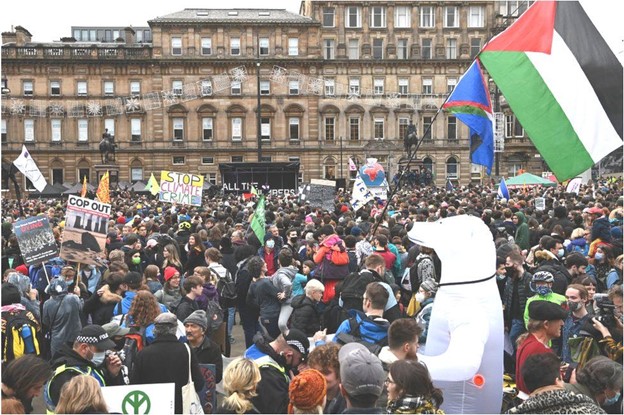
When my brother shares that he must go through a police checkpoint to access his office because the COP 26 conference is happening across the street, I can picture his commute. When he shares photos of police officers lining the roads, I recognize Argyle Street and think about the nearby parks I have enjoyed with my nephew. When I see photos of the youth rally in George Square, I remember a delicious lunch I had around the corner. These places are alive for me.

Argyle Street, Glasgow. November 1, 2021. Photo provided to author by Joel Spark.

The field of emotional geography explores the relationship between an environment and its emotional content; how environments facilitate emotion, and how emotions play out in different environments (Davidson et al., 2007). For me, the emotional geography of the COP 26 conference is mediated through my own lived experience and the experiences of my family in that city. My interpretation of the events and outcomes are happening through a lens of familiarity and nostalgia. For Glaswegians, the event is taking place right where they work, live, and play in real time. I wonder if this helps the climate conversation feel more real there. It’s tangible – it’s blocking their access to work. It’s hard not to pay attention to the conversations happening at one’s doorstep.

Youth climate march, George Square, Glasgow. November 5, 2021. BBC.

Locale is also important when talking about climate impacts, not just climate conferences. Climate communications research has found that effective messages are personalized to fit audiences (Dupar et al., 2019) and clearly demonstrate the impacts of climate change in people’s day-to-day experiences (O’Sullivan, 2019). As Altinay (2017) summarizes, “The strength of local framing comes from its ability to counteract the need for psychological distancing by localizing the consequences and heightening risk perceptions by giving personal, local meanings to global issues” (p. 295). In my view, this localizing and personalizing often relies on the emotional geography of a place: triggering memories of shared experiences and local events. For example, I often hear Albertans talk about the heat dome and heavy smoke from forest fires this past summer. Sharing these experiences with one another reminds us of the hazy views from our windows, and the smoke in our lungs when we went outside. Home didn’t look or smell like home anymore.  

This focus on the local also occurs in climate science through a process called downscaling. This is a statistical procedure by which information from global climate models are translated to smaller geographic scales (Murdock et al., 2014). Downscaling extrapolates from larger patterns to show how climate will impact specific regions. Unfortunately, downscaling can often introduce uncertainty since there is limited high-resolution data (Pyle, 2021). The smaller the scale, the more difficult it is to predict precisely what will happen.

This puts climate communicators in a difficult situation. Research tells us that in order to be effective, we need to communicate how climate change will impact daily experiences. Yet climate models don’t allow the level of precision that might be meaningful to individuals due to the statistical consequences of downscaling. We can anticipate large-scale patterns of change; however, we never know how it will impact individuals on a day-to-day basis. Will climate change impact my commute? Will my favourite restaurant go bankrupt due to food prices? Will my house be flooded? It’s impossible to predict how an individual may be locally impacted by climate change because they themselves are complex beings living within complex systems.

I am beginning to realize this is the challenge for climate leaders more broadly (and our cohort specifically for the CALS501 design challenge): to work through this discrepancy and find ways to translate through the uncertainty. It’s our role to find and connect with the emotional threads and memories that people rely on to make meaning out of their local environments. This is a type of ‘downscaling’, yet one that requires creativity and empathy instead of statistical models.

References

Altinay, Z. (2017). Visual Communication of Climate Change: Local Framing and Place Attachment. Coastal Management 45(4), 293-309.

British Broadcasting Corporation (BBC) (2021). The march culminated in a rally at the city’s George Square [Photograph]. BBC. https://www.bbc.com/news/uk-scotland-59179181

Davidson, J., Bondi, L., & Smith, M. (2007). Emotional Geographies. Ashgate Publishing Limited.

Dupar, M., McNamara, L., & Pacha, M. (2019). Communicating climate change: A practitioner’s guide. Insights from Africa, Asia and Latin America. Climate and Development Knowledge Network. https://unfccc.int/sites/default/files/resource/Communicating%20climate%20change_Insights%20from%20CDKNs%20experience.pdf

Murdock, T., Cannon, A. & Sobie, S. (2014). Statistical downscaling of future climate projections for North America. Pacific Climate Impacts Consortium. https://www.pacificclimate.org/data/statistically-downscaled-climate-scenarios

O’Sullivan, F. (2019). To survive climate change we’ll need a better storyBloomberg CityLab. https://www.bloomberg.com/news/articles/2019-11-11/meet-sweden-s-chief-storyteller-for-climate-change 

Pyle, L. (2021, February 18). Climate Models [Course lecture]. Science and Impacts of Climate Change Course, Royal Roads University, Victoria, BC, Canada.

Emotional Downscaling Read More »

Tiny Ecology 2: It’s the scariest time of year

Oct 23, 2021

It’s an unusually rainy October day in Calgary. Unlike our friends in other parts of the country, Calgarians are generally unprepared for rain. At Halloween we are used to snow. I remember planning my Halloween costume to ensure my snowsuit could fit underneath it. I remember the difficulty of collecting candy with my hands wrapped in thick mittens.

This year, parents may be modifying costumes to ensure their children stay dry rather than just warm. This isn’t unexpected – Canada’s Changing Climate Report (2019) tells us there is a shift toward less snowfall and more rainfall in many parts of the country – but when climate change starts to impact trick or treating, well, it starts to sink in.

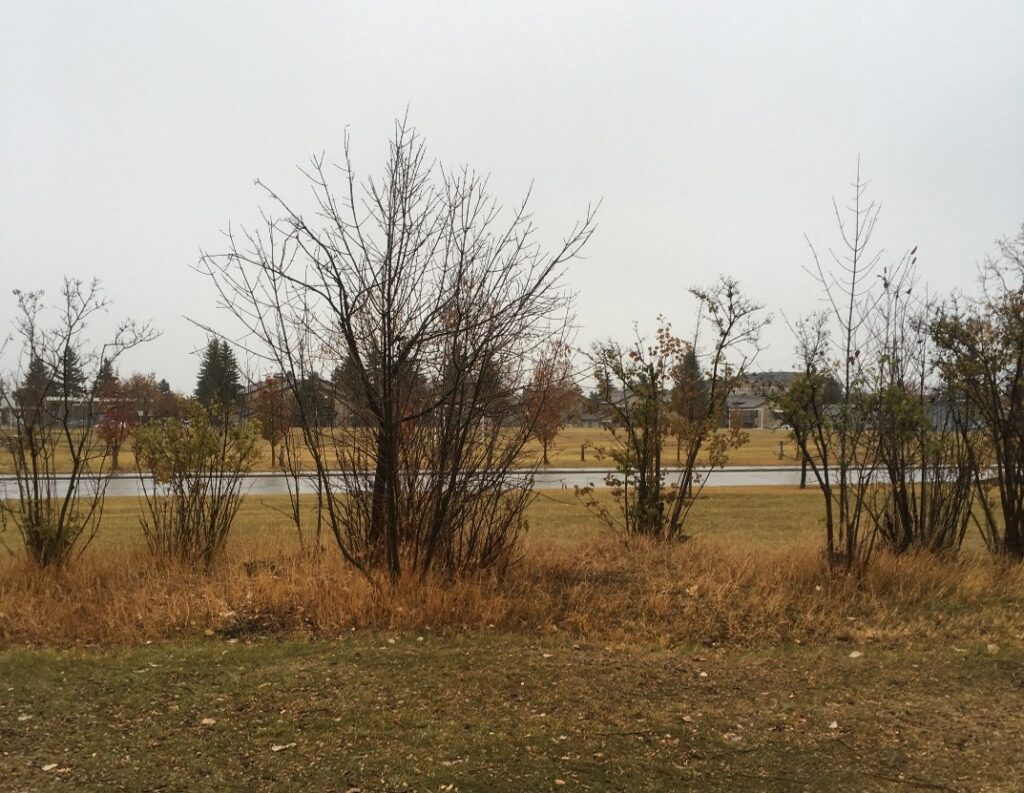
The rain is also impacting my sit spot. I’ve decided to pace my spot today – determined to engage with this space but avoiding my usual comfortable bench to keep my clothes dry. The rain is making everything look a little blurry – particularly the sparse bushes across the park. Colours are muted, and everything is morphing into a gray haze. This haze is beautiful in its own way.

Poplar Park, Calgary. Photo provided by author.

However, the hazy logic and smoke and mirrors I saw play out in Alberta’s political sphere this week is anything from beautiful. In fact, it’s a perfect example of disinformation.

The final report of the Public Inquiry into Anti-Albertan Energy Campaigns was made public this week. This inquiry was launched in 2019 by the Alberta government to investigate funds from American foundations that were used in campaigns against Alberta’s fossil fuel industries. After three extensions and a million dollars over budget (Johnson, 2021), the final report came to light. The report concluded there was no evidence of legal wrongdoing by environmental groups (in fact, these groups were exercising their right to free speech), and the report’s author further concluded that “I am not in a position to find that these campaigns alone caused project delays or cancellations” of energy projects (Allan, 2021, p. 14). So, we can all rest easy knowing that our democracy is working as it should, and move on from this expensive and unnecessary inquiry, correct?

Unfortunately, no.

Minister of Energy Sonya Savage used this as an opportunity to share her opinion on the report. Despite the report finding there is no link between foreign funds entering Canada and the cancellation of energy projects, Minister Savage stated in an interview with CBC news, “you just have to look at our large pipeline projects… to see there is a clear link” (CBC News, 2021). This isn’t just misinformation – this is disinformation – intentionally ignoring the results of a public inquiry to fit a preplanned message. It was a deliberate attempt to misdirect the conversation away from the findings of the report.

Alberta Energy Minister Sonya Savage, Oct 21, 2021. Photo by Larry Wong, Postmedia.

At a press conference on Oct 21, Minister Savage shared: “In my 13 years working in the energy sector, I personally saw the evidence of these campaigns as they targeted pipelines… I could see the antics and tactics of these campaigns on the ground” (Government of Alberta, 2021). She continued, “While these [environmental groups] boasted, Albertans were hurt. People lost their jobs, businesses went under, families were hurt.” The actual results of the report were barely referenced at the press conference. Instead, we heard Minister Savage’s interpretation of the findings.  

Minister Savage relied on several central tenants of effective communication and disinformation in her press conference speech. She relied on the fact that people trust messengers who hold similar views (Armstrong et al., 2018), so she emphasized that she had worked in the energy sector for more than a decade. She evoked populism, framing boastful well-funded environmental groups pitted against everyday Albertans, pointedly ignoring that many Albertans work for the same environmental groups she referenced. She also relied on personal anecdotes (“I personally saw…”) rather than emphasizing the conclusions of the report. Both techniques – relying on populist sentiments and personal anecdotes – have been identified by Lewandowsky as practices of disinformation (2020).

View of rainy downtown Calgary. Photo provided by author.

Our week 4 prompt asked us to tell an anecdote about an experience at our sit spot that connects to climate action. My experience – the heavy and unseasonal rain – makes me think about how Halloween is changing for kids in Calgary due to climate change. But the rain also makes me think about how truth is becoming cloudy and more difficult to discern. Everyone knows that Halloween is just playful deceit (using costumes to get candy from strangers). However, when an elected official intentionally spreads misinformation, there is nothing playful about it. Minister Savage is entitled to her feelings about the public inquiry report. What she is not entitled to is to use her feelings and her position as an elected official to misinterpret information for Albertans.

How can one respond effectively to disinformation and misdirection from elected officials about climate change?

References

Allan, J.S. (2021). Report of the Public Inquiry into Anti-Alberta Energy Campaigns. Government of Alberta. https://open.alberta.ca/dataset/3176fd2d-670b-4c4a-b8a7-07383ae43743/resource/a814cae3-8dd2-4c9c-baf1-cf9cd364d2cb/download/energy-report-public-inquiry-anti-alberta-energy-campaigns-2021.pdf  

Armstrong, A.K., Schuldt, J.P., & Krasny, M.E. (2018). Establishing trust. Communicating climate change: A guide for educators. Cornell University Press. Ebook.

CBC News. (2021, October 22). Alberta public inquiry finds no wrongdoing by anti-oilsands activists [Video]. YouTube. https://www.youtube.com/watch?v=1mha4PX1_I8  

Environment and Climate Change Canada. (2019). Canada’s Changing Climate Report. https://changingclimate.ca/site/assets/uploads/sites/2/2020/06/CCCR_FULLREPORT-EN-FINAL.pdf

Government of Alberta [YourAlberta]. (2021, October 21). Release of public inquiry report – October 21, 2021 [Video]. YouTube. https://www.youtube.com/watch?v=9cSZL62l-d4

Johnson, L. (2021, October 22). No evidence of wrongdoing found in Allan inquiry report into ‘anti-Alberta’ campaigns. Edmonton Journal. https://edmontonjournal.com/news/politics/long-awaited-allan-inquiry-report-into-anti-alberta-campaigns-released

Lewandowsky, S. (2020). Climate change disinformation and how to combat it. Annual Reviews of Public Health 42, 1-21.

Wong, L. (2021). Alberta Energy Minister Sonya Savage provided details on Thursday October 21, 2021 about the report of the public inquiry into anti-Alberta energy campaigns. [Photograph]. Postmedia. https://edmontonsun.com/news/politics/long-awaited-allan-inquiry-report-into-anti-alberta-campaigns-released/wcm/7dc18c13-0fac-471d-8087-3575ef337712

Tiny Ecology 2: It’s the scariest time of year Read More »

Tiny Ecology 1: What do emotions have to do with it?

Oct 17, 2021

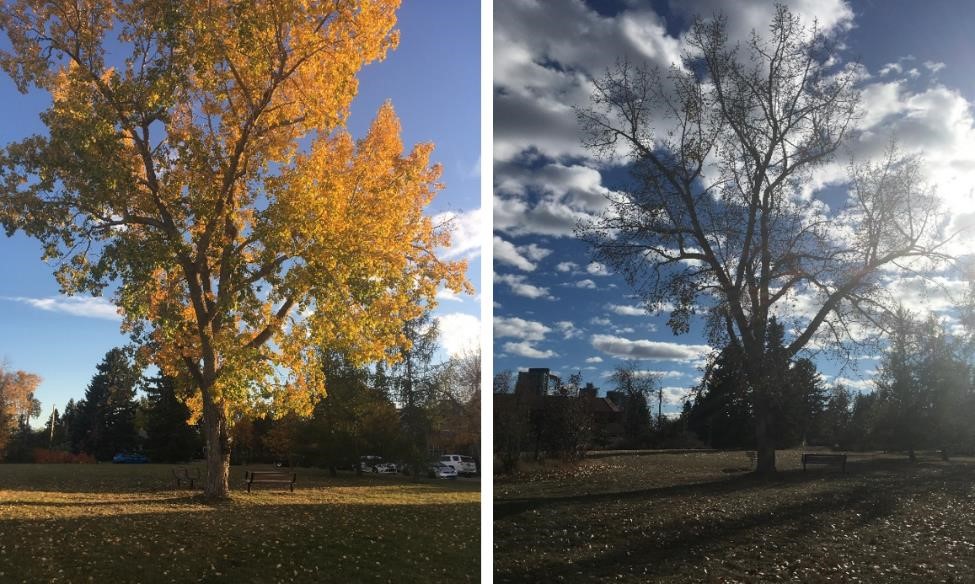
My sit spot is changing quickly. The leaves that had been green fading to yellow only a few short weeks ago are now brown or gone altogether. The bright sunshine is still there but the warmth has disappeared. The spot is graciously reflecting my sour mood. Today I’m in no mood to see the beauty or think deeply. I just want to sit. My notebook – normally full of arrows and thoughts in the margins – today just says “Despondent. Seeing the election signs – ugh. Nostalgia.”

I’m not sure of the exact origin of my bad mood. It might have been too much time in front of the computer, or the latest wave of Covid weariness, or just a sense of feeling lost in turbulent times. Either way, I’m leaning into the process of my sit spot, letting it teach me.

Poplar Park, Calgary. Photos provided by author.

A few weeks ago, I was debriefing the recent federal election with friends. As a politically active person, I was eager to discuss the nuances: the ups, downs and surprises of the snap election. Instead, all I heard was disappointment. My friends were craving strong climate leadership from their elected officials, and were frustrated by the results. Several of them shared sentiments of “I feel surprised every time an election rolls around… why do I even let myself be hopeful?”

Several days after that, I gave a presentation on climate to a local community group. At the beginning, I asked them to share what they were interested in discussing. Most wanted to know what they could do to reduce their carbon footprint. One gentleman, however, was despondent. He told the group he needed to feel hope again. He was so discouraged by the lack of action at the political level and wanted to know what he could do with his anger and hopelessness. 

In both these cases, I thought back to my communications training. I remembered the literature emphasizes understanding your audience and shape messaging to fit the audience (Zia & Todd, 2010). So, I started with language to demonstrate I was listening (“I know it is disappointing”) and then talked about specific impacts and actions I thought would resonate. I remembered gain-frames are more effective than loss-frames (Morton et al., 2011). So, I emphasized the progress happening locally and the shift in Alberta attitudes the federal election uncovered. I thought of the six Americas by the Yale Program on Climate Change Communication and remembered that research from Australia found people falling into both the “alarmed” and “uncommitted” categories respond to similar framing (Hine et al., 2016). So, I walked the line of balanced realism, trying to acknowledge that people felt alarmed, but encouraging them to get (or stay) involved. I tried my hardest to communicate by the book.

Unfortunately, in both situations I left the conversation feeling as though my community thought I was naïve for even attempting to frame the climate emergency as an opportunity for positive change.

One of our sit spot prompts was to reflect on a situation in which we need to motivate and inspire two groups with two different versions of the same message. Yet as I sat under the large, rapidly emptying poplar tree earlier this week I realized that perhaps we need to acknowledge various audiences within ourselves. There aren’t only six types of people – there are multiple people within each of us.

I had been communicating as though people were one-dimensional and unchangeable – as though their mental and emotional state doesn’t fluctuate day by day or hour by hour. I saw my friends and this gentleman as part of a group of “alarmed and discouraged”. Yet, I realized that is exactly how I was feeling on my second visit to my sit spot. I was discouraged and despondent and didn’t want to think about climate. I saw the lawn signs for our upcoming municipal election and thought “ugh”, despite being politically active. But I don’t always feel like this – sometimes I feel hopeful and driven – like I did the first time I came to my sit spot. Both versions of myself are there; its just that depending on the day, one tends to be louder than the other.

I went back and read about the six Americas again. One part stood out to me more than it had before: effective engagement must start “with the fundamental recognition that people are different and have different psychological, cultural, and political reasons for acting – or not acting – to reduce greenhouse gas emissions” (Yale, 2020, para. 1). Initially, I had assumed that the psychological state referenced in this statement was static. I only needed to find the right language and right framing to fit someone’s psychological state to be effective. However, I know from my own experience that human psychology is anything but static. It is fluid, changeable, and malleable. Perhaps getting to know one’s audience really means getting to know your audience in this particular moment in time.

The next time I communicate about climate, should I take a step back and ask first, “how are you doing? No, I mean – how are you really doing?” Would our communication efforts be more meaningful and effective if we took the time to understand and incorporate the emotional state of the person we are speaking to?

References

Hine, D.W., Phillips, W.J., Cooksey, R., Reser, J.P., Nunn, P., Marks, A.D.G., Loi, N.M., & Watt, S.E. (2016). Preaching to different choirs: How to motivate dismissive, uncommitted, and alarmed audiences to adapt to climate change? Global Environmental Change 36, 1-11. doi: 10.1016/j.gloenvcha.2015.11.002

Morton, T., Rabinovich, A., Marshall, D., & Bretschneider, P. (2011). The future that may (or may not) come: How framing changes responses to uncertainty in climate change communications. Global Environmental Change 21(1), 103-109.

Yale Program on Climate Change Communication. (2020). Global Warming’s Six Americas. https://climatecommunication.yale.edu/about/projects/global-warmings-six-americas/

Zia, A., Todd, A.M. (2010). Evaluating the effects of ideology on public understanding of climate change science: How to improve communication across ideological divides? Public Understanding of Science 19(6), 743-761. doi: 10.1177/0963662509357871

Tiny Ecology 1: What do emotions have to do with it? Read More »

Sustainability Talk

October 9, 2021

With the dominance of social media in our communication landscape, we don’t hear a lot about the influence of radio. As someone who avoids social media, radio is medium that introduces me to new music and keeps me connected to my city without having to share anything personal about myself. I’m not alone: according to the Canadian Radio-television and Telecommunications Commission (2019), 88% of Canadians over 18 report having listened to the radio in any given month. For this assignment, I am analyzing the impact of the Sustainability Talk program on 106.5 Mountain FM in the Bow Valley of Alberta (Murray, 2021).

Downtown Banff
Image source: Louis Paulin from Banff, Unsplash

The radio waves of Mountain FM are short-lived, captured between the peaks of the eastern slopes of the Rocky Mountains. The station’s target audience are the residents of the towns of Banff and Canmore and hamlets of Harvie Heights and Exshaw – collectively known as the Bow Valley. I can attest by personal experience that by the time you have driven past the last peak and onto the plains, Mountain FM is turning to static.

The station highlights the lives of the people in the valley. The focus on the surrounding mountains is reinforced by show titles such as “The Mountain Insider” and “Rocky Mountain Retro Hour”. The description for the Mountain Insider states: “we’re keeping it local, talking about the news and issues affecting Banff, Canmore and the Bow Valley” (Mountain FM, 2021). The station lives up to this promise, hosting interviews with candidates for the upcoming municipal election, sponsoring the Canmore Eagles junior hockey team, and promoting local events. An area of the station’s website is focused on ski conditions. This is a radio station that fully embraces the culture of the tight-knit mountain community.

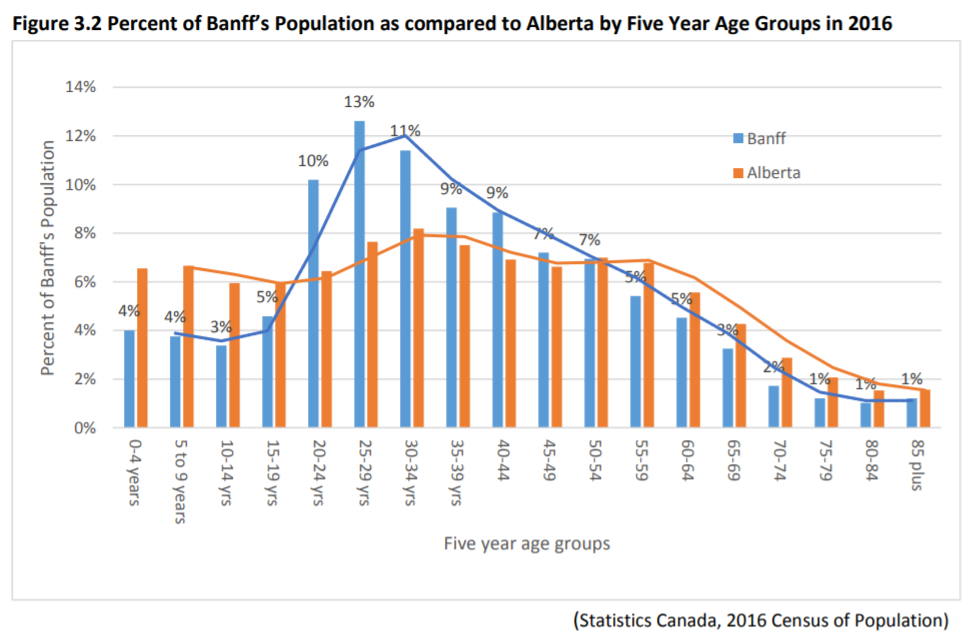
The demographics of the valley are unique. Due to the prevalence of seasonal work at ski hills and tourist attractions, valley residents tend to be younger compared to the rest of Alberta. Over a third of Banff residents are between 20-34 years old, compared to only 20% in the rest of Alberta (Gerrits et al., 2019). Residents are also highly educated: 73% of adults in Banff over the age of 25 have completed some form of postsecondary education, significantly higher than the Alberta average of 55% (Gerrits et al., 2019).

Image source: Gerrits et al. (2019)

The Sustainability Talk segment launched in November 2019 by host Rob Murray. Each segment (averaging 75 seconds) is composed of a short audio clip by a special guest. At time of writing, there are 29 clips publicly available on the Mountain FM website, published every few weeks. There are no public records on how often or how many times the clips are played over the radio.

While reviewing content for this analysis, I noticed the first 26 segments draw upon similar techniques for audience engagement (outlined in the chart below). However, two of the most recent posts had a distinctly different tone than the earlier clips. For this analysis, I will focus on the clip titled Responsibility and Vulnerability in detail. That said, it is important to assess this segment in the context of the rest of the radio show.  

The Sustainability Talk show frequently draws upon the following four techniques to engage its audience on climate change:

TechniqueExamples from Sustainability TalkSupporting research
Tailor messages to a local audienceIn the first clip, the guest speaker uses the Bow River as a metaphor to describe materials that “constantly flow through our lives” to make a point about recycling. The speaker uses a local natural feature to draw people into the topic.  

In one clip, a local grocery store is celebrated for the efforts they have taken to reduce food waste in their operations.

The first 12 segments of the show were sponsored by a Bow Valley-based recycling company.    
Dupar et al. (2019) encourage speakers to tailor information to specific stakeholder groups. In this case, the content is tailored specifically to the Bow Valley community by emphasizing local landmarks and businesses.  
Provide tangible solutions and actions community members can takeSeveral clips highlight specific actions residents can take, such as installing solar panels and applying for local rebates, participating in events, purchasing green electricity, reducing food waste, etc.  When messages give specific adaptation advice, it increases intentions for action in audiences (Hine et al., 2016).
Emphasize co-benefitsClimate change is a common theme among the clips, regardless of the specific topic. A consistent narrative is woven into discussions of energy, waste, and biodiversity. For example, one speaker states: “diverting food waste away from landfill helps to meet Canmore’s climate action goals”.  

Economic development is a common co-benefit referenced in several clips. For example, one speaker emphasized the growth in jobs in the recycling sector by diverting more waste from landfill.  
Maibach et al. (2011) recommend emphasizing “win-win” solutions as this approach tends to engage a broader cross-section of audiences.  

Further, Connor et al. (2016) emphasize that focusing on the benefits of mitigation inspires more action than focusing on the negative impacts of inaction.
Rely on trusted messengersThe show draws heavily on residents, experts, and trusted community members (for example, local business owners, municipal staff, high school students, and politicians). Only one speaker in the entire series is from outside Alberta. When it is unclear whether a speaker is from the valley by their title alone, the announcer will emphasize their ties to the valley. For example, when introducing a speaker from the Pembina Institute, the announcer emphasizes that she is “Canmore-based”.

The announcer and producer, Rob Murray, is “well respected and well connected in the community”, which builds credibility for the show as a whole (C. Bitz, personal communication, October 8, 2021).  
Armstrong et al. (2018) emphasize that people tend to trust messengers who hold similar views and values. Seemingly small details (like emphasizing someone’s “local” status) can affect the credibility of a messenger.

Lewandowsky (2020) highlights that “elite cues” (such as press from politicians) is the greatest determinant of public concern about climate change. By featuring a local politician, the show demonstrates that elected representatives care about climate.

The segment Responsibility and Vulnerability is unique and deserves more focused analysis. It is one of only two clips that has a more philosophical or academic approach, whereas earlier clips make clear real-world connections between climate change and the community (for example, encouraging people to sign up for a local solar rebate). In contrast, Responsibility and Vulnerability talks about climate change in a more abstract manner. The speaker, Dr. Andreanne Doyon, states “we are more responsible [for climate change] than smaller countries and countries that have lower socio-economic status”. This segment is the first clip in the series to highlight climate justice, which is a large concept to digest in 90 seconds. The audience is also left with no specific suggested action to take.

Despite this difference in tone, the clip does draw on one similar technique: the emphasis of the local. Although Dr. Doyon is based at Simon Fraser University, she is described as a “Canmore local”. Additionally, she spends the second half of her interview emphasizing how climate injustice and vulnerability can play out theoretically at local levels (for example, if someone cannot move away from the flood plain). The emphasis on localizing the content is still there, although it is done in a more abstract way.

With these observations in mind, at first glance the Responsibility and Vulnerability clip seems to be less effective than the previous clips. There is a more ambiguous connection to the local context and no tangible actions presented. However, when seen in context of the show as a whole and analyzed through the ecological model by Hodson (2019), it begins to make more sense.

The ecological model of climate marketing positions “attitudes and behaviours change at multiple, increasingly broad levels of interaction around the individual” (Hodson, 2019, p. 6). People’s individual attitudes and behaviours are influenced by their one-on-one relationships, community, and society as a whole; and vice versa: society is influenced by individual and collective actions and beliefs. Most of Sustainability Talk’s clips are focused on influencing the community (meso) level. Yet, Responsibility and Vulnerability begins to pull people outside of their own community and introduce them to concepts like international climate justice (macro level).

Image source: Hodson (2019)

Sustainability Talk has been a recurring communication channel in the Bow Valley community for almost two years. The show has taken its time to build familiarity with climate change by relying on local messengers, weaving the narrative of climate into multiple topics, and emphasizing tangible actions. Now that the radio show has the trust of the local community, they can begin to take listeners on a journey outside of their comfort zone. They have built a foundation on which more abstract and justice-focused communications can begin to take place. If the Responsibility and Vulnerability clip were transplanted to a new town without the previous context or trust-building, I doubt it would be successful. However, the holistic approach of emphasizing tangible actions as a first step and then building abstract ideas onto that foundation creates a more complete narrative of climate action.

With that said, there are two things that could make Sustainability Talk more effective. None of the 29 clips used storytelling as a technique. As Bayer & Hettinger (2019) demonstrate, storytelling is more effective in engaging a listener than relying on data alone. Additionally, although Mountain FM has an active Facebook page and Twitter account, rarely are either used to promote Sustainability Talk. Communicators are encouraged to create content that is easy to share and promote across multiple platforms (Dupar et al., 2019). Sustainability Talk could amplify their clips on their existing social media platforms to reach a broader audience; specifically, the high proportion of young adults living in the valley.

People often listen to the radio while engaged in other activities: while driving, cooking, or cleaning. It is a unique opportunity for climate communicators to reach people that are not intentionally seeking out climate information. Sustainability Talk on Mountain FM does this well for the Bow Valley community, although they could deepen their influence by emphasizing stories over information. It would be interesting to see if a similar approach would work for larger communities like the nearby city of Calgary.

References

Armstrong, A.K., Schuldt, J.P., & Krasny, M.E. (2018). Establishing trust. Communicating climate change: A guide for educators. Cornell University Press. Ebook.

Bayer, S, & Hettinger, A. (2019). Storytelling: A natural tool to weave the threads of science and community together. Bulletin of the ecological society of America, 100(2), 1-6.

Canadian Radio-television and Telecommunications Commission. (2019). Communications Monitoring Report 2019. https://crtc.gc.ca/eng/publications/reports/policymonitoring/2019/cmr5.htm

Connor, P., Harris, E., Guy, S., Fernando, J., Shank, D., Kurz, T., Bain, P., & Kashima, Y. (2016). Interpersonal communication about climate change: How messages change when communicated through simulated online social networks. Climatic Change 136(3-4), 463-476. doi: 10.1007/s10584-016-1643-z   

Dupar, M., McNamara, L., & Pacha, M. (2019). Communicating climate change: A practitioner’s guide. Cape Town: Climate and Development Knowledge Network. https://unfccc.int/sites/default/files/resource/Communicating%20climate%20change_Insights%20from%20CDKNs%20experience.pdf

Gerrits, A., Harrison, J., & Pryor, R. (2019). Community Social Assessment. Town of Banff. https://banff.ca/DocumentCenter/View/6315/2018-Banff-Community-Social-Assessment  

Hine, D.W., Phillips, W.J., Cooksey, R., Reser, J.P., Nunn, P., Marks, A.D.G, Loi, N.M., & Watt, S.E. (2016). Preaching to different choirs: How to motivate dismissive, uncommitted, and alarmed audiences to adapt to climate change? Global Environmental Change 36, 1-11. doi: 10.1016/j.gloenvcha.2015.11.002

Hodson, J. (2019). An ecological model of climate marketing: A conceptual framework for understanding climate science related attitude and behavior change. Cogent Social Sciences 5(1), 1-15.

Lewandowsky, S. (2020). Climate change disinformation and how to combat it. Annual Review of Public Health 42, 1-21. https://www.annualreviews.org/doi/abs/10.1146/annurev-publhealth-090419-102409

Maibach, E., Nisbet, M., & Weathers, M. (2011). Conveying the Human Implications of Climate Change: A Climate Change Communication Primer for Public Health Professionals. George Mason University Center for Climate Change Communication. https://www.climatechangecommunication.org/wp-content/uploads/2016/04/Climate-Communication-Primer-for-Public-Health-Professionals-1.pdf

Mountain FM. (2021). The Mountain Insider. Mountain FM Canmore Banff 106.5. https://www.mountainfm.ca/shows/the-mountain-insider/

Murray, R. (Host). (2021, August 4). Responsibility and Vulnerability [Radio]. In Sustainability Talk. Rogers Media 106.5 Mountain FM. https://www.mountainfm.ca/audio/sustainability-talk-responsibility-and-vulnerability/

Sustainability Talk Read More »

Entanglements

June 5, 2021

This week we explored the concept of transdisciplinary leadership in terms of climate action. Since the concept of transdisciplinarity is “at once between disciplines, across disciplines, and beyond all disciplines” (Nicolescu, 2014, p. 187), what does this mean for leaders working at the forefront of climate change? Especially when it can be difficult for practitioners to stay on top of the knowledge being cultivated and shared within a single discipline, let alone multiple disciplines.

Corman and Cox (2020) identify eight qualities of transdisciplinary leaders, including “valuing doubt and resistance to new ideas” and “understanding the need for constant adaptation” (p. 13). On the surface, these qualities appear to be contradictory. How can one value resistance to new ideas while also embracing new solutions and adopting a future-orientation? It reminds me of the conversations I have with my two-year-old nephew: “Do you want to go on the slide?”. His response: an emphatic “no!” while running toward the slide.

I have come to realize his answer is somewhere in the middle: “Yes, I want to go on the slide – but I want to do it my way – not your way.” The “no” is really a “yes”, and yet his “no” needs to be respected.

I have been reflecting on how this messy middle may be a keystone of climate action.

Climate is not the first discipline to tackle this messiness. Quantum physics embraces the messy middle enthusiastically: for example, the foundational principle of ‘wave-particle duality’, which suggests that any entity may be described as either a particle or wave. So, if particles can also be waves, and a “yes” can simultaneously be a “no”; then perhaps effective climate action can be equally resistant and welcoming to new ideas.

Until this week, I had not considered climate action through the lens of physics. Upon reflection however, I thought of another relevant quantum property – ‘entanglement’. Philip Ball describes this property as what happens “when two quantum particles interact… their quantum states are inter-dependent… they somehow transmit some kind of influence” even when separated in space (The Royal Institution, 2019). There is an invisible thread holding the particles together and dictating their actions. Scientists are still trying to determine how the two particles remain entangled, even when they are not physically connected.

What would entanglement look like at the climate action scale? Perhaps it means that the action of one leader in one part of the world has unseen, unmeasurable ripple effects on leaders in other parts of the world. As ideas are shared, processes are developed, old narratives are taken apart and replaced with new ones, an intangible change seems to be occurring. Perhaps transdisciplinary leaders are the ones that can translate these intangible connections into tangible actions.  

As you can tell, this is a metaphor in development, and any feedback would be welcome. Does the concept of ‘entanglement’ resonate as a leadership strategy? Where do you see the ‘messy middle’ or contradictory strategies at play in the climate sphere?  

References

Corman, I., & Cox, R. (2020). Transdiciplinarity: A Primer. Royal Roads University. https://commons.royalroads.ca/macal/wp-content/uploads/sites/88/2021/04/MACAL_Transdisciplinary_Thinking03-31-21-3.pdf

Nicolescu, B. (2014). Methodology of Transdisciplinarity. World Futures 70(3-4), 186-199.

The Royal Institution. (2019, February 13). Understanding Quantum Entanglement – with Philip Ball [Video]. YouTube. https://www.youtube.com/watch?v=5_0o2fJhtSc

Entanglements Read More »